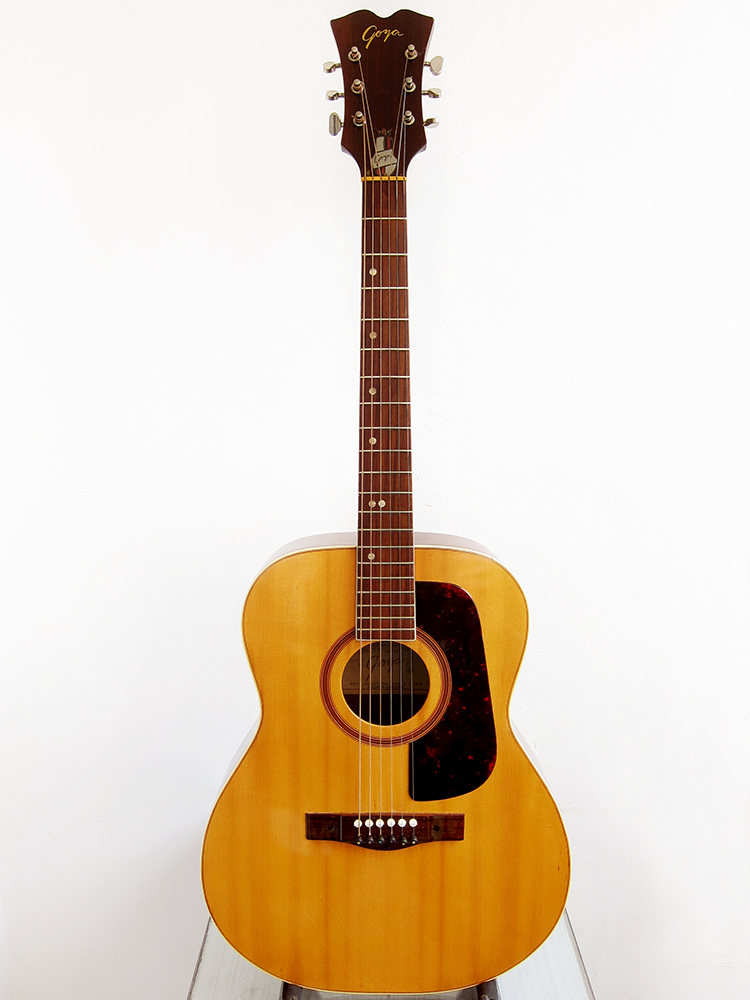
It has been an extremely good Christmas, not only did I manage to find a 1979 Fender Stratocaster, I also received a little Levin LT-14 from 1965. It’s the smallest of the 1960’s Levin guitars and is roughly like a Martin 00 in size. I bought it about two weeks ago from a guy in Heidelberg, Germany and then it got stuck in some warehouse over Christmas until the Spanish post service could be asked to deliver it. It’s an awesome guitar, pretty much like my dad’s old Levin LT-16 but a tiny bit smaller and with a bit less bass but with more clarity in the upper register. It’s also ladder braced instead of X braced which is not necessarily a bad thing in this case, it gives it a pretty great sound. The weirdest thing is that it’s so well kept for being 50 years old, close to mint and it can’t have been played much in it’s life. Well that’s going to change now because I really like it, especially for finger picking and I’m sure it will mature and sound better and better the more it gets played. This is my 10th Levin, or 11th if you count a Levin LS-16 that I have waiting for me in Sweden. Perhaps it’s time to stop buying old Levin guitars but I can’t, they are just too good to turn down. I have liked some of my Levin guitars less and then one day they surprise you and just sound amazing. I guess the more you play them, the better they sound.
It’s the first time I get a 50 years old guitar home and I have to do nothing to it. There are actually no scratches to the top, that’s just in the grain of the spruce.
Levin LT-14 / Goya T-14 Grand Concert size: Body width: 360 mm, body length: 465 mm, body depth: 98 mm
Fingerboard width: 43 mm, scale length: 630 mm
Spruce top, mahogany back and sides, 4-ply bound top, single-bound back
Mahogany bolt-on neck with adjustable truss rod
Unbound rosewood fingerboard with bass side dot inlay
Nickel plated individual Van Gent tuners with metal buttons
Rosewood bridge, matte natural finish and one year warranty
Now I actually have all three, the Levin LT-18, well it’s a Goya T-18 but close enough, my dad’s old Levin LT-16 and this new little Levin LT-14. Taken from a 1965 Levin catalogue. Thanks to Vintage Guitars Sweden
A great way to improve the tone of your acoustic guitar and to get it to open up is to use a normal air pump from a fish tank to give the top a massage. I got an old one, I think the older they are the more they vibrate, that I use on guitars that I buy that hasn’t been played for years. It works great and seems to add both bass, volume and clarity to the guitar. A day or two with the pump is like months of actually playing.
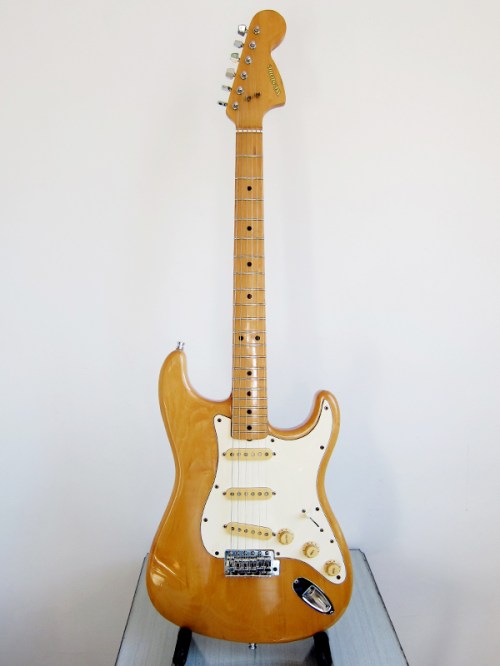
Fender Stratocaster, made at the Fullerton plant in 1979
I have always loved the 1970’s Fenders with the classic 3-tone sunburst. I guess it started when I first picked up the guitar and fell in love with the big headed Strats but nowadays I’m probably more in to Telecasters, even though they are way to expensive and hard to find. That was the main reason why I put my Claescaster together, to have a Telecaster that looked like late 1970’s Fender but for a lot less money. I actually bought a Tokai Silver Star back in October for the same reason, that I’m completely gay for 1970’s Fender 3-tone sunburst. So when I was down south for Christmas and walked past a small guitar shop in Lorca and saw a 1979 Fender Stratocaster in the window I couldn’t resist. It was the only second hand guitar they had in the whole shop, vintage guitars are really tricky business in the south of Spain since people aren’t really used to pay more money for something old when they can get something brand new for less. The price was ok and I could even live with 1980’s looking Seymour Duncan hot rails, switches and all, and since I really like gold hardware that wasn’t an issue either. The problem was, is it real, is it a US made Fender Stratocaster from the late 1970’s? The man in the shop said yes, the serial number on the head starts with S8, that is 1978, and it says made in the USA under, what more do you need to know? I tried to explain that there are a few other numbers on an old Fender that you have to check to be sure, and that the decal on the head is very easy to fake and stick on yourself. The man would hear none of this, he was sure he knew more about old guitars that this weird foreigner that had just walked in to his shop, on top of that, he really trusted the guy that he was selling it for. I said I had to think about it and left. I went home and started to read everything I could find about late 1970’s Fenders and found this site, Dating Late 1970’s Fender Stratocasters, extremely helpful.
I spent the whole Christmas just thinking about the guitar, was it worth it even if I couldn’t know for sure that it was made in 1978, or if it was even a real Fender? On the morning of the 26th we got the seller to travel in to the guitar shop with the original pickups, that was my first demand, if I saw them then hopefully I would be convinced that it was real. When we arrived to the shop the guitar was still there in the window and I was presented with a shoebox with all the original hardware, machine heads, bridge and pickups. I felt fairly sure that it was the real deal, I mean who would bother to bring in a box with old Fender stamped hardware for a fake guitar? I asked one last time if the old man in the shop had any proof that the guitar was real and he got really annoyed, saying that I could either take it or leave it. I managed to calm him down and explained that it would be a fairly common procedure to take the neck off if you sell old Fenders, or at least show the bottom of the pickguard, especially since there are a few questionable late 1970’s Fenders circulating in Spain that I’m 99% sure weren’t made at the Fullerton plant in the USA. The man just kept saying that it says USA on the head, that means it’s not made in Mexico, I had to explain that they didn’t start to make Fenders in Mexico until 10 years later, after the Fullerton plant had closed down and Fender had moved to Corona. He wasn’t convinced, and neither was I, but after seeing the pickups which pointed at 1979 and seeing the original hardcase which is the type Fender introduced in 1979 I felt that it was close enough, and bought it. I’m glad I did because as soon as I returned to Barcelona and I could take the guitar apart I found the proof needed. Even though I really like this guitar I have it listed for sale if anyone is interested in buying it.
Ideally I would have liked to find a few more stamps in the neck pocket but they have either been sprayed over or there used to be a sticker that have fallen off. The neck has a serial number on the end that points at 1978 so together with the S8 serial on the head I guess it was made in 1978. The serial number under the pickguard points at 1979, just like the original pickups. The pots are unfortunately the general CTS pots that can’t be traced and the body has been shielded, which I didn’t want to remove, so I couldn’t find any numbers there. The matching stamp on the heel and neck pocket is the quality stamp Fender used in the late 1970’s. The Seymour Duncan pickups sounds way better than I expected, a bit too hot for more liking perhaps but still pretty nice. I haven’t decided if I’m going to keep it like this for a while or return it to it’s former glory with it’s original pickups and hardware.
Fender had grey bottom pickups up until 1979 and then introduced black bottoms without serial numbers in 1980. I’m not sure if the bridge pickup is from 1980 and the others from 1979 or if it has been changed sometime in the last 35 years. The 3 screws neck plate and the saddles has the correct numbers and they machine heads looks like they should too. The original hardcase is actually way lighter and easier to carry than I expected, it has grown on me even if it looks a bit plastic and 1980’s for my normal taste. My first guitar was a Japan made 1993 Fender Squier with a rosewood fretboard and even though I prefer maple fretboards these days, there is something quite nice about a rosewood Strat. I also really like that it’s a hardtail, I never use the tremolo so I prefer a hardtail any day of the week, they feel more like a Telecaster too. All in all, this was not only my first USA made instrument but a pretty awesome guitar on it’s own that made me fall in love with Stratocasters again. Thanks again to Dating Late 1970’s Fender Stratocasters for all the useful information.
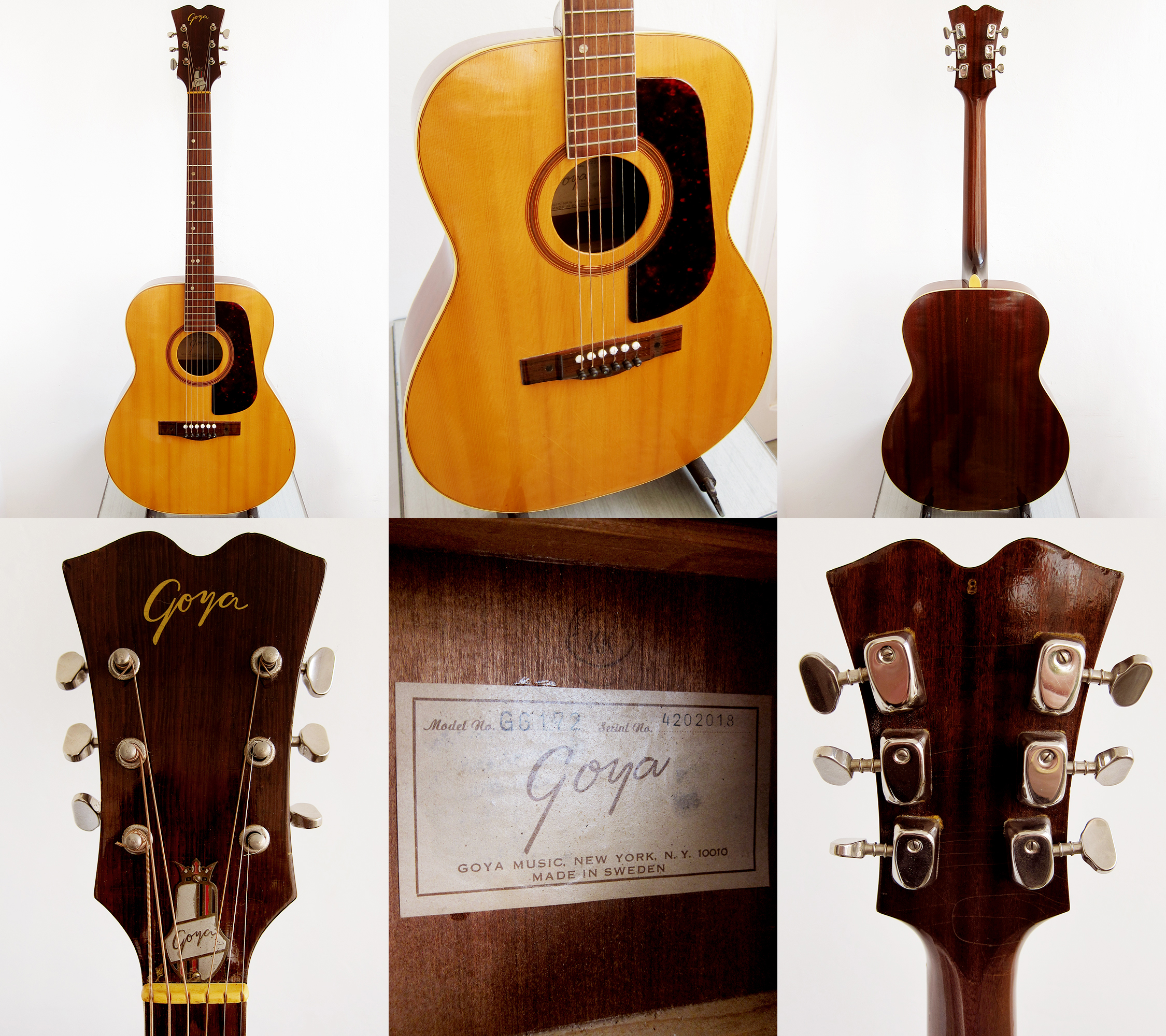
I feel really ashamed, I’ve had a beautiful Levin at home since June without fixing her up. There was a lot of things to got in the way, me building a Telecaster from scratch being the main one, but also that I had a lot of different ideas of what to do with this guitar that in the end never happened. This is my 8th Levin, or actually it’s number 9 in the collection since I got my 1951 Levin Royal after. It’s an old worn Goya Model GG-172 from 1970, according to Vintage Guitars Sweden. You can check how old your Levin / Goya is here, Levin serial numbers / Goya serial numbers. It plays very well now after my little restoration and starts to sound better and better, I have a feeling that no one has played this for a very long time. The Goya GG-172 is grand concert sized Levin, the same size as my dad’s old Levin LT-16. They are 38 cm wide just like a Martin 000, they are 15″ which is 38.1 cm. It’s a very nice size to play, slightly smaller than a normal Dreadnought but with decent bass from the solid mahogany back and sides. I bought the guitar via eBay from a pawn shop in Browns Mills, New Jersey, I freaking love the internet. I used the Global Shipping Program which worked fine this time as well, it took 2 weeks just like it did when I bought my Goya 163. I really wished that the Japanese sellers would start with this as well since it was such a mess when I bought my K.Yairi TG-40, it took 40 days to get through customs, with the Global Shipping Program you pay all the import taxes and charges straight away so it just goes straight trough customs without any delays. It’s a really nice little Levin but since I have 9 of them now and actually another on the way, I might have to consider selling it to make some room. If you are interested send me an email to claesgellerbrink@gmail.com
Levin Model 172 / Goya Model 172 / Goya GG-172 Grand Concert size: Body width: 380 mm, body length: 480 mm, body depth: 98 mm
Fingerboard width: 43 mm, scale length: 630 mm
Spruce top, mahogany back and sides, 4-ply bound top, single-bound back
Mahogany bolt-on neck with adjustable truss rod
Single-bound rosewood fingerboard with bass side pearloid dot inlay
Rosewood bridge with individual height adjustable plastic saddles
Nickel plated individual Van Gent tuners with metal buttons
Matte natural finish and ten year warranty
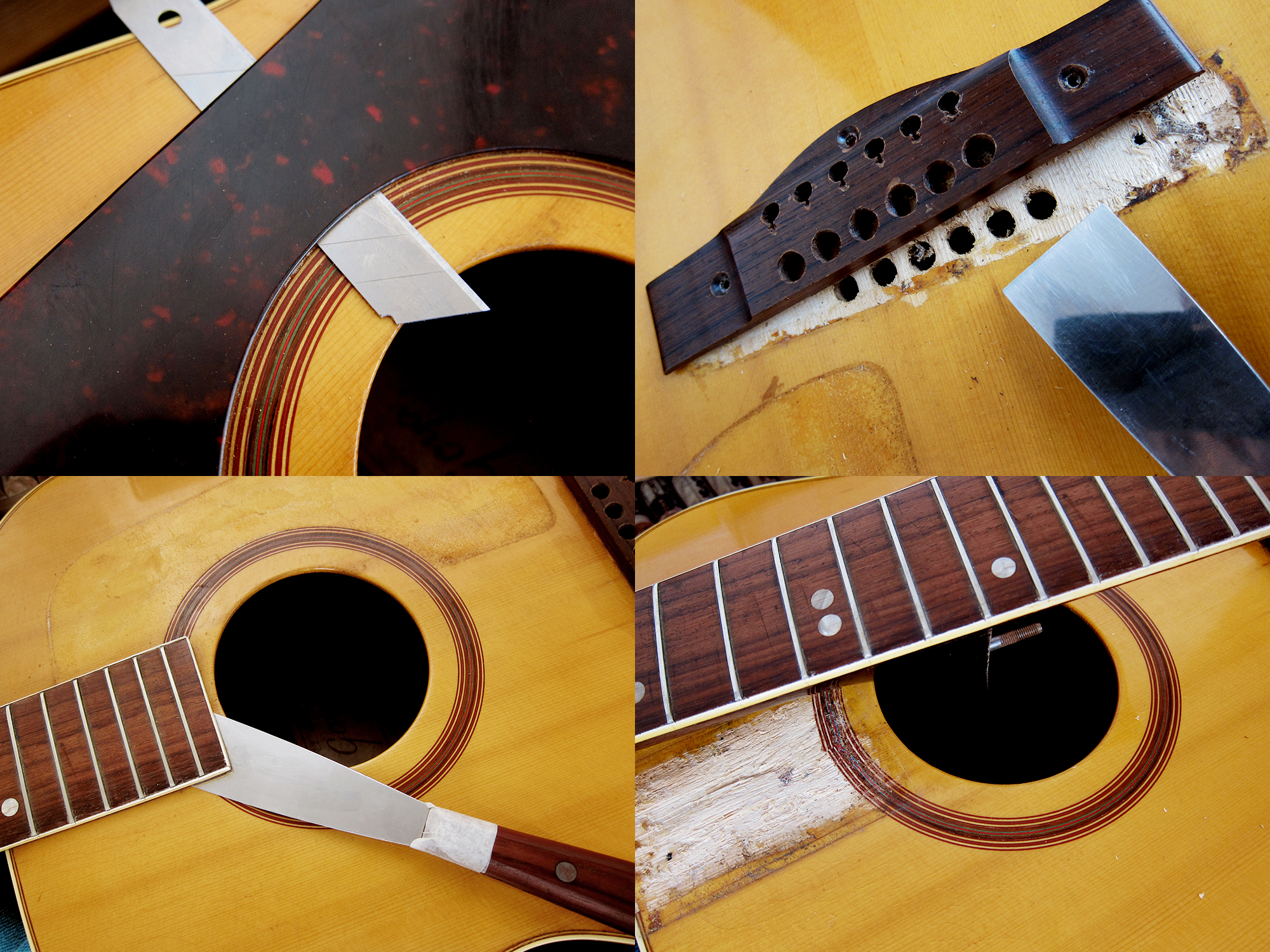
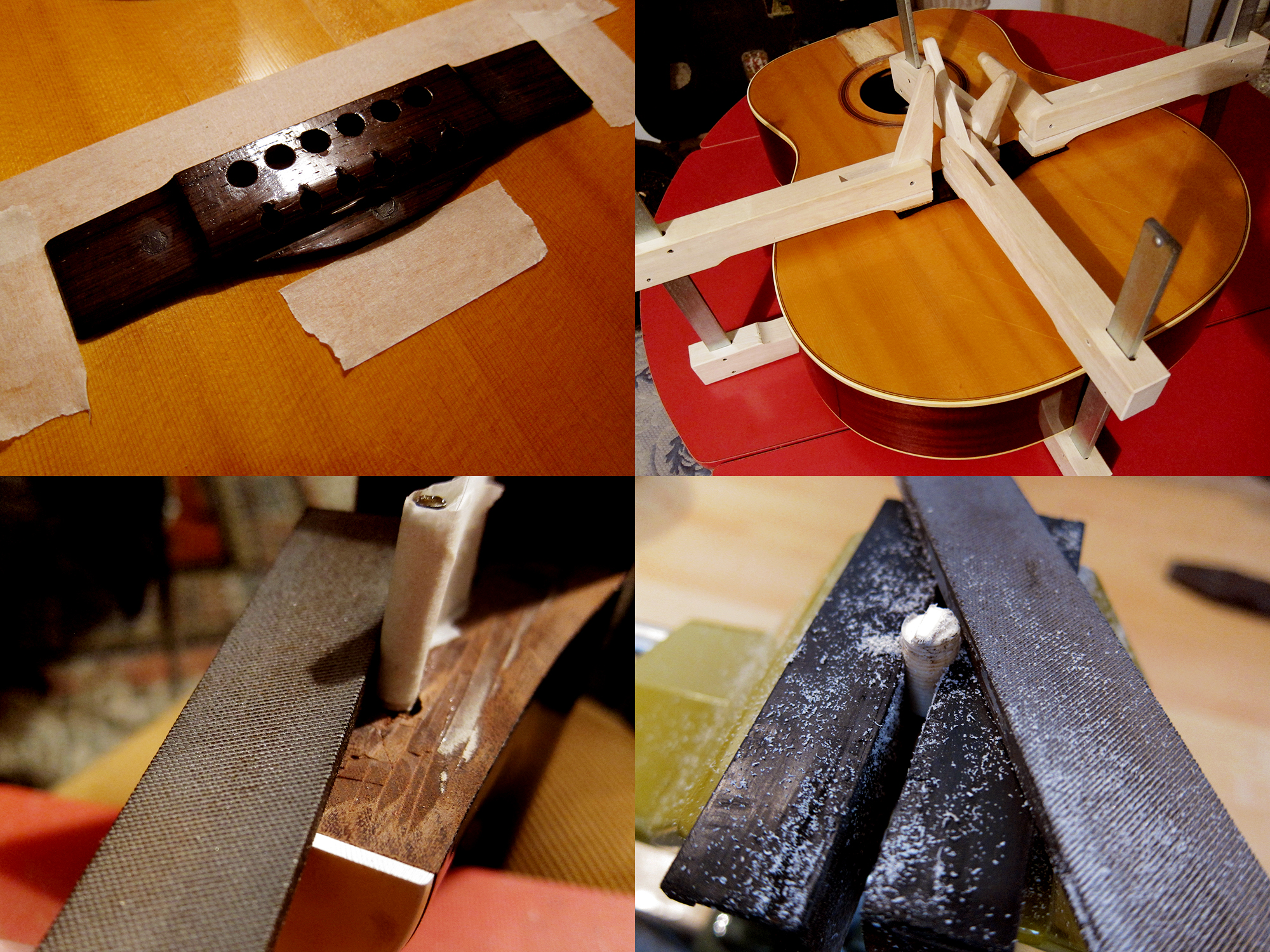
I started with taking the guitar apart. The neck needed a reset, the pickguard was loose and the previous owner had bolted the bridge to the top. I used a spatula that I heated on a normal clothes iron, worked like a charm.
I filled the holes in the bridge and then glued it back. I filed down the heel to get the neck angle correct and get guitar playable again. I re-glued the pickguard and reshaped the top on the saddle screws.
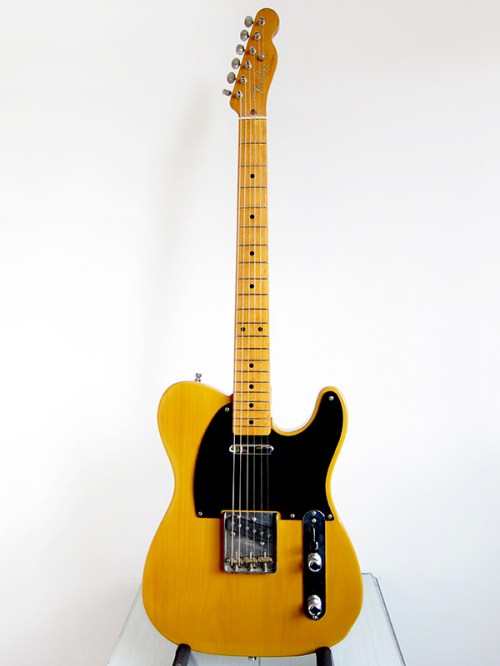
Fender Telecaster TL52-75, ’52 re-issue, Made in Japan by FujiGen between 1987-1989
In loving memory of Nancy, my Fender Telecaster TL52-75, that was sold last night. I miss her already but I’m glad she went to a good home. She lives in Zaragoza now with Juan and I’m sure she will get more love than I could ever give her. Two guitars have left me in the same week, I think I’m still in shock, sad but kind of happy at the same time.
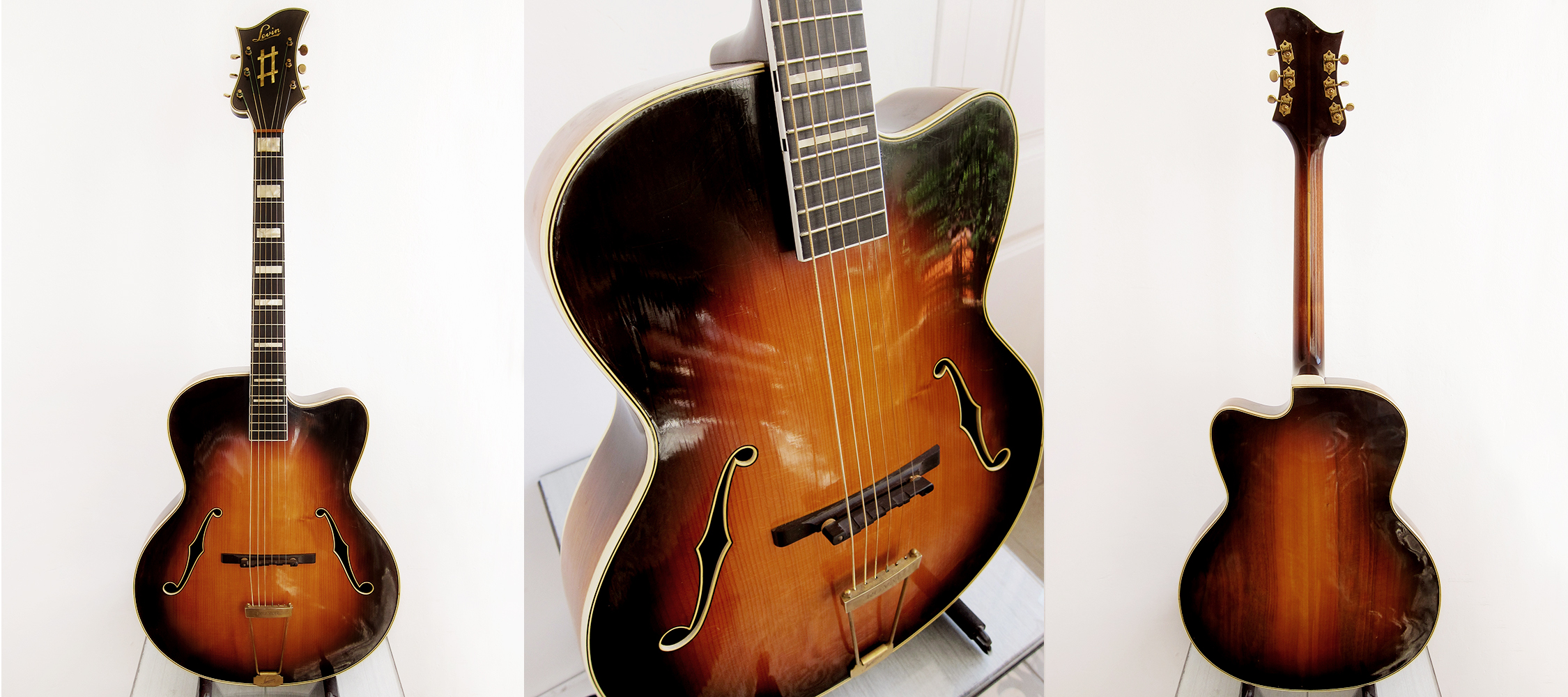
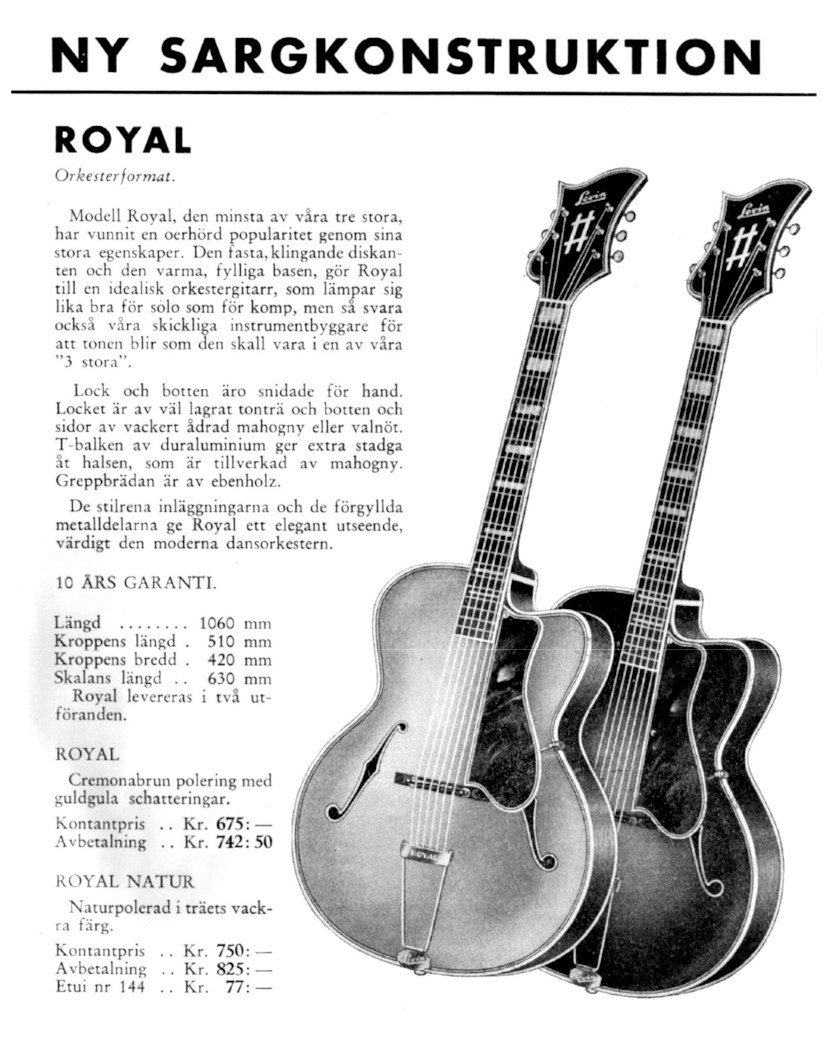
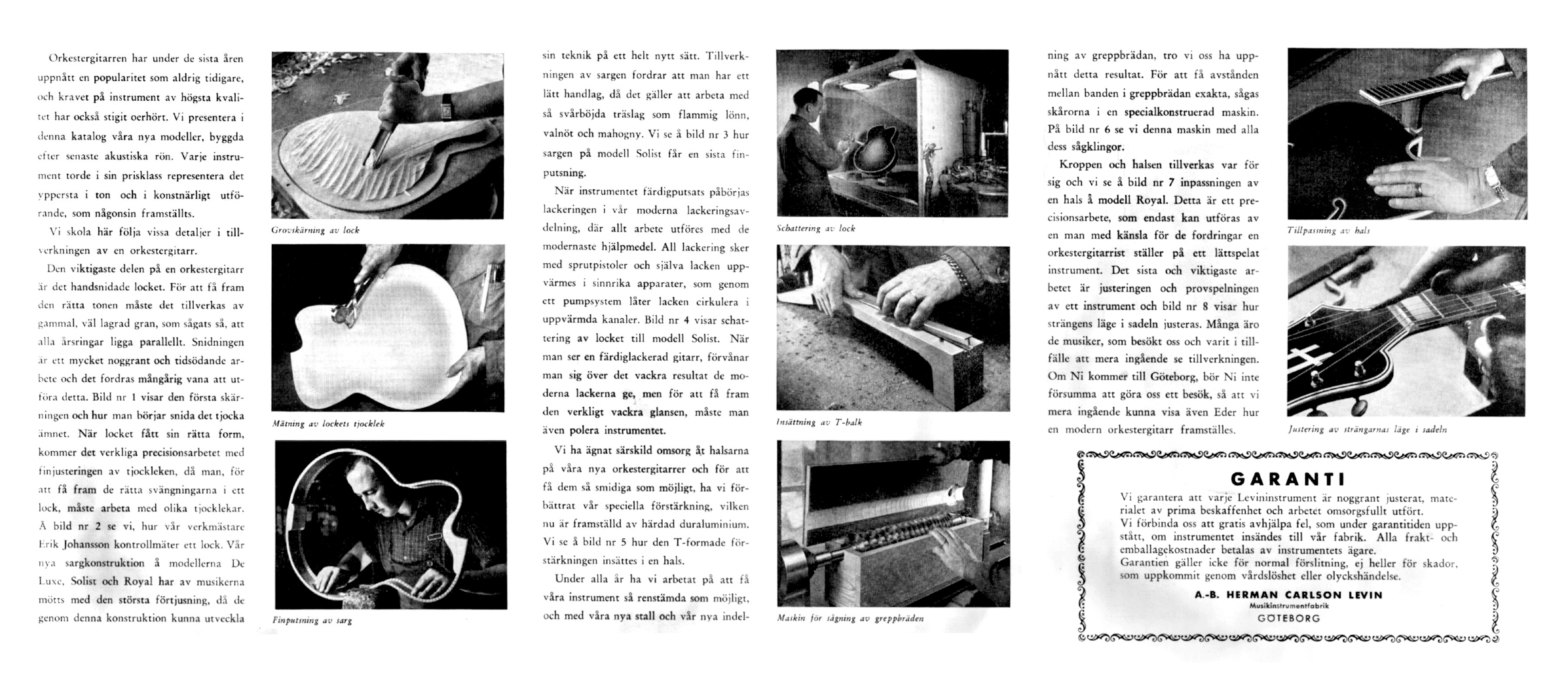
I’m so excited about my new gal, last week I received a 1951 Levin Model 3 Royal. I got it fairly cheap from Jam, a guitar shop in Stockholm and managed to get it to Spain in one piece in less than a week, very impressive. This is my 9th Levin, number 8th was a Goya GG-172 that I received back in June but haven’t had time to fix up yet. I tried one of these Levin orchestra guitars when I was back in Sweden in May and felt both confused and intrigued by it, I wasn’t sure if I was supposed to play it like an acoustic or electric guitar. Now I know that you can play pretty much anything on it, it sounds as full and rich as my other acoustic Levin’s but with the playability and feel of an hollow bodied electric guitar. I was actually really surprised how good the bass response was, perhaps because of the hand carved Rumanian spruce top and walnut back, it’s my first guitar with walnut and I really like it. Levin Royal is the 3rd fanciest orchestra guitar that Levin made during the 1930-50’s, with the De Luxe and Solist above it. The De Luxe is massive so I was worried that the Royal would be really big too, Levin Model 1 De Luxe (Body width: 475 mm), Levin Model 2 Solist (Body width: 445 mm) and Levin Model 3 Royal (Body width: 420 mm), but it’s just 2 cm wider than my Levin 174 and the other Goliath sized acoustic Levin’s I have. I’m really happy with it and will definitely look in to the possibilities of electrifying it, without ruining it, so I can use it live with Chest Fever.
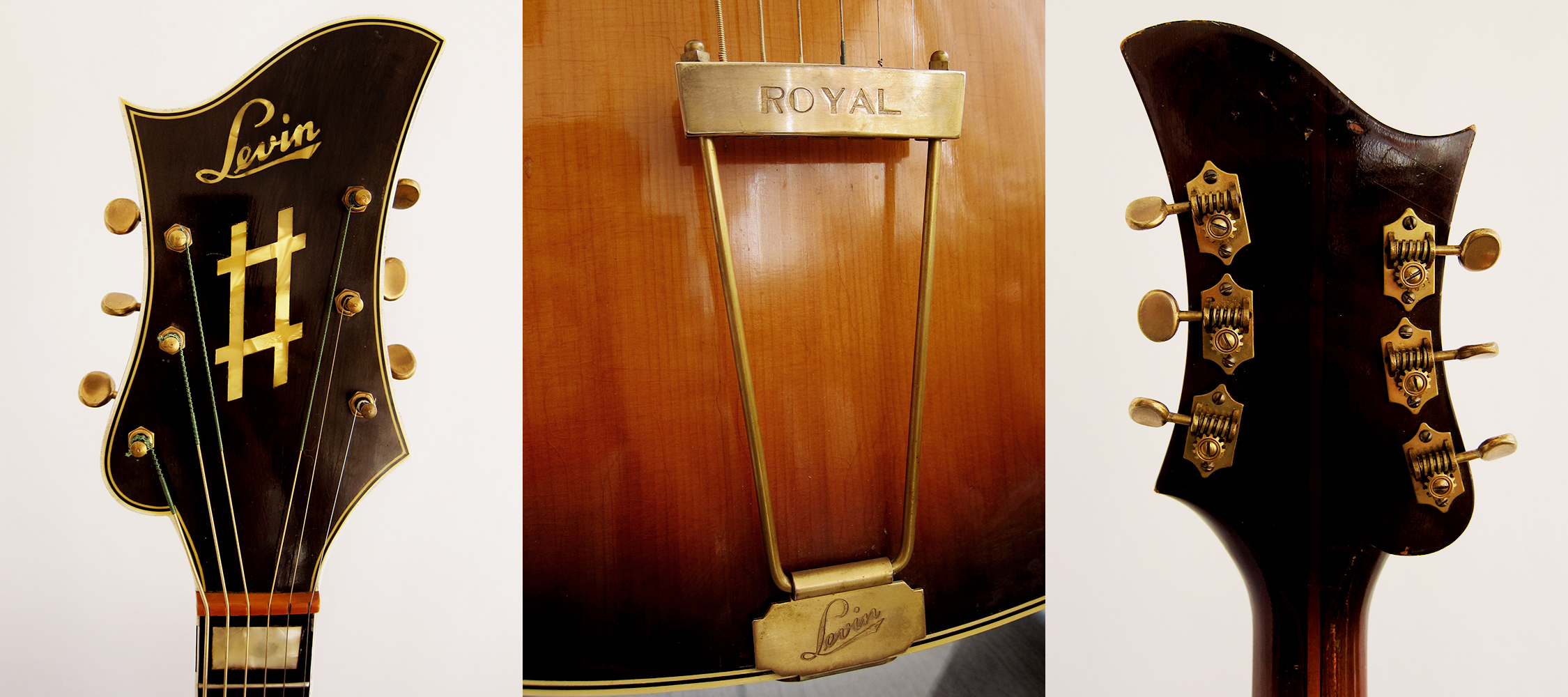
It’s in pretty good state for it’s age and almost all original, the pickguard is missing and one of the pearloid block inlays on the fretboard has been replaced with a plastic one. The only thing I had to do when I got it was to raise the action, it was way too low for me, polish the frets and even out the ebony fretboard a bit, some of the inlays was sticking up. The neck is pretty straight, it does have a T-shaped duraluminum truss rod inside but it’s non-adjustable so there isn’t much you can do without heating and reshaping the neck but that’s not needed yet.
Levin Model 3 Royal
Body width: 420 mm, body length: 510 mm
Hand carved Romanian spruce top with mahogany or walnut back and sides
4-ply bound top with double-bound f-holes, 4-ply bound back, triple-bound pickguard
Mahogany neck with non-adjustable T-shaped duraluminum truss rod
Triple-bound headstock with perloid music sharp sign inlay
Single-bound ebony fingerboard with pearloid block inlay
Grover Sta-Tite style tuners, gold plated hardware
Sunburst or natural finish and ten year warranty
I have a couple of more guitars for sale now so if you’re interested or have any questions just send me an email claesgellerbrink@gmail.com or give me a call 639586158.
Hohner Telecaster, Made in Japan, Moridaira factory, 1970’s, 500€ SOLD A great Telecaster copy in a good shape for age but with some dings to the bottom of the body. Frets are in great condition and there isn’t a single mark on the back of the neck. It’s a pretty heavy Telecaster with great sustain and nice feel to it. The pickups sounds awesome and everything is working fine, all original except for the 3-way switch that wasn’t working properly so I replaced it with a new one. Really fast and smooth neck, lovely to play. A great sounding guitar with amazing sustain and great Japanese build quality. Made in Japan by Morris in the Moridaira factory, where H.S. Anderson made the Mad Cats that Prince uses. You can read more about the guitar here and here is a Youtube clip.
VOX Les Paul, Made in Japan, 1970’s, 350€ SOLD This is the first Japan made VOX guitar I’ve found in Spain. It’s a pretty decent copy of a 1958′ Les Paul with a great feeling fat neck and narrow head. The body has a lovely grain and the guitar is in pretty good shape for the age with a couple scratches and a few dents. Frets show some wear but are still fine and everything is working perfectly. The humbuckers have a nice tone too them, not too heavy or muffled. A pretty versatile and nice guitar to play with great Japanese build quality. You can read more about the guitar here and here is a Youtube clip.
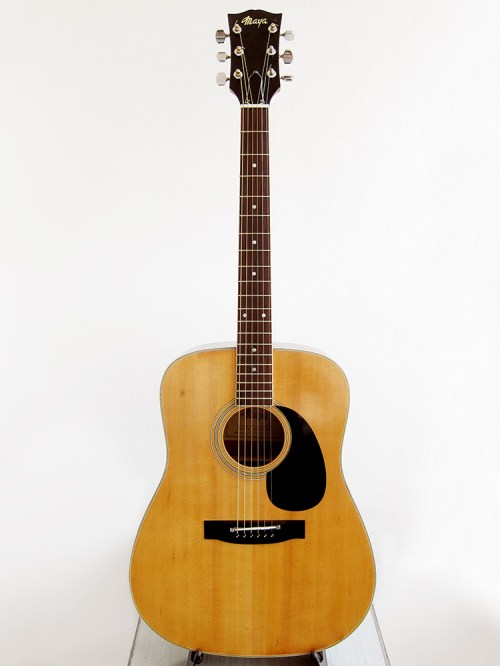
Maya F335G, Dreadnought acoustic, Made in Japan, 1970’s, 250€ SOLD Japan made Gibson J-50 copy in a pretty good state for it’s age. I couple of marks on the spruce top and few knocks on the head but structurally very sound without any cracks. This Maya F334G was made by Chushin Gakki in Kobe, Japan, during the 1970’s. It has a really fat neck, it’s feels great to play, adjustable bridge with both bone nut and saddle. The sound is very full with a great booming bass, you can listen to it here. If you want more pictures you can check the post I wrote about it.
Fender Telecaster TL52-75, ’52 re-issue Made in Japan, FujiGen 1987-1989. 900€ SOLD In mint condition, all original, without any doubts the best Telecaster I have ever played. Imported straight from Japan. The only reason for selling is because I prefer fat 70’s necks. There is no way to find the production year of these A-serial Telecaster with the serial number on the bridge plate. However, it must have been made between 1987 and 1989 since it’s a TL52-75. They were called TL52-70 between 1984-1986 and then changed to TL52-700 in 1990. You can read more about the guitar here and listen to it in this Youtube clip.
Westone Stratocaster, Made in Japan, Matsumoku factory, 1979, 400€ SOLD An amazing Stratocaster copy from 1979 made in Japan by Matsumoku. In really good shape for age but with some dings and scratches to the body. Frets are in great condition and there isn’t a single mark on the back of the neck. The wood in the body is amazing, without any doubt the heaviest and most solid Strat I have ever seen with fantastic sustain. Really nice tone in the pickups and everything is working fine, the original 3-way switch has been replaced with an Oak Grigsby 5-way switch. Really fast and smooth neck, lovely to play. A great sounding guitar with amazing sustain and great Japanese build quality.Here is some more info about the Westone brand. Here is a Youtube clip with the guitar.
It’s with a heavy heart that I have decided to part with my Hagstrom Viking. I bought the guitar back in 2010 and have unfortunately not had time to play it as much as I wanted, some Japanese Telecasters got in the way. I had three semi-hollow bodied guitars at one point and kept this the longest, I sold the other two last year. I guess the more guitars you have the more you realise what feels good for you to play. For me, fat necked Telecasters feels really nice to play, I’m a bit gay for old Greco Telecasters from the 1970’s. If you are interested in inherit this Hagstrom Viking from the Claes Collection then get in touch. You can read more about it here for sale, or in Spanish here.
Update: April 4, 2014The Hagstrom Viking is now sold to Rafa from Cobarde.
Hagstrom, or Hagström as we call it back home, was founded in 1925 by Albin Hagström in Älvdalen, Sweden. They made amazing electric guitars from 1958 to 1983, played by guys like Elvis Presley, Jimi Hendrix, Noel Redding, Joe Walsh, Dweezil and Frank Zappa to name a few. I have played on a lot of Hagstrom guitars and amps during my teenage years back in Sweden and learned to play bass on my stepdad Sten’s Hagstrom Jazz bass from 1976. I have an fairly mint Hagström HIIN OT from 1975 back in Sweden that I really like. I guess it was out of national pride that I got so excited and bought the Hagstrom Viking when they started to make them again in 2004. They have a few models that are made in the EU, but not in Sweden, and the rest is made in China. I have actually only played my Viking from 2008 so I can’t really comment on the quality of the Chinese Hagstroms today but mine is very well built for the price. I would say that they are better than Gretsch Electromatic, Epiphone and the Ibanez semi-hollow bodied, all in roughly the same price range.
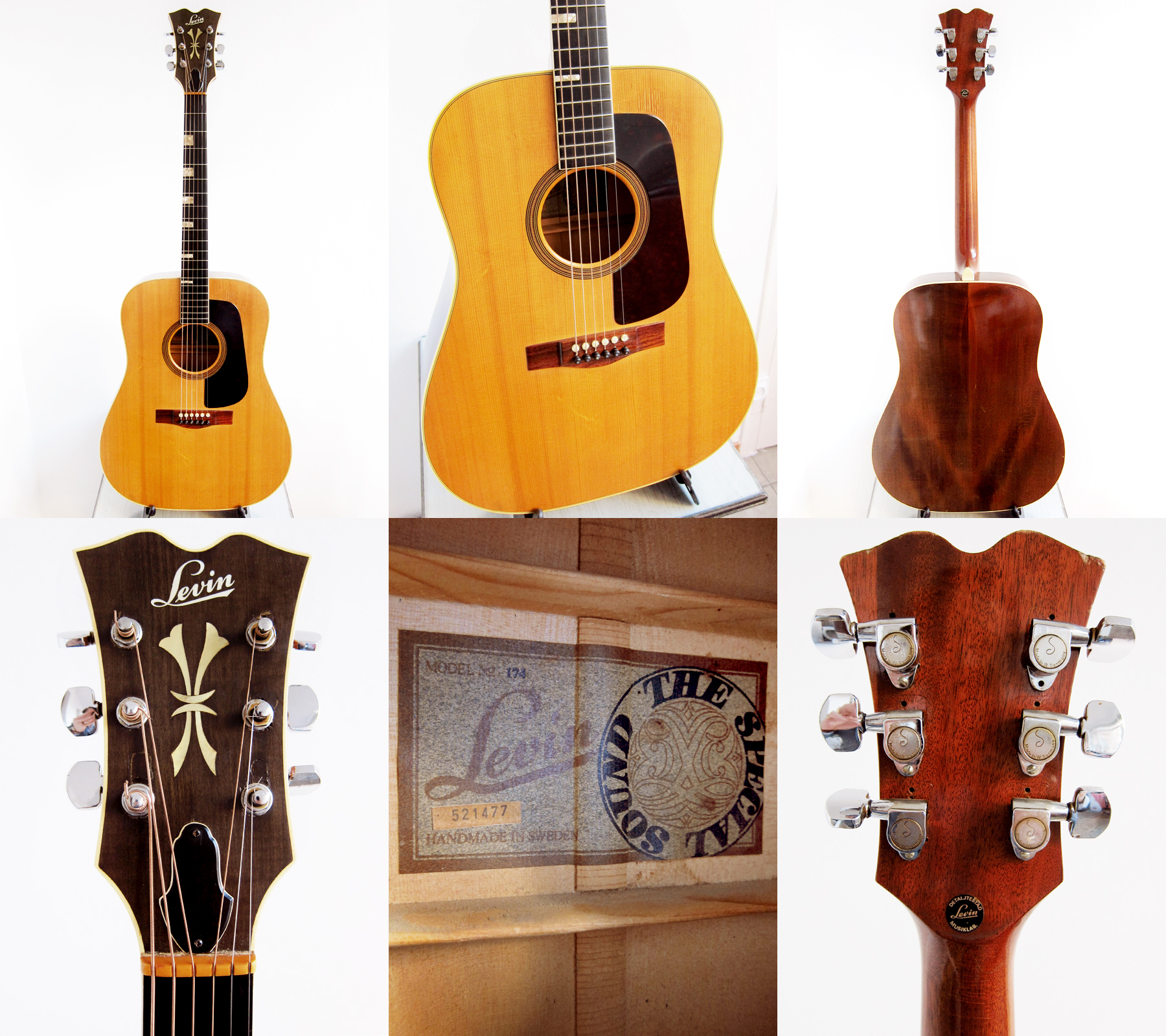
My latest acquisition, a 1972 Levin Model 174. The story how I got this guitar is pretty amazing. I wrote a post about Levin guitars back in August 2013 when I had just started to collect them. In the end of the post I mentioned that I would love to find a Levin Model 174, it’s basically a Levin LT-18 but with a massive head. There is something about that huge head that I find very appealing, I guess it reminds me of old an archtop guitar from 1930-40’s and it’s almost a bit Art Deco. Three months later, in the end of November, I got a comment from a Danish guy called Orla saying that he had one for sale. We started to email each other and he told that a few days earlier he had seen a guy about to throw a guitar case in a skip so he had gone up to him and asked if he could have it instead. Orla took the case home, opened it and found a 1972 Levin Model 174 in pretty good shape inside. He Googled the name and model and pretty soon found my blog post saying that I was looking for one. Since Orla doesn’t play guitar himself, he just wanted to save it from a certain death, he contacted me and offered me to buy it and I’m very grateful that he did. It was a bit scary to buy a guitar from a guy I didn’t know who had contacted me through my blog, it felt a bit fishy somehow. A part of me thought it was a Nigerian email scam in disguise and another part said that I should trust the good in people, especially a Northern neighbour like Orla. In the end I decided that it was an offer I really couldn’t turn down, especially since most of the 174’s I had seen for sale were all Goya labelled and made later in the 1970’s. It took some time to get the guitar down to Spain, we had some logistic issues but finally it arrived about two weeks ago and I was stunned. Since Orla doesn’t play he couldn’t give me any info about what state the guitar was in, he had sent me some pictures but it’s pretty hard to get an idea if it’s even playable from just that. Luckily it was in a really good state and it both sounds and feels great.
Levin Model 174 /Goya Model 174 Goliath size: Body width: 400 mm, body length: 505 mm, body depth: 95/120 mm
Fingerboard width: 43 mm, scale length: 630 mm
Spruce top, flame maple back and sides, 4-ply bound top, single-bound back
Mahogany bolt-on neck with adjustable truss rod
Single-bound headstock with mother-of-pearl inlay
Single-bound ebony fingerboard with bass side pearloid block inlays
Rosewood bridge with individual height adjustable plastic saddles
Nickel plated individual Van Gent tuners with metal buttons
Natural finish and ten year warranty
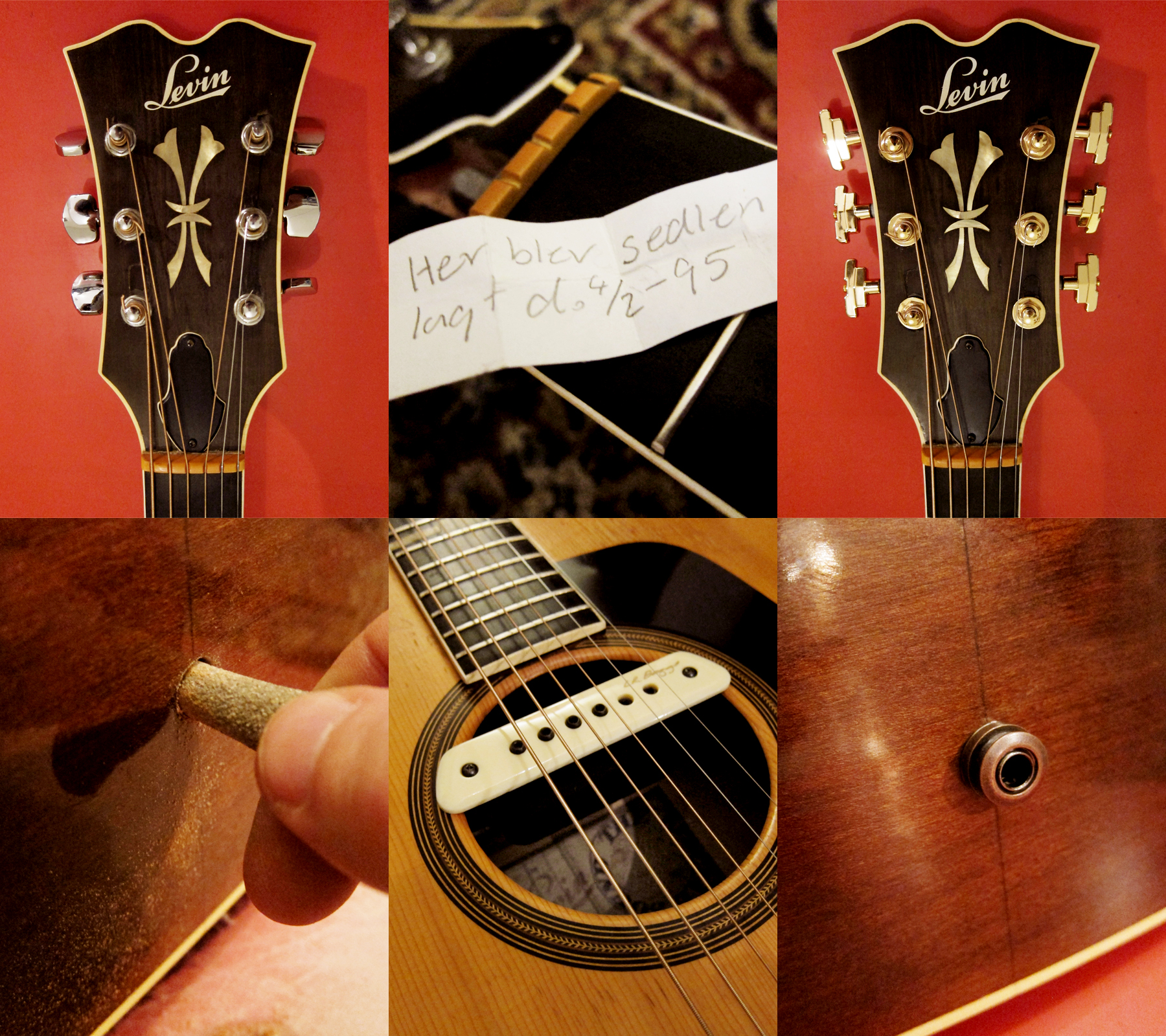
I didn’t have to do much to it, the action was really good as it was. Which was very lucky because this 174 doesn’t have the Levin bolt-on neck system, they stopped with that in the early Seventies. The original Van Gent machine heads had been changed at some point, probably in the 1970’s, to Schaller’s and I really don’t like these type of buttons so I changed them for Wilkinson WJ-309 in gold, to make it look even more Art Deco. I also installed an endpin jack so I can use it live with my LR Baggs M1. I had to clean it a bit, polish the frets and oil the fretboard but overall it was pretty good from the start. There was a note hidden under the trussrod cover saying, Her blev sedlen lagt 4th of February 1995. I assume that’s referring to that the nut was raised a bit 19 years ago, something I need to redo at some point because they seem to have used some paper like material instead of bone.
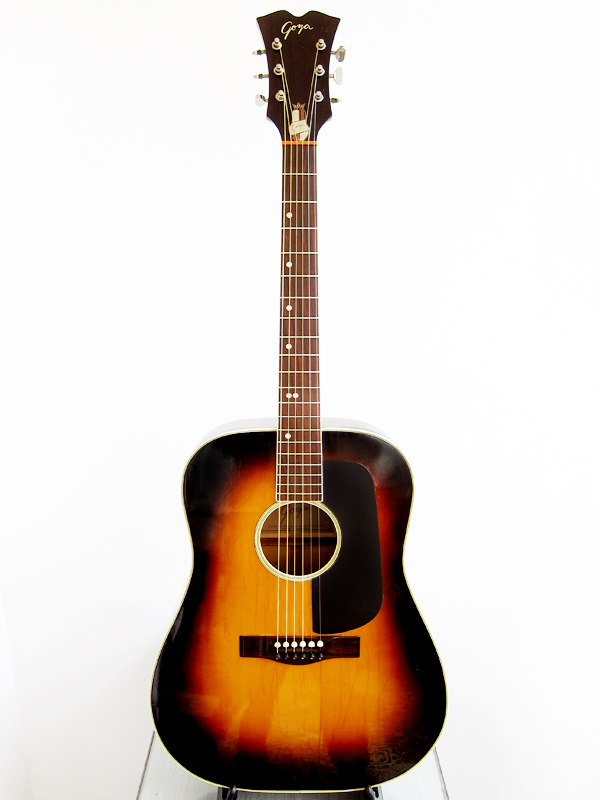
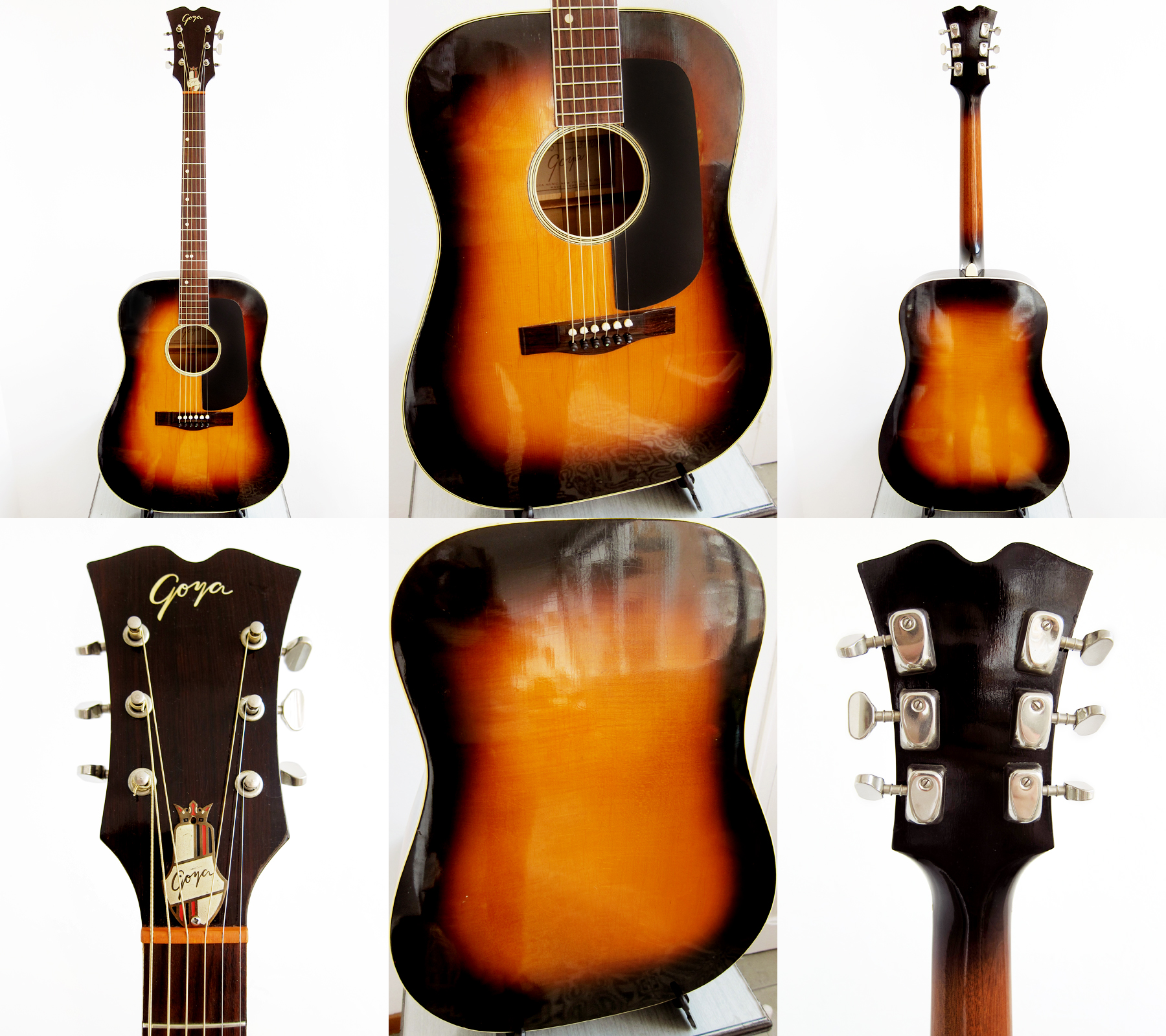
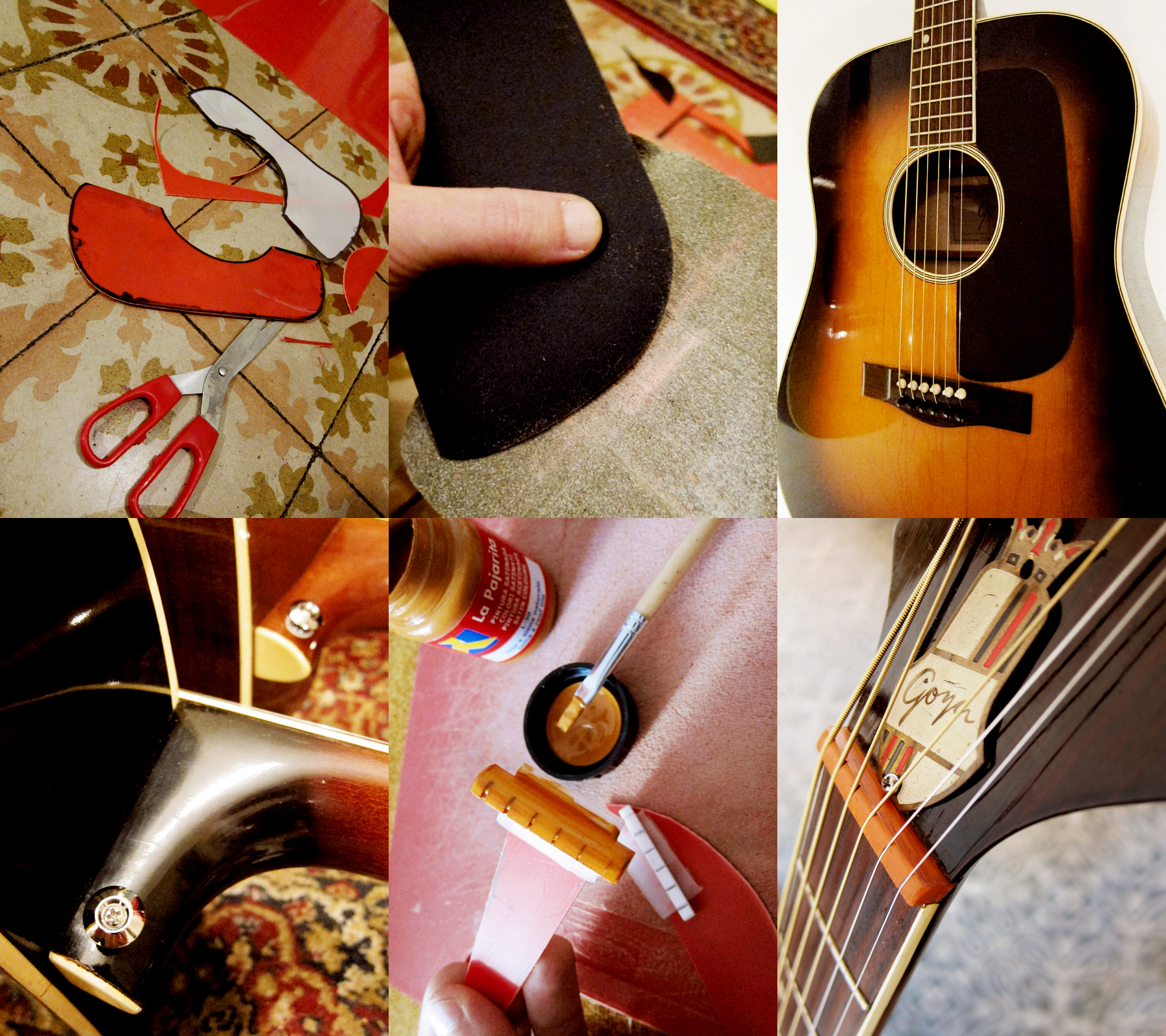
I thought I might as well post some images of the Goya 163 I received back in January. There was some work to be done, actually quite a lot. First I had to reset the neck to get the action down and then I had to remove the bridge and redo the saddle screws. I cut a new pickguard over the weekend, well it’s not perfect yet, I’m still looking for a better material but it will do for now. I bought this Goya from a girl called Marilyn Moser in Maynard, Massachusetts. She had used the guitar for some live gigs in the New York area but gave up on it because of the high action, it was fairly unplayable when I got it. The guitar came with a nice handwritten note to me, the new owner, that’s why I got curious to find out a bit more about her. Here are links to some of her music and her awesome 1960’s blog.
Levin 163 / Goya 163 Goliath size: Body width: 400 mm, body length: 505 mm, body depth: 95/120 mm
Fingerboard width: 43 mm, scale length: 630 mm
Spruce top, flame maple back and sides, 4-ply bound top, single-bound back
Mahogany bolt-on neck with adjustable truss rod
Single-bound rosewood fingerboard with bass side pearloid dot inlay
Rosewood bridge with individual height adjustable plastic saddles
Nickel plated individual Van Gent tuners with metal buttons
Sunburst finish and ten year warranty
I still haven’t found a good pickguard material. Well the red plastic that I happened to find in the street is actually perfect but who wants a red pickguard. I’ve managed to find 0.8 mm thick matt black plastic but I need something around 1-1.5 mm and preferable in high gloss jet black or even better in red tortoise. I fitted a strap button in the usual place, and then I painted the new bone nut orange to match the original Levin Galalith nut.
Update: March 21, 2014The pickguard material I ordered from China looked a lot classier than expected so I cut in to shape and put it on
 Levin LT-14 Made in Sweden in 1965
 It’s the first time I get a 50 years old guitar home and I have to do nothing to it. There are actually no scratches to the top, that’s just in the grain of the spruce.
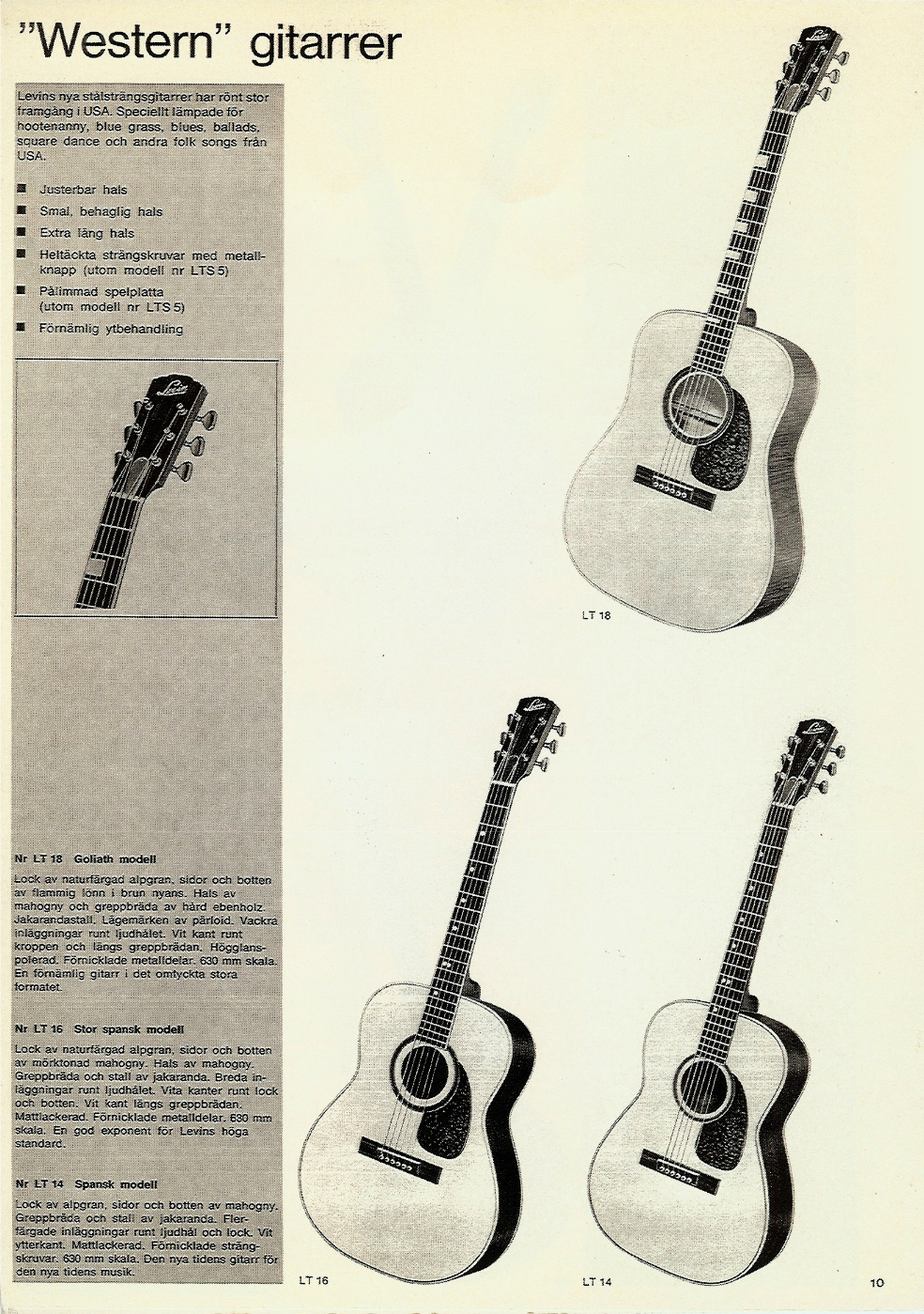 Now I actually have all three, the Levin LT-18, well it’s a Goya T-18 but close enough, my dad’s old Levin LT-16 and this new little Levin LT-14. Taken from a 1965 Levin catalogue. Thanks to Vintage Guitars Sweden
 The Levin family at the moment, from left to right: Goya GG-172 (1970), Levin Model 13 (1950), Goya Model 163 (1968), Levin Model 174 (1972), Levin Royal (1951), Levin LM-26 (1959), Levin Model 65 (1942), Goya T-18 (1966), Levin LT-14 (1965), Levin LT-16 (1966)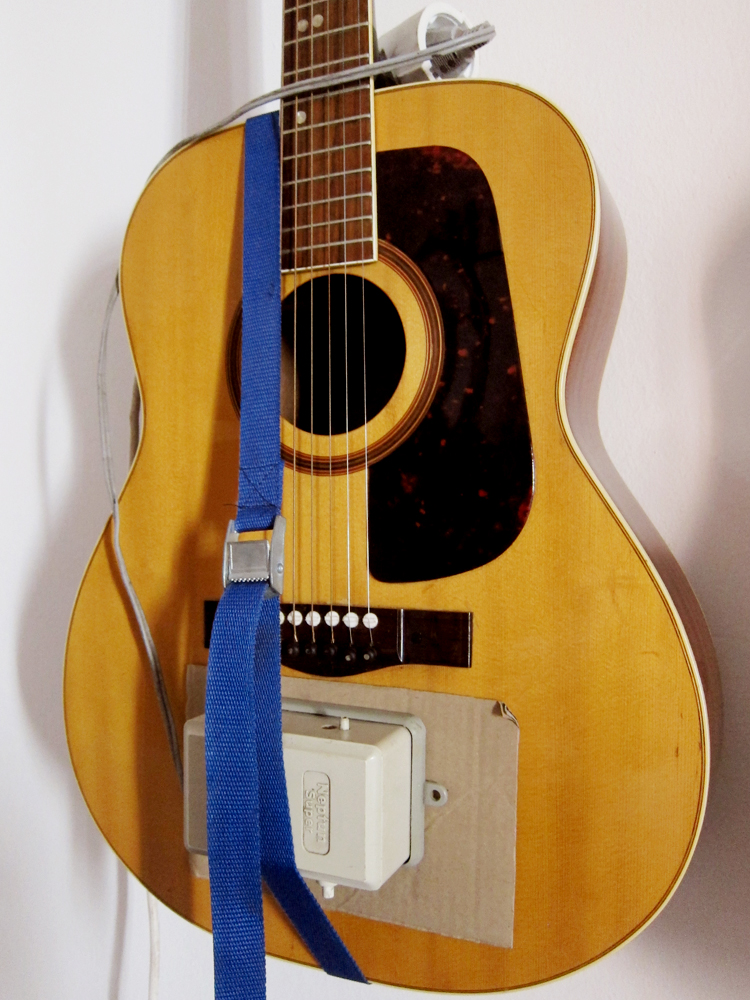










 Claescaster
