I’ve always been a huge fan of White Falcons but never really felt I could afford one. They are so over the top Las Vegas bling but still works so well on scruffy looking musicians like Neil Young, see below. I’m not overly keen on newly made acoustic guitars, I believe that everything sounds better after 20 years, but after seeing this I have to admit I have second thoughts. Gretsch has just launched a White Falcon acoustic, and not only does it look awesome, it’s cheap too. Compared to a White Falcon that cost around 3200€ it feels pretty cheap with 550€ for the new Rancher Falcon in white. It’s almost as exciting as when Fender released the Fender Japan TN72G-FT.
Jack White is doing a surprise gig at the South by Southwest festival Austin Texas in 2011 with a custom made Gretsch White Falcon acoustic. When I saw this picture I really felt that I wanted one too. I have an all black Morris WL-35, really Johnny Cash, but imagine to have an all white Gretsch guitar with extra gold. Hmm, gold, I love gold.
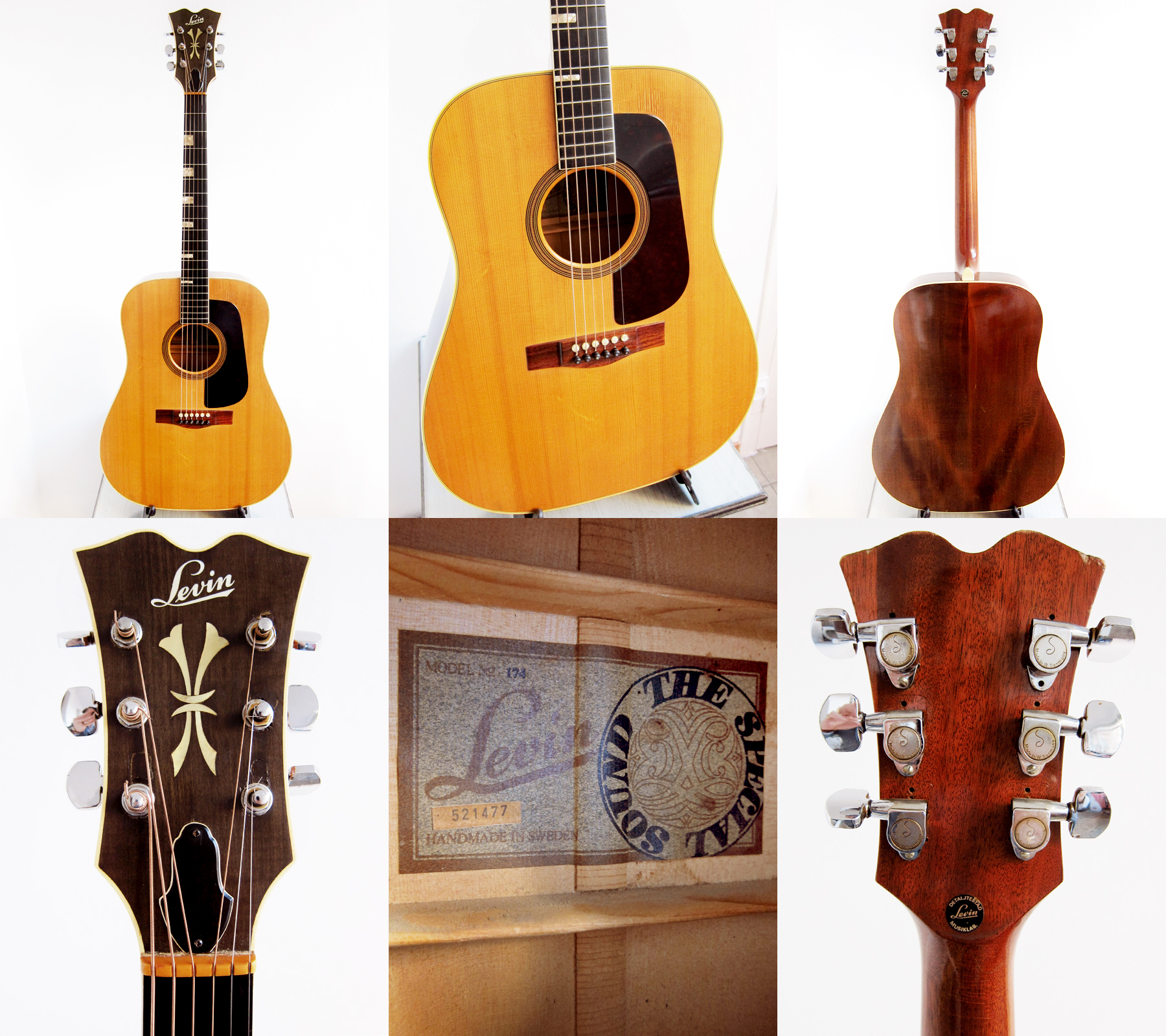
My latest acquisition, a 1972 Levin Model 174. The story how I got this guitar is pretty amazing. I wrote a post about Levin guitars back in August 2013 when I had just started to collect them. In the end of the post I mentioned that I would love to find a Levin Model 174, it’s basically a Levin LT-18 but with a massive head. There is something about that huge head that I find very appealing, I guess it reminds me of old an archtop guitar from 1930-40’s and it’s almost a bit Art Deco. Three months later, in the end of November, I got a comment from a Danish guy called Orla saying that he had one for sale. We started to email each other and he told that a few days earlier he had seen a guy about to throw a guitar case in a skip so he had gone up to him and asked if he could have it instead. Orla took the case home, opened it and found a 1972 Levin Model 174 in pretty good shape inside. He Googled the name and model and pretty soon found my blog post saying that I was looking for one. Since Orla doesn’t play guitar himself, he just wanted to save it from a certain death, he contacted me and offered me to buy it and I’m very grateful that he did. It was a bit scary to buy a guitar from a guy I didn’t know who had contacted me through my blog, it felt a bit fishy somehow. A part of me thought it was a Nigerian email scam in disguise and another part said that I should trust the good in people, especially a Northern neighbour like Orla. In the end I decided that it was an offer I really couldn’t turn down, especially since most of the 174’s I had seen for sale were all Goya labelled and made later in the 1970’s. It took some time to get the guitar down to Spain, we had some logistic issues but finally it arrived about two weeks ago and I was stunned. Since Orla doesn’t play he couldn’t give me any info about what state the guitar was in, he had sent me some pictures but it’s pretty hard to get an idea if it’s even playable from just that. Luckily it was in a really good state and it both sounds and feels great.
Levin Model 174 /Goya Model 174 Goliath size: Body width: 400 mm, body length: 505 mm, body depth: 95/120 mm
Fingerboard width: 43 mm, scale length: 630 mm
Spruce top, flame maple back and sides, 4-ply bound top, single-bound back
Mahogany bolt-on neck with adjustable truss rod
Single-bound headstock with mother-of-pearl inlay
Single-bound ebony fingerboard with bass side pearloid block inlays
Rosewood bridge with individual height adjustable plastic saddles
Nickel plated individual Van Gent tuners with metal buttons
Natural finish and ten year warranty
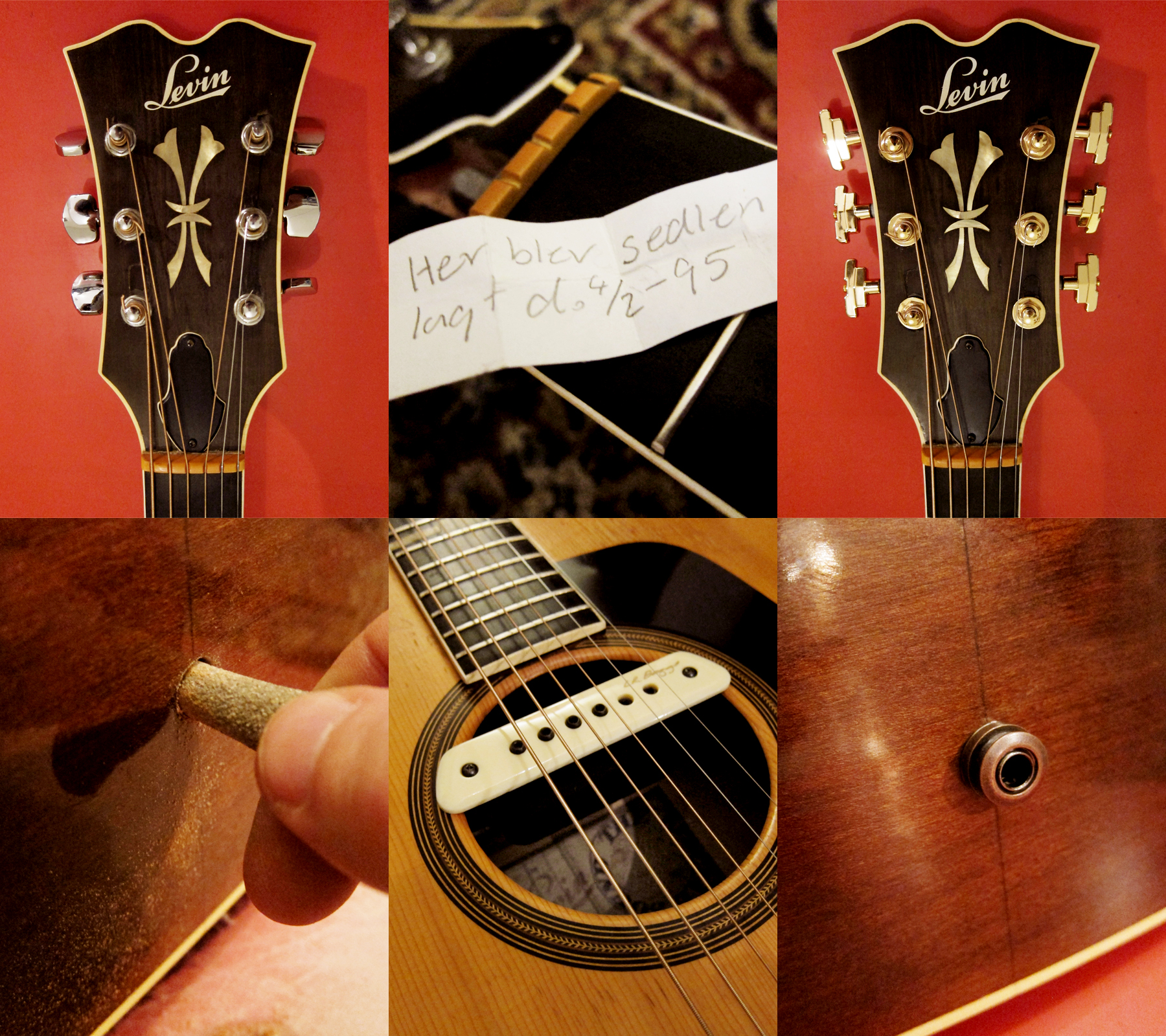
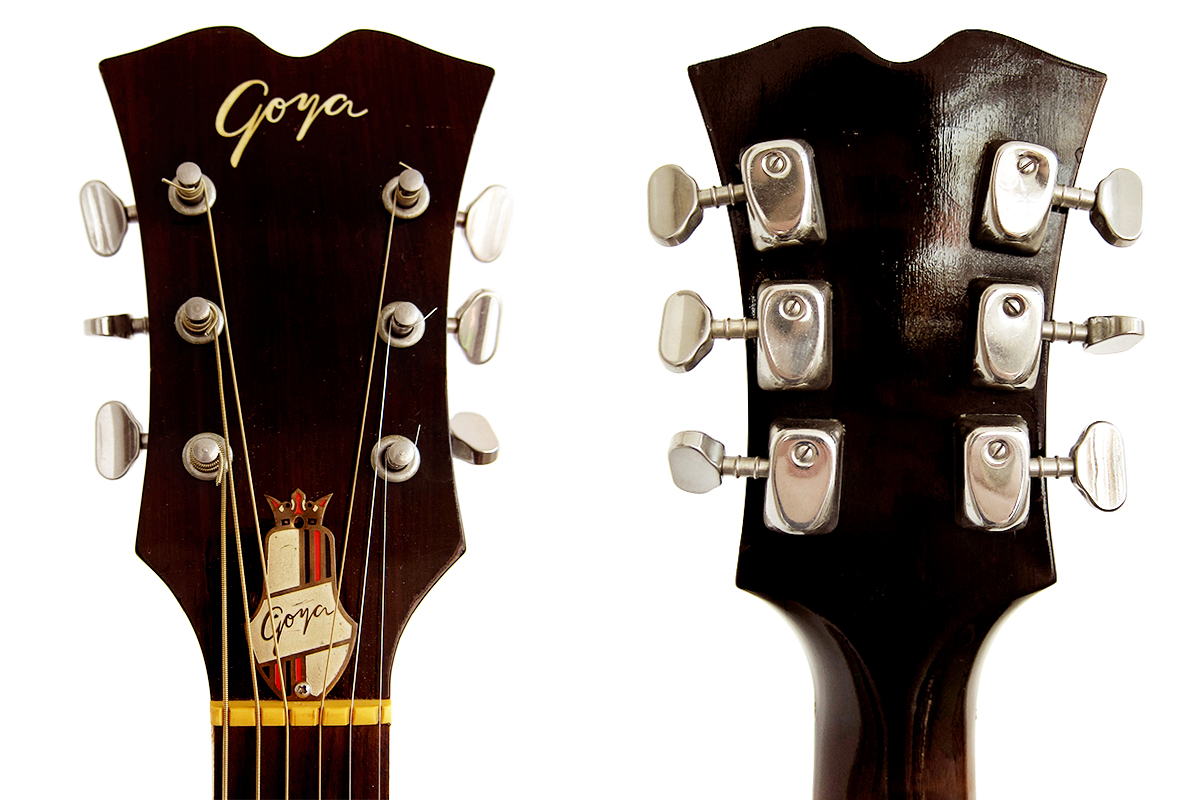
I didn’t have to do much to it, the action was really good as it was. Which was very lucky because this 174 doesn’t have the Levin bolt-on neck system, they stopped with that in the early Seventies. The original Van Gent machine heads had been changed at some point, probably in the 1970’s, to Schaller’s and I really don’t like these type of buttons so I changed them for Wilkinson WJ-309 in gold, to make it look even more Art Deco. I also installed an endpin jack so I can use it live with my LR Baggs M1. I had to clean it a bit, polish the frets and oil the fretboard but overall it was pretty good from the start. There was a note hidden under the trussrod cover saying, Her blev sedlen lagt 4th of February 1995. I assume that’s referring to that the nut was raised a bit 19 years ago, something I need to redo at some point because they seem to have used some paper like material instead of bone.
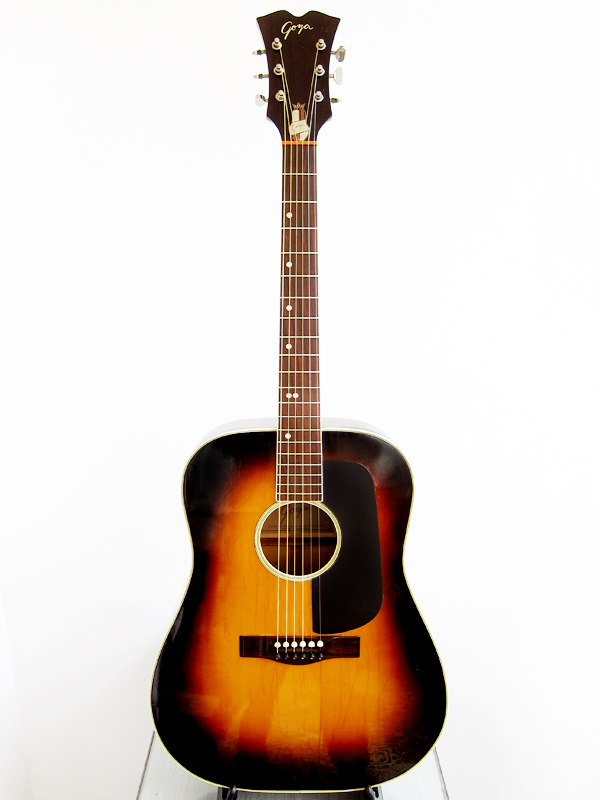
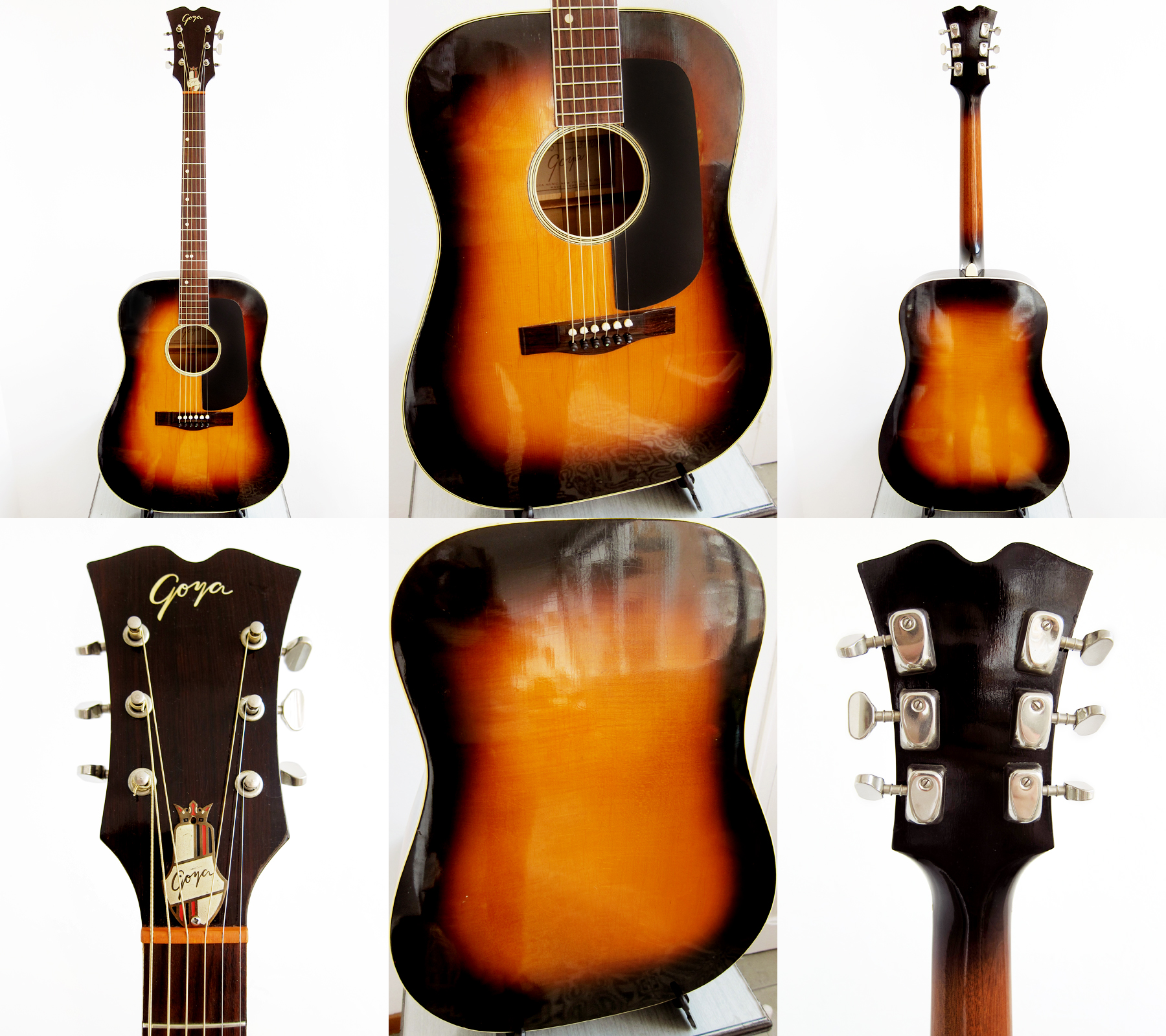
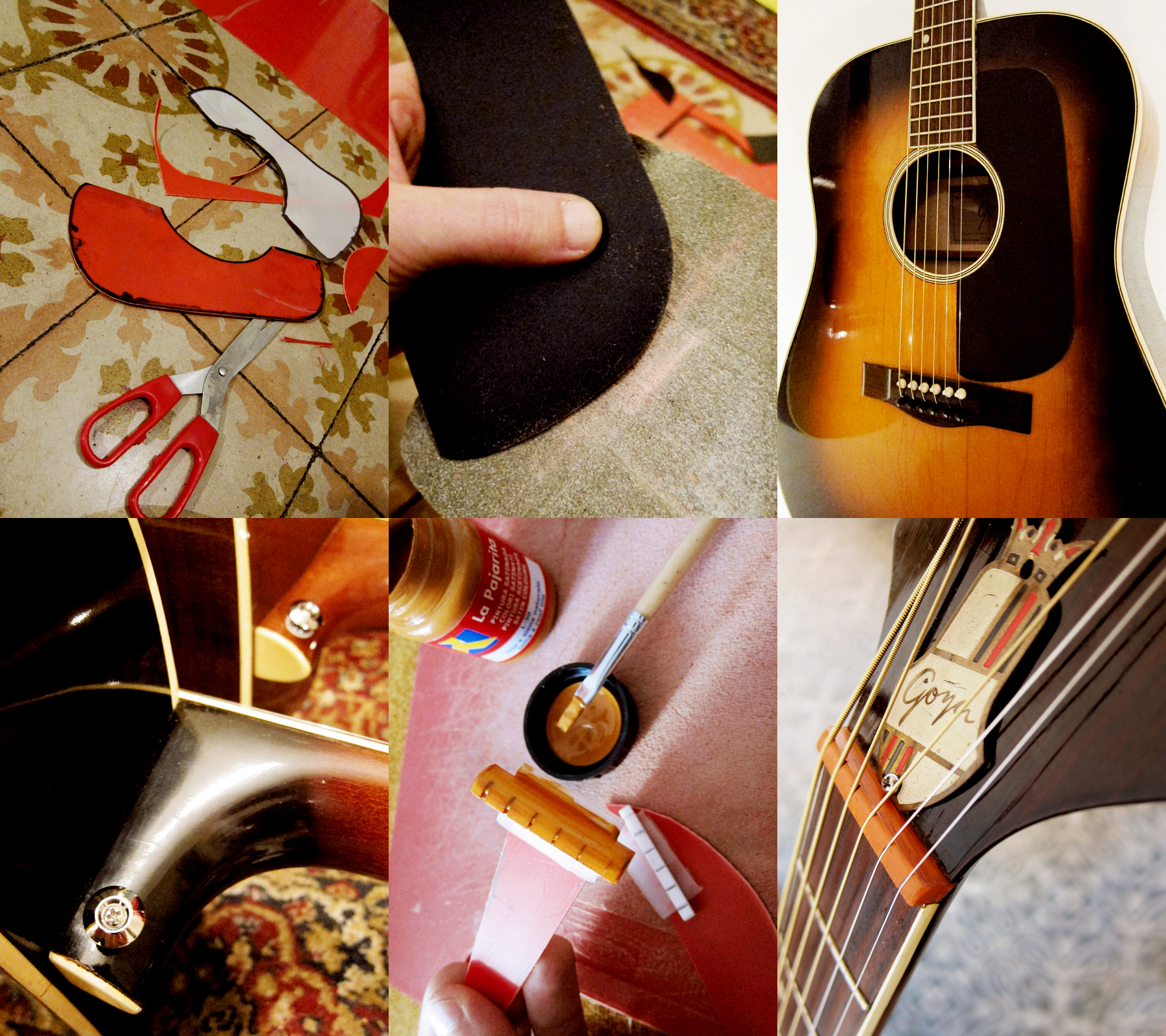
I thought I might as well post some images of the Goya 163 I received back in January. There was some work to be done, actually quite a lot. First I had to reset the neck to get the action down and then I had to remove the bridge and redo the saddle screws. I cut a new pickguard over the weekend, well it’s not perfect yet, I’m still looking for a better material but it will do for now. I bought this Goya from a girl called Marilyn Moser in Maynard, Massachusetts. She had used the guitar for some live gigs in the New York area but gave up on it because of the high action, it was fairly unplayable when I got it. The guitar came with a nice handwritten note to me, the new owner, that’s why I got curious to find out a bit more about her. Here are links to some of her music and her awesome 1960’s blog.
Levin 163 / Goya 163 Goliath size: Body width: 400 mm, body length: 505 mm, body depth: 95/120 mm
Fingerboard width: 43 mm, scale length: 630 mm
Spruce top, flame maple back and sides, 4-ply bound top, single-bound back
Mahogany bolt-on neck with adjustable truss rod
Single-bound rosewood fingerboard with bass side pearloid dot inlay
Rosewood bridge with individual height adjustable plastic saddles
Nickel plated individual Van Gent tuners with metal buttons
Sunburst finish and ten year warranty
I still haven’t found a good pickguard material. Well the red plastic that I happened to find in the street is actually perfect but who wants a red pickguard. I’ve managed to find 0.8 mm thick matt black plastic but I need something around 1-1.5 mm and preferable in high gloss jet black or even better in red tortoise. I fitted a strap button in the usual place, and then I painted the new bone nut orange to match the original Levin Galalith nut.
Update: March 21, 2014The pickguard material I ordered from China looked a lot classier than expected so I cut in to shape and put it on
You might have noticed that eBay have started with something new, well fairly new, called Global Shipping Program. Basically you pay all the import taxes and charges straight away and therefore don’t have to go through the customs when the item arrives to your country. I have had some issues in the past when I have bought things from the US, like my Claescaster body and my Goya T-18. It took the Spanish customs a month the process the item and deliver it to me and they charged me 40% of the original price including shipping in import tax and other fees. I recently purchased a lovely Goya 163 from Massachusetts using the Global Shipping Program and it took exactly 14 days to get it and I only had to pay 32.5 % tax on the actual price of the guitar, not final price plus shipping as they normally charge me when it goes through the Spanish customs in Madrid and best of all, no paperwork. So for anyone living in Spain I can highly recommend buying things from the States using the Global Shipping Program.
This is the last acoustic guitar I have left for sale, all the others are gone now. If you’re interested or have any questions just send me an email claesgellerbrink@gmail.com or give me a call 639586158.
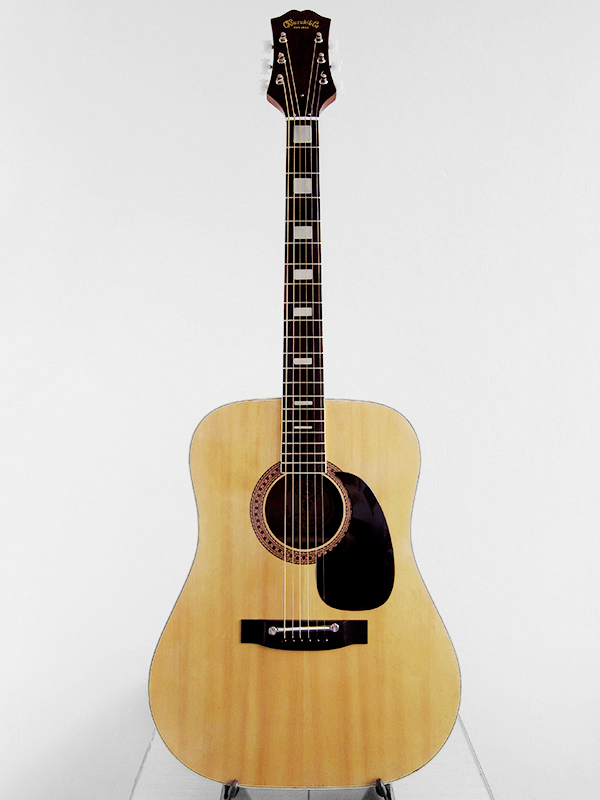
Suzuki Three-S F-120 Dreadnought acoustic, Made in Japan, 1976, 250€ SOLD A nice Suzuki Violin Co. LTD, Suzuki Three-S F-120 built in Japan in 1976. It’s in really good shape with just a few scratches on the back and sides, nothing that stands out. The tone is great, very clear sounding and it’s really easy to play with low action and no buzzing. It seems to be solid spruce top, nato back and sides, with nato neck and rosewood fingerboard. It looks like it’s a Martin D-18 copy. The neck is straight, no marks on the back and everything works as it should. A well built Japanese acoustic from one of the most famous guitar makers. You can find videos on Youtube here: Suzuki Three-S F-120 and here: Suzuki Three-S F-120 (bonus).
I just installed a new set of Wilkinson WJ44 in gold on my Morris W-40. I wasn’t happy with the fake 10€ tulip Grovers I had before so I decided to get some Wilkinson Deluxe tuners instead. They cost me about 33€ including shipping from Vansonguitars on eBay. I really love the tulip shape and will always chose that if possible but I really don’t like the green buttons that most companies use, even the big ones like Schaller, Kluson and Grover. Luckily Wilkinson has started to make their deluxe tuners in both vintage green and cream white so I could get my beloved gold deluxe tuners in off white instead of hospital green. Another good thing with these Wilkinson’s is that they have a 9mm bushing instead of 8mm which makes them easier to fit if you have modern 10mm holes for the tuners. Wilkinson are manufactured in Korea by Jin Ho and I’m very impressed with their quality considering how the cheap they are. I have both Wilkinson tuners and bridge on my Claescasters, I love their vintage bridge with compensated brass saddles.
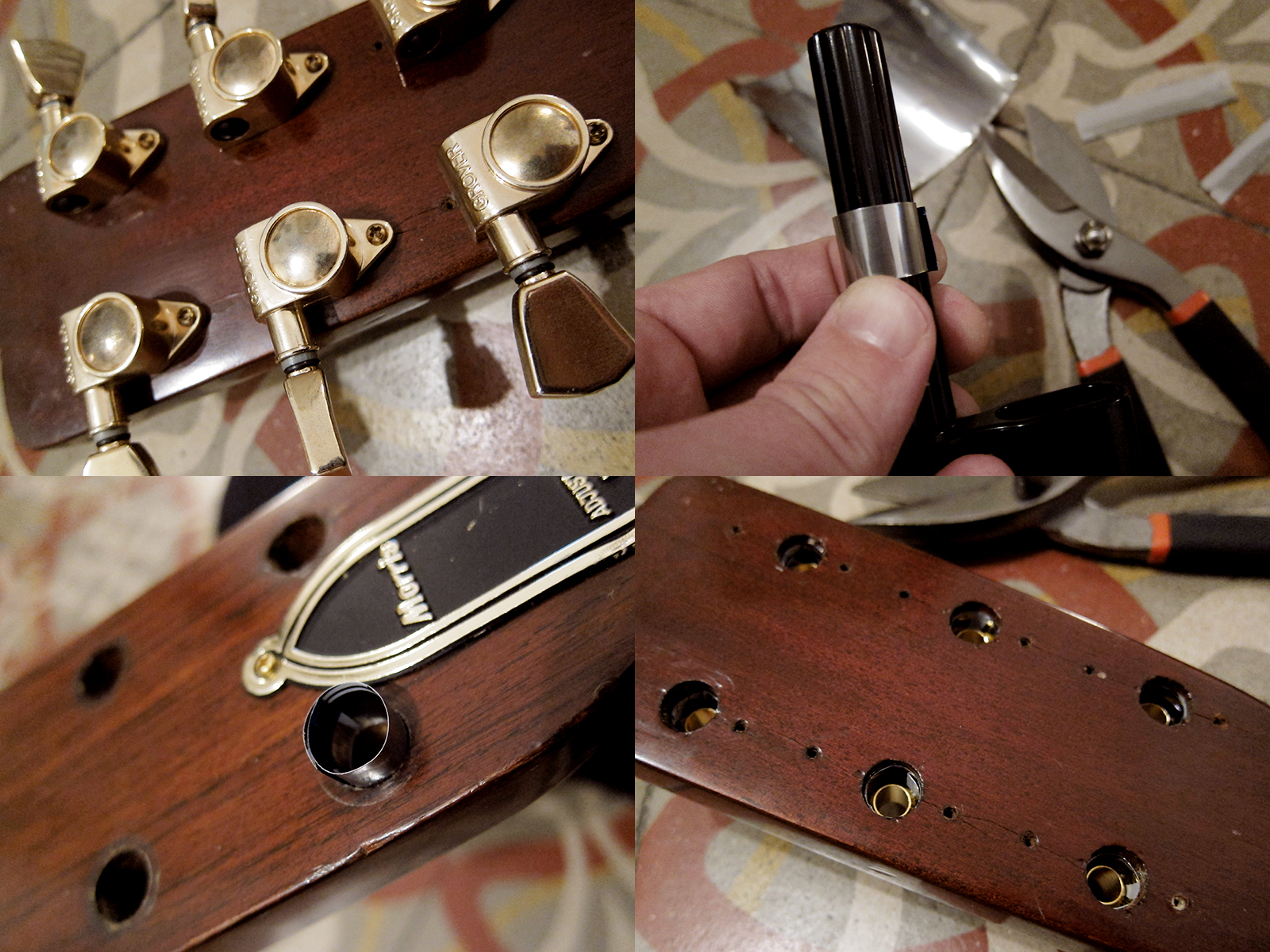
Since the Morris W-40 has 10mm holes I had to try to make the 9mm bushings 1mm bigger. I decided to try the beer can trick which turned out to work pretty well. Cut a can open and remove the top on the bottom and then just cut strips as wide as the bushing. 1mm might sound like nothing but the bushing needs to sit tight in the holes otherwise they will be pulled out or move from the string tension. I had to go for about 1.5 strip to fill the gap and there was a lot of fiddling and pain in my thumbs to get it in place but I eventually succeeded.
I was hoping that the screw spacing matched the old Morris tuners but they didn’t so I had to drill new holes. They are going to be hidden under the original tuners if I restore it but for now, I prefer gold and tulip buttons to the original Japanese 70’s chrome tuners.
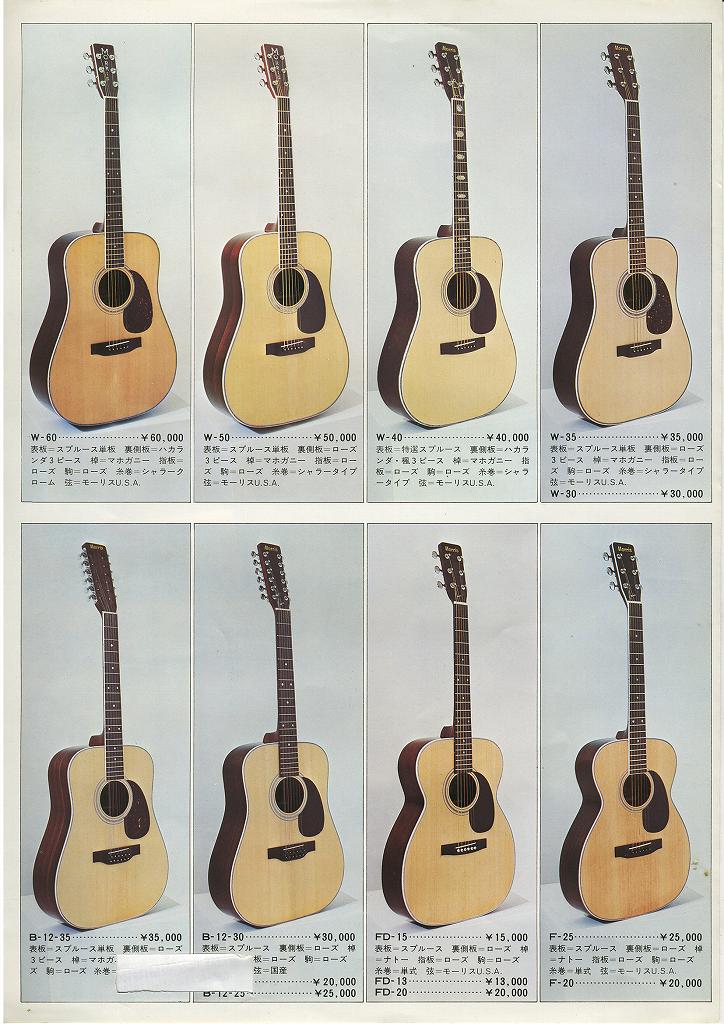
I’ve recently come across I pretty good source for old catalogue scans for Japan made acoustic guitars. It’s called oldguitar and has about 50 different Japanese guitar brands represented, some brands has more scans than others and most of them are in Japanese but it still pretty nice to see your guitars in old catalogues. Unfortunately I only managed to find my Morris W-40, K. Yairi TG-40 and Suzuki Three-S F-120, my Morris WL-35 and Kiso Suzuki WE-150 seems a bit harder to track down.
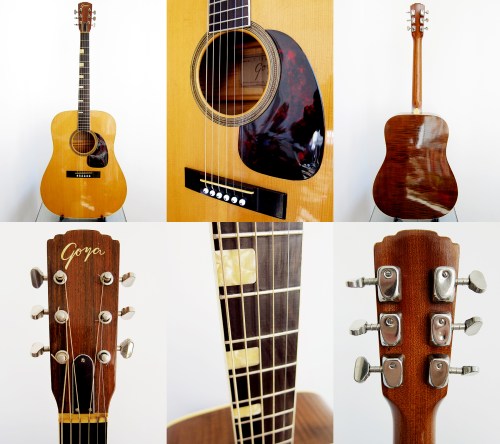
When my Goya T-18 arrived from the US back in September I didn’t really know where to start. It had an amazing tone, actually every time I pick it up I think it’s my best sounding guitar, but it needed work. The action was way too high, there was three deep really annoying dents on the back of the neck and the pickguard was loose. Last weekend I actually got to work on all three problems and I managed to get my Goya up and running and now I struggle to put it down.
Levin LT-18 / Goya T-18 Goliath size: Body width: 400 mm, body length: 505 mm, body depth: 95/120 mm
Fingerboard width: 43 mm, scale length: 630 mm
Spruce top, flame maple back and sides, 4-ply bound top, single-bound back
Mahogany bolt-on neck with adjustable truss rod
Single-bound ebony fingerboard with bass side pearloid block inlay
Nickel plated individual Van Gent tuners with metal buttons
Ebony bridge, natural finish and ten year warranty
Marketed by U.K. distributors as Super Goliath Model 1855
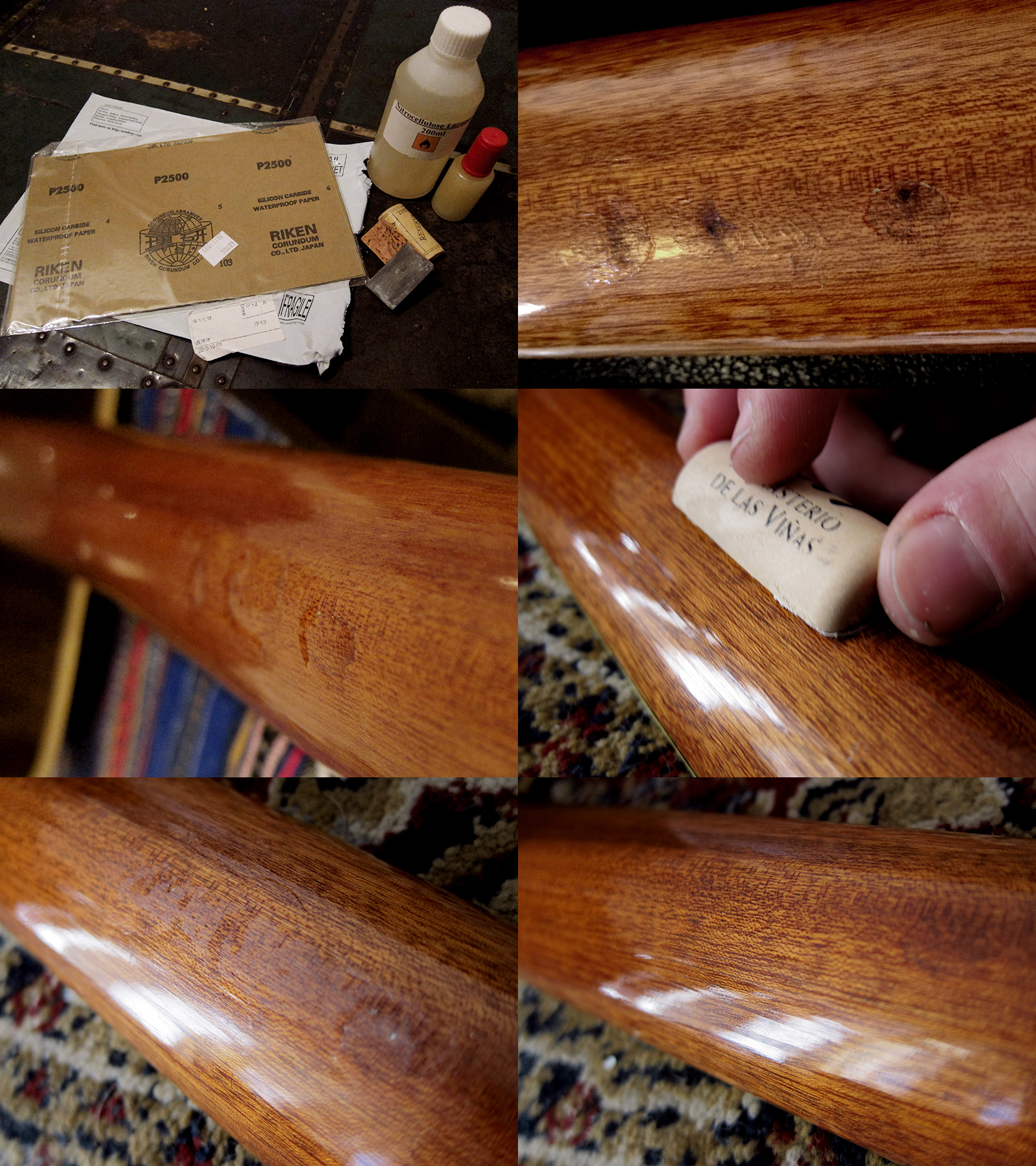
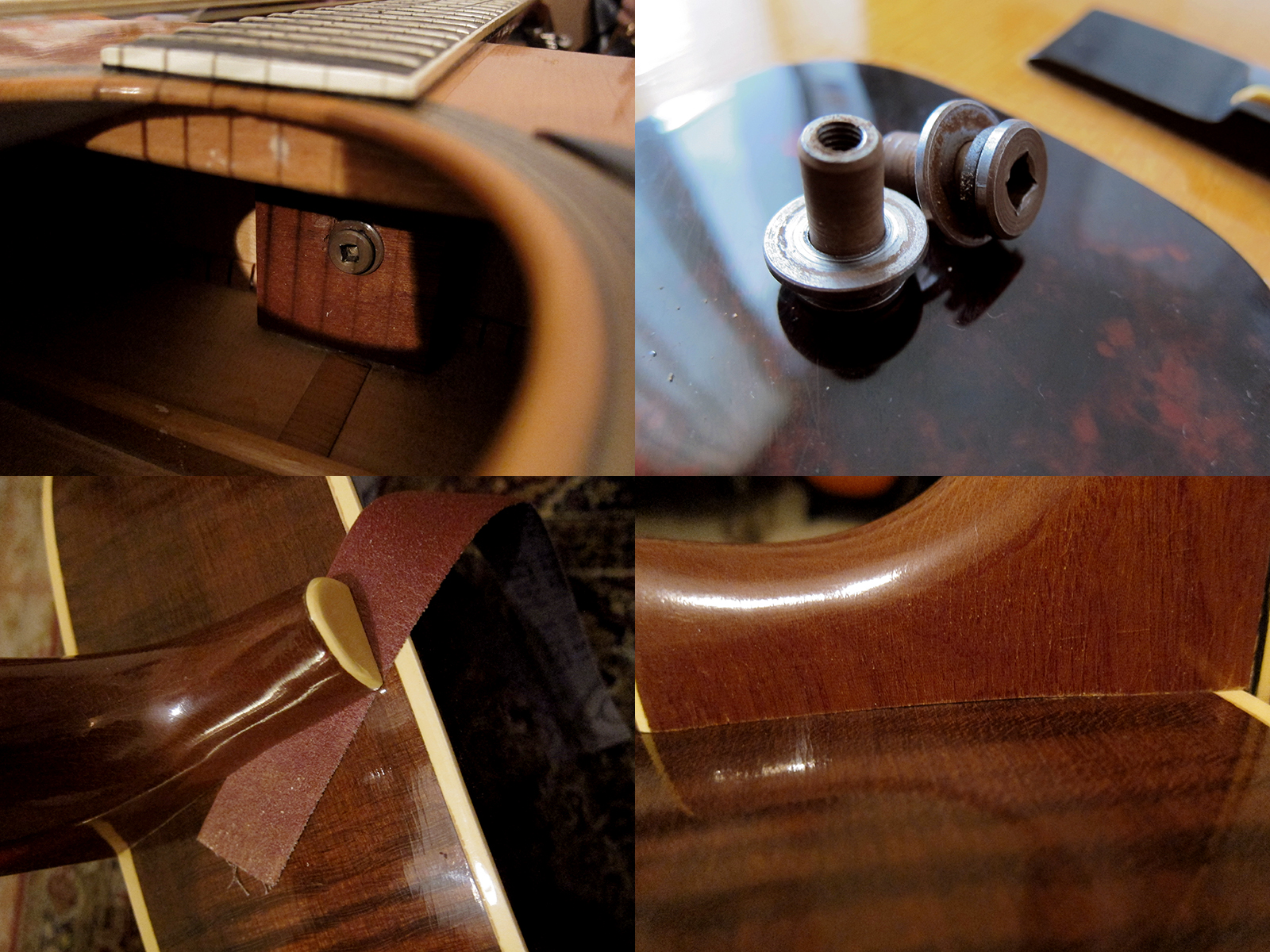
First I had to try to fix the three deep dents in the back of the neck. Since they went through the original finish down to the wood I actually added some water first to let the mahogany swell a bit and that way make them less deep. After a couple of days I added the first layer of Nitrocellulose lacquer with a toothpick, just one drop at the time. I had to repeat the process quite a few times to get it even, the lacquer sinks when it dries. Next step was to get rid of the edges with a razor, like mentioned in my previous post, and then sand it even. I used 400, 800, 1500, 2000 and 2500 grit and then added a layer of Carnauba wax and a lot of elbow grease and then buffed it up with a fine microfiber cloth. I guess because of the thickness of the original finish my repair blended in really well and it’s even hard to notice.
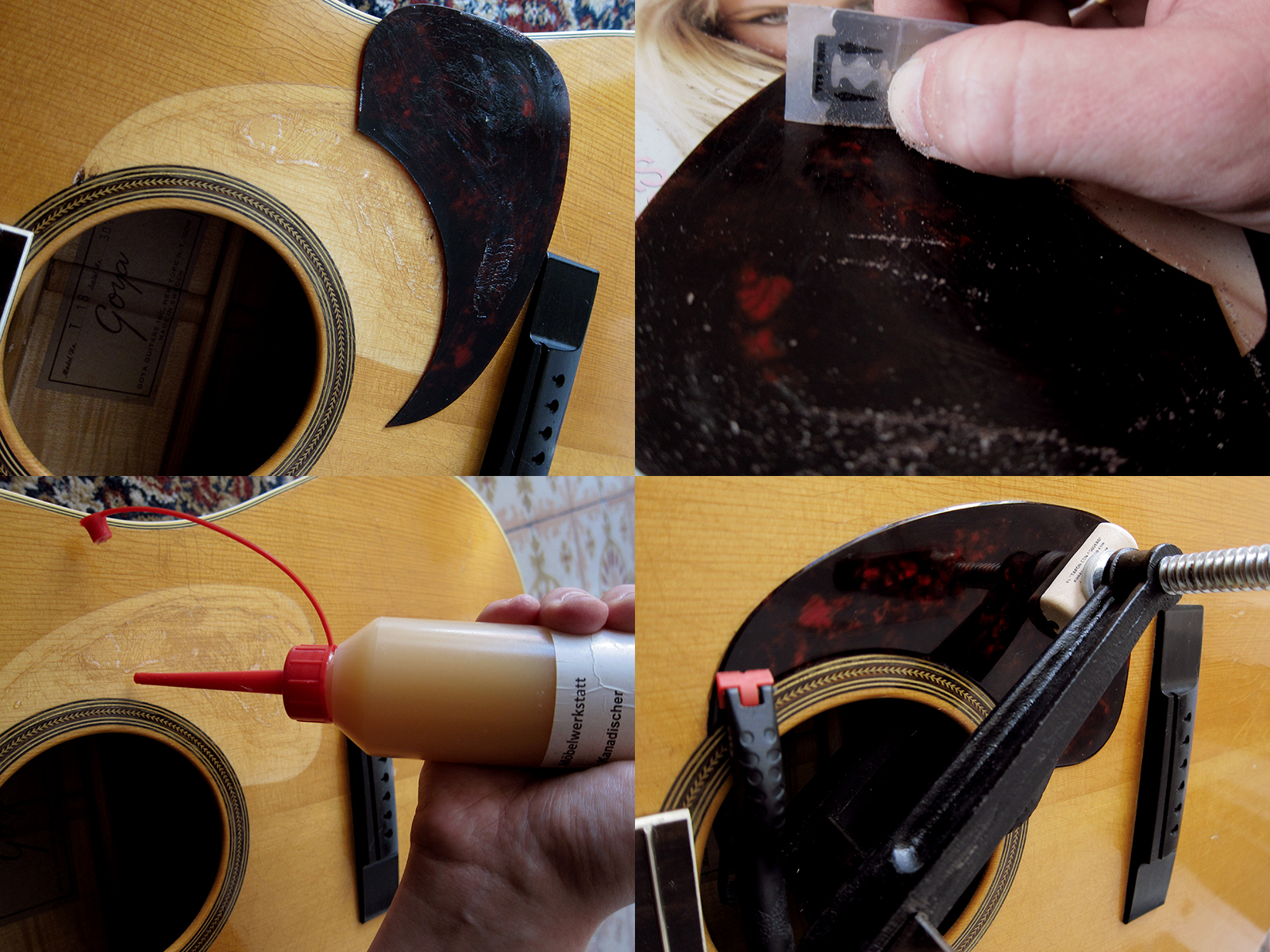
The pickguard was loose so I decided to remove it completely and then glue it back again. I cleaned off the old glue with a razor blade and made sure that both the top of the guitar and the back of the pickguard was smooth and even before I glued it back with my trusty old fish glue. I added some pressure with a clamp, I had a little block of wood on the inside and half a wine cork on the outside for not ruining the finish.
The main thing that was needed on this Goya T-18 was a neck reset to get the action down. I was pretty worried about this and that’s why I have put it off for so long. I have never done anything like this before and I wasn’t even sure what I could use to loosen the two bolts on the inside, these Levin / Goya guitars have used a combination of glue and the Levin bolt-on neck system since the early Sixties. It turned out that a normal Philips screwdriver no 2 fitted perfectly, they are square in the base of the tip. Once the bolts were off I tried to remove the neck completely but without any luck, well the heel came loose straight away but not the fretboard. I tried with heat, steam and all sorts of magic but it didn’t budge and since I didn’t want to do anything too drastic and ruin the guitar I left it. Then I read on a Swedish guitar forum that you could leave the neck on and just lift the heel, get a bit of sandpaper in under, add some pressure and then pull. That way you would get some material of the heel off without removing the neck completely. The guy in the forum mentioned that he had done 40 pulls on both the left and the right side so I did 30 on each to be on the safe side. I fastened the bolts and strung the guitar up again and it worked, it actually worked really well. I played it for a couple of days and then decided to sand off a bit more, so I loosened the neck again and did another 15 pulls on each side and now it’s perfect. Crazy Swedes, coming up with such a quick and easy way of resetting a neck on an acoustic guitar. Thank you Levin for thinking of me 47 years down the line.
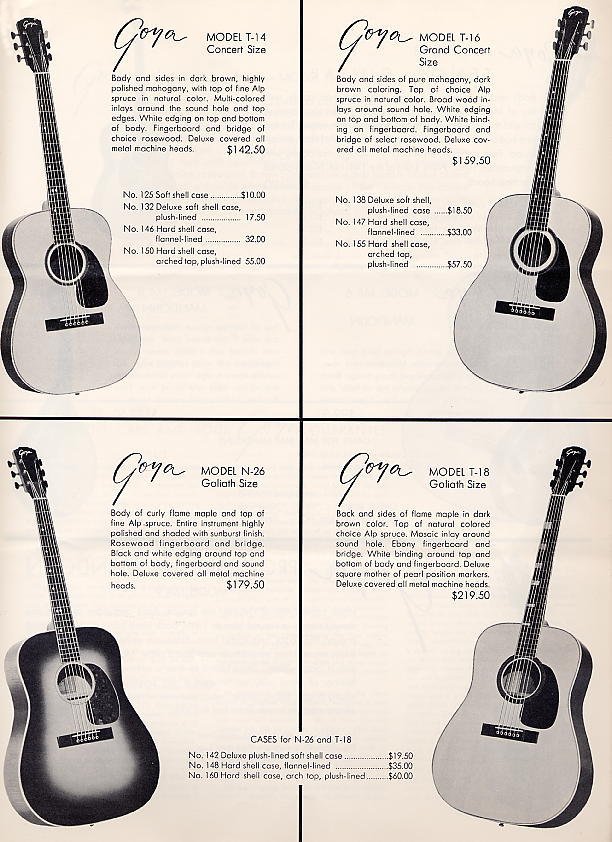
The Goya T-18 was top of the line back in 1965 and cost $219.50 new, I wish they still cost that.
I really liked Jethro Tull when I was a teenager, especially Ian Anderson’s acoustic guitar playing. The extracts from Thick As A Brick are pretty awesome in this live concert from 1977.
I recently came across this Suzuki Three-S F-120 that I have fixed up and it’s now for sale. It seems to be a copy of an early Martin D-18, it feels less bulky than most dreadnoughts. Built in 1976 by Suzuki Violin Co. LTD in Nagoya Japan. It’s a beautiful guitar in a really good shape for being almost 40 years old. It’s very easy to play with low action and it has a great tone, very warm and rich.
I took the machine heads a part, cleaned, polished and oiled them before I put them back together. I polished the frets and oiled the fretboard and then made a new compensated saddle in bone. Now it sounds and plays great.
I have another Suzuki for sale, however, these guitars were not made by the same company. Both were originally building violins so both are called Suzuki Violin Co. LTD but they were based in different parts of Japan. Kiso-Suzuki manufactured guitars in the region of Kiso-Fukushima. Nagoya Suzuki manufactured guitars in the region of Nagoya.
I finally found an old catalogue for it. It seems to be spruce top, nato back and sides and nato neck with rosewood fingerboard















 I finally found an old catalogue for it. It seems to be spruce top, nato back and sides and nato neck with rosewood fingerboard
 Claescaster