Claescaster

Category: Guitars

Guitar of the day

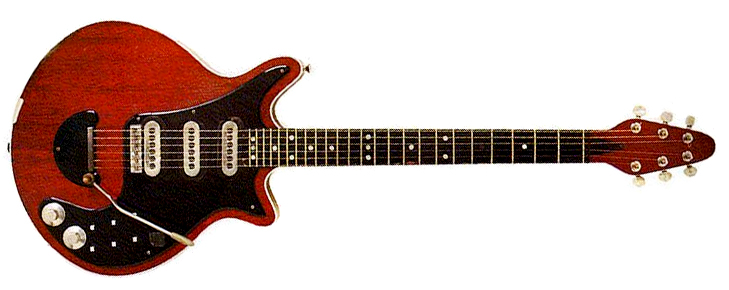
Brian May, Queen, Big Red

The Red Special is an electric guitar owned by Queen guitarist Brian May and custom-built by him and his father, Harold. The Red Special is also sometimes named in reviews as the Fireplace or the Old Lady, both nicknames used by May when referring to the guitar. A guitar that would define Brian’s signature style, it was purposely designed to feedback. He has used it on Queen albums and in live performances since the band’s advent in the early 1970s. The name Red Special came from the reddish-brown colour the guitar attained after being stained and painted with numerous layers of Rustins’ plastic coating. The name Fireplace is a reference to the fact that the wood used to make the neck came from a fireplace mantel. The pickups are three modified Burns Tri-Sonic and the tremolo system is known as the knife-edge tremolo as it features a knife-edge. The tremolo rocks on a knife-edge that is linked to a couple of motorbike valve springs in the guitar. The tremolo-arm itself was made from a saddle bag carrier from an old bike and a knitting needle from his mother.. Wikipedia

Brian May of Queen Red Special

Acoustic guitar demo

After watching Kris Kristofferson the other day I got really curious and wanted to know what a Gibson Southern Jumbo really sounds like. I know that Jackson Browne plays a lot of these old Gibson guitars and they sound amazing when he plays them but what is the difference between a Southern Jumbo, J-50 and J-45? I’ve never played a real Gibson acoustic or a proper Martin and doubt I ever will in this town since people are so extremely unfriendly in the guitar shops here, that’s why I have to buy everything online. Luckily I managed to find these great demo’s so I could finally hear the difference between them all and unfortunately it’s not always a good thing. I’ve always loved the Hummingbirds and been looking for a Japan made copy for some time but it the originals sound this thin and boring then I’m not sure how good a copy will sound, even if it’s made in Japan. Maybe I have to rethink this again, I mean the Southern Jumbo sounds the best. Full and deep but not muffled when strummed like the SJ-200 or some of the other Jumbo’s. When I saw that awesome Youtube concert with Dan Tyminski the other day I thought that his 1946 Martin D-28 was the best sounding guitar in the world and wanted to find a copy of that, I doubt I can afford a real Martin from the 1940’s. I guess all guitar shapes have their purpose in life, I just need to find the one that is right for me.

1952 Gibson Southern Jumbo

1964 Gibson J-50

1944 Gibson J-45

2012 Gibson SJ-200

1978 Gibson Hummingbird

1959 Martin D-28

1947 Martin 00-21

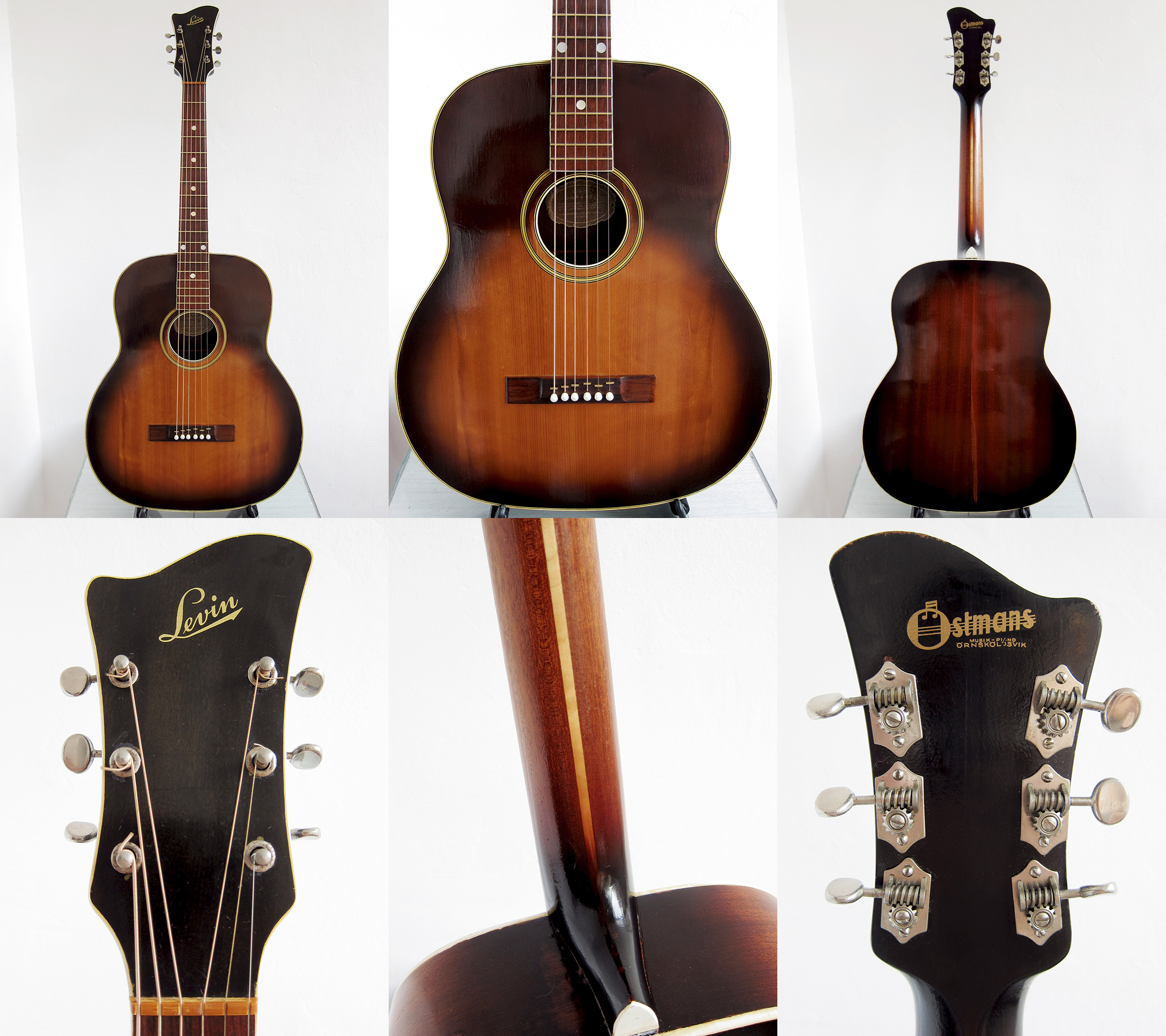
Levin Model 13 Ambassadör

Levin Model 13 Ambassadör Made in Sweden 1950

I have recently befriended Roger Häggström, a great luthier in Örnsköldsvik, Sweden. He is also the man behind my Levin Model 13 Ambassadör. It’s been great to hear from the man himself what he did to it to get it to play and feel so good. He created a new bridge and made new brass saddles to get it to intonate better, refretted it with brass frets, reset the neck, fixed up some cracks and touched up the lacquer. I think he did a great job, just look at it. I have so much things to learn but I’m really happy taking it one step at the time and who knows, maybe one day I will be as awesome as Roger. Here is his site GammelGura

Levin Model 13 Ambassadör
Body width: 400 mm, body length: 480 mm, scale length: 640 mm
Spruce top, walnut back and sides, 4-ply bound top, single-bound back
Mahogany neck with non-adjustable T-shaped duraluminum truss rod
Single-bound rosewood fingerboard with 18 frets and pearloid dot inlay
Single-bound headstock, rosewood bridge, nickel plated individual tuners
Sunburst finish and ten year warranty

Yamaha FX-310

Yamaha FX-310
An Indonesian made Yamaha FX-310 from the late 1990’s

My Art Director at work, the new proud owner of the White Falcon copy, asked me if I could bring his old Yamaha FX-310 back from the dead. There was a fair share of cleaning involved and then I tightened the screws and oiled the machine heads, polished the frets and oiled the fretboard and then I tried to correct the neck angle. I’m not sure if it was because the guitar has been without strings for so long and was missing the string tension but the action was so low that that everything just buzzed. I tried to correct the angle of the neck with the trussrod but it made no difference, it was as loose as it could be. I had to make the saddle higher but since it had the piezo pickup built in to the bottom of the saddle I couldn’t just change it for a new one. In the end I cut a matchstick in half and put under it, I guess bone or some other material would have been better for the tonal qualities but since they saddle was made of plastic anyway I don’t think it would have made any difference. It actually plays pretty well now and sounds really good for have been made in Indonesia. I’m not sure if all Yamaha’s sounds and plays this well but I was pretty impressed. When I started to play guitar 20 years ago a lot of my friends had Yamaha’s and other inexpensive Far East made acoustic guitars but I was fortunate enough to learn to play on my dad’s old Levin LT-16 so I never really tried any of these Yamaha’s back in the early 1990’s.

Greco Spacey Sounds TL-500

Greco Spacey Sounds TL-500
Greco Spacey Sounds TL-500, Made in Japan by FujiGen in August 1979

Yesterday the newest member of my Greco family arrived from Japan. I went a bit bananas last week when I saw that my favourite eBay seller Tokyowax was selling a Greco Spacey Sounds TL-500 so I bought it straight away. These Greco TL-500 are pretty rare, there are about 3-4 Greco TE-500, the Thinline version, for sale on eBay at the moment but I have only seen 2-3 Greco TL-500 for sale in the last two years. I’m not sure if they produced more Thinline copies in late Seventies than normal Telecasters or if people refuse to sell them, but you rarely see these and when you do they are normally very expensive. I got mine fairly cheap since one of the string ferrules on the back was missing. Well I shouldn’t really call it cheap and now the import tax from Japan had increased as well, I had to pay 95€ instead of the normal 75-80€.  I didn’t have to do much to her, everything was pretty well set up already. The frets looked pretty bad so I polished them, oiled the machine heads, tightened all the screws and restrung her. She plays amazingly, even better than my old mistress, my Greco Spacey Sounds TE-500 Thinline copy. It might seem weird that I put my old “Nancy”, my Fender Telecaster TL52-75, up for sale and then bought a new one the same week. The truth is that even though I love my Japan made Fender, I don’t dare to use it since it’s in such a good state. I prefer guitars that are older than me and have a couple of battle scars already. I guess I’m also a bit gay for late 1970’s Greco guitars.

Greco Spacey Sounds TL-500

Greco Spacey Sounds TL-500
The body has quite a few marks on it but the back of the neck is like new and that’s the only thing I really care about.

Greco Spacey Sounds TL-500
The frets looked pretty bad so I masked the fretboard and polished them with 400 and 800 grit and then wire-wool. It looked like they had put the frets on before they applied lacquer to the neck and then after 35 years of playing half of it had worn off. The electronics seemed to be in good order and the guitar sounded awesome when I plugged it in so no reason to mess with that.

Greco Spacey Sounds TE-500N, Greco Spacey Sounds TL-500, Greco Les Paul Custom EG-600C
Greco Spacey Sounds TE-500N 1977, Greco Les Paul Custom EG-600C 1980, Greco Spacey Sounds TL-500 1979

Goya T-18

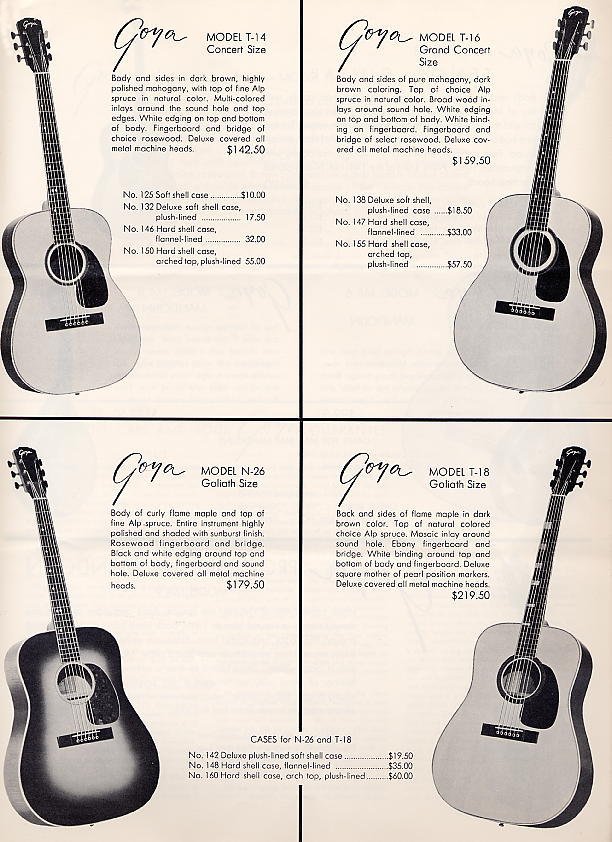
Goya catalogue 1965
Levin’s Goya catalogue from 1965

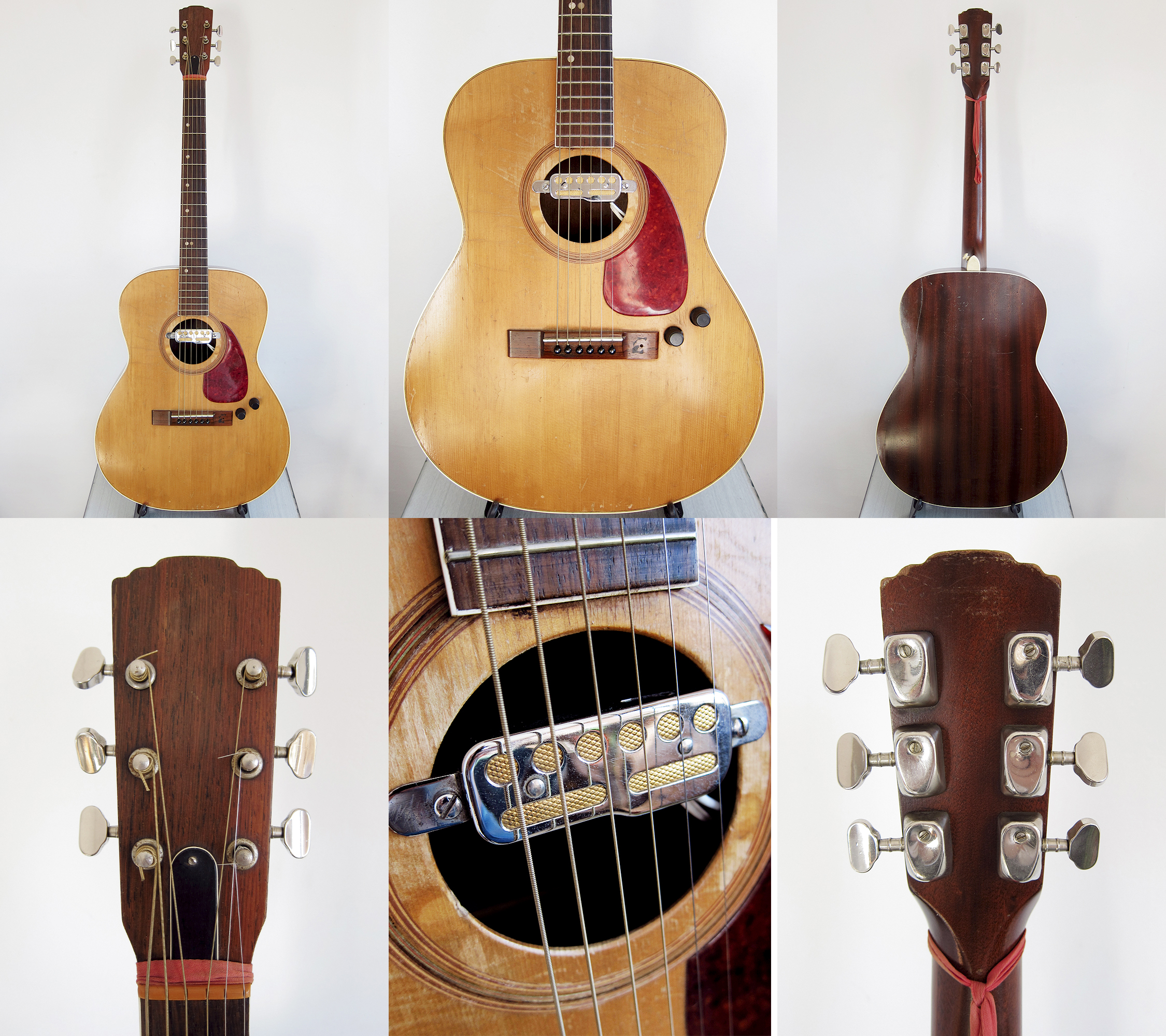
I’m very excited about my future Goya T-18 from 1966. I managed to find one in a fairly good state for a reasonable sum on eBay and couldn’t resist. I’ve decided that from now on I’m just buying Swedish made Levin acoustics, they were called Goya in the US. Since I haven’t received the guitar yet, it will probably spend a week or to in the customs office in Madrid, I have to stick to looking at old catalogues and dream. They have a review of a Goya T-18 from 1965 in the latest issue of Acoustic Guitar, under Great acoustics, 1965 Goya T-18 by Teja Gerken. I need to find a copy so I can get an idea of what I’ve got myself in to. It can’t be that different from my dad’s old Levin LT-16 also from 1966, which is among the best acoustic guitars I’ve ever played. The Levin LT-16 or Goya T-16, has alp spruce top and mahogany back and sides while the Levin LT-18 or Goya T-18, has alp spruce top and flame maple back and sides. The LT-18/T-18’s Goliath size is also a bit bigger than LT-16/T-16’s Grand Concert size so let’s see how the size in combination with maple instead of mahogany affects the sound. The LT-18/T-18The LT-18/T-18 was top of the line in the mid Sixties and cost $219.50 new in 1965.

Goya catalogue 1965
Levin’s Goya catalogue from 1965. Next I will have to find a Goya N-26 or Goya N-22 in sunburst from the mid 1960’s.

Levin LT-16 Made in Sweden 1966
My dad’s old Levin LT-16 from 1966

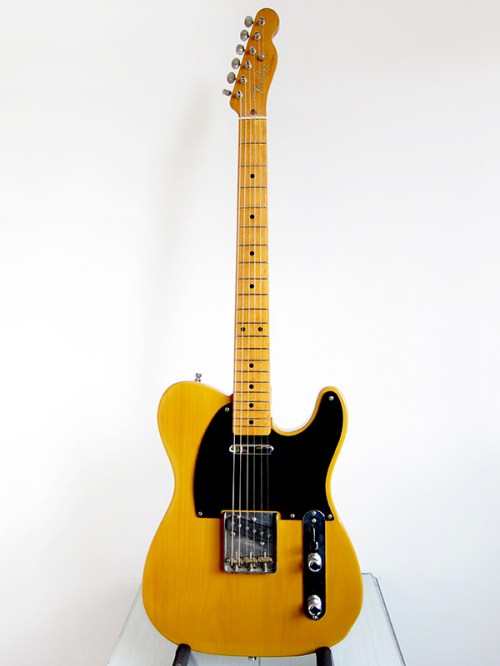
Fender Telecaster Japan TL52-75

Fender Telecaster TL52-75, ’52 re-issue, Made in Japan
Fender Telecaster TL52-75, ’52 re-issue, Made in Japan by FujiGen between 1987-1989

I have thought long and hard about it and now decided to put “Nancy” up for sale. It’s going to be sad to see her go but sometimes you have to sell things you love for the greater good of the collection. I’m going to focus more on Greco and Levin from now on. I also have two guitars on their way so I need to make some room for my new babies.

Fender Japan TL52-75
Fender Telecaster TL52-75,
’52 re-issue Made in Japan, FujiGen 1987-1989.
900€ SOLD
In mint condition, all original, without any doubts the best Telecaster I have ever played. Imported straight from Japan. The only reason for selling is because I prefer fat 70’s necks. There is no way to find the production year of these A-serial Telecaster with the serial number on the bridge plate. However, it must have been made between 1987 and 1989 since it’s a TL52-75. They were called TL52-70 between 1984-1986 and then changed to TL52-700 in 1990.

Fender Japan Twang catalogue 1989

How to… refret a guitar

How to… refret a guitar
The shiny new Jescar FW47104 frets I put on my Tokai Love Rock LS-55 Les Paul Standard “Made in Japan” 1991

Here is a little update on my previous post on How to… refret a guitar. It turns out that maybe it wasn’t as easy as I first thought to level, crown and polish the frets on a guitar. I have had some small issues with both the Tokai that I refretted and my old Claescaster that I levelled the frets on. I didn’t pay enough attention to the height of the frets and I hardly used the fret rocker the first time around. This resulted in some buzzing when some frets were pressed down. I have now levelled, crowned and polished both guitars again and checked every single fret with the fret rocker to make sure they were all the same height. It would probably have helped if I had glued in the frets on the Tokai when I refretted it, which I didn’t in case I needed to take them out again for some reason. I think the frets not being glued in combination with the difference in the neck with and without the tension of the strings was enough to cause problems with on the Tokai. Now I when I levelled it again I pushed down the guitar to simulate the tension of the strings and that worked pretty well. The Claescaster was a lot easier, that was just a case of paying a bit more attention when I levelled the frets and actually use the fret rocker properly. When I first attempted to level, crown and polish frets it was evening so it got pretty dark and my main light source was the ceiling lamp above me. I have since learned that it’s a lot easier to get this done properly if you have light coming from the opposite side of you. This time I was working in front of the windows and had an even flow of natural light coming in which made it a lot easier to see if the frets were even and later during the polishing stage, if they were smooth enough. Both necks still feels a bit weird but I think that after a couple of hours of heavy playing, not playing heavy music just playing a lot, they will settle and even out a bit. Normally guitars feels weird even after just adjusting the bridge saddles, imagine after changing all the frets.

How to refret a guitar
I checked every single fret with the fret rocker and then marked any parts that was higher with a black marker. I levelled the frets and took extra care with the problem areas. I used a small Bahco file this time instead of the long fret leveller that I used last time. I checked with the fret rocker, levelled a bit more and then checked again until it was perfectly even.

How to refret a guitar
When everything was levelled I just had to crown the frets again and then polish them. I’ve realised that these little aluminium fret board protectors that I have used in the past doesn’t really work. If you have levelled and crowned the frets you have to run a sandpaper over the whole fretboard, feeling every single fret with your fingers to round them off, that’s the only way to get them smooth and nice. For that you really need to do it properly and tape the whole fretboard to protect it.

Guitar strings

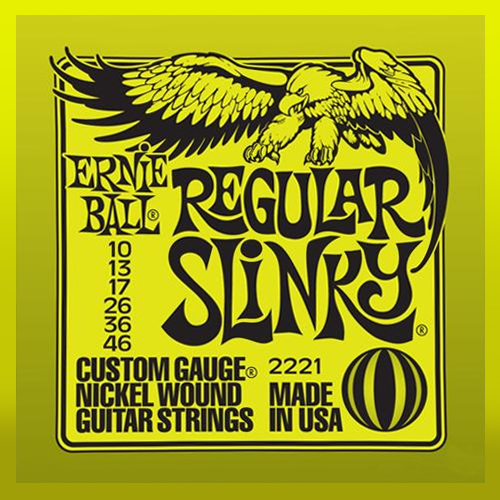
How do you chose what strings to use? Do you listen to others, read reviews or actually try all the brands available? In my case I guess it has been a combination of what others are using, what I’ve read good things about and what I actually realised that I like. I don’t really know much about different materials or how some type of strings affect the sound in certain ways. I guess a big part for me has always been the price since I’m a hard hitter and tend to break strings a lot. When I was young I was poor and had to stick to the cheaper brands and now when I’m older and less poor I have too many guitars to afford to string them up with the best brands. I’ve always been stuck in the middle and changed brands many times depending on what’s affordable and popular in the country I’ve been living. I used Rotosound (Roto Reds 11-48) while I lived in the UK and now in Spain I’ve changed to Ernie Ball (Regular Slinky 10-46). The main reason why I changed from 11’s to 10’s was because I felt that I was old enough to use what I wanted and not care about what everyone else said. My whole life people around me have told me that the thicker the better, and that you are less of a man if you play on anything thinner than 11’s. Remember that Billy Gibbons uses 08’s and still has a pretty descent tone on his ‘Pearly Gates’ 1959 Les Paul. When I started to use 10’s my guitar playing changed completely, not only could I play faster but I also started to bend more and play in ways that I hadn’t been able to or bothered with before. My Telecasters stringed with 10’s are pure country heaven and way much more fun than before. I still use 11’s on my Hagström Viking and the Gretsch copy I have. At the moment I’m using Martin M175 (80/20 Custom Light Bronze Acoustic Strings 11-52) on my acoustics. Mainly because my girlfriend Araceli liked 11’s on her parlour guitars and it was easier to buy the same strings in bulk for both of us but also because I like to play acoustic like I play electric and don’t want to feel held back with too thick string gauge. I’m planning to put a set of 12’s or 13’s on one of my Dreadnoughts just to try if it really makes a world of difference to the tone. I would love to know what others are using and why. Please write a comment below and let me know.

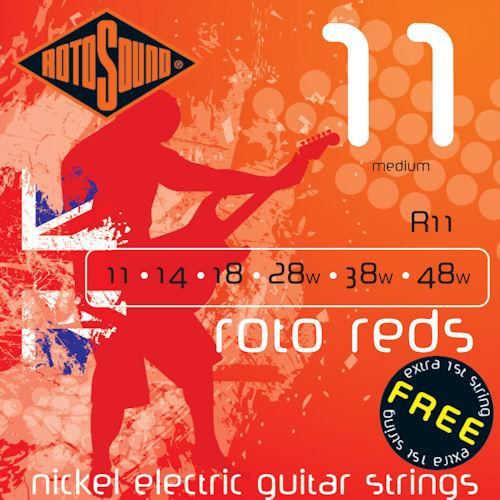
Roto Sound roto reds 11
I used these for years but have now given up on 11’s

Ernie Ball Regular Slinky 10-46
My new found favourites, so smooth and easy to play without being too flimsy. I tend to buy them in bulk on eBay from USA

Martin acoustic guitar 11-52
Araceli and I tend to stick to these since you can get a 3-pack for 9,90€ from Thomann

Peavey electric guitar strings

Peavey acoustic guitar strings
I’m not proud to admit it but I do use Peavey’s discount strings occasionally. In Alfasoni you can get them for 2€ and they are perfect when you break a string or you just need to string up a guitar that you don’t use that much.

L.R. Baggs M1

I just ordered myself a L.R. Baggs M1 and I really hope it’s as good as people say. I have only tried cheap magnetic soundhole pickups so far, like Artec and Belcat and they worked ok both of them but sounded a bit thin, hopefully the M1 will be more full and warm without sounding muffled or muddy. I have an old Shadow humbucker from the 1970’s that I kind of like but it’s a bit too dark for dreadnought guitars. The undersaddle ARTEC PP-607 I installed in the parlour was way too uneven when played hard, and a bit thin sounding as well. My favourite magnetic pickup is still the old Japanese 1960’s one that my dad fitted in his Levin LT-16. I got the L.R. Baggs M1 new from dont_tell_the_wife_guitars on eBay and it only cost $139.00 with free shipping so I felt it was worth a try. If it’s good enough for David Gilmour then I’m sure it will be just fine for me.

Update 2013-09-10
I just received my new L.R. Baggs M1 and it looks awesome. Cheap, quick shipping and no customs issues, couldn’t be better. I noticed that the M1 Passive doesn’t have a volume control but I’m pretty sure I can live without since I have never used that on any of my acoustic pickups. I’m really excited about rehearsing with Chest Fever on Thursday so I can try it out loud. I hope it sounds as good as it looks. 

Update 2013-09-20
Last night I finally got to play the L.R. Baggs M1 loud, we had to cancel the rehearsal last week since Araceli’s and I celebrated 6 years together. I fitted it in my Kiso Suzuki WE-150 and it sounded pretty good, well it sounded just like the Suzuki does unplugged. It was the first pickup I have ever tried that could handle my hard hitting solo playing and I’m really impressed with how responsive it is, loud enough when picking and not too loud when strumming. I can’t wait to put it in an even better guitar and really hear it’s full potential.

Levin LT-16 1966
The Japanese pickup fitted in my dad’s old Levin LT-16 from 1966


A nice example of L.R. Baggs M1


David Gilmour playing L.R. Baggs M1, skip to 1:06