Claescaster

Category: Claes Collection

K. Yairi TG-40

K. Yairi TG-40 Made in Japan 1977K.Yairi TG-40 a Guild D-40 copy from 1977. Every K.Yairi guitar is given birth in Kani, a small community in the beautiful mountainside area of Honshu, Japan.

My new K.Yairi TG-40 has finally arrived, after 40 days stuck in Spanish customs. I have mentioned earlier that it’s a lot easier to import things from Japan to Spain compared to buying things from the US, well that was a lie. I have bought three electric guitars, mainly Greco’s from an eBay seller called Tokyowax. They all arrived within 48 hours so I stupidly assumed that everything from Japan would arrive quickly and without any problems, but no. Tokyowax uses DHL Express and they tend to deliver things within 2-5 days and you pay the taxes straight to them when they deliver the guitar. It wasn’t that easy with EMS Japan, that package went straight to customs in Madrid and spent 40 days in their lazy company. How can anything take that long? K. Yairi could probably have built me a new guitar in that time, if he was still alive. It seems like the only option now when buying guitars on eBay is to use the Global Shipping Program, that worked for my Goya 163 at least. Anyway, the guitar is amazing so it was well worth waiting for.

K. Yairi TG-40 Made in Japan 1977

It has a really nice tone with great bass response. It easily has the best bass of all my acoustics, even better than my Morris W-40 which has that Martin D-45 bass sound, this is nicer and a lot clearer. I guess it sounds like an old Guild D-40, at least if I can trust the Youtube clips I have seen since I haven’t had the chance to play one myself. It actually reminds me a bit of a Gibson Jumbo, like I mentioned in my Gibson J-45/J-50 post: “The Yairi TG-40 is a Guild D-40 copy, which was introduced in the Sixties as a competitor to Gibson’s J-45. The Guild D-40 became famous as the Bluegrass guitar for their even response over all the strings and I really like the sound of them, it’s actually not too far off from a Sixties Gibson J-45. With a bit of luck it’s going to be an awesome Yairi copy of an Guild which might sound a bit like a Gibson.”

K. Yairi TG-40 Made in Japan 1977I didn’t have to do much to it, it was ready to play when I got it. However, the pickguard was loose so I had to remove that, clean it up and then glue it back again with my trusty fish glue. When the strings was off I quickly polished the frets and oiled the ebony fretboard. I also installed a jack for my LR Baggs M1 and a strap button.

I bought this K.Yairi TG-40 from a really nice eBay seller called montebell86 who was a pleasure to deal with. The guitar was listed as “Taniguchi Gakki” Japanese guitar shop original model, very rare. Solid spruce top, sides and back in solid mahogany, neck in Honduras mahogany, bridge and Fretboard in black ebony. The label states it was made in 1977 but the serial number starts with 51 which was the 51st year of Emperor Shōwa and puts it to 1976.

K. Yairi TG-40 Made in Japan 1977K. Yairi TG-40 Made in Japan 1977I got this K.Yairi TG-40 fairly cheap since the pickguard needed to be reglued and one machine head wasn’t working properly. It also has two cracks, one on each side that has been professionally repaired and can’t be seen from the outside. Since the machine heads needed to be replaced I decided to change them for Wilkinson WJ-309 in gold, just like I did on my Levin 174


Here is a quick little comparison between the K.Yairi TG-40 and my Morris W-40, they sound pretty similar and I don’t think I would be able to tell them apart in a blind test. Well the Morris has a bit more bass and is a slightly weaker on the treble side, I feel that the Yairi is more even over all the strings.

Yairi TG-40 Japan Catalogue 1970'sK.Yairi TG-40in the Japanese catalogue from the late 1970′s. List price ¥60.000, around 420€, which must have been a fortune back in 1977. Then again, this was a fairly cheap guitar for being K Yairi, the top model cost ¥200.000, about 1400€.

K.Yairi TG-40

Yairi TG-40 Made in Japan 1977
K.Yairi TG-40 a Guild D-40 copy from 1977. Every K.Yairi guitar is given birth in Kani, a small community in the beautiful mountainside area of Honshu, Japan.

Sometimes when I’m left unsupervised, especially on Sunday nights, I end up buying guitars that maybe I shouldn’t have bought, or rather that maybe I don’t really need. I’ve been thinking a lot about trying to find a 1970’s Gibson J-45, I can’t really afford anything earlier, but that would still set me back a at least 1500€ which is really hard to justify for a guitar player on my level. I’ve managed to track down the guitar sound that I love to Gibson’s old jumbo models, think Jackson Browne, and the J-45 or J-50 would have been ideal, I think, it’s hard to know without trying but from all the Youtube clips I’ve been listening to they all have a very similar sound. It’s that dry woody booming bass sound that is unmistakably a Gibson J-45. Now I got a Japanese made Guild D-40 copy instead, it wasn’t really planned but I couldn’t resist, or I got carried away, anyway, it’s mine now. The Guild D-40 has a lot of awesome qualities, it’s a proper bluegrass guitar and was built for their even response over all the strings. I trust that Yairi did a good job 37 years ago and even if it doesn’t sound like a Gibson J-45, I’m sure it will have a lot of warmth and good bass, just what I’ve been looking for. On top of that, it’s a freaking Yairi, I never thought I would be able to afford that and I’ve dreamt of a Yairi since I bought my first Japanese acoustic.

Yairi TG-40 Japan Catalogue 1970's K.Yairi TG-40in the Japanese catalogue from the late 1970’s. List price ¥60.000, around 420€, which must have been a fortune back in 1977. Then again, this was a fairly cheap guitar for being K Yairi, the top model cost ¥200.000, about 1400€.

Radius gauge

Understand radius
My Westone Stratocaster is getting the strings adjusted to the 7.25″ radius of the fretboard

I recently received my Understring Radius Gauge set from the friendly Portuguese luthier supplier Guitars & Woods. If I had only bought this before I ordered four new sets of Jescar frets from Philaluthiertools. I stupidly thought that most of my old Japanese guitars had a radius of 9.5″, they didn’t feel as curved as my Fender Telecaster TL52-75, which I knew had a radius of 7.25″. It turned out that both my Greco Teles and Hohner and Westone Strats had a vintage radius of 7.25″, so now I have to order new frets for them. I have never really cared about adjusting the strings after the radius, I read somewhere that Eric Clapton and others had the saddles flat so I thought I could have that too but when I received my Greco Spacey Sounds TL-500 back in September and it had really well adjusted action set after the radius I instantly fell in love. It’s such a difference on a Strat or Tele with a 7.25″ radius, you can really see and feel the curve. I adjusted all the guitars I could according to their radius and in most cases I had to raise the string height on the D and G string, which makes them really snappy and twangy, it sounds and feels awesome on my Telecasters.

Hagstrom Viking

Hagstrom Viking, Tobacco Sunburst 2008Hagstrom Viking, Tobacco Sunburst 2008

It’s with a heavy heart that I have decided to part with my Hagstrom Viking. I bought the guitar back in 2010 and have unfortunately not had time to play it as much as I wanted, some Japanese Telecasters got in the way. I had three semi-hollow bodied guitars at one point and kept this the longest, I sold the other two last year. I guess the more guitars you have the more you realise what feels good for you to play. For me, fat necked Telecasters feels really nice to play, I’m a bit gay for old Greco Telecasters from the 1970’s. If you are interested in inherit this Hagstrom Viking from the Claes Collection then get in touch. You can read more about it here for sale, or in Spanish here.

Update: April 4, 2014 The Hagstrom Viking is now sold to Rafa from Cobarde.

Hagstrom, or Hagström as we call it back home, was founded in 1925 by Albin Hagström in Älvdalen, Sweden. They made amazing electric guitars from 1958 to 1983, played by guys like Elvis Presley, Jimi Hendrix, Noel Redding, Joe Walsh, Dweezil and Frank Zappa to name a few. I have played on a lot of Hagstrom guitars and amps during my teenage years back in Sweden and learned to play bass on my stepdad Sten’s Hagstrom Jazz bass from 1976. I have an fairly mint Hagström HIIN OT from 1975 back in Sweden that I really like. I guess it was out of national pride that I got so excited and bought the Hagstrom Viking when they started to make them again in 2004. They have a few models that are made in the EU, but not in Sweden, and the rest is made in China. I have actually only played my Viking from 2008 so I can’t really comment on the quality of the Chinese Hagstroms today but mine is very well built for the price. I would say that they are better than Gretsch Electromatic, Epiphone and the Ibanez semi-hollow bodied, all in roughly the same price range.

Zappa plays Zappa, Hagstrom ad

Levin information pages

Goya Model 163 (1968), Goya T-18 (1966), Levin Model 13 (1950), Levin LT-16 (1966), Levin Model 65 (1942), , Levin LM-26 (1959), Levin Model 174 (1972)Levin guitars, from left to right: Goya Model 163 (1968), Goya T-18 (1966), Levin Model 13 (1950), Levin LT-16 (1966), Levin Model 65 (1942), Levin LM-26 (1959), Levin Model 174 (1972), might be the greatest Levin collection in Spain.

If there is anything you would like to know about Levin guitars, then Vintage Guitars Stockholm is your best bet. They have the Levin information pages where you can find pretty much every model Levin ever made, serial numbers, history, photos and information. Rikard who runs the place just put up photos of my three latest Levin guitars on their site so now you can find all seven online. Here are the links: Levin Model 65, Levin Model 13 Ambassadör, Levin LT-16, Goya T-18, Levin LM-26, Goya Model 163, Levin Model 174.

Vintage Guitars Stockholm Sweden

Levin 174

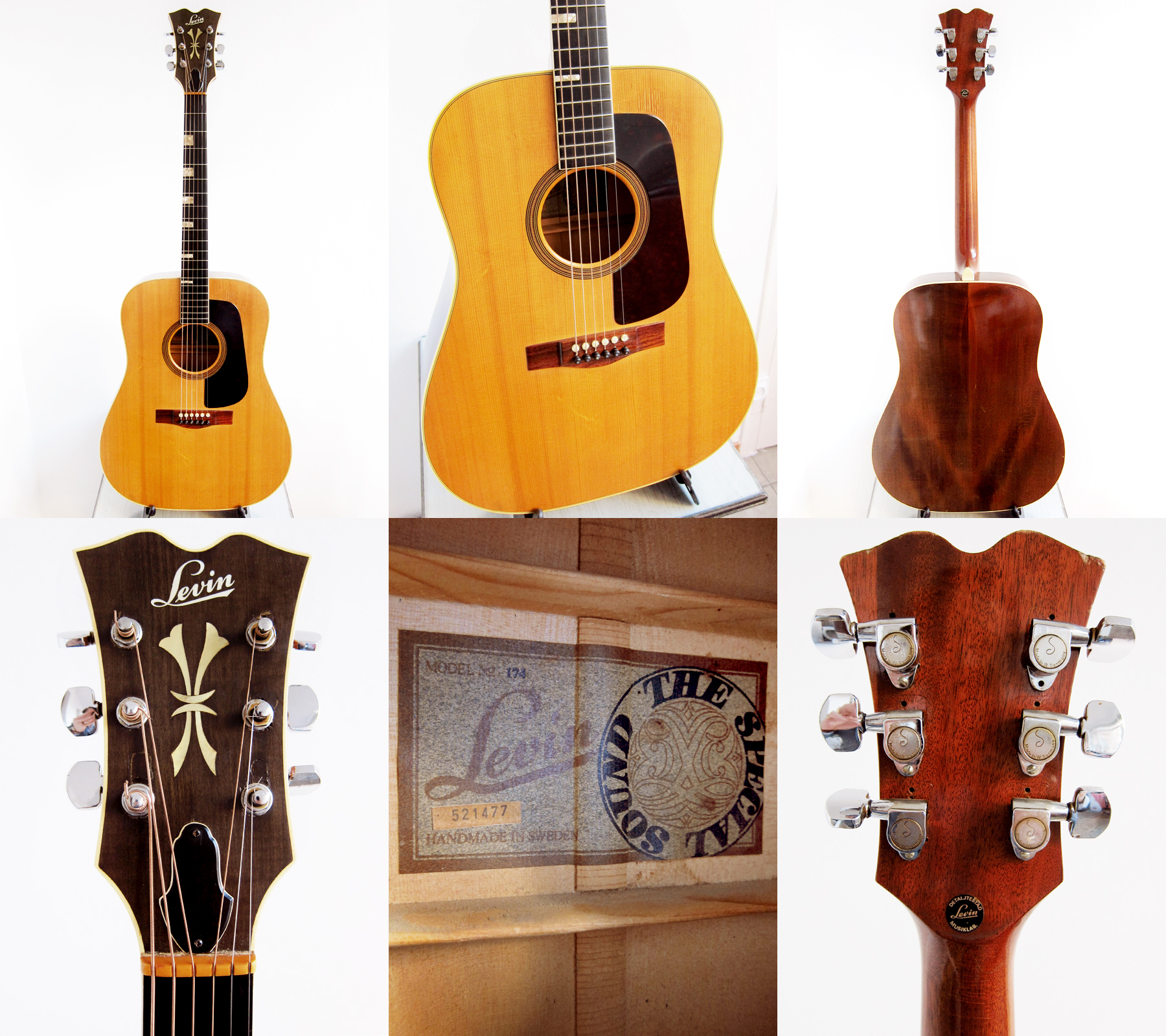
Levin Model 174 Made in Sweden 1972Levin Model 174 Made in Sweden 1972

My latest acquisition, a 1972 Levin Model 174. The story how I got this guitar is pretty amazing. I wrote a post about Levin guitars back in August 2013 when I had just started to collect them. In the end of the post I mentioned that I would love to find a Levin Model 174, it’s basically a Levin LT-18 but with a massive head. There is something about that huge head that I find very appealing, I guess it reminds me of old an archtop guitar from 1930-40’s and it’s almost a bit Art Deco. Three months later, in the end of November, I got a comment from a Danish guy called Orla saying that he had one for sale. We started to email each other and he told that a few days earlier he had seen a guy about to throw a guitar case in a skip so he had gone up to him and asked if he could have it instead. Orla took the case home, opened it and found a 1972 Levin Model 174 in pretty good shape inside. He Googled the name and model and pretty soon found my blog post saying that I was looking for one. Since Orla doesn’t play guitar himself, he just wanted to save it from a certain death, he contacted me and offered me to buy it and I’m very grateful that he did. It was a bit scary to buy a guitar from a guy I didn’t know who had contacted me through my blog, it felt a bit fishy somehow. A part of me thought it was a Nigerian email scam in disguise and another part said that I should trust the good in people, especially a Northern neighbour like Orla. In the end I decided that it was an offer I really couldn’t turn down, especially since most of the 174’s I had seen for sale were all Goya labelled and made later in the 1970’s. It took some time to get the guitar down to Spain, we had some logistic issues but finally it arrived about two weeks ago and I was stunned. Since Orla doesn’t play he couldn’t give me any info about what state the guitar was in, he had sent me some pictures but it’s pretty hard to get an idea if it’s even playable from just that. Luckily it was in a really good state and it both sounds and feels great.

Levin Model 174 Made in Sweden 1972

Levin Model 174 /Goya Model 174
Goliath size: Body width: 400 mm, body length: 505 mm, body depth: 95/120 mm
Fingerboard width: 43 mm, scale length: 630 mm
Spruce top, flame maple back and sides, 4-ply bound top, single-bound back
Mahogany bolt-on neck with adjustable truss rod
Single-bound headstock with mother-of-pearl inlay
Single-bound ebony fingerboard with bass side pearloid block inlays
Rosewood bridge with individual height adjustable plastic saddles
Nickel plated individual Van Gent tuners with metal buttons
Natural finish and ten year warranty

Introduced circa 1969 as a replacement for LT 18

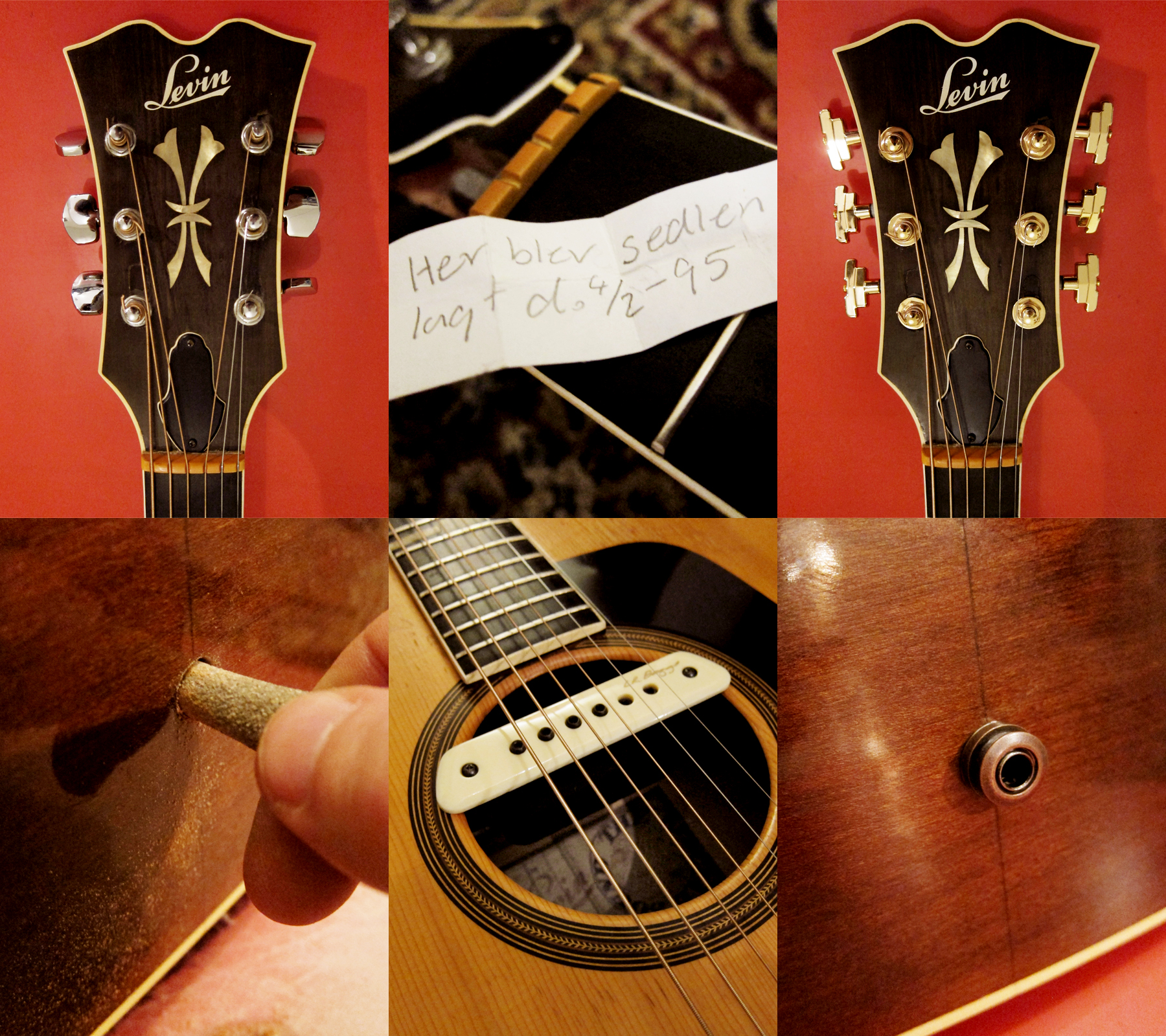
Levin Model 174 Made in Sweden 1972I didn’t have to do much to it, the action was really good as it was. Which was very lucky because this 174 doesn’t have the Levin bolt-on neck system, they stopped with that in the early Seventies. The original Van Gent machine heads had been changed at some point, probably in the 1970’s, to Schaller’s and I really don’t like these type of buttons so I changed them for Wilkinson WJ-309 in gold, to make it look even more Art Deco. I also installed an endpin jack so I can use it live with my LR Baggs M1. I had to clean it a bit, polish the frets and oil the fretboard but overall it was pretty good from the start. There was a note hidden under the trussrod cover saying, Her blev sedlen lagt 4th of February 1995. I assume that’s referring to that the nut was raised a bit 19 years ago, something I need to redo at some point because they seem to have used some paper like material instead of bone.

Goya Model 163 (1968), Goya T-18 (1966), Levin Model 13 (1950), Levin LT-16 (1966), Levin Model 65 (1942), , Levin LM-26 (1959), Levin Model 174 (1972)The whole Levin family, Goya Model 163 (1968), Goya T-18 (1966), Levin Model 13 (1950), Levin LT-16 (1966), Levin Model 65 (1942), Levin LM-26 (1959), Levin Model 174 (1972).

Goya 163

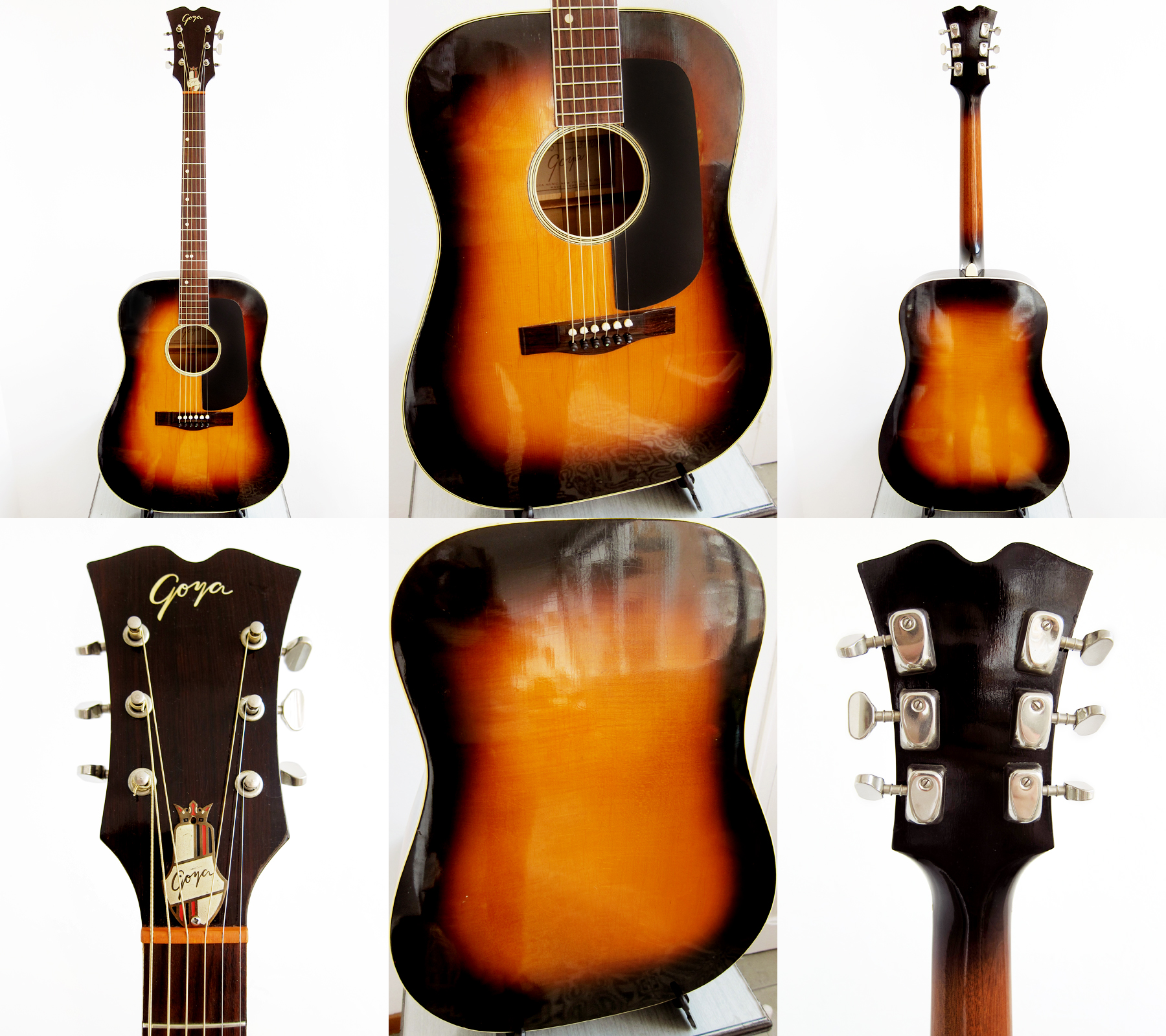
Goya Model 163 Made in Sweden 1968
A very early Goya Model 163, they were introduced in 1969 but the serial number puts this one to 1968. That would make it the earliest known example on the Vintage Guitars Sweden site. Levin serial numbers / Goya serial numbers

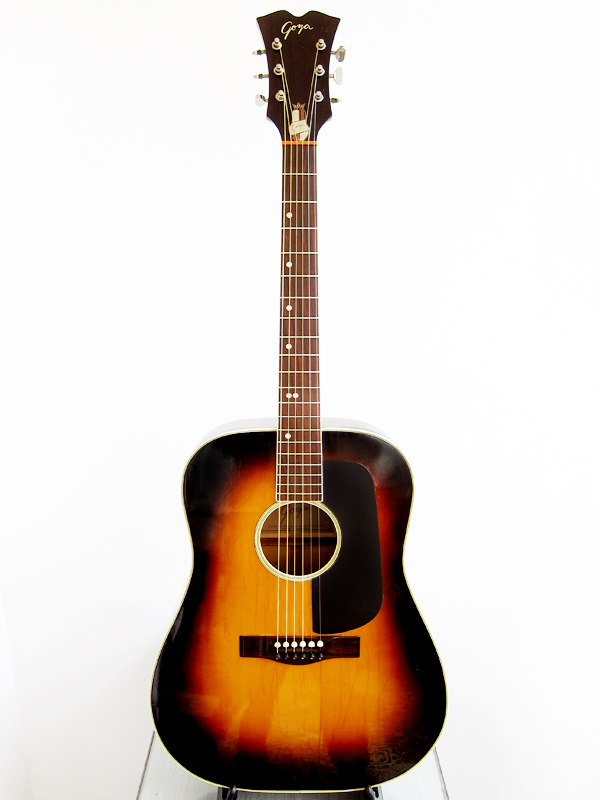
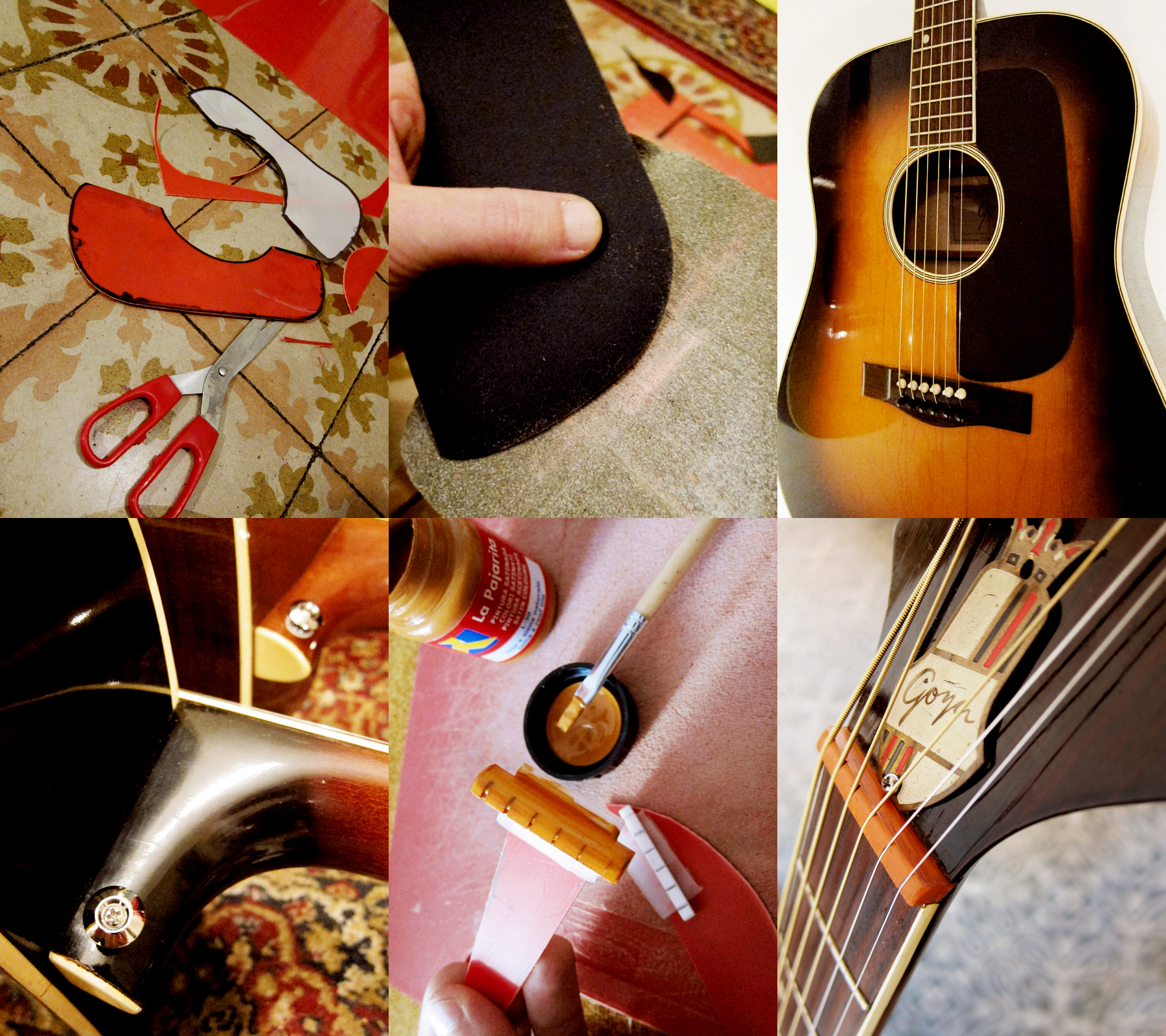
I thought I might as well post some images of the Goya 163 I received back in January. There was some work to be done, actually quite a lot. First I had to reset the neck to get the action down and then I had to remove the bridge and redo the saddle screws. I cut a new pickguard over the weekend, well it’s not perfect yet, I’m still looking for a better material but it will do for now. I bought this Goya from a girl called Marilyn Moser in Maynard, Massachusetts. She had used the guitar for some live gigs in the New York area but gave up on it because of the high action, it was fairly unplayable when I got it. The guitar came with a nice handwritten note to me, the new owner, that’s why I got curious to find out a bit more about her. Here are links to some of her music and her awesome 1960’s blog.

Goya Model 163 Made in Sweden 1968
Goya Model 163, made in Sweden by Levin in 1968

Levin 163 / Goya 163
Goliath size: Body width: 400 mm, body length: 505 mm, body depth: 95/120 mm
Fingerboard width: 43 mm, scale length: 630 mm
Spruce top, flame maple back and sides, 4-ply bound top, single-bound back
Mahogany bolt-on neck with adjustable truss rod
Single-bound rosewood fingerboard with bass side pearloid dot inlay
Rosewood bridge with individual height adjustable plastic saddles
Nickel plated individual Van Gent tuners with metal buttons
Sunburst finish and ten year warranty

Goya Model 163 Made in Sweden 1968
I still haven’t found a good pickguard material. Well the red plastic that I happened to find in the street is actually perfect but who wants a red pickguard. I’ve managed to find 0.8 mm thick matt black plastic but I need something around 1-1.5 mm and preferable in high gloss jet black or even better in red tortoise.  I fitted a strap button in the usual place, and then I painted the new bone nut orange to match the original Levin Galalith nut.

Levin Goya Model 163 1968
Update: March 21, 2014 The pickguard material I ordered from China looked a lot classier than expected so I cut in to shape and put it on

Ad of the day

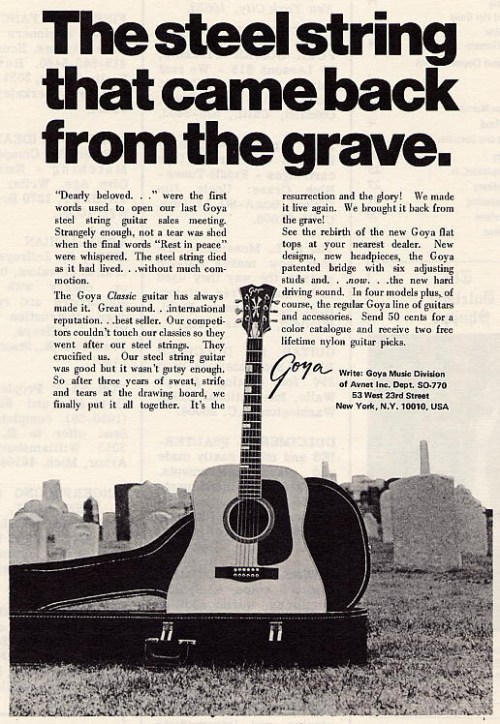
Back from the grave, Goya 174 ad from 1970 2
Back from the grave, Goya 174 ad from 1970

It seems like I will soon be the proud owner of an early 1970’s Levin 174. A nice Danish chap by the name of Orla wrote a comment on my previous post about Levin, saying that he had one for sale. I will write more about it as soon as I get it but for now, enjoy this Goya ad for the same guitar from 1970.

How to… remove a bridge

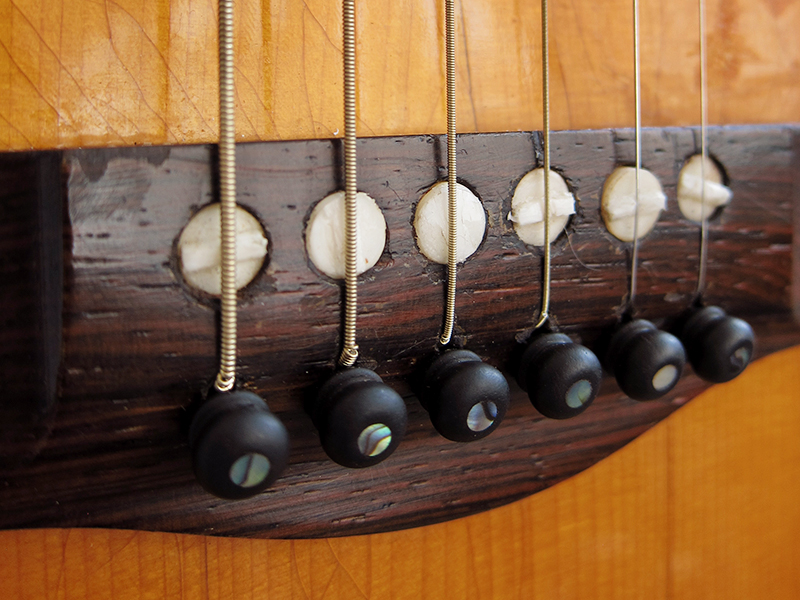
Levin / Goya 163 individual height adjustable plastic saddles
The old plastic saddles before I removed the bridge on my Goya Model 163 from 1968.

I recently had to remove my first bridge on an acoustic guitar, after removing my first neck it just felt like a natural next step. It turned out to be both harder and easier than I first thought it would be. I needed to do this for two reasons, first because the bridge started to come loose, it felt like the glue had dried up and started to fall apart. Second, I wasn’t too excited about the extremely low individual height adjustable plastic saddles, as Levin calls them, that the previous owner had left me. They were too low to adjust and made some strings sound muted and dull. I watched a Youtube clip before I started with Julyan Wallis, who happened to be working on a Levin guitar as well, and learned a few good tricks. He was heating up the spatula on an normal clothes iron and that way managed to loosen the old glue under the bridge. It worked extremely well.

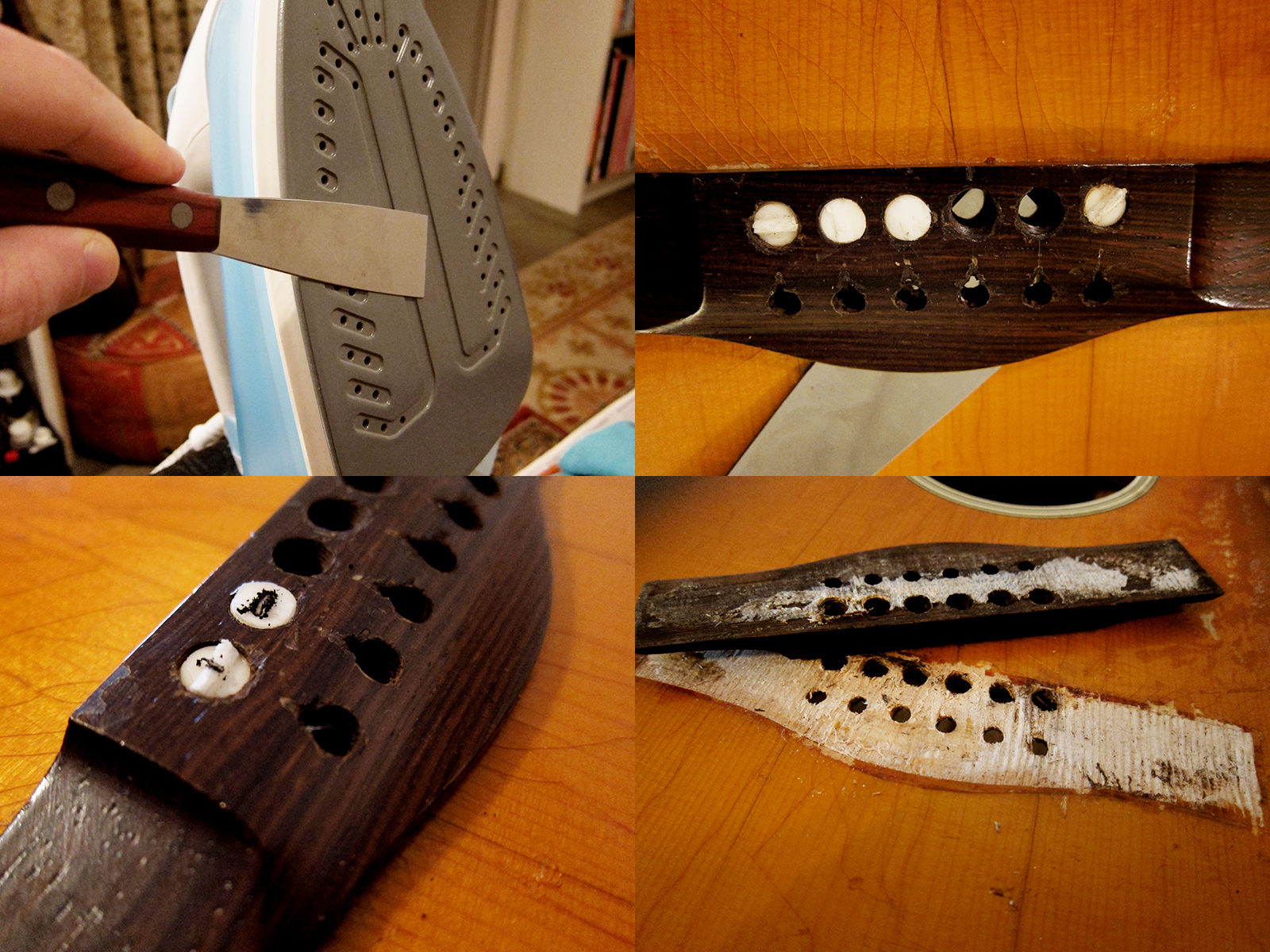
Goya 163 bridge removal
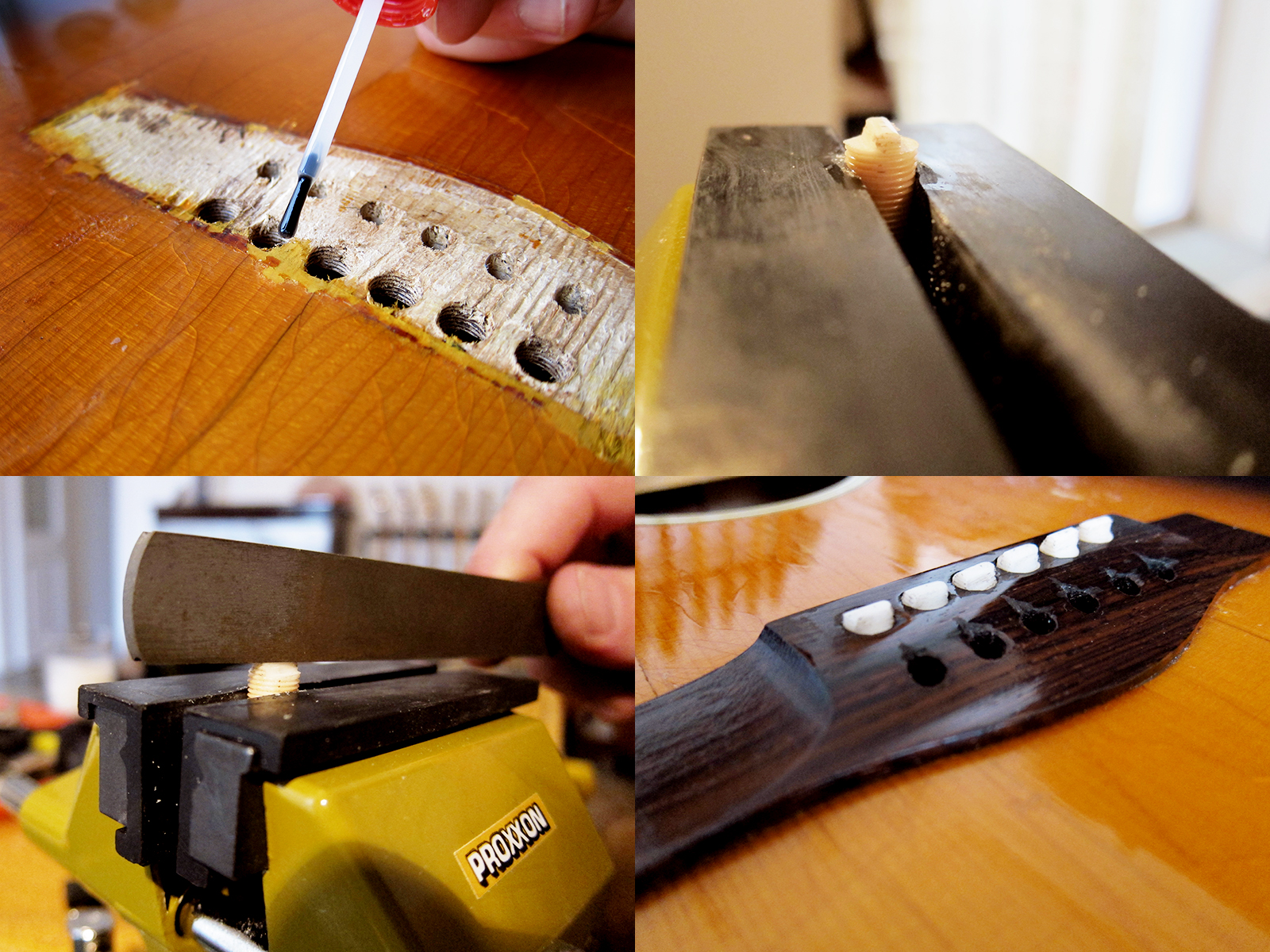
I heated up the spatula on a normal clothes iron and touched it with my fingers to make sure it didn’t get too hot, I was scared to scorch the lacquer. As soon as you loosened the corners and worked your way around the whole bridge you can keep the tip of the spatula quite hot if you are quick to get it in under the bridge and not resting it on the lacquer. This could have been such a smooth and and easy job if I would have realised earlier that that saddle screws went all the way through and was actually screwed in to the top as well, something that kept the bridge secure even when all the glue was loosened. I tried over and over and even managed to damaged the lacquer in two places in my desperate attempts to get the bridge off. Since I couldn’t get a grip of the saddle screws, two was filed down smooth and the others were too low to hold on to with any pliers. I had to heat up a screwdriver on a candle, I should probably have used the clothes iron, and then melt the tip in to the saddle and that way get a grip and unscrew them. Once all the saddle screws were out the bridge came off straight away. It could have been a cleaner removal if I had realised that the saddles were attached to the top but still, I’m pretty pleased with the result for being my first time.

Goya 163 bridge removal
I painted the wood where the finish had come off and then added a bit of nitro lacquer to seal it. Since I had to burn the tip of the saddles to get them out I thought the best I could do in order to save as much material as possible was the flip them over and reshape the bottom instead. I used a normal hand file to shape the saddles, I made the tip both higher and wider to get a better grip with the pliers when I adjust them. Once the shape was good I rounded them off with my fret crowning file. I glued the bridge back in place with fish glue and a couple of clamps and let it set for 24 hours. It worked pretty well, the tone is better and I can now easily adjust the string height like Levin intended 46 years ago.

How to… reset a Levin neck

Levin LM-26 1959A fairly unplayable 1959 Levin LM-26 before I reset the neck

I’ve been very lucky and managed to get my hands on a couple of really nice Levin and Goya guitars over the last year. I would probably have thought twice about getting any random 50 years old acoustic since the action is normally a bit of an issue but with Levin it’s quite easy to reset the neck. They have been using a bolt-on neck system since the 1950’s which makes the job pretty manageable.
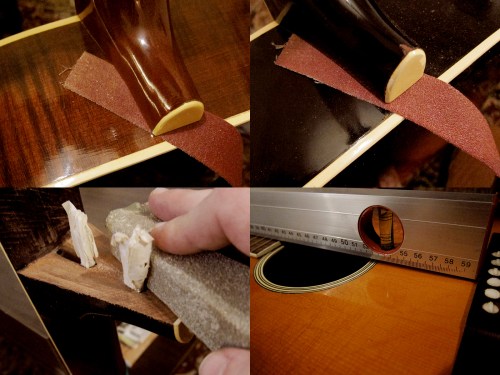
How to reset a Levin neckRemove the two bolts that attach the heel with the neck block, you can see them if you look inside. A normal Philips no 2 screwdriver fits if you don’t have a square Allen key. The heel is normally not glued in so you will feel it loose as soon as you remove the bolts. If not, apply a bit of pressure upwards to loosen the heel. Now you will be able to fit a sanding strip under the heel and can start to sand it down and that way change the neck angle and lower the action. Apply a bit of pressure on the neck and just pull, it might take 40-60 pulls on each side so so be patient. Check the neck angle with a straight edge once in a while so you don’t take it too far. As long as the straight edge doesn’t go over the bridge it should be fine. I have done the sanding strip trick on two guitars so far, my Goya T-18 and a Goya 163. On my Levin LM-26 I felt it was better to remove the whole neck so that made the sanding process even easier.
Goya 163 neck removal
Update: January 27, 2014
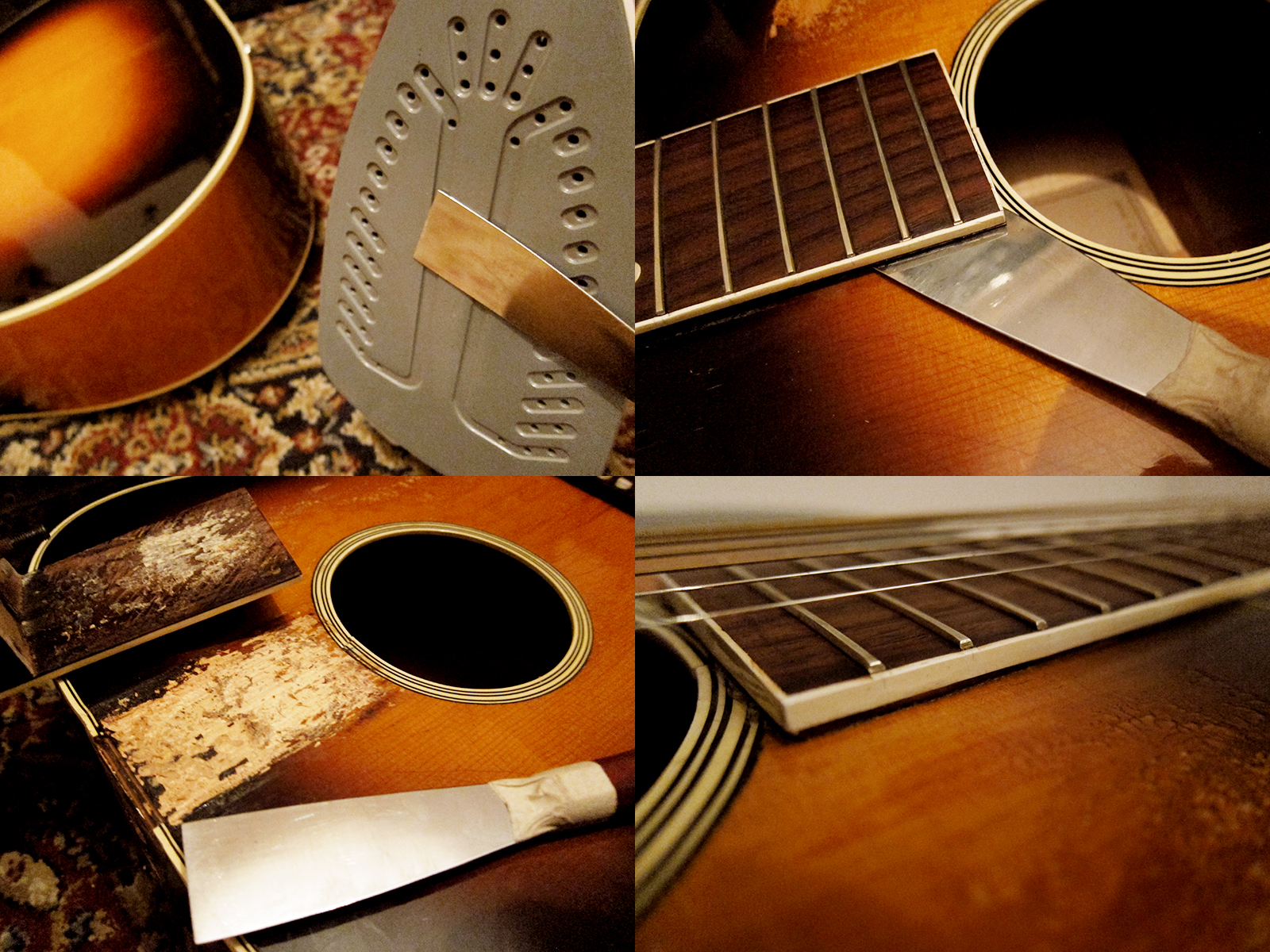
I needed to sand down the heel a bit further on my Goya Model 163 and realised that the fretboard started to come loose. It looked and felt just like the bridge, like the glue had dried up and started to crack and fall apart. I tried a new trick that I learned on Youtube, to heat up the spatula instead of heating the neck, like a did on my Levin LM-26. My God, this was so easy and quick, I think it took me 7 min to remove the neck. When I had sanded down the heel a bit further I glued the neck back with some fish glue and a couple of clamps.

Levin bolt-on neck