Rondo, built by Levin in Gothenburg Sweden in 1960
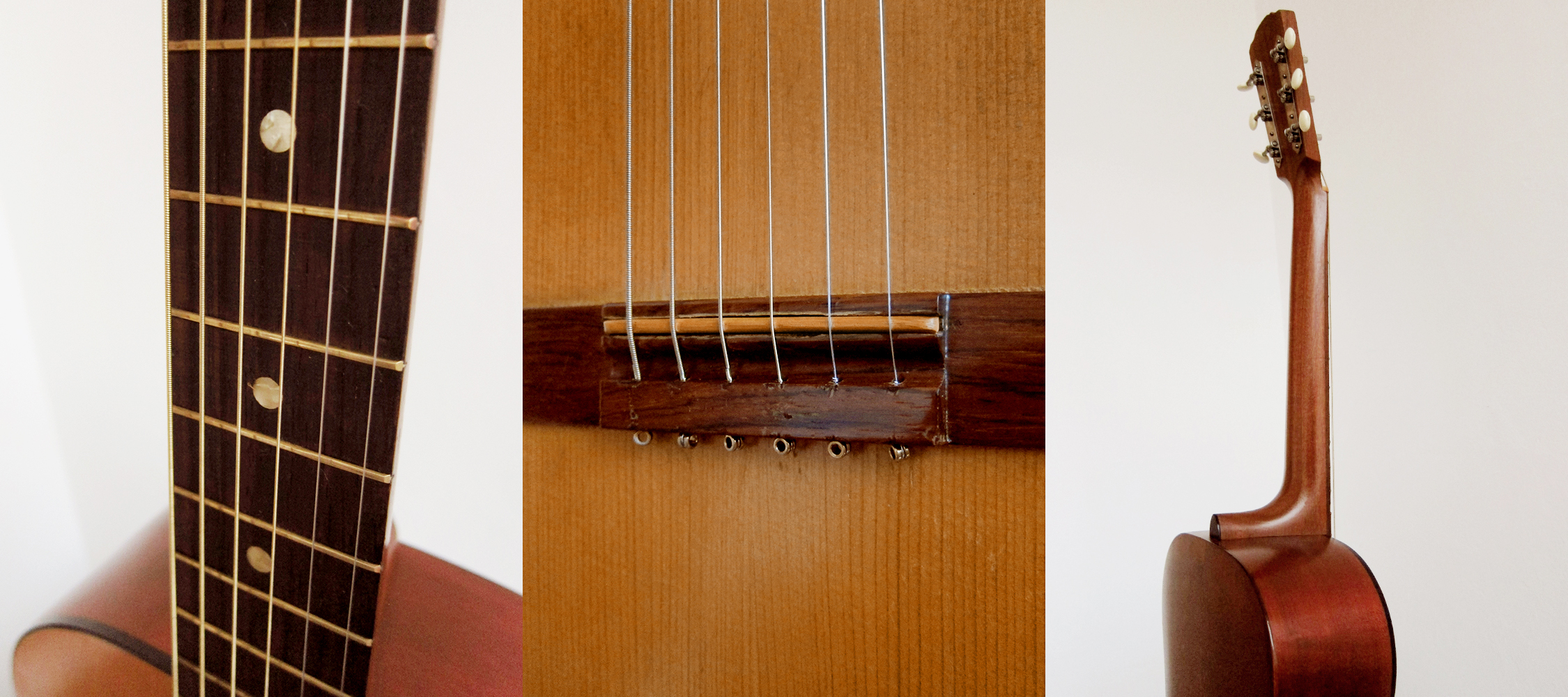
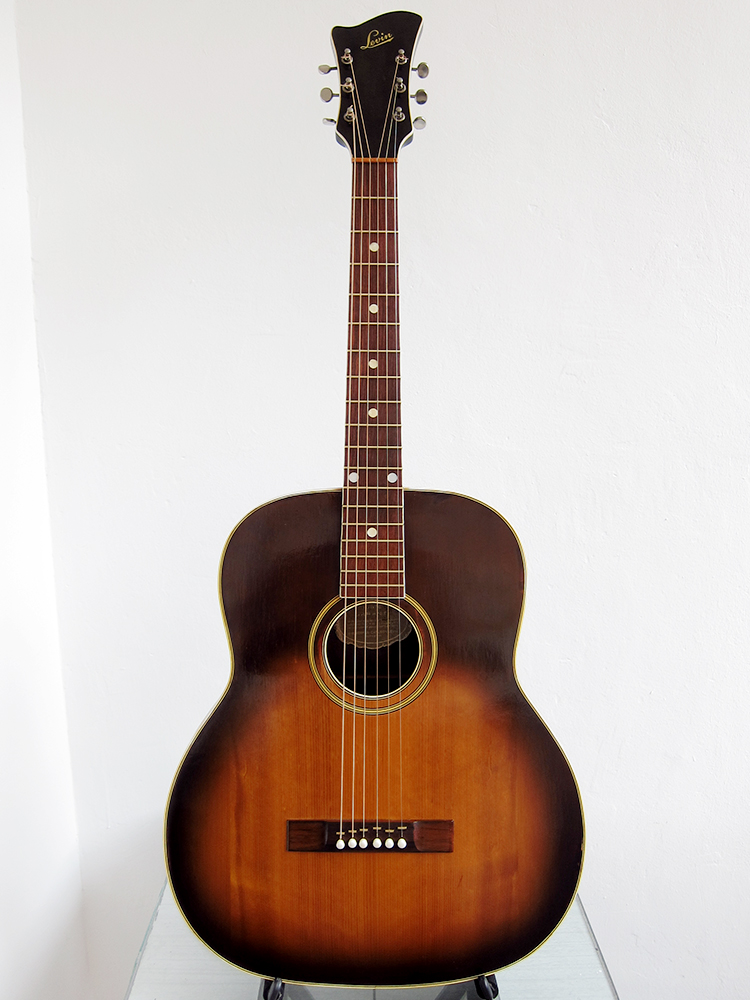
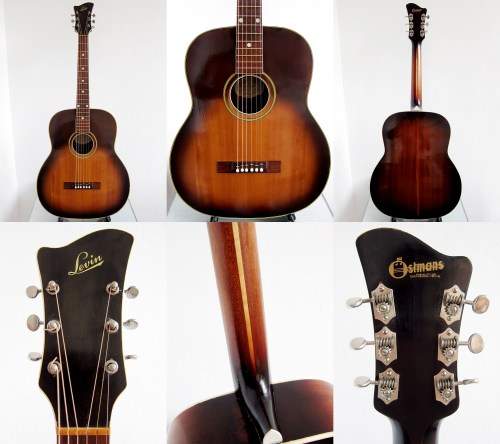
Today is wife’s birthday so tried to be a good husband and got here an old guitar. I found her a little Rondo, a mail order guitar built by Levin in the late 1950’s. I have actually never seen one of these before so I was quite exited when it arrived. It surely feels, plays, smells and sounds like a Levin. Rondo was made by Levin for Musik AB Westin & Co, a music store and publishing company in Stockholm with a large mail order business. It looks pretty similar to a Levin 119 and was made for both steel and nylon strings, this was pretty common on smaller Levin guitars in the 1950-60’s. It’s a very nice little guitar to play and it has more volume and sounds sweeter than I expected, perhaps because it’s fan braced instead of ladder braced. My wife seemed very happy with it too when she got it this morning.
Rondo
Non-cutaway. Body width: 320 mm, body length: 455 mm
Body depth: 95 mm, scale length: 595 mm
Spruce top, maple back and sides, fan braced
Single-bound top, unbound back, unbound headstock
Unbound rosewood fingerboard with pearl dot inlay
Mahogany neck with non-adjustable T-shaped duraluminum truss rod, rosewood bridge, stainless tuners
Natural finish, one year warranty
It was in pretty good shape when it arrived. I had to glue a couple of small cracks, polish the frets, oil fretboard and machine heads and give her a good clean but that was it. The only problem was that this had to be done when my wife wasn’t around so I’ve been a guitar repairing ninja for the last week.
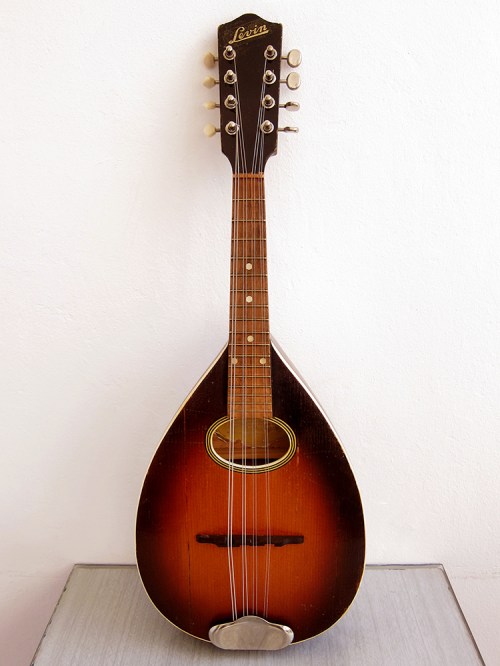
A couple of weeks ago I found a little Levin Model 46 Classic, 8-string mandolin. This is one of the less fancy ones that Levin made in the 1940’s but it’s still a great little mandolin. Someone has unfortunately changed the machine heads on one side during it’s life but the rest is original. I had a cheap Thomann mandolin before and this is a world of difference, I wonder how good Levin’s top of the line mandolins sound if a simple one like this could be so strong and powerful.
Levin Model 46 Classic
8-string Mandolin, flat back
Body width: 225 mm
Spruce top with birch back & sides
Single-bound top and back, unbound headstock
Unbound walnut fingerboard with pearloid dot inlay
Nickel plated tuners, sunburst finish, one year warranty
Now I just have to learn how to play mandolin properly
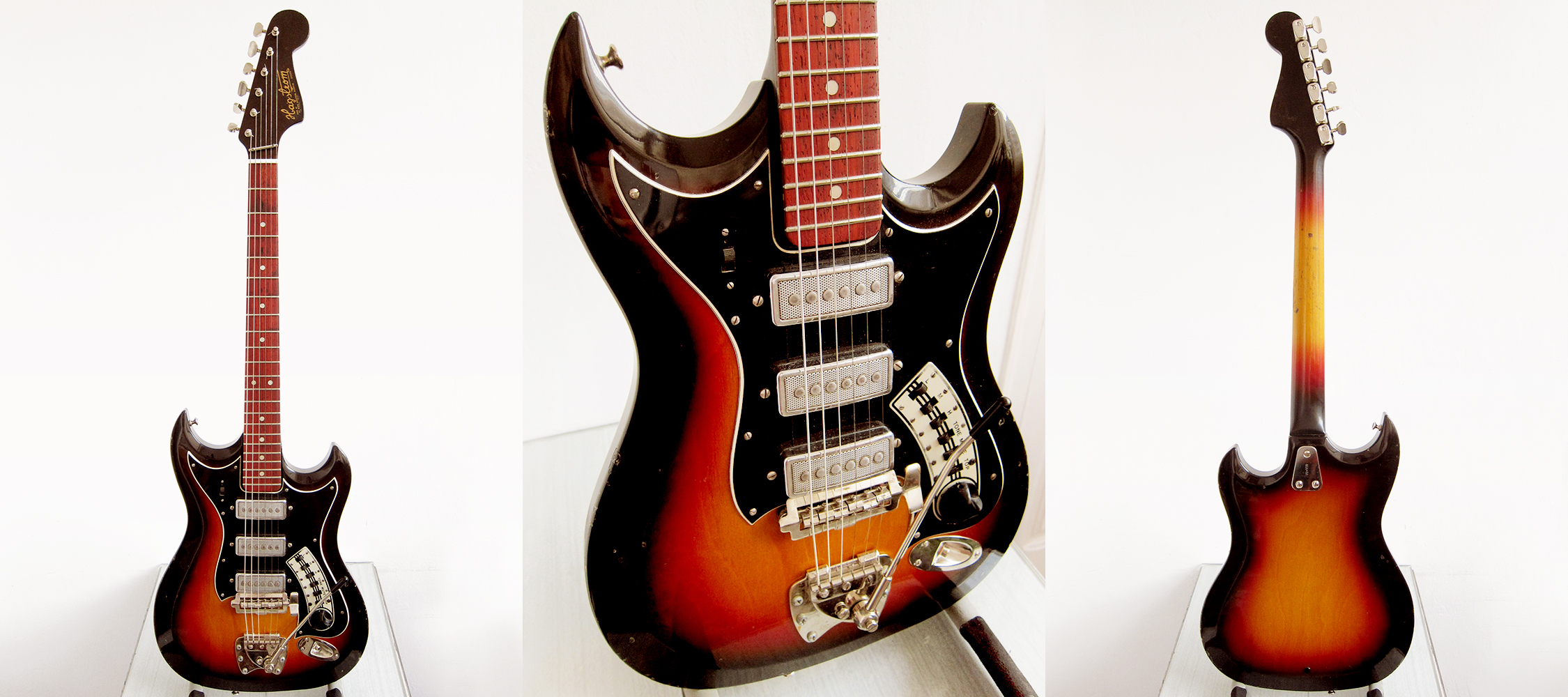
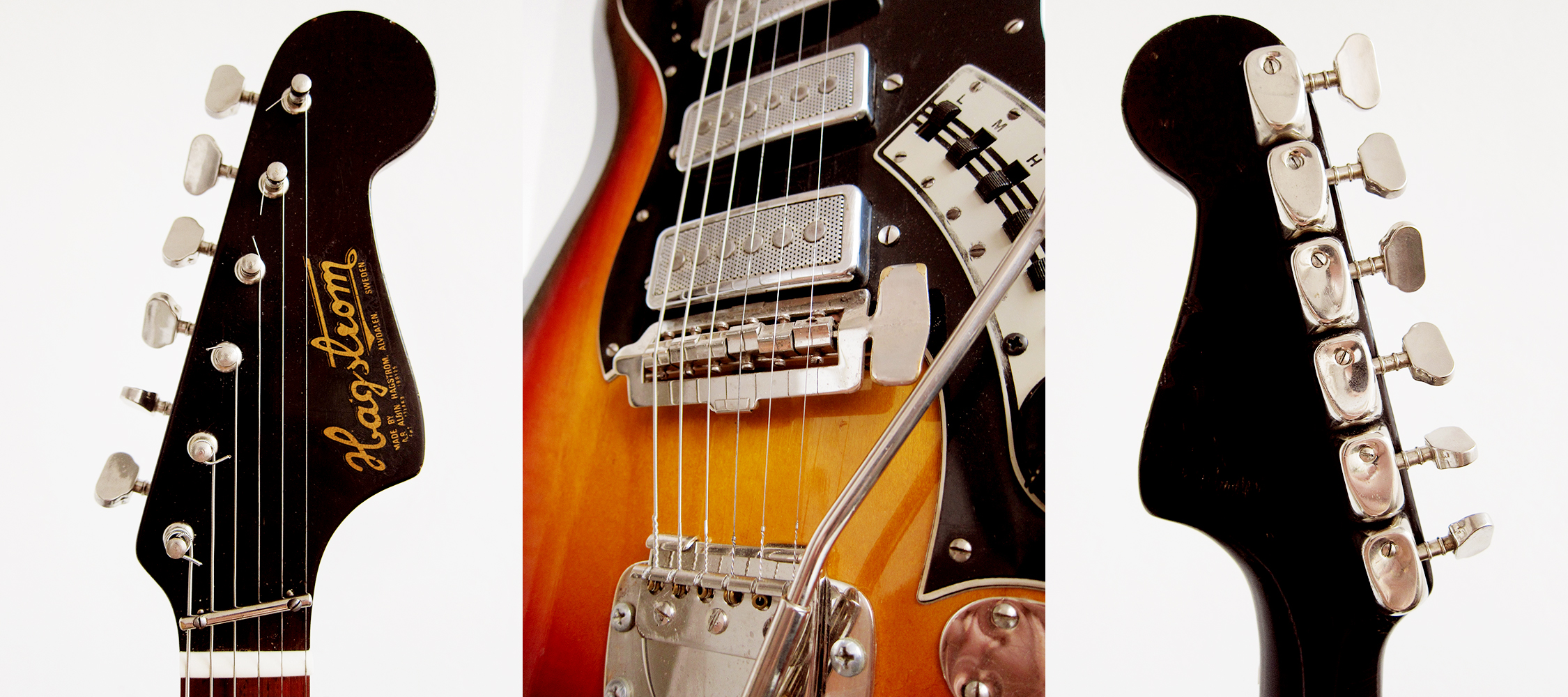
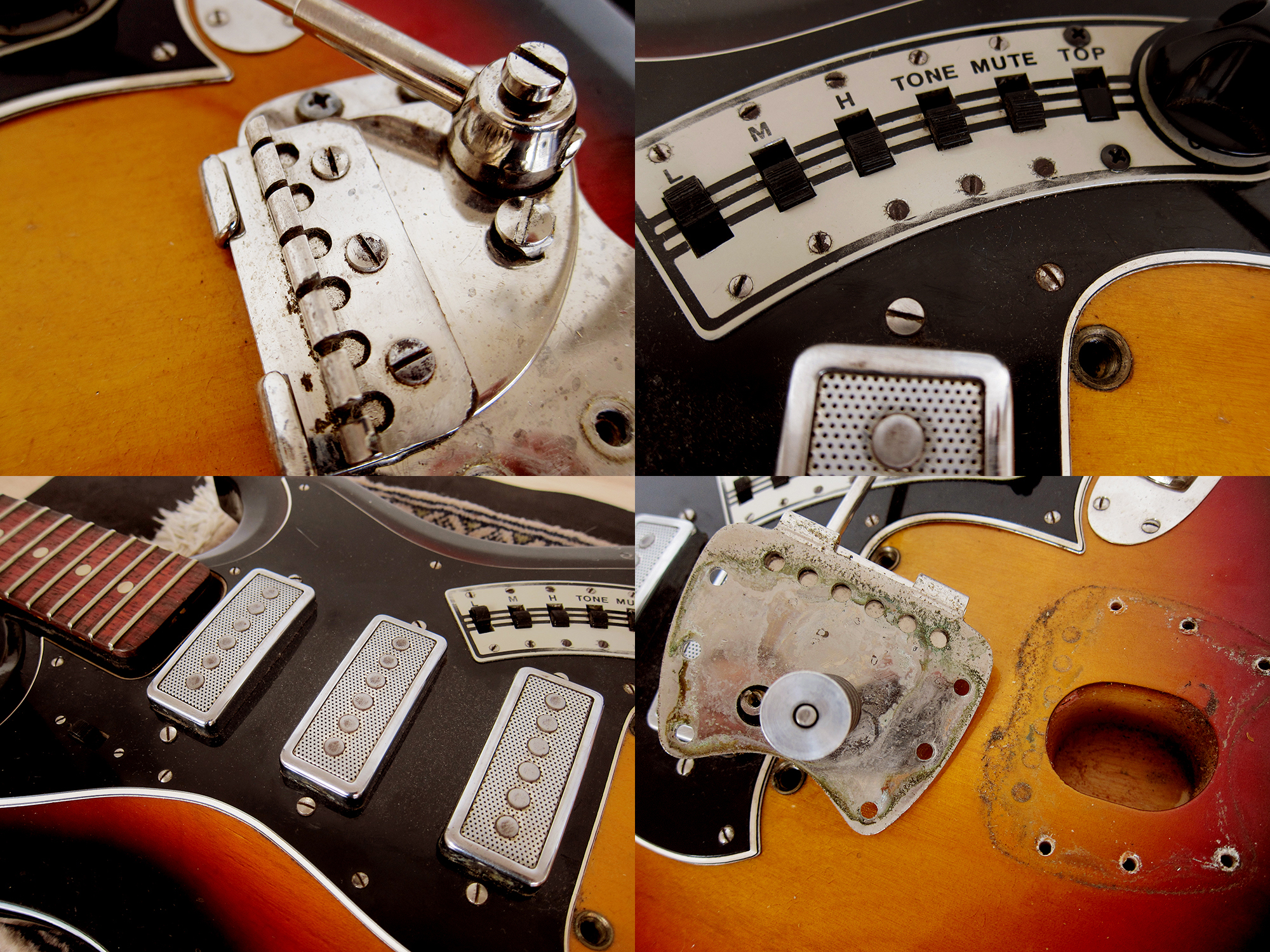
I found a Hagström HIII back in April that I felt really sorry for and had to rescue, or rather save it from being slaughtered and sold for parts by someone else. Unfortunately it wasn’t a bargain and I probably wouldn’t have bought it if I wasn’t drunk at time, I need to stop browsing eBay on Sunday evenings. It had all the parts but the fretboard and frets were in a terrible state and the electronics weren’t working properly, basically a nice guitar and worth the price if it was working. All the hardware cleaned up nicely, I love the Van Gent machine heads, a complete set tend to go for 100€ on their own, and it had the original tremolo, pickups and pickguard. I had to remove the old frets, even out the fretboard and then refret it to get it playable. After waiting for over a month I finally got the switch needed from Hong Kong here we are, a fully restored and working 1970 Hagström HIII. Even though I love the look and sound of this guitar I can’t seem to get used to the fast Hagström neck, the fastest neck in the world, and therefore it’s for sale.
Hagström HIII made in Älvdalen, Sweden between 1970-1972. It’s the 491st HIII made in a series of totally 708 guitars, this was the last run ever of this model since it was replaced by the more 1970’s looking Hagström HIIN
I started with taking the guitar apart and cleaning everything with a toothbrush and some soap and then polish up all the hardware.
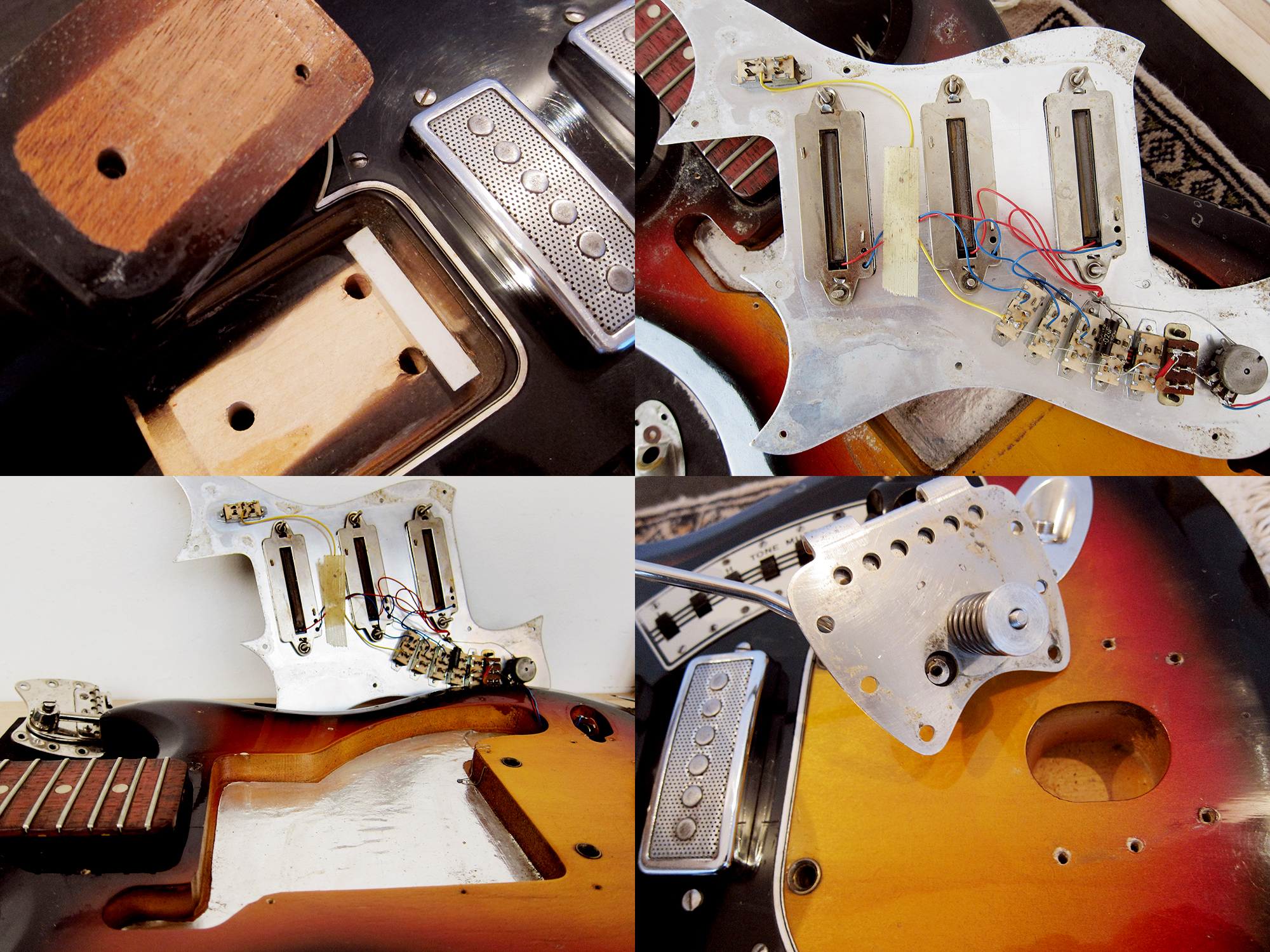
The electronics was in fairly good state but needed to be grounded properly. Also the on/off wasn’t plugged in and the bridge pickup’s switch wasn’t working properly so I had to wait a month for a new one from Hong Kong. Now everything is soldered up properly and is working fine.
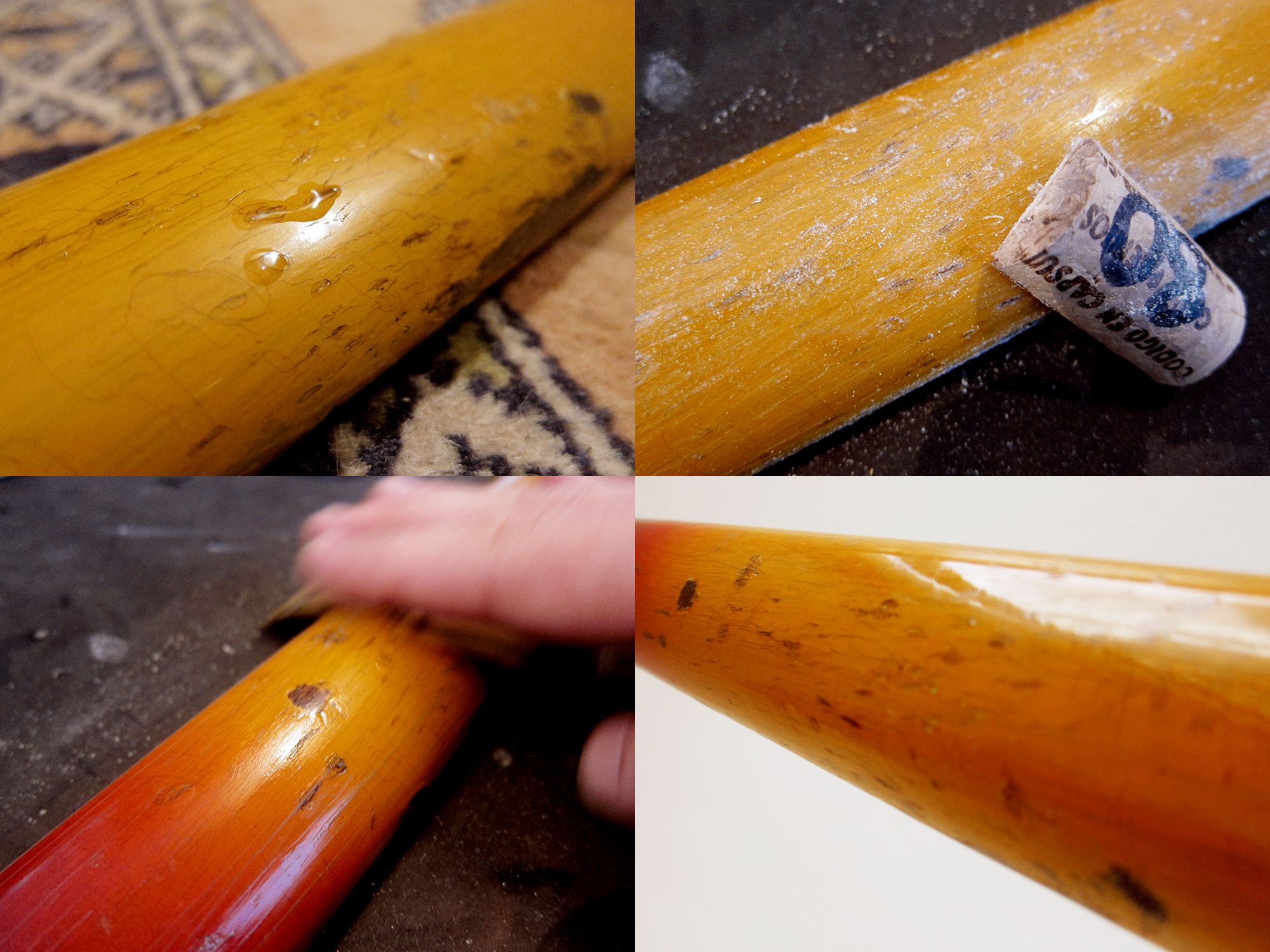
The back of the neck was a mess, dents and groves everywhere so I filled them with Nitro and sanded everything smooth before I buffed it up with metal polish so now you can’t feel it.
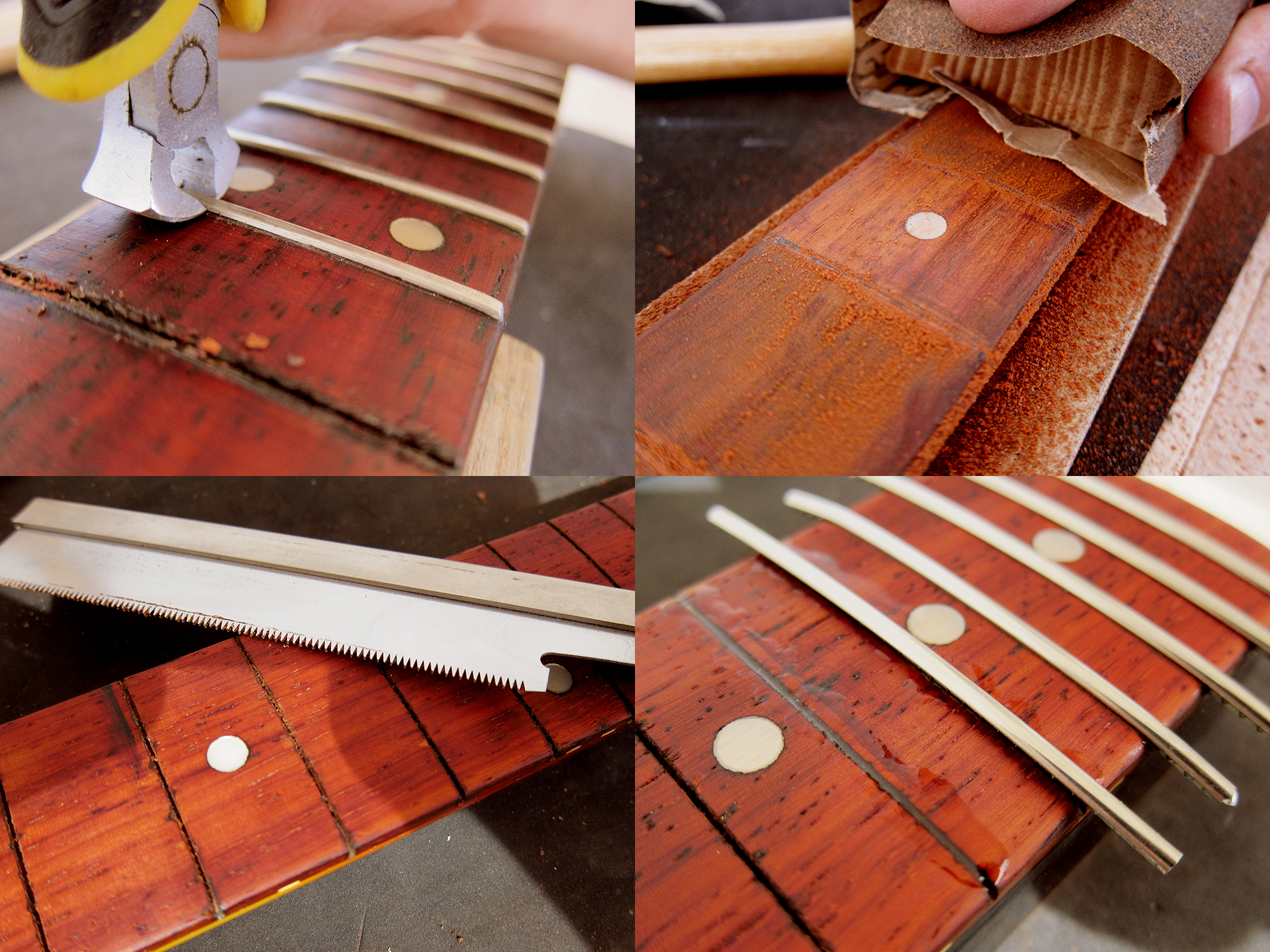
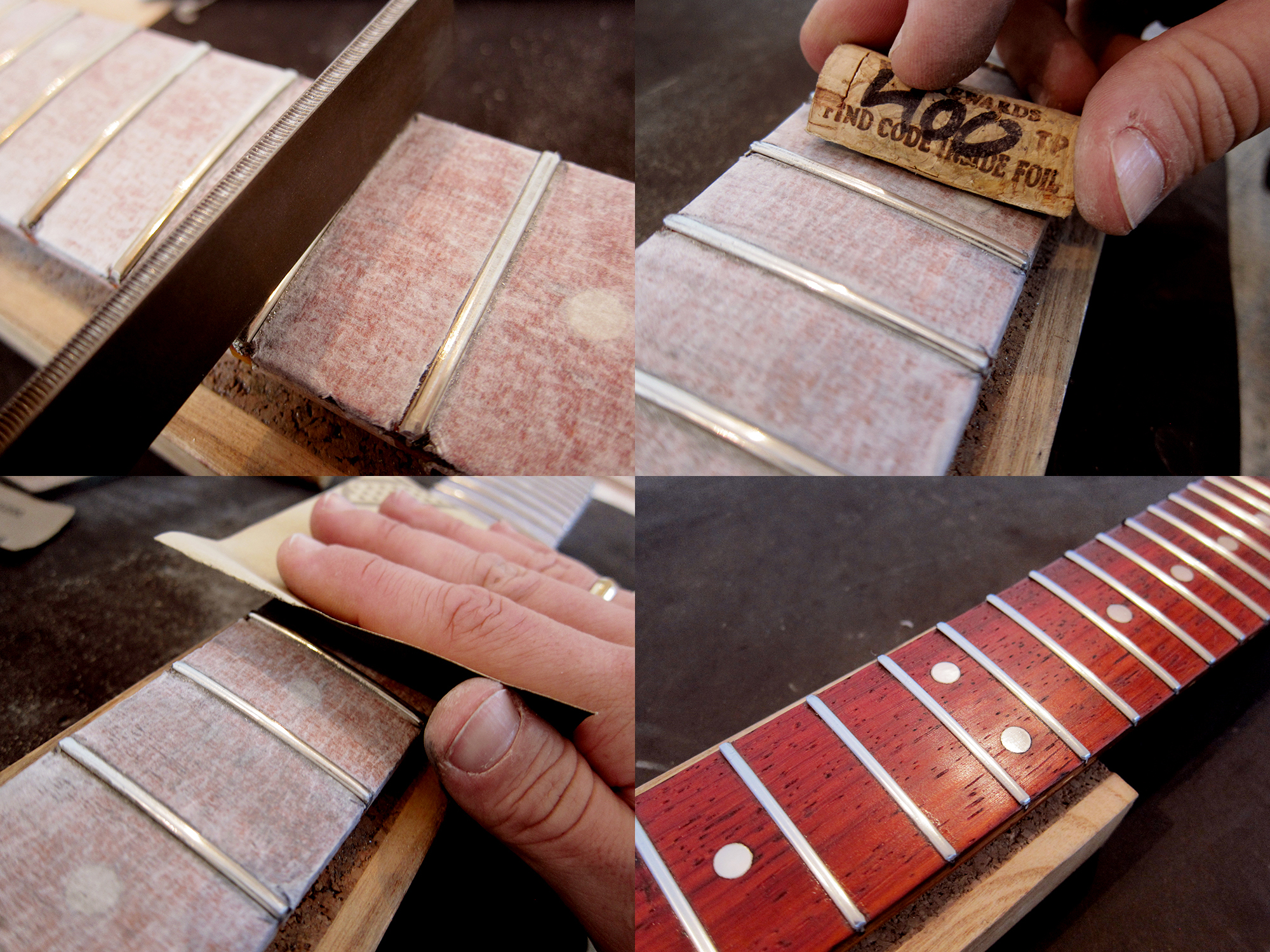
The main problem with the fretboard was the deep groves in it, it almost looked like the first 5-7 frets had been scalloped. The original frets were really uneven too so I decided to refret it completely. I pulled out the old frets, sanded the fretboard even and then gave it 10″ radius before I re-cut the fret slots and installed new Jescar jumbos.
I levelled, crowned and polished the frets and in the end the fretboard looked pretty damn good if I may say so myself.
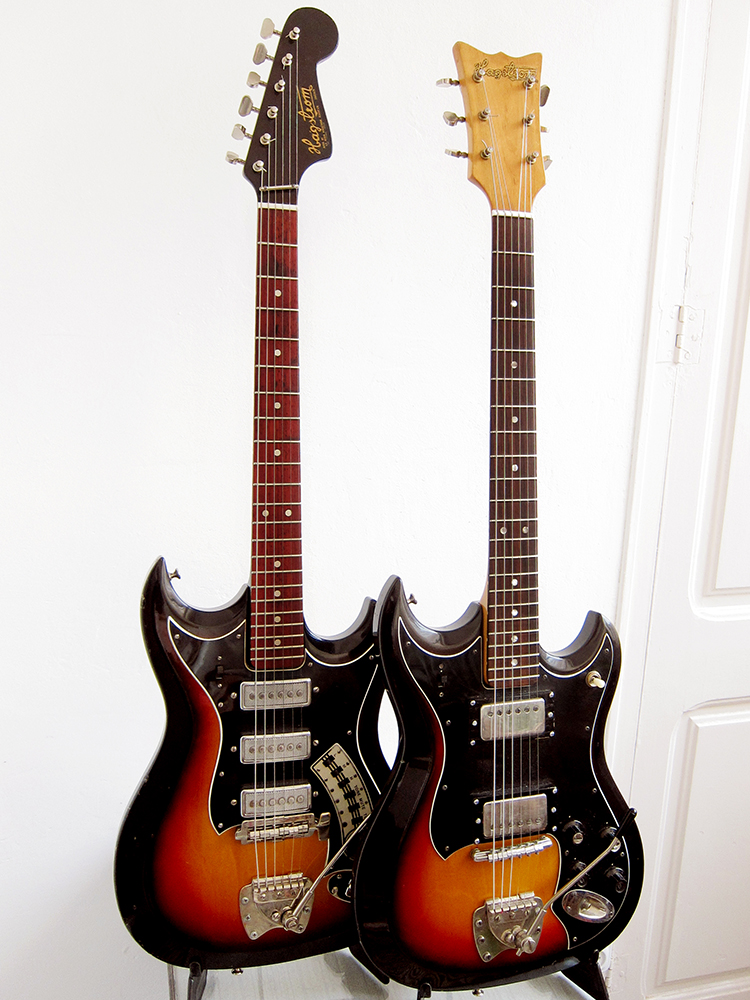
Hagström HIII and my friend Rafa’s Hagström HIIN, both Made in Sweden in 1970, same body but different pickups, electronics and head shape
This video was shot before I changed the bridge pickup’s switch so it’s cutting out occasionally, that has been sorted now with a new switch. I posted these two videos so you can here the difference between Hagström’s fat single coils and their humbuckers.
Here is a new video of the Hagström III with all the switches working, unfortunately my amp is acting up and is making hell of a noise
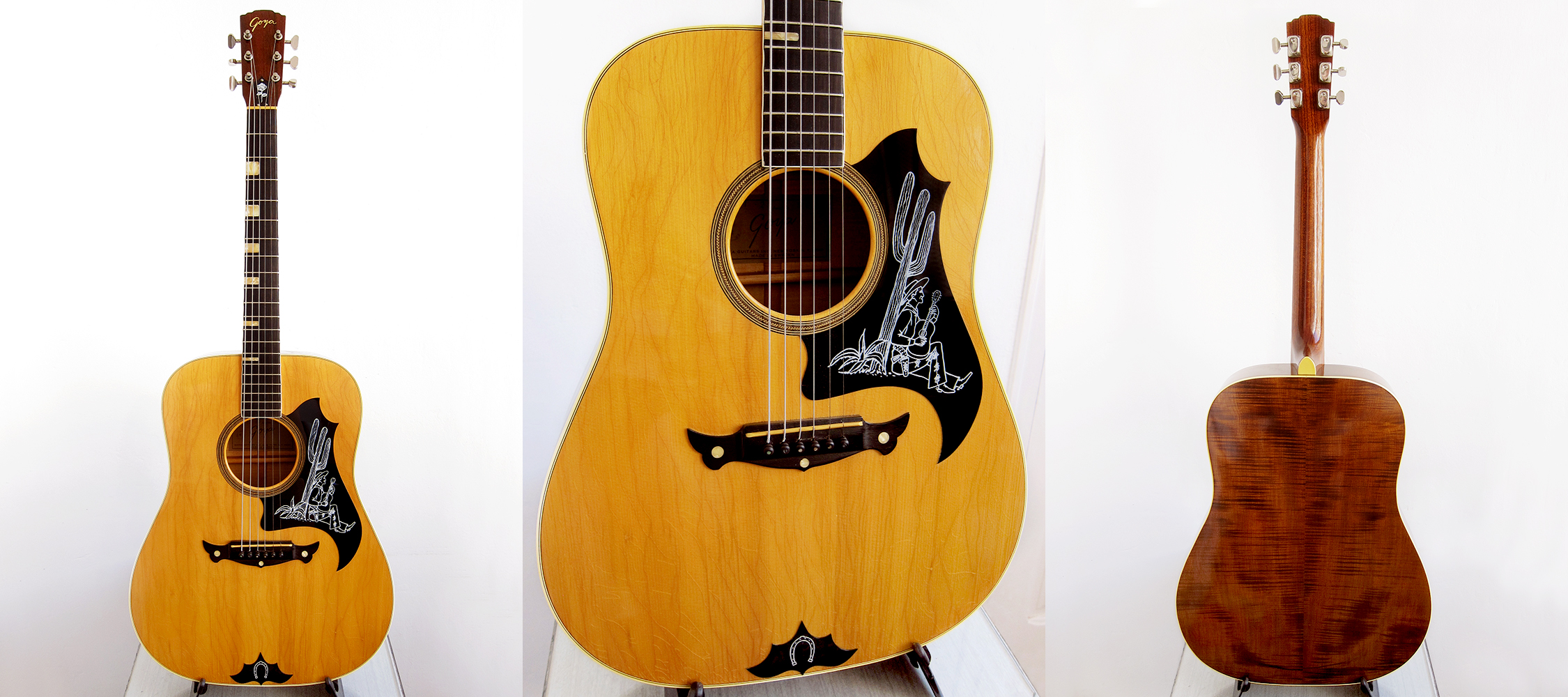
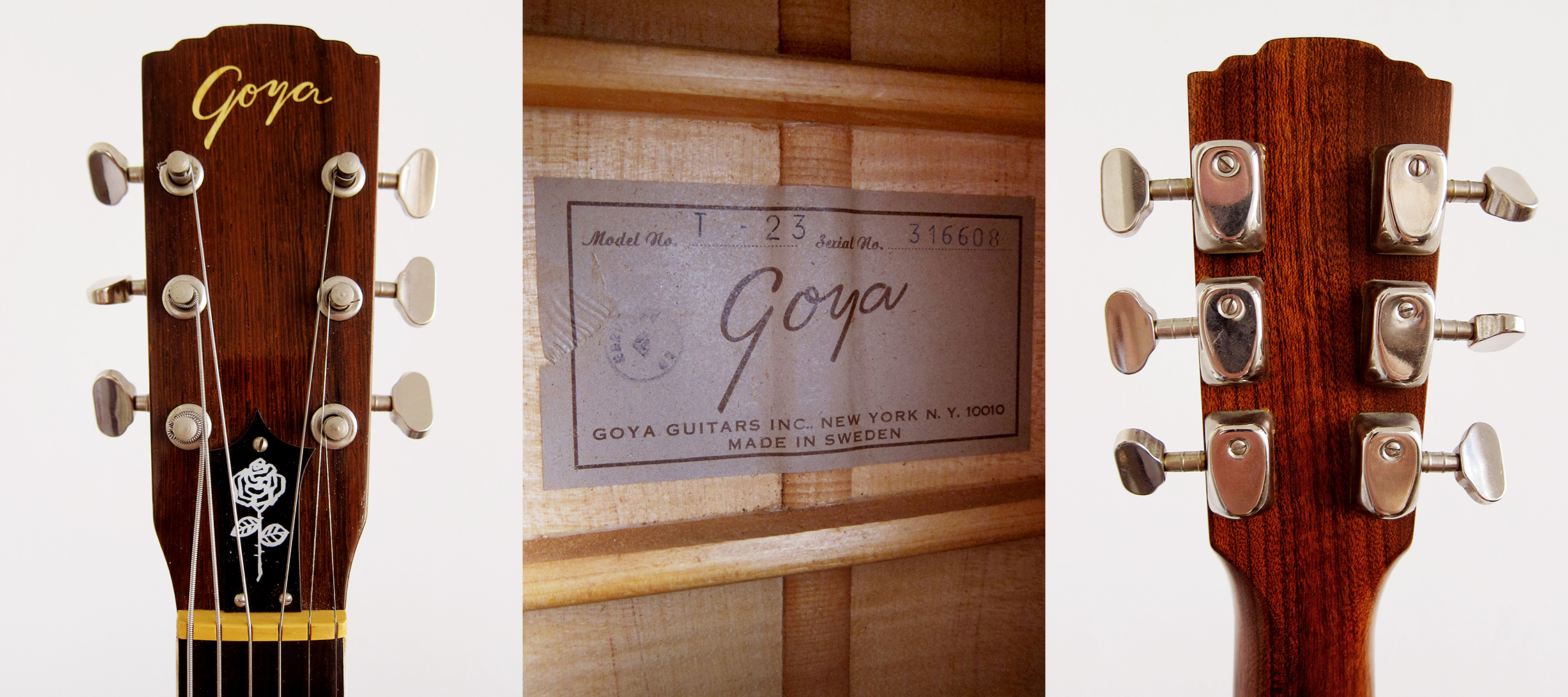
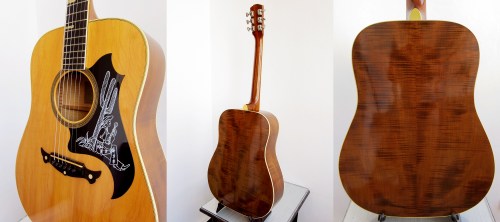
Finally, it took two years but now I’m at last the proud owner of a lovely Goya T-23. When I bought my first Levin back in the summer of 2013 I started to search Vintage Guitars Sweden for different models to study and learn everything I could about Levin. There was 3-4 different guitars that I fell in love with straight away, Levin LM-50 with all it’s bling, Levin De Luxe the king of archtops, Levin 174 which I later found, and of course Levin LT-23, the cowboy version of Levin LT-18. I love my 1966 Goya T-18 so I was pretty sure that this Goya T-23 would sound pretty sweet too, but it sounds even better than I could have imagined. My friend Wolf and I had a little jam last Saturday and it seems like the T-18 and T-23 were made to be played together, I will try to sort a video. I love everything about this guitar, the ebony fretboard with it’s block inlays, the flamed maple back and sides, the amazing cowboy pickguard and plastic details, the bridge shape and most of all, the sound. It has a Gibson like bass response but with a Martin like mid and treble, kind of the best of both worlds. It was well worth the wait, the next holy grail to find would be a Levin LM-50.
I haven’t done any work to this guitar yet, I bought it from a seller in Franklin, Indiana, USA and since it seemed really dry when it arrived I wanted to wait and see how it reacts to the subtropical heat of Barcelona first. Most likely I will have to sand down the heal a bit to get the action down and perhaps even remove the binding on the neck and file down the frets since the fretboard has been dry and shrunk so the frets are poking out a bit. Hopefully the humidity here will help a bit and if not I will sort this issues after the summer. It’s very playable as it is and almost in mint condition with minimal wear.
Levin LT-23/ Goya T-23 Goliath size: Body width: 400 mm, body length: 505 mm, body depth: 95/120 mm. Fingerboard width: 43 mm, scale length: 630 mm. Spruce top with X-bracing, flame maple back and sides, 4-ply bound top, single-bound back. Mahogany bolt-on neck with adjustable truss rod. Single-bound ebony fingerboard with bass side pearloid block inlay. Nickel plated individual Van Gent tuners with metal buttons. Ebony bridge, natural finish and ten year warranty
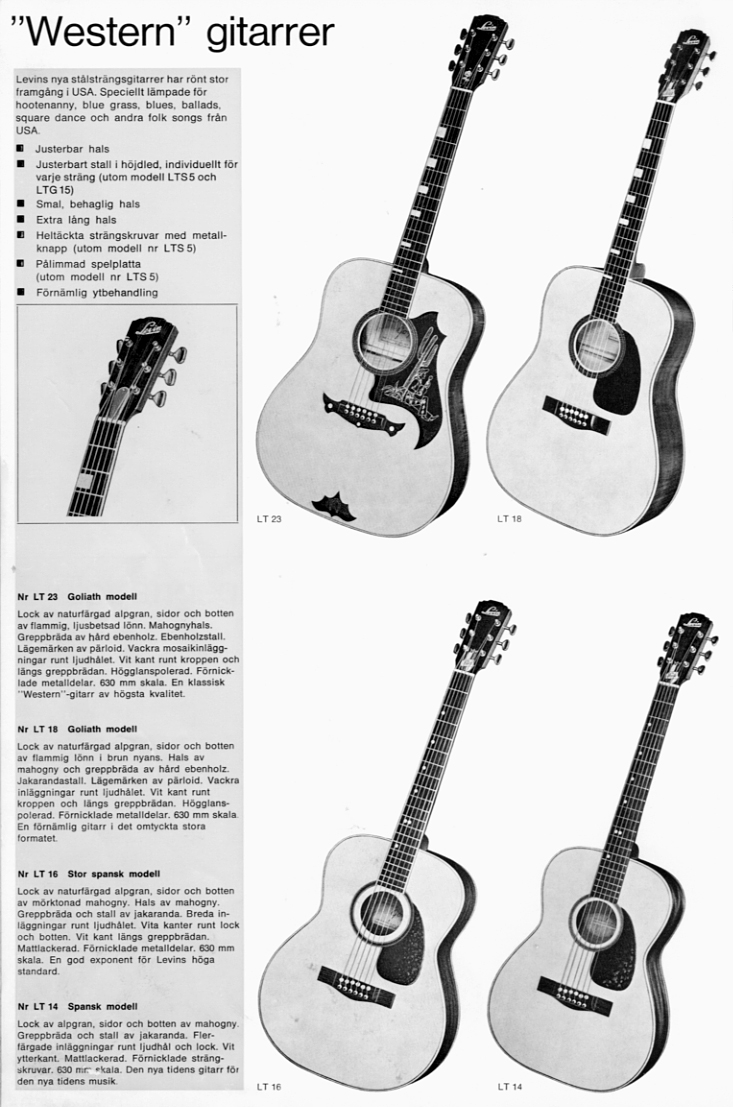
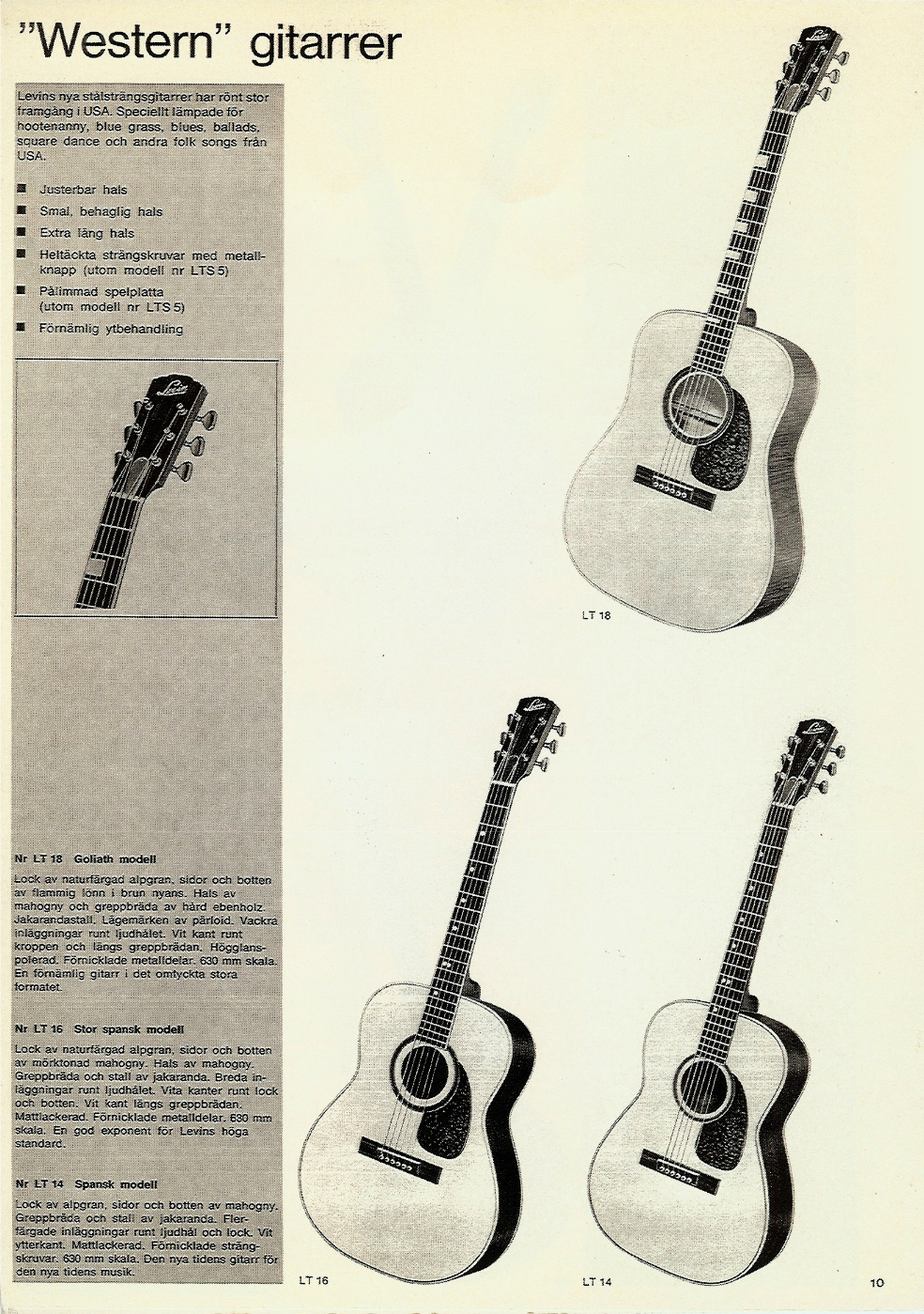
Levin catalogue from 1967. Now I finally have all four of them, the two top as Goya and the bottom two as Levin, but mine are from 1965-66 so they have a proper saddle instead of the adjustable saddle screws. Goya T-23 (1966), Goya T-18 (1966), Levin LT-16 (1966), Levin LT-14 (1965). Taken from Vintage Guitars Sweden
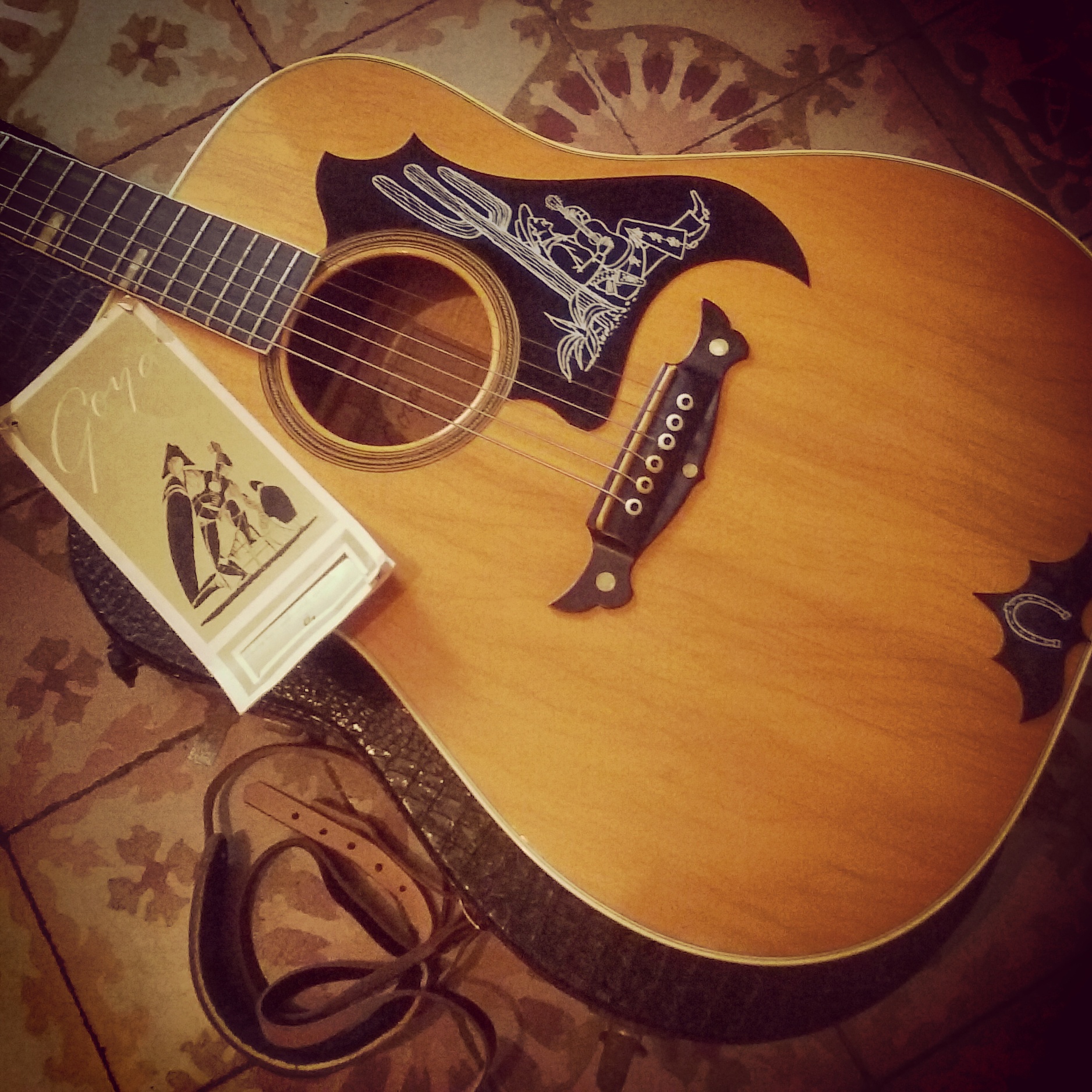
It arrived with the original Goya hang tag, an unused 1960’s leather strap and this awesome looking black alligator hard case that I think is original too. Taken from my Instagram
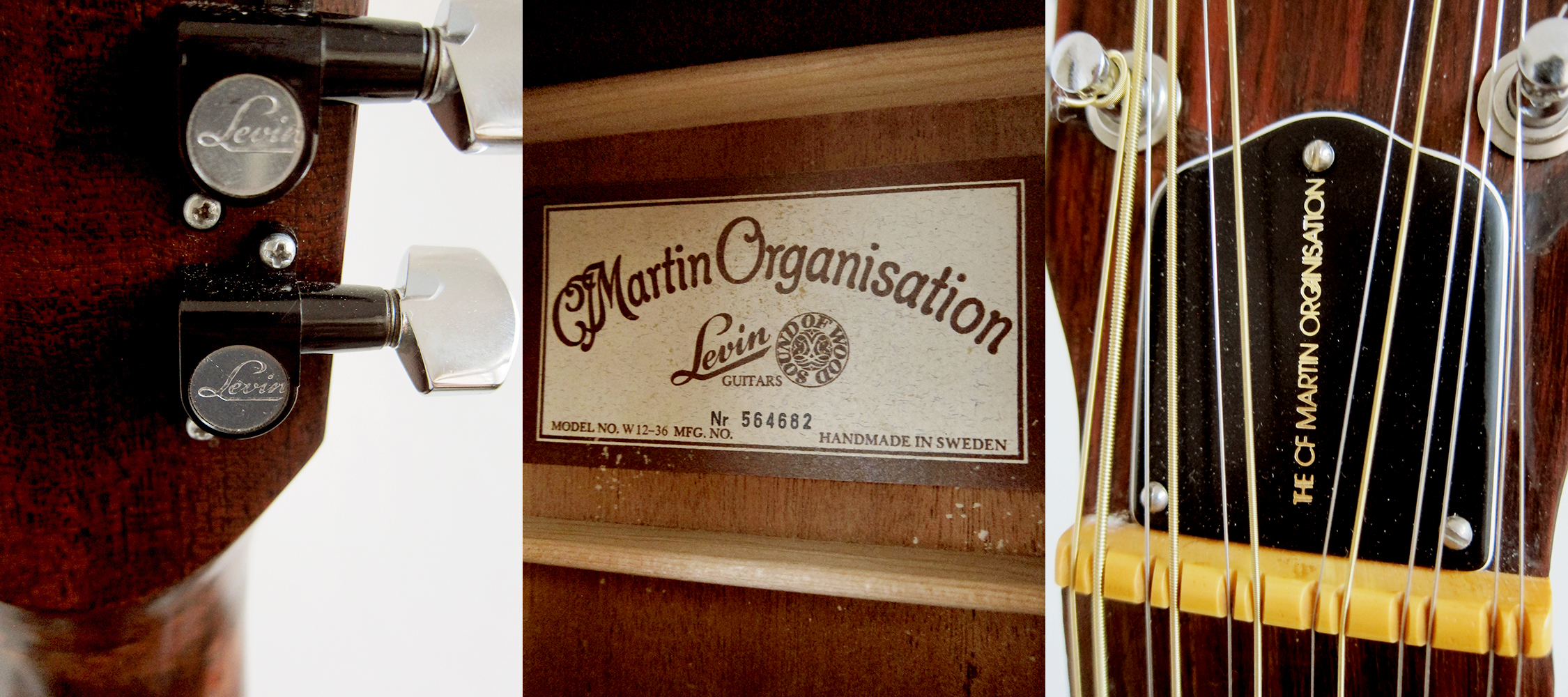
Last week I went a bit bananas and got a 12 string Levin. It wasn’t really planned but sometimes you make a best offer on eBay when you are slightly tipsy and then occasionally you become the new owner of some old guitar, like a 1978 Levin W 12-36. I wasn’t even sure if I liked 12 string acoustics or not, I mean they do make a terrible loud noise and seemed a bit too hippie / folk for me, but then I remembered David Crosby who really likes 12 strings and I really liked David Crosby, so that was it. I got it last Friday and played it quite a lot over the weekend and I think I really have grown to like it. I mean you can’t really play it like a normal guitar since it makes too much noise and the notes tend to just eat each other, so you need to space out your strokes a bit. Once you get a hang of it it’s a pretty powerful and interesting instrument to have in the arsenal even if you wouldn’t use it everyday.
I bought the guitar from a German eBay seller,with a name in Spanish, compravender. I’m not sure if he had fixed it up himself or if it came straight from a luthier but the frets were polished and it was well set up so I didn’t have to do anything to it when I got it. The only downside is that the guitar has suffered a broken headstock at some point but it’s really well repaired and seems solid enough.
This Levin W 12-36 was made in 1978 and seems to be the latest knows to Vintage Guitars Sweden. This is also the “newest” Levin I have, they stopped making them in 1979. I haven’t seen the Martin Organisation label before, or the CF Martin trussrod cover.
Levin W 12-36
12-string, non-cutaway. Body width: 400 mm, body length: 505 mm, body depth: 95/120 mm, fingerboard width: 52 mm, scale length: 630 mm
Spruce top with X-bracing, mahogany back and sides, 5-ply bound top, single-bound back, mahogany neck with two adjustable truss rods
Black plastic truss rod cover, unbound headstock with decal logo, unbound rosewood fingerboard with mother-of-pearl dot inlay, rosewood bridge.
Black and chrome plated individual Levin Schaller tuners
Natural finish and five year warranty
I have decided to thin out my Levin collection a bit, I have 12 at the moment, so the first to go will be my beloved 1950 Levin Model 13 Ambassadör. It was restored a few years ago by GammelGura, a great luthier in Örnsköldsvik, Sweden. With new bronze frets, a neck re-set, cracks glued and a new bridge was created to improve the intonation, the rest is all original. It even has the sticker on the back of the head from the guitar shop in Örnsköldsvik where the guitar was bought 65 years ago. If you are interested in the guitar send me an email or give me a call, all info can be found on the For sale page.
Levin Model 13 Ambassadör
Body width: 400 mm, body length: 480 mm, scale length: 640 mm
Spruce top, walnut back and sides, 4-ply bound top, single-bound back
Mahogany neck with non-adjustable T-shaped duraluminum truss rod
Single-bound rosewood fingerboard with 18 frets and pearloid dot inlay
Single-bound headstock, rosewood bridge, nickel plated individual tuners
Sunburst finish and 10 years warranty
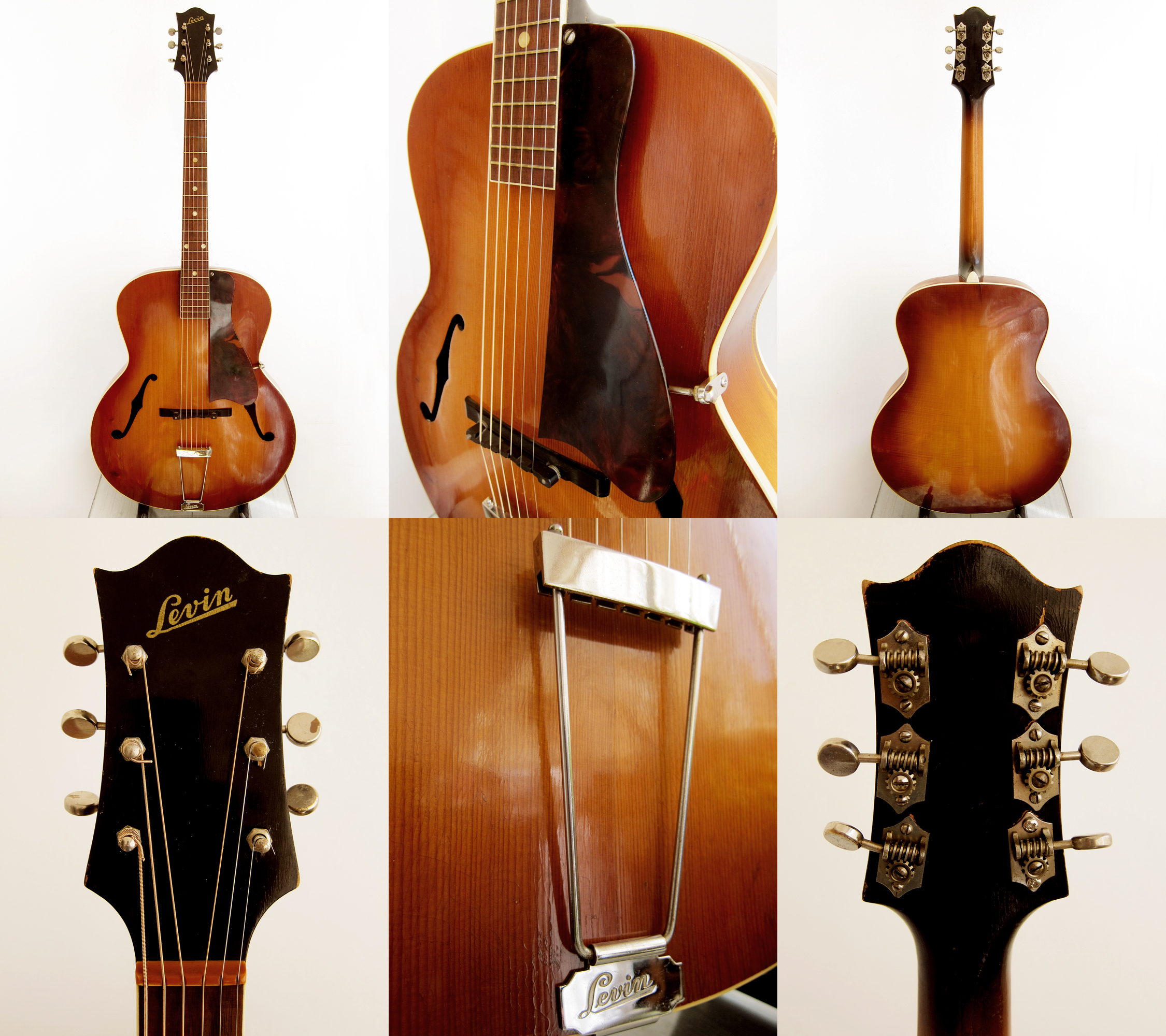
I recently got this old 1946 Levin Model 32 from an eBay seller in Vienna. The guitar has clearly seen better days but I felt she deserved a second chance in life so I got her home, dolled her up and now she is playable again. I had no idea what model it was when I got it and I was actually hoping that it would be a Model 30 from the late 1930’s, they look very similar but it turned out to be a Model 32 from the mid 1940’s instead, which isn’t bad. I guess I just wanted to have a Levin that was older than my 1942 Levin Model 65. It’s pretty close to my 1951 Levin Royal in sound and feel but with a more casual appearance. I guess there was a shortage of tonewoods all over Europe during the war so they used what they got. This one has a hand carved 3-piece Romanian spruce top and you can even see a couple of knots around the f-holes. I don’t really mind, together with all the cracks it’s just adding to that old worn archtop look and feel. The back is really beautiful though and the neck feels great, really fat and chunky as I like. It also has a quite different sunburst compared to what Levin normally used in 1940-50’s. Levin used to copy Gibson’s tobacco sunburst but this one has more of a cherry sunburst.
Levin Model 32
Non-cutaway. Body width: 420 mm, body length: 510 mm
Hand carved Romanian spruce top, mahogany back and sides
Single-bound top with unbound f-holes
Single-bound back, unbound pickguard and unbound headstock
Mahogany neck with non-adjustable T-shaped duraluminum truss rod
Single-bound rosewood fingerboard with mother-of-pearl dot inlay
Nickel plated hardware, sunburst finish and ten years warranty
Available between 1940 – 1947
Levin Model 32, here between the model above, the beautiful Model 27 and the slightly cheaper Model 35. I love that the case option offered in the bottom of each ad is a plain textile bag with a zip, really, textile? The list price for the guitar in 1946 was 285 SEK, around 30 Euro. The Royal listed that year at 575 SEK an the top of the line, the Deluxe at 1000 SEK. Taken from a 1946 Levin archtops catalog, thanks to Vintage Guitars Sweden
She looked a bit sad when she arrived, but there was nothing that couldn’t be fixed
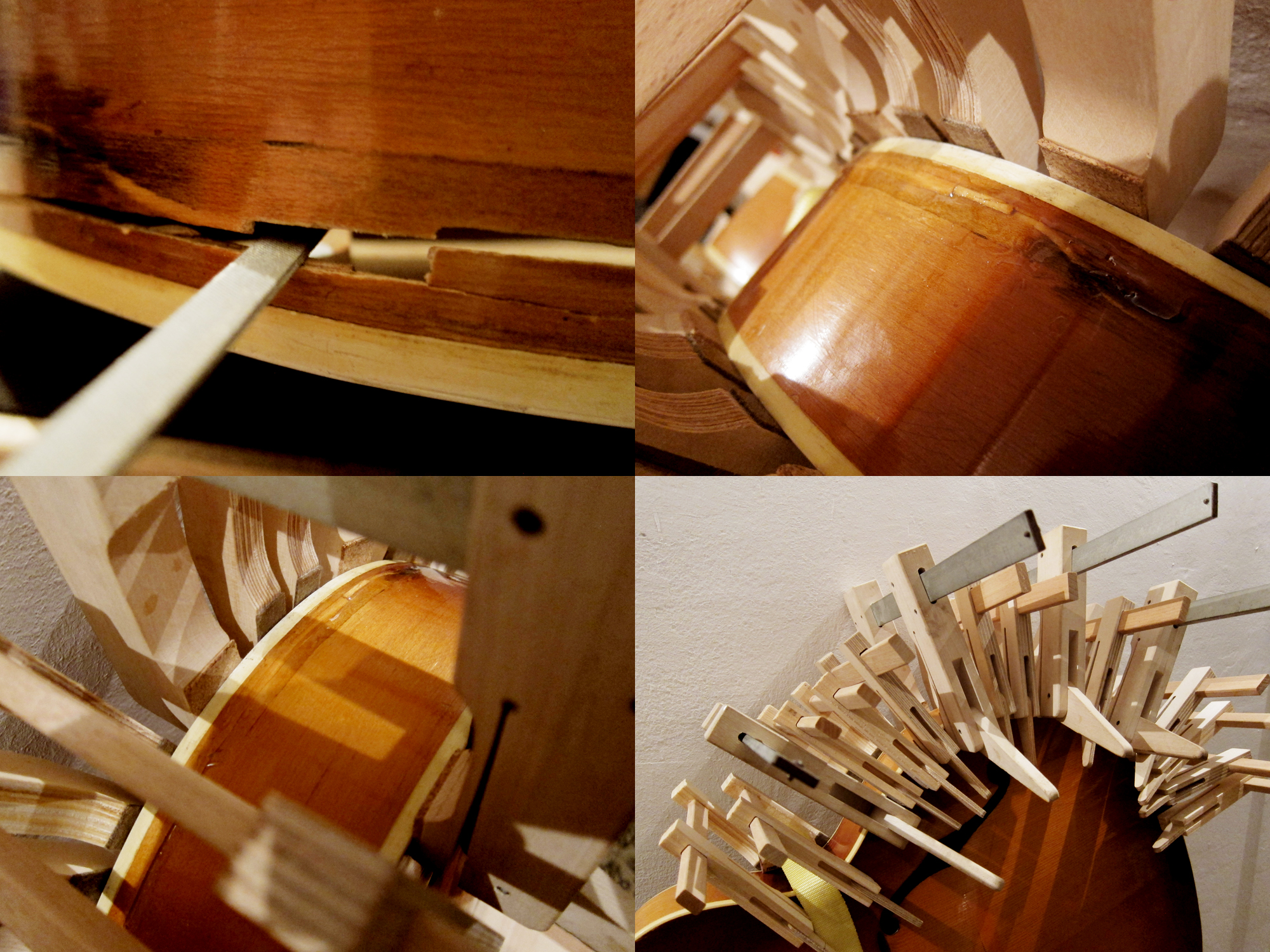
First I had to deal with the crack that was running along the whole bottom side, from the upper bout to the endpin. There was also another crack, or hole, that the previous owner had glued in perhaps not the most discrete fashion.
I have never attempted to glue anything this big before but there is a first time for everything. I noticed that there was a piece of wood missing so I started with making the hole square and then I fitted a little piece of wood in the exact same size. The main problem I had was that the guitar had been cracked for so long, with the tension of the strings I think, so the whole side had kind of warped. In parts the crack was overlapping in one way then suddenly changed to go the other way. Which meant that when I was trying to close the crack it didn’t line up, at all. I did my best and with a bit of force and a lot a clamps I managed to get it to close at least, even if it didn’t line up perfectly. I know that the correct way of doing this would have been to glue cleats on the inside and perhaps a string coming trough that you can tighten from the outside or even better, magnets, but unfortunately the crack was just over the kerfing which would have made it hard to glue any cleats on top of the kerfing. I also couldn’t figure out a way of getting any magnets inside an archtop, there wasn’t really any way of getting my hands in there.
It went ok for being my first time and it seems to be very solid after letting the fish glue cure for 48 hours, I added some extra glue over the old crack too just to be on the safe side. I sanded everything smooth and then lacquered with shellac, I was trying to match the original lacquer but it turned out to be impossible to copy the sunburst. Maybe I can figure out a way and redo this part but at least now the guitar is playable. I buffed up the old lacquer and made it blend with the new shellac by polishing it with metal polish, that always works great on old guitars. It’s the same technique I use for the back of the necks, filling the dents with nitro lacquer and then sand it smooth and buff it up with metal polish. The original machine heads are pretty wonky but they work fine and cleaned up nicely, just like the tail piece, so I decided to keep the guitar all original.
It has been an extremely good Christmas, not only did I manage to find a 1979 Fender Stratocaster, I also received a little Levin LT-14 from 1965. It’s the smallest of the 1960’s Levin guitars and is roughly like a Martin 00 in size. I bought it about two weeks ago from a guy in Heidelberg, Germany and then it got stuck in some warehouse over Christmas until the Spanish post service could be asked to deliver it. It’s an awesome guitar, pretty much like my dad’s old Levin LT-16 but a tiny bit smaller and with a bit less bass but with more clarity in the upper register. It’s also ladder braced instead of X braced which is not necessarily a bad thing in this case, it gives it a pretty great sound. The weirdest thing is that it’s so well kept for being 50 years old, close to mint and it can’t have been played much in it’s life. Well that’s going to change now because I really like it, especially for finger picking and I’m sure it will mature and sound better and better the more it gets played. This is my 10th Levin, or 11th if you count a Levin LS-16 that I have waiting for me in Sweden. Perhaps it’s time to stop buying old Levin guitars but I can’t, they are just too good to turn down. I have liked some of my Levin guitars less and then one day they surprise you and just sound amazing. I guess the more you play them, the better they sound.
It’s the first time I get a 50 years old guitar home and I have to do nothing to it. There are actually no scratches to the top, that’s just in the grain of the spruce.
Levin LT-14 / Goya T-14 Grand Concert size: Body width: 360 mm, body length: 465 mm, body depth: 98 mm
Fingerboard width: 43 mm, scale length: 630 mm
Spruce top, mahogany back and sides, 4-ply bound top, single-bound back
Mahogany bolt-on neck with adjustable truss rod
Unbound rosewood fingerboard with bass side dot inlay
Nickel plated individual Van Gent tuners with metal buttons
Rosewood bridge, matte natural finish and one year warranty
Now I actually have all three, the Levin LT-18, well it’s a Goya T-18 but close enough, my dad’s old Levin LT-16 and this new little Levin LT-14. Taken from a 1965 Levin catalogue. Thanks to Vintage Guitars Sweden
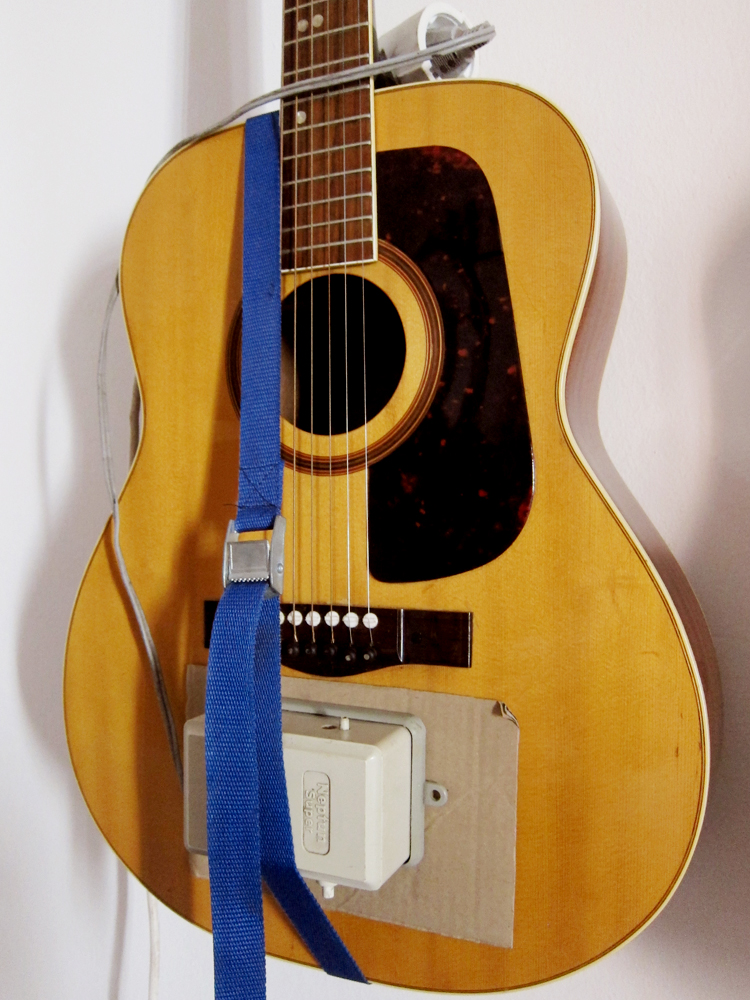
A great way to improve the tone of your acoustic guitar and to get it to open up is to use a normal air pump from a fish tank to give the top a massage. I got an old one, I think the older they are the more they vibrate, that I use on guitars that I buy that hasn’t been played for years. It works great and seems to add both bass, volume and clarity to the guitar. A day or two with the pump is like months of actually playing.
 Rondo, built by Levin in Gothenburg Sweden in 1960

 It was in pretty good shape when it arrived. I had to glue a couple of small cracks, polish the frets, oil fretboard and machine heads and give her a good clean but that was it. The only problem was that this had to be done when my wife wasn’t around so I’ve been a guitar repairing ninja for the last week.
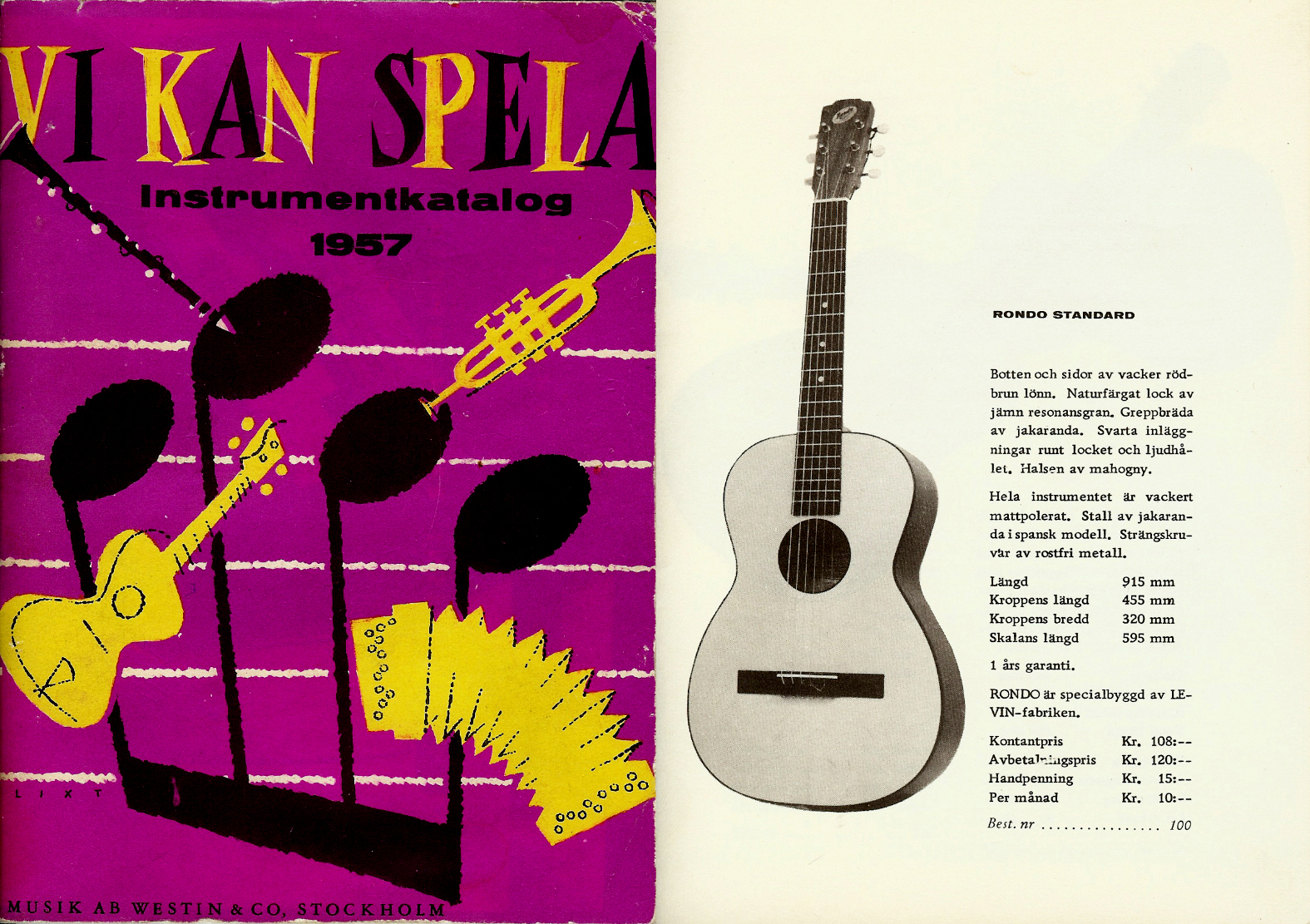 The Levin built Rondo guitar in a 1957 catalogue from Musik AB Westin & Co
 Levin Model 46 Classic











 Claescaster