Claescaster

Tag: guitars

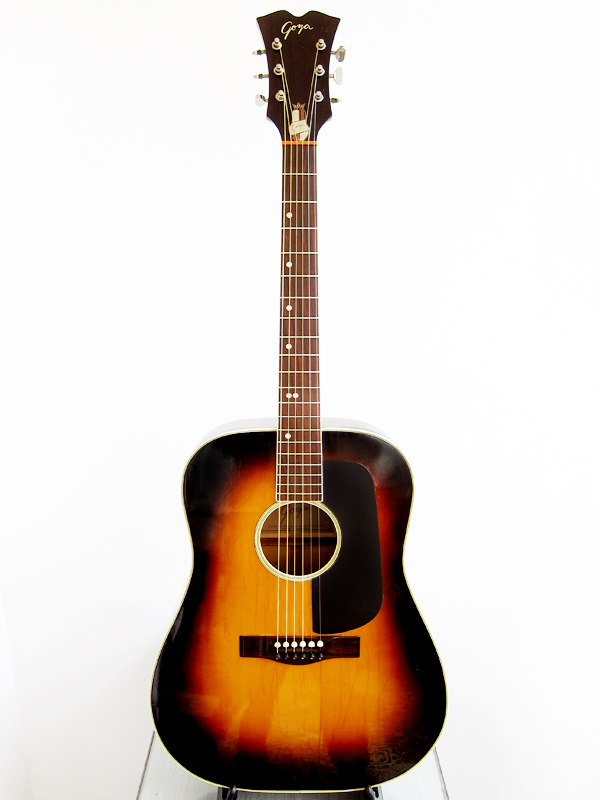
Goya 163

Goya Model 163 Made in Sweden 1968
A very early Goya Model 163, they were introduced in 1969 but the serial number puts this one to 1968. That would make it the earliest known example on the Vintage Guitars Sweden site. Levin serial numbers / Goya serial numbers

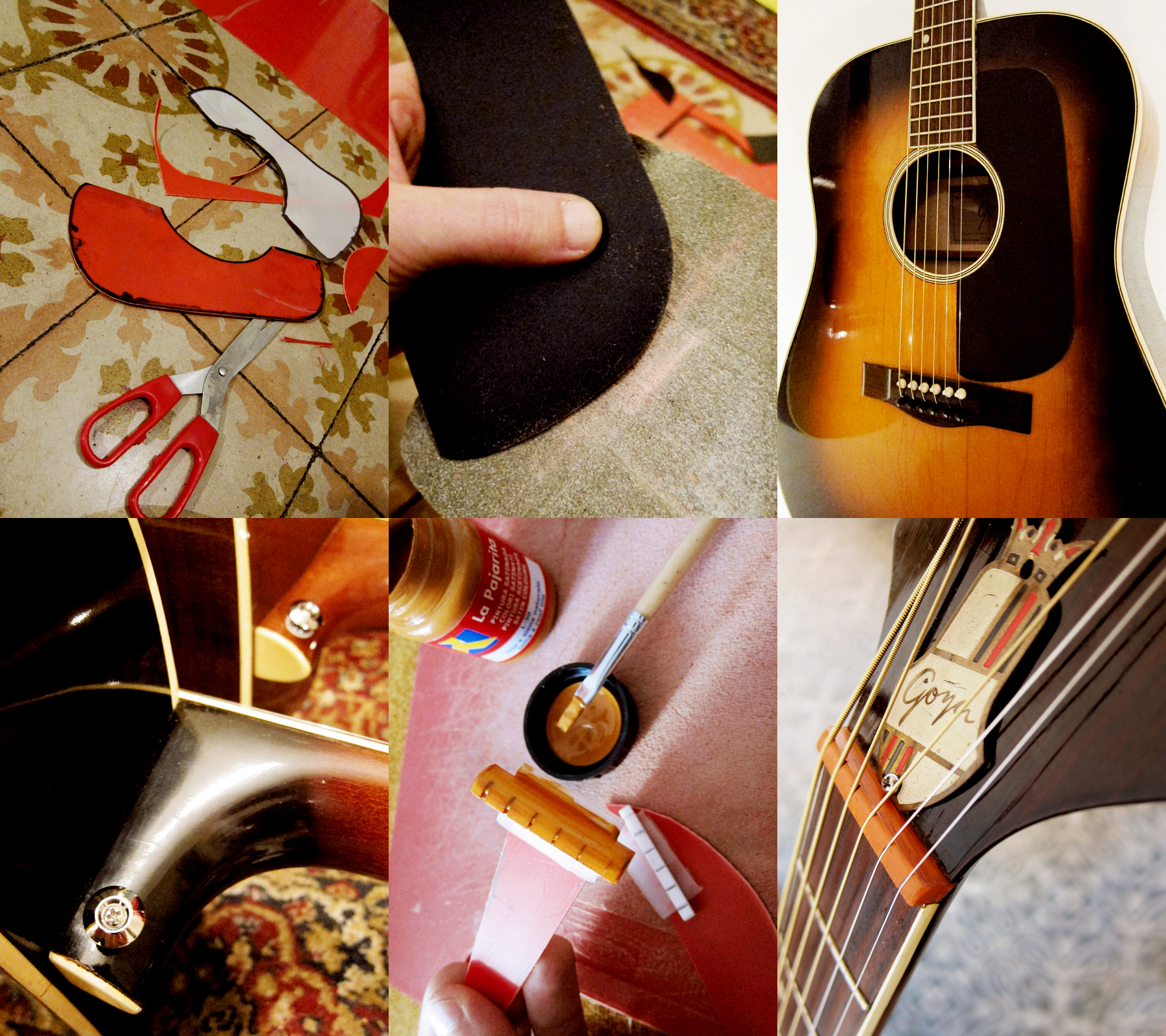
I thought I might as well post some images of the Goya 163 I received back in January. There was some work to be done, actually quite a lot. First I had to reset the neck to get the action down and then I had to remove the bridge and redo the saddle screws. I cut a new pickguard over the weekend, well it’s not perfect yet, I’m still looking for a better material but it will do for now. I bought this Goya from a girl called Marilyn Moser in Maynard, Massachusetts. She had used the guitar for some live gigs in the New York area but gave up on it because of the high action, it was fairly unplayable when I got it. The guitar came with a nice handwritten note to me, the new owner, that’s why I got curious to find out a bit more about her. Here are links to some of her music and her awesome 1960’s blog.
Goya Model 163 Made in Sweden 1968
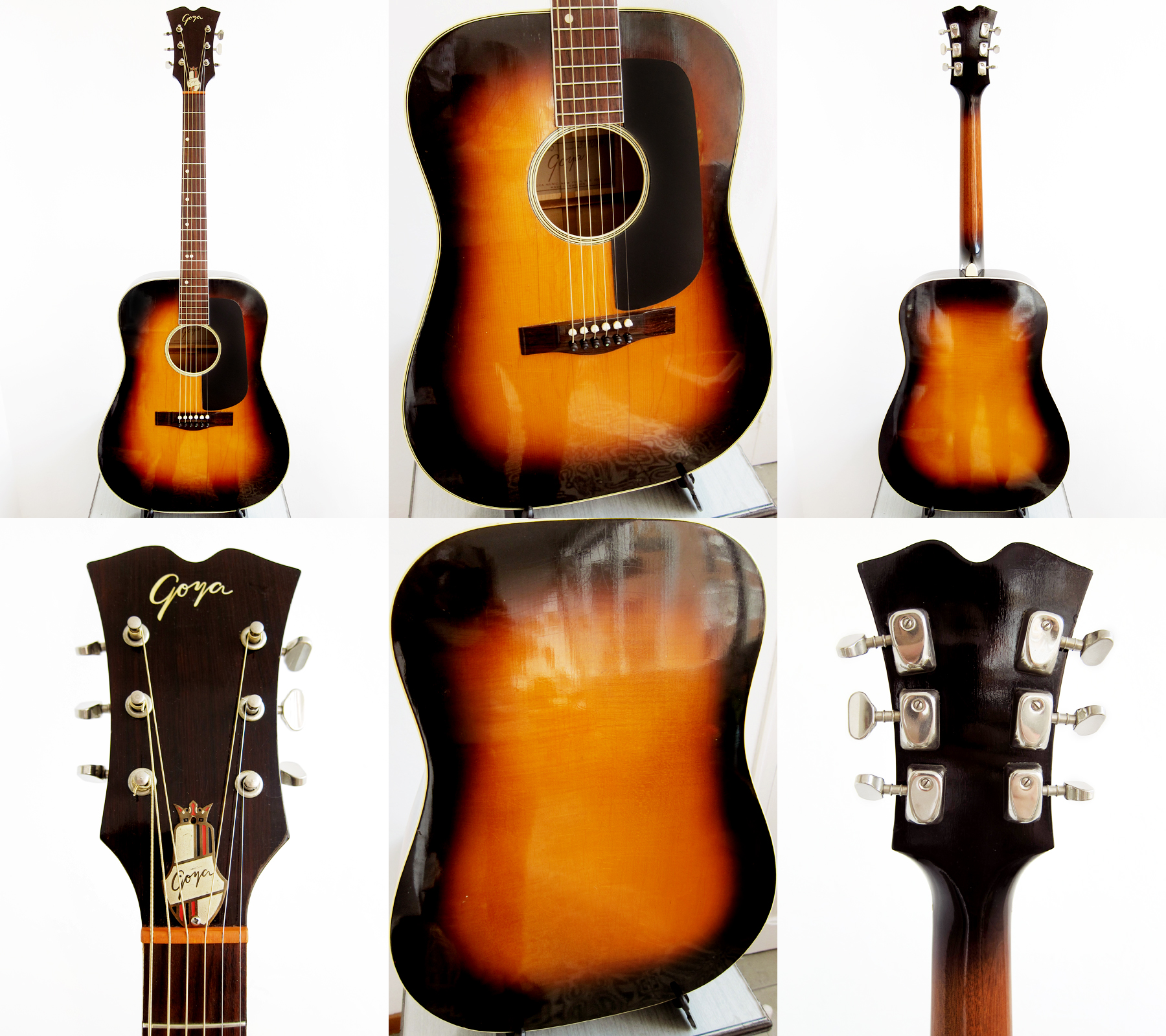
Goya Model 163, made in Sweden by Levin in 1968

Levin 163 / Goya 163
Goliath size: Body width: 400 mm, body length: 505 mm, body depth: 95/120 mm
Fingerboard width: 43 mm, scale length: 630 mm
Spruce top, flame maple back and sides, 4-ply bound top, single-bound back
Mahogany bolt-on neck with adjustable truss rod
Single-bound rosewood fingerboard with bass side pearloid dot inlay
Rosewood bridge with individual height adjustable plastic saddles
Nickel plated individual Van Gent tuners with metal buttons
Sunburst finish and ten year warranty
Goya Model 163 Made in Sweden 1968
I still haven’t found a good pickguard material. Well the red plastic that I happened to find in the street is actually perfect but who wants a red pickguard. I’ve managed to find 0.8 mm thick matt black plastic but I need something around 1-1.5 mm and preferable in high gloss jet black or even better in red tortoise.  I fitted a strap button in the usual place, and then I painted the new bone nut orange to match the original Levin Galalith nut.

Levin Goya Model 163 1968
Update: March 21, 2014 The pickguard material I ordered from China looked a lot classier than expected so I cut in to shape and put it on

Movie of the day

Mark Knopler's first guitar
Mark Knopfler with his first guitar, a Höfner Super Solid

Global Shipping Program

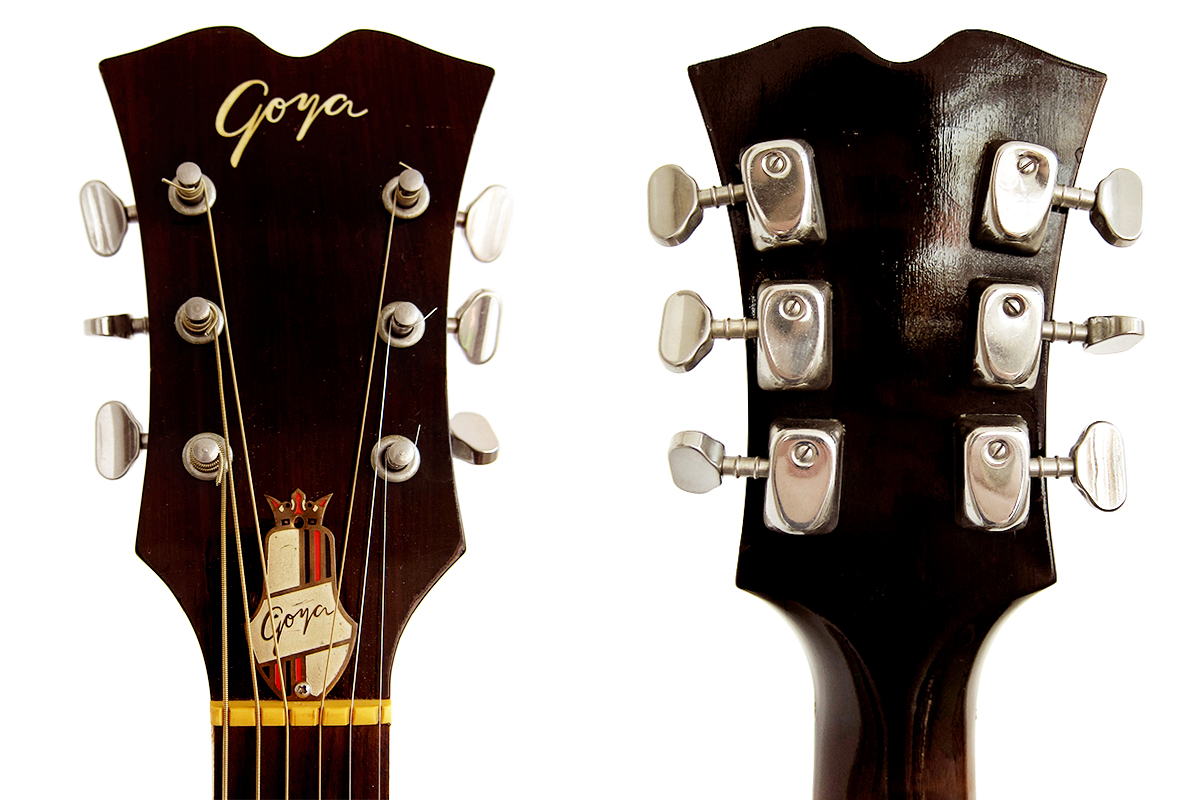
1968 Levin / Goya 163 head
Goya Model 163 , made by Levin in Sweden in 1968

You might have noticed that eBay have started with something new, well fairly new, called Global Shipping Program. Basically you pay all the import taxes and charges straight away and therefore don’t have to go through the customs when the item arrives to your country. I have had some issues in the past when I have bought things from the US, like my Claescaster body and my Goya T-18. It took the Spanish customs a month the process the item and deliver it to me and they charged me 40% of the original price including shipping in import tax and other fees. I recently purchased a lovely Goya 163 from Massachusetts using the Global Shipping Program and it took exactly 14 days to get it and I only had to pay 32.5 % tax on the actual price of the guitar, not final price plus shipping as they normally charge me when it goes through the Spanish customs in Madrid and best of all, no paperwork. So for anyone living in Spain I can highly recommend buying things from the States using the Global Shipping Program.

Guitars for sale

This is the last acoustic guitar I have left for sale, all the others are gone now. If you’re interested or have any questions just send me an email claesgellerbrink@gmail.com or give me a call 639586158.

Suzuki Three-S F-120
Suzuki Three-S F-120 Dreadnought acoustic, Made in Japan, 1976, 250€ SOLD
A nice Suzuki Violin Co. LTD, Suzuki Three-S F-120 built in Japan in 1976. It’s in really good shape with just a few scratches on the back and sides, nothing that stands out. The tone is great, very clear sounding and it’s really easy to play with low action and no buzzing. It seems to be solid spruce top, nato back and sides, with nato neck and rosewood fingerboard. It looks like it’s a Martin D-18 copy. The neck is straight, no marks on the back and everything works as it should. A well built Japanese acoustic from one of the most famous guitar makers. You can find videos on Youtube here: Suzuki Three-S F-120 and here: Suzuki Three-S F-120 (bonus).

Wilkinson WJ44

Morris W-40, Wilkinson WJ44

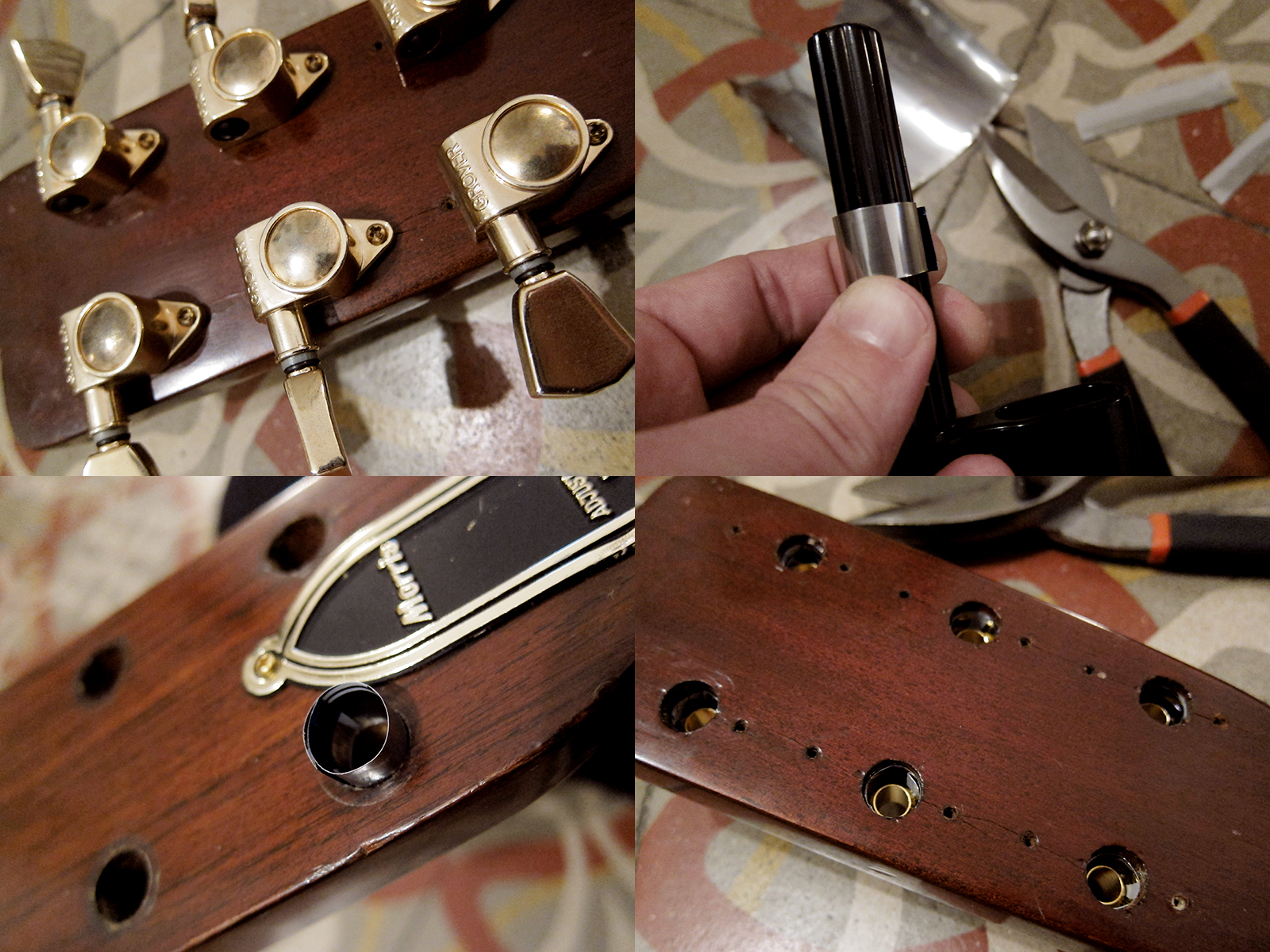
I just installed a new set of Wilkinson WJ44 in gold on my Morris W-40. I wasn’t happy with the fake 10€ tulip Grovers I had before so I decided to get some Wilkinson Deluxe tuners instead. They cost me about 33€ including shipping from Vansonguitars on eBay. I really love the tulip shape and will always chose that if possible but I really don’t like the green buttons that most companies use, even the big ones like Schaller, Kluson and Grover. Luckily Wilkinson has started to make their deluxe tuners in both vintage green and cream white so I could get my beloved gold deluxe tuners in off white instead of hospital green. Another good thing with these Wilkinson’s is that they have a 9mm bushing instead of 8mm which makes them easier to fit if you have modern 10mm holes for the tuners. Wilkinson are manufactured in Korea by Jin Ho and I’m very impressed with their quality considering how the cheap they are. I have both Wilkinson tuners and bridge on my Claescasters, I love their vintage bridge with compensated brass saddles.

Morris W-40, Wilkinson WJ44
Since the Morris W-40 has 10mm holes I had to try to make the 9mm bushings 1mm bigger. I decided to try the beer can trick which turned out to work pretty well. Cut a can open and remove the top on the bottom and then just cut strips as wide as the bushing. 1mm might sound like nothing but the bushing needs to sit tight in the holes otherwise they will be pulled out or move from the string tension. I had to go for about 1.5 strip to fill the gap and there was a lot of fiddling and pain in my thumbs to get it in place but I eventually succeeded.

Morris W-40, Wilkinson WJ44I was hoping that the screw spacing matched the old Morris tuners but they didn’t so I had to drill new holes. They are going to be hidden under the original tuners if I restore it but for now, I prefer gold and tulip buttons to the original Japanese 70’s chrome tuners.

Guitar of the day

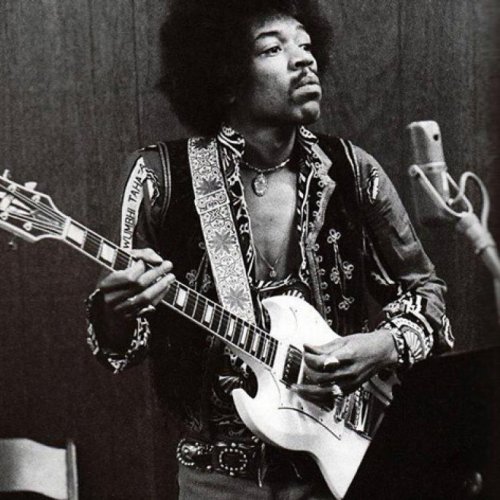
Jimi Hendrix 1967 Gibson SG Custom

En3BN0lXMAEaZjV
Jimi Hendrix on his 1967 Gibson SG Custom

Jimi Hendrix 1967 Gibson SG Custom

https://youtu.be/gYC0CzGSGSo

Jimi Hendrix playing Redhouse live in Sweden Jan 9th 1969

Japanese guitar catalogues

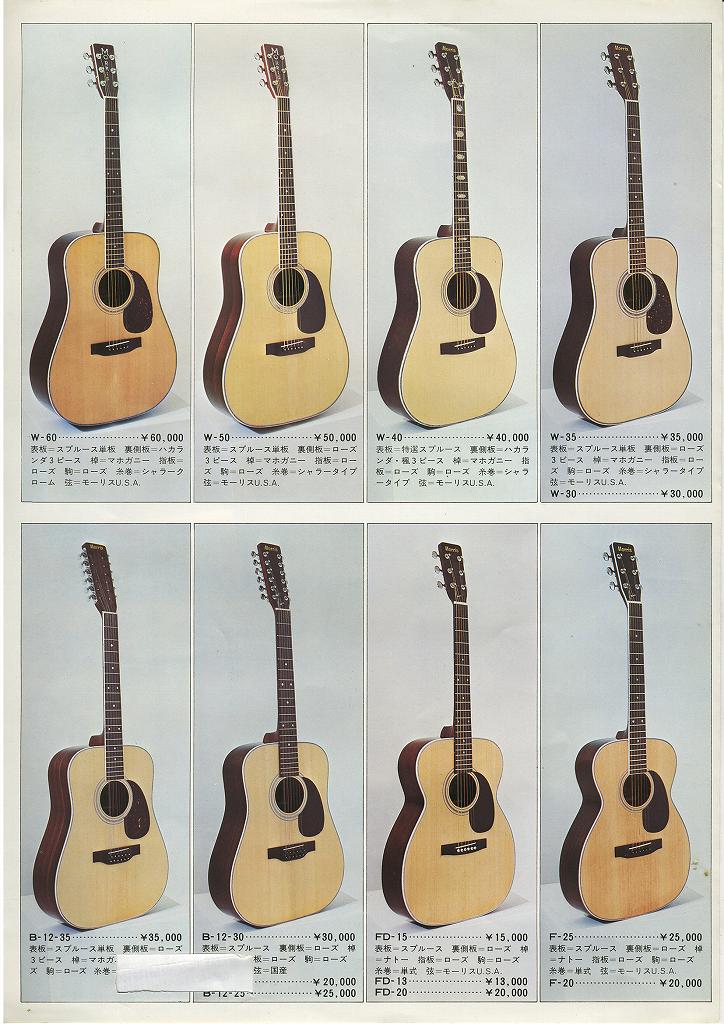
Morris catalogue Japan 1976

I’ve recently come across I pretty good source for old catalogue scans for Japan made acoustic guitars. It’s called oldguitar and has about 50 different Japanese guitar brands represented, some brands has more scans than others and most of them are in Japanese but it still pretty nice to see your guitars in old catalogues. Unfortunately I only managed to find my Morris W-40K. Yairi TG-40 and Suzuki Three-S F-120, my Morris WL-35 and Kiso Suzuki WE-150 seems a bit harder to track down.

Morris W-40 1973
Morris W-40
Made in Japan by Terada 1973

Morris catalogue Japan 1975Morris W-40 in the Morris catalogue for Japan 1975

K. Yairi TG-40 Made in Japan 1977

Yairi TG-40 Japan Catalogue 1970'sYairi TG-40 in a Japan Catalogue from the late 1970’s

Suzuki Three-S F-120
Made in Japan 1976

Suzuki Three-S catalogue USA 1979Suzuki Three-S F-120 in the Suzuki Three-S catalogue for USA 1979

Kiso Suzuki Violin Co. LTD. WE-150
Kiso Suzuki WE-150
Made in Japan 1970’s

Kiso Suzuki Violin Co. LTD. catalogue Japan 1976My Kiso Suzuki WE-150 seems to be a mix of the W-150 and then WH-200 in this catalogue from Japan 1976

Blog of the day

The Selvedge Yard, The Rolling Stones guitars backstage in 1969
The Rolling Stones guitars backstage in 1969

I really love The Selvedge Yard it’s easily one of my favourite blogs. It’s such a great mix of everything a modern man that is stuck in the past likes. Here is a great new post, The Rolling Stones | Road worn, forlorn & almighty guitar porn


Suzuki Three-S F-120

Suzuki Three-S F-120Suzuki Three-S F-120 Made in Japan in 1976

I recently came across this Suzuki Three-S F-120 that I have fixed up and it’s now for sale. It seems to be a copy of an early Martin D-18, it feels less bulky than most dreadnoughts. Built in 1976 by Suzuki Violin Co. LTD in Nagoya Japan. It’s a beautiful guitar in a really good shape for being almost 40 years old. It’s very easy to play with low action and it has a great tone, very warm and rich.

Suzuki Three-S F-120I took the machine heads a part, cleaned, polished and oiled them before I put them back together. I polished the frets and oiled the fretboard and then made a new compensated saddle in bone. Now it sounds and plays great.

Suzuki Three-S F-120Suzuki Three-S F-120
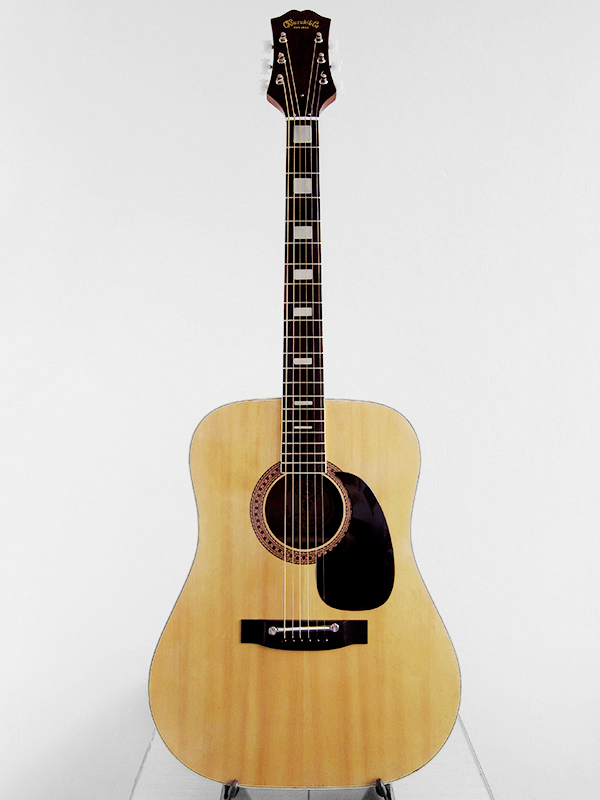
I have another Suzuki for sale, however, these guitars were not made by the same company. Both were originally building violins so both are called Suzuki Violin Co. LTD but they were based in different parts of Japan. Kiso-Suzuki manufactured guitars in the region of Kiso-Fukushima. Nagoya Suzuki manufactured guitars in the region of Nagoya. 

Suzuki Three-S F-120I finally found an old catalogue for it. It seems to be spruce top, nato back and sides and nato neck with rosewood fingerboard
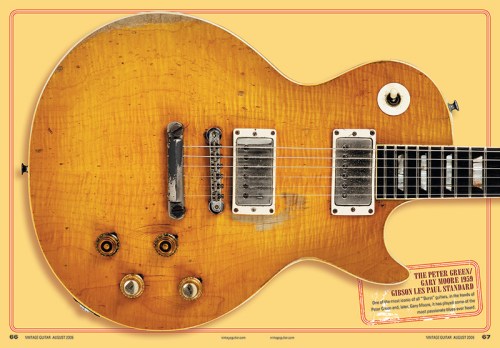
Guitar of the day

PGBurstPeter Green 1959 Gibson Les Paul Standard

One of the most famous and highly collectable vintage guitars of all time, the infamous Peter Green Les Paul. Most Blues fans will know that as well as being revered for his amazing tone and unmistakeable vibrato, B.B. King once remarked “He has the sweetest tone I ever heard. He’s the only one who gave me the cold sweats.”, over the years Peter’s Les Paul has built up a similar legend in guitar folklore. Now in the hands of a private collector, it made it’s journey through Peter Greens hands and into the arms of Gary Moore who put it to good use on a number of his albums and live shows. Earlier on in his career, Peter Green played a  Harmony Meteor, a cheap hollow-body guitar, but quickly started playing a  Gibson Les Paul with  The Bluesbreakers after he replaced Eric Clapton in the band. Green’s guitar was often referred to as his “magic guitar”. “I never had a magic one. Mine wasn’t magic…It just barely worked” said Green in 2000. “I stumbled across one when I was looking for something more powerful than my Harmony Meteor. I went into Selmer’s in Charing Cross Road [central London] and tried one. It was only £110 and it sounded lovely and the color was really good. But the neck was like a tree trunk… It was very different from Eric’s Les Paul, which was slim with a very fast action.”

In part, his unique tone derived from a modification to the neck  pickup which was reversed and rewired, a modification made after 1967. For anyone looking to modify their guitar in the same way, we found a link to a nice blog here on how to perform the tone mod in detailed steps http://www.geetarz.org/axes/green.htm

It was in the early 70’s when Green passed the guitar over to Gary Moore. Peter was suffering from mental health problems and would put his guitar down for the best part of 8 years. At the time, the Irishman was a friend and close neighbor of Green’s in London. Green initially tried to give the Les Paul to him on the understanding that he could ask for it back when he was well enough to play again but Moore insisted on paying the £110 that it originally cost and Peter Green never did ask for it to be returned. Once in the hands of Gary Moore, the guitar went on to be used on a number of recordings, most notably the ‘Blues For Greeny’ album of Fleetwood Mac covers dedicated to the orginal owner. Green used it extensively until he sold the guitar in 2006.

Peter Green and Gary Moore with the 1959 Les Paul Standard

Gary Moore explained why he parted ways with the iconic instrument: “It’s a long story. The instrument itself was a very special instrument, obviously. But it got to the point where I couldn’t take it anywhere. I didn’t want to sell it. I had to sell it for various reasons because I injured my hand a few years ago and the insurance didn’t pay up, and I had to cover the tour costs for canceled shows with my own money, and I didn’t get paid for any of the shows, obviously, or for anything. I ended up with debt. So it was kind of a financial thing, really, and that was the quickest way to do anything about it. So I never wanted to sell it. I mean, why would I? I kept the other ’59 Les Paul and I sold that one. That guitar was played by Jimi Hendrix, Jeff Beck, Rory Gallagher played it, and I’ve played it. It was a very special instrument. Les Pauls are all so different. That one is a big old battle axe. Peter Green never really liked that guitar because the neck was too big. He wanted me to have it because he said he wanted it to go to a good home.” Taken from Interactive Guitar