Guitar Moves
I’ve been watching a couple of these while eating lunch in front of my computer. I’m not really sure if I have learned anything new but I kind of like the format, very relaxed.
I’ve been watching a couple of these while eating lunch in front of my computer. I’m not really sure if I have learned anything new but I kind of like the format, very relaxed.
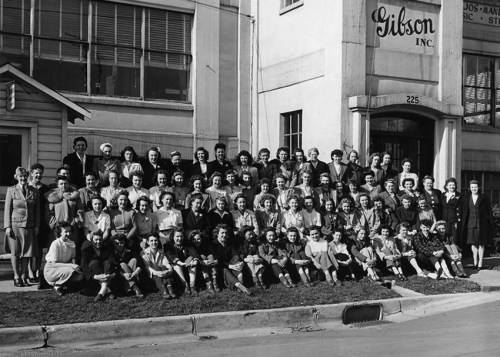
I have never thought about before but of course everything was built by women during the war. Not just guns, aircraft and cars, guitars as well. Kalamazoo Gals: A Story of Extraordinary Women & Gibson’s ‘Banner’ Guitars of WWII by John Thomas is a book that came out in 2013.
The book revolves around the interviews of a dozen women who appeared in the Gibson Guitar Company’s 1944 workforce photograph. Prior to my discovery of these women, Gibson had claimed in Wartime advertisements and in a 1973 company history authored by its WWII personnel director that it ceased producing guitars during the War. The younger members of its workforce had left to serve the military War effort. The remaining seasoned craftsmen repaired some instruments but, because of their limited numbers and wartime restrictions on the use of raw materials, were unable to construct new musical instruments. I discovered that the female workforce produced nearly 25,000 instruments during the war. Taken from Banner Gibson

I have always been gay for the H.S. Anderson Mad Cat. I’m not even a Prince fan, this is the guitar that Prince made famous and used during the first half of his career, it’s something else. I think I really like it because of the unique look, it’s a bit too much of everything, a “all in” kind of guitar. The leopard pickguard should be too much but for me it just looks awesome, actually it reminds me a bit of Prince, but in a good way. If an African dictator, you know the ones with huge palaces in marble while the people are starving, needed an electric guitar, this would be it. I’m sure that Gaddafi had a couple in his guitar collection. H.S. Anderson was created by Mr. Hidesato Shiino and distributed and crafted by Moridaira who made Morris. Morris have always been seen as one of the better acoustic guitar builders but their electric guitars were fairly poor in the early 1970’s. When Shiino started H.S. Anderson in 1973 it was meant as a high quality custom shop brand aimed at the professional Japanese market. Here is some more information taken from Music-trade in Japan:
Mr. Shiino said that the original design of MADCAT came from the Takahiko Ishikawa who is top guitarist here in Japan (Maybe Mr. Ishikawa played over 10,000 songs…!!! He is mainly playing the acoustic guitar). Anyway, when they have a drinking, Mr. Ishikawa just wrote the original design of MADCAT. A few weeks later, Mr. Shiino added his idea and made the prototype of MADCAT. Well, about Mr. Shiino, you could check my JV history page. The logo mark was designed by Mr. Atsuro Yamada who is currently Managing director of Gramco Ltd – Top Strategic Brand Consulting Company. Mr. Shiino and Mr.Yamada were a good friend, and Mr.Yamada designed the logo mark and even MADCAT illustration. The Morris factory for H.S. Anderson was independent from Morris Acoustic guitar factory in Nagano. I’ve heard hat 3 craftsmen (Mr.Shinoda, Mr.Imafuku – He is Fujigen manager currently and other craftsman) made H.S. Anderson brand guitars. Early days (1973 -1974) made Madcat hasn’t got the serial numbers and signature in cavity. Later day (after 1975), H.S. Anderson guitars have their signature of these builders somewhere – PU cavity. Of course, Mr. Shiino left already (He established the ESP in 1975).
Music-trade has a beautiful Mad Cat in their collection that is unfortunately not for sale, which I can understand. I have actually never seen a real H.S. Anderson Mad Cat on eBay, only later versions made by Hohner, they were made in the Moridaira factory too, at least the first versions. The later Hohner “The Prinz” guitars that came in the 1980’s were most likely made in Korea by Cort. There has been numerous re-issues of the original H.S. Anderson Mad Cat, some better than others. Now there is one called Vintage re-issue Mad Cat made by Moridaira, the plant that made Morris and H.S. Anderson back in the 1970’s. Here is a review from Premier Guitar.

I do love the H.S. Anderson cat

Prince back in the days with his H.S. Anderson Mad Cat
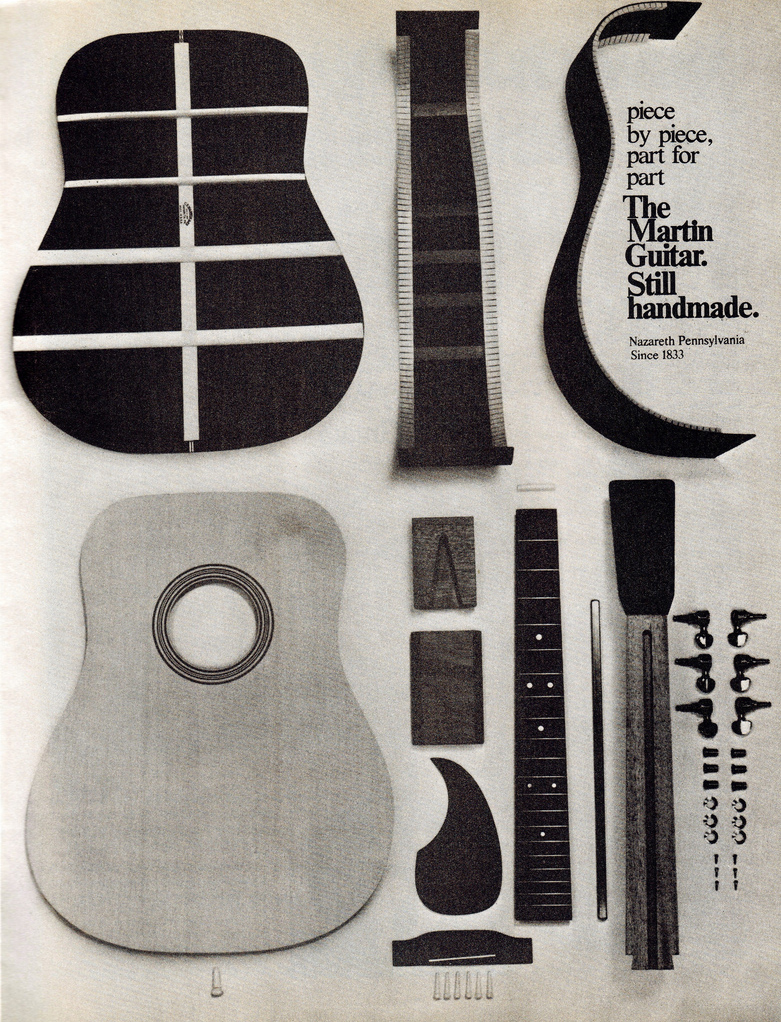
Martin guitar ad from Guitar Player Magazine, September 1974. I love how few parts an acoustic guitar has.

My Westone Stratocaster is getting the strings adjusted to the 7.25″ radius of the fretboard
I recently received my Understring Radius Gauge set from the friendly Portuguese luthier supplier Guitars & Woods. If I had only bought this before I ordered four new sets of Jescar frets from Philaluthiertools. I stupidly thought that most of my old Japanese guitars had a radius of 9.5″, they didn’t feel as curved as my Fender Telecaster TL52-75, which I knew had a radius of 7.25″. It turned out that both my Greco Teles and Hohner and Westone Strats had a vintage radius of 7.25″, so now I have to order new frets for them. I have never really cared about adjusting the strings after the radius, I read somewhere that Eric Clapton and others had the saddles flat so I thought I could have that too but when I received my Greco Spacey Sounds TL-500 back in September and it had really well adjusted action set after the radius I instantly fell in love. It’s such a difference on a Strat or Tele with a 7.25″ radius, you can really see and feel the curve. I adjusted all the guitars I could according to their radius and in most cases I had to raise the string height on the D and G string, which makes them really snappy and twangy, it sounds and feels awesome on my Telecasters.

The Fender Fullerton Plant at 500 South Raymond Avenue in 1959
After including a tour of the K. Yairi factory yesterday I came to think of a video I saw about a year ago, a tour of the Fender Fullerton plant in 1959. Enjoy!
1959 8mm Film by Forrest White. Digital Film Restoration by CinePost http://www.posthouse.com Edited by Ross Lenenski. Read the story behind this film in “Fender: The Inside Story,” by Forrest White available at Amazon: http://www.amazon.com/Fender-Inside-S… Music by Russell Eldridge
 Hagstrom Viking, Tobacco Sunburst 2008
It’s with a heavy heart that I have decided to part with my Hagstrom Viking. I bought the guitar back in 2010 and have unfortunately not had time to play it as much as I wanted, some Japanese Telecasters got in the way. I had three semi-hollow bodied guitars at one point and kept this the longest, I sold the other two last year. I guess the more guitars you have the more you realise what feels good for you to play. For me, fat necked Telecasters feels really nice to play, I’m a bit gay for old Greco Telecasters from the 1970’s. If you are interested in inherit this Hagstrom Viking from the Claes Collection then get in touch. You can read more about it here for sale, or in Spanish here.
Update: April 4, 2014 The Hagstrom Viking is now sold to Rafa from Cobarde.
Hagstrom, or Hagström as we call it back home, was founded in 1925 by Albin Hagström in Älvdalen, Sweden. They made amazing electric guitars from 1958 to 1983, played by guys like Elvis Presley, Jimi Hendrix, Noel Redding, Joe Walsh, Dweezil and Frank Zappa to name a few. I have played on a lot of Hagstrom guitars and amps during my teenage years back in Sweden and learned to play bass on my stepdad Sten’s Hagstrom Jazz bass from 1976. I have an fairly mint Hagström HIIN OT from 1975 back in Sweden that I really like. I guess it was out of national pride that I got so excited and bought the Hagstrom Viking when they started to make them again in 2004. They have a few models that are made in the EU, but not in Sweden, and the rest is made in China. I have actually only played my Viking from 2008 so I can’t really comment on the quality of the Chinese Hagstroms today but mine is very well built for the price. I would say that they are better than Gretsch Electromatic, Epiphone and the Ibanez semi-hollow bodied, all in roughly the same price range.


Tanglewood Premier TW133, designed in the UK and handcrafted in China in 2010
When I met my other half Araceli back in 2007 she already new the basic cowboy chords but never really played guitar, I had only heard her strum a handful of times. She told me that she didn’t really like to play on my guitars since I seemed to care so much about them so I thought the best way around that would be to get her a guitar of her own. I also felt that since I had experienced so much joy through music in my life that would be the least I could give to the woman I love. I talked to her family and we agreed to put in 50 Euro each and get her a guitar for her birthday in September 2010. It was down to me to find a suitable guitar within our budget so I started to do some research. I knew that a parlour guitar would be best option, she is pretty small so I thought that a small bodied guitar would be easier for her to handle. I already had an inexpensive parlour a Vintage V880N that I liked but didn’t love so I thought I would try another brand this time and started to read about Tanglewood. People seemed to really like them, especially in the UK, and they had quite a few parlour sized models so it felt like a good start. Since you can’t just walk in to a guitar shop here in Barcelona and try what you are looking for, the shops here are useless and have nothing in stock, I had to rely on reviews and then order the guitar online. In the end I went for the Tanglewood Premier TW133, since I thought she would really like the look of it, or at least I loved the dark wood and the simplicity of it. I also felt that a solid mahogany top and back would give a bit more warmth and body to it compared to most new made parlour guitars which I feel normally lack that. She was really happy with her birthday present and started to play almost daily and soon after we even started a band together called Chest Fever.

Araceli, Chest Fever session, Barcelona 29-04-2012
Tanglewood Premier Historic TW133 ASM
SHAPE: Parlour, TOP: Solid Mahogany, BACK: Solid Mahogany
SIDES; Mahogany, NECK: One Piece Mahogany
FINGERBOARD: Rosewood, BRIDGE: Rosewood
SADDLE: PPS, Compensated, 72mm, NUT: PPS (43mm)
SCALE LENGTH: 650mm, BRIDGE PINS: Black with White Dots
MACHINE HEADS: Chrome open geared (changed to gold Grovers)
FINISH Natural Satin, STRINGS: D’Addario EXP11, 12-53, RRP: £269.95
 Gibson S-1 advert from 1977 with Ron Wood
Gibson’s S-1 was a guitar that tried to find a niche and couldn’t quite succeed. Created in the late 1970s when the guitar company was owned by Norlin, the S-1 was a hybrid’s hybrid. Featuring three single-coil pickups, a four-position chicken head phase selector switch- plus a toggle switch- but only one tone and one volume knob, and a bolt on the neck, the guitar seemed like an attempt to create an American guitar to outdo the Teisco Spectrum. The guitar was sold from 1976 to 1980, but despite getting Ron Wood on board as an endorsee, he had just taken over Mick Taylor’s spot in The Rolling Stones, almost no one was interested in a Gibson that tried to be a Fender by way of Tokyo. It eventually suffered the same ignoble fate as a similarly designed and marketed Gibson, the Marauder. Taken from The National GUITAR Museum
 Levin Model 174 Made in Sweden 1972
My latest acquisition, a 1972 Levin Model 174. The story how I got this guitar is pretty amazing. I wrote a post about Levin guitars back in August 2013 when I had just started to collect them. In the end of the post I mentioned that I would love to find a Levin Model 174, it’s basically a Levin LT-18 but with a massive head. There is something about that huge head that I find very appealing, I guess it reminds me of old an archtop guitar from 1930-40’s and it’s almost a bit Art Deco. Three months later, in the end of November, I got a comment from a Danish guy called Orla saying that he had one for sale. We started to email each other and he told that a few days earlier he had seen a guy about to throw a guitar case in a skip so he had gone up to him and asked if he could have it instead. Orla took the case home, opened it and found a 1972 Levin Model 174 in pretty good shape inside. He Googled the name and model and pretty soon found my blog post saying that I was looking for one. Since Orla doesn’t play guitar himself, he just wanted to save it from a certain death, he contacted me and offered me to buy it and I’m very grateful that he did. It was a bit scary to buy a guitar from a guy I didn’t know who had contacted me through my blog, it felt a bit fishy somehow. A part of me thought it was a Nigerian email scam in disguise and another part said that I should trust the good in people, especially a Northern neighbour like Orla. In the end I decided that it was an offer I really couldn’t turn down, especially since most of the 174’s I had seen for sale were all Goya labelled and made later in the 1970’s. It took some time to get the guitar down to Spain, we had some logistic issues but finally it arrived about two weeks ago and I was stunned. Since Orla doesn’t play he couldn’t give me any info about what state the guitar was in, he had sent me some pictures but it’s pretty hard to get an idea if it’s even playable from just that. Luckily it was in a really good state and it both sounds and feels great.
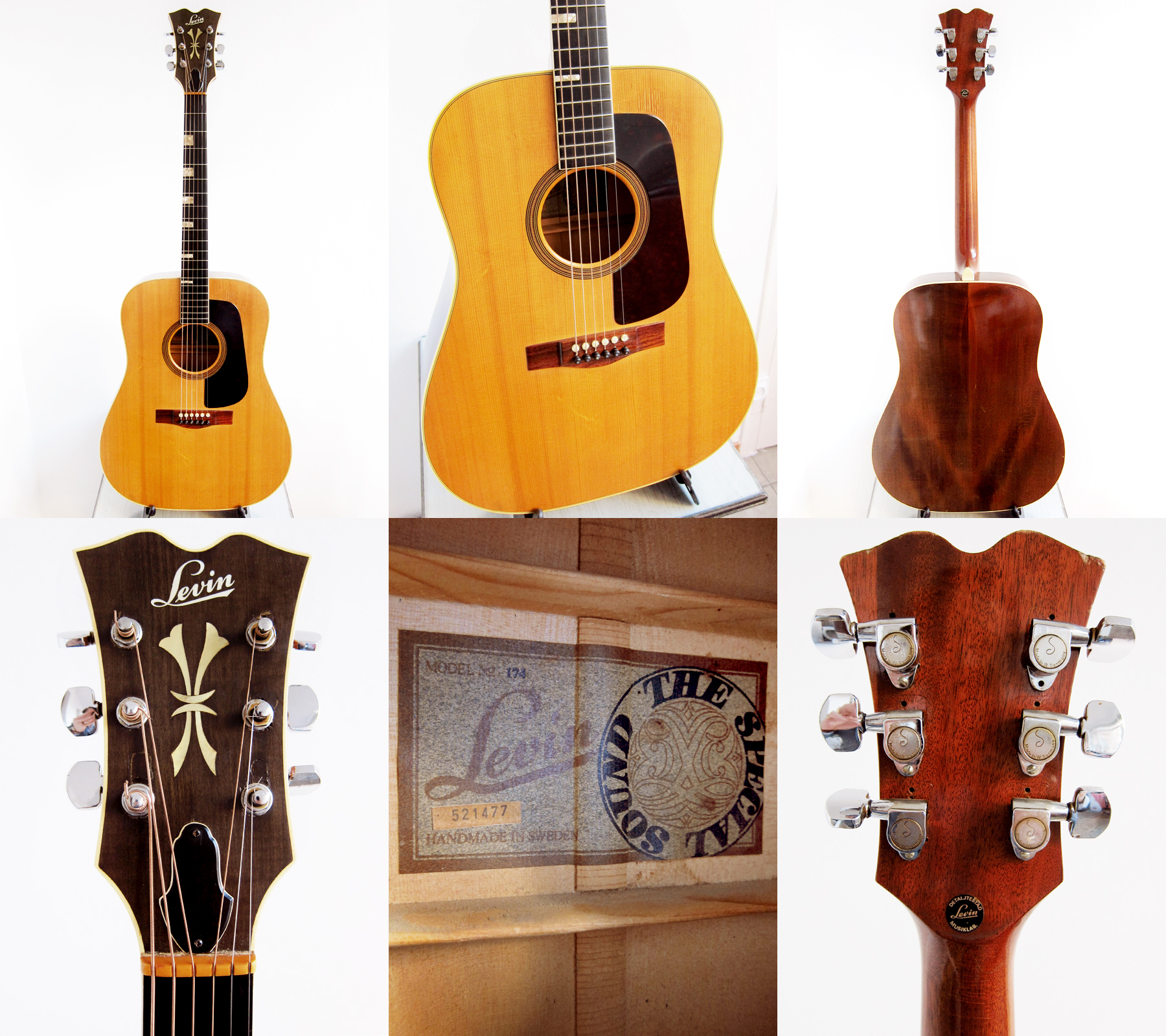
Levin Model 174 /Goya Model 174
Goliath size: Body width: 400 mm, body length: 505 mm, body depth: 95/120 mm
Fingerboard width: 43 mm, scale length: 630 mm
Spruce top, flame maple back and sides, 4-ply bound top, single-bound back
Mahogany bolt-on neck with adjustable truss rod
Single-bound headstock with mother-of-pearl inlay
Single-bound ebony fingerboard with bass side pearloid block inlays
Rosewood bridge with individual height adjustable plastic saddles
Nickel plated individual Van Gent tuners with metal buttons
Natural finish and ten year warranty
Introduced circa 1969 as a replacement for LT 18
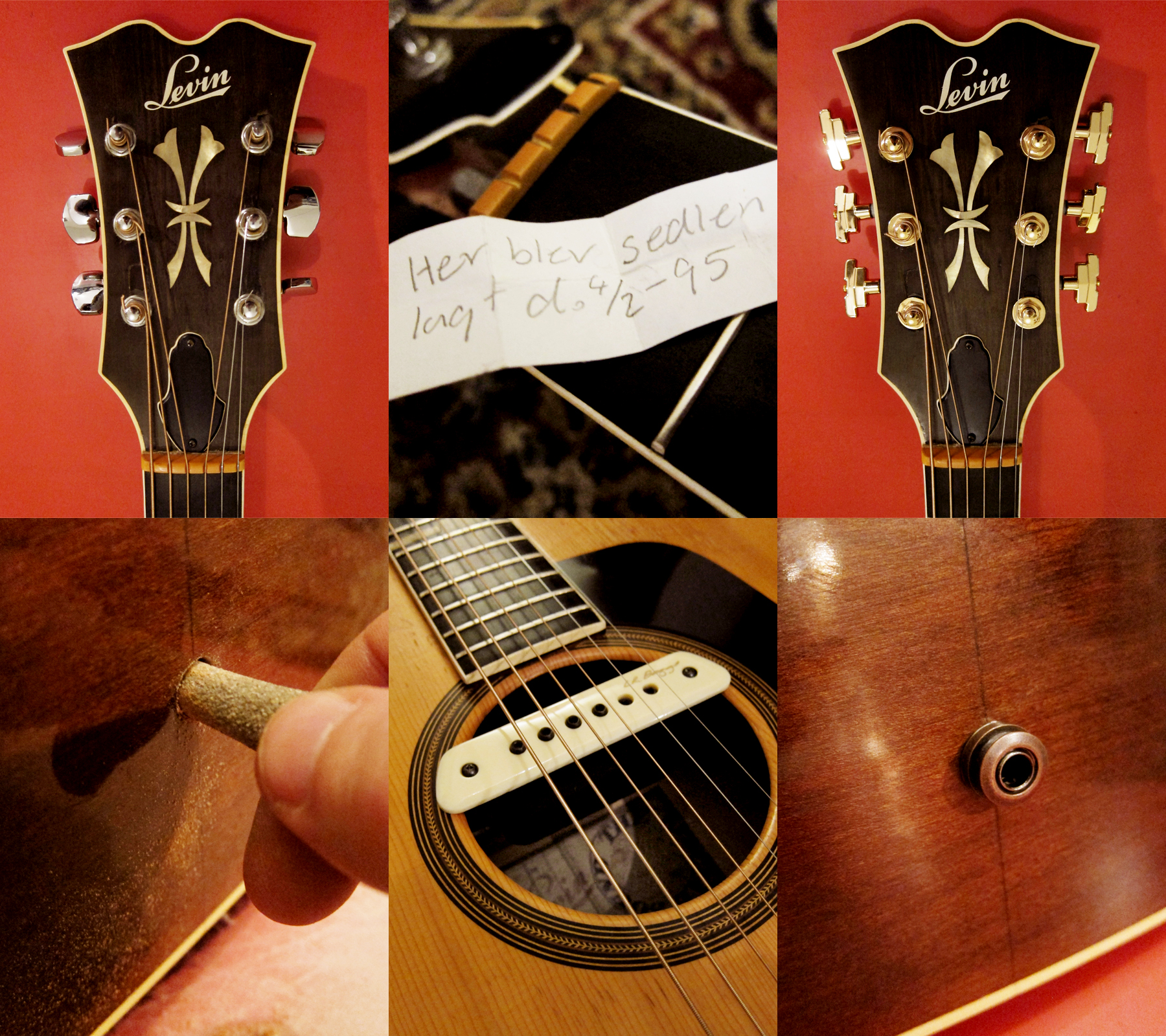 I didn’t have to do much to it, the action was really good as it was. Which was very lucky because this 174 doesn’t have the Levin bolt-on neck system, they stopped with that in the early Seventies. The original Van Gent machine heads had been changed at some point, probably in the 1970’s, to Schaller’s and I really don’t like these type of buttons so I changed them for Wilkinson WJ-309 in gold, to make it look even more Art Deco. I also installed an endpin jack so I can use it live with my LR Baggs M1. I had to clean it a bit, polish the frets and oil the fretboard but overall it was pretty good from the start. There was a note hidden under the trussrod cover saying, Her blev sedlen lagt 4th of February 1995. I assume that’s referring to that the nut was raised a bit 19 years ago, something I need to redo at some point because they seem to have used some paper like material instead of bone.
 The whole Levin family, Goya Model 163 (1968), Goya T-18 (1966), Levin Model 13 (1950), Levin LT-16 (1966), Levin Model 65 (1942), Levin LM-26 (1959), Levin Model 174 (1972).
 Claescaster