Claescaster

Blog of the day

The Selvedge Yard, The Rolling Stones guitars backstage in 1969
The Rolling Stones guitars backstage in 1969

I really love The Selvedge Yard it’s easily one of my favourite blogs. It’s such a great mix of everything a modern man that is stuck in the past likes. Here is a great new post, The Rolling Stones | Road worn, forlorn & almighty guitar porn


Hondo II P-bass

Hondo II P-bass
It took 3 months but now it’s finally ready, Verushka’s Hondo II P-bass

We had such a bad luck with the pickups we ordered for Verushka’s Hondo II P-bass. First we ordered a set of Artec P-bass pickups my favourite Hong Kong store EY Parts, but they never arrived, we waited for more than two month and finally got refunded instead. Then we decided to order from Custom World in Holland but that took ages too. Now we got everything we needed, full sized 250K Alpha pots, Orange drop cap, cloth covered wire, new jack and the Artec pickups. I put it together the other night and got it to work fine. I’m still really impressed with these Hondo II basses, the electronics and hardware are pretty cheap but that’s easy to change, and it’s so worth it for these amazing necks.

Hondo II P-bassIt was pretty straight forward to change the electronics. I checked the Seymour Duncan’s wiring diagram for P-basses and followed that instead of the old wiring.

Hondo II P-Bass
Hondo II P-Bass
I really liked the look of the Hondo II I got for Dani but this is ten times better for Verushka, all black just like her

Movie of the day

Jethro Tull Ian Anderson

I really liked Jethro Tull when I was a teenager, especially Ian Anderson’s acoustic guitar playing. The extracts from Thick As A Brick are pretty awesome in this live concert from 1977.

Suzuki Three-S F-120

Suzuki Three-S F-120Suzuki Three-S F-120 Made in Japan in 1976

I recently came across this Suzuki Three-S F-120 that I have fixed up and it’s now for sale. It seems to be a copy of an early Martin D-18, it feels less bulky than most dreadnoughts. Built in 1976 by Suzuki Violin Co. LTD in Nagoya Japan. It’s a beautiful guitar in a really good shape for being almost 40 years old. It’s very easy to play with low action and it has a great tone, very warm and rich.

Suzuki Three-S F-120I took the machine heads a part, cleaned, polished and oiled them before I put them back together. I polished the frets and oiled the fretboard and then made a new compensated saddle in bone. Now it sounds and plays great.

Suzuki Three-S F-120Suzuki Three-S F-120
I have another Suzuki for sale, however, these guitars were not made by the same company. Both were originally building violins so both are called Suzuki Violin Co. LTD but they were based in different parts of Japan. Kiso-Suzuki manufactured guitars in the region of Kiso-Fukushima. Nagoya Suzuki manufactured guitars in the region of Nagoya. 

Suzuki Three-S F-120I finally found an old catalogue for it. It seems to be spruce top, nato back and sides and nato neck with rosewood fingerboard

Guitar of the day

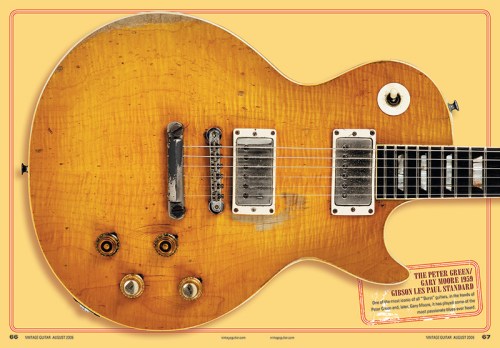
PGBurstPeter Green 1959 Gibson Les Paul Standard

One of the most famous and highly collectable vintage guitars of all time, the infamous Peter Green Les Paul. Most Blues fans will know that as well as being revered for his amazing tone and unmistakeable vibrato, B.B. King once remarked “He has the sweetest tone I ever heard. He’s the only one who gave me the cold sweats.”, over the years Peter’s Les Paul has built up a similar legend in guitar folklore. Now in the hands of a private collector, it made it’s journey through Peter Greens hands and into the arms of Gary Moore who put it to good use on a number of his albums and live shows. Earlier on in his career, Peter Green played a  Harmony Meteor, a cheap hollow-body guitar, but quickly started playing a  Gibson Les Paul with  The Bluesbreakers after he replaced Eric Clapton in the band. Green’s guitar was often referred to as his “magic guitar”. “I never had a magic one. Mine wasn’t magic…It just barely worked” said Green in 2000. “I stumbled across one when I was looking for something more powerful than my Harmony Meteor. I went into Selmer’s in Charing Cross Road [central London] and tried one. It was only £110 and it sounded lovely and the color was really good. But the neck was like a tree trunk… It was very different from Eric’s Les Paul, which was slim with a very fast action.”

In part, his unique tone derived from a modification to the neck  pickup which was reversed and rewired, a modification made after 1967. For anyone looking to modify their guitar in the same way, we found a link to a nice blog here on how to perform the tone mod in detailed steps http://www.geetarz.org/axes/green.htm

It was in the early 70’s when Green passed the guitar over to Gary Moore. Peter was suffering from mental health problems and would put his guitar down for the best part of 8 years. At the time, the Irishman was a friend and close neighbor of Green’s in London. Green initially tried to give the Les Paul to him on the understanding that he could ask for it back when he was well enough to play again but Moore insisted on paying the £110 that it originally cost and Peter Green never did ask for it to be returned. Once in the hands of Gary Moore, the guitar went on to be used on a number of recordings, most notably the ‘Blues For Greeny’ album of Fleetwood Mac covers dedicated to the orginal owner. Green used it extensively until he sold the guitar in 2006.

Peter Green and Gary Moore with the 1959 Les Paul Standard

Gary Moore explained why he parted ways with the iconic instrument: “It’s a long story. The instrument itself was a very special instrument, obviously. But it got to the point where I couldn’t take it anywhere. I didn’t want to sell it. I had to sell it for various reasons because I injured my hand a few years ago and the insurance didn’t pay up, and I had to cover the tour costs for canceled shows with my own money, and I didn’t get paid for any of the shows, obviously, or for anything. I ended up with debt. So it was kind of a financial thing, really, and that was the quickest way to do anything about it. So I never wanted to sell it. I mean, why would I? I kept the other ’59 Les Paul and I sold that one. That guitar was played by Jimi Hendrix, Jeff Beck, Rory Gallagher played it, and I’ve played it. It was a very special instrument. Les Pauls are all so different. That one is a big old battle axe. Peter Green never really liked that guitar because the neck was too big. He wanted me to have it because he said he wanted it to go to a good home.” Taken from Interactive Guitar

Photo of the day

tggs315nxgoy
Waylon Jennings and Buddy Holly in 1959

“Buddy was the first person to have faith in my music. He encouraged me in my music and my writing. He was my friend. If anything I’ve ever done is remembered, part of it is because of Buddy Holly.” – Waylon Jennings

How to… Repair lacquer damage

I really like worn guitars, well it’s hard to avoid when most of my guitars are 30-40 years old, the oldest guitar I got is my little Levin from 1942. However, there is one thing that I can’t stand, marks and dents on the back of the neck. Some little imperfection that you feel every time you move you hand up and down the neck. I’m not sure if it’s related to my slight OCD but it annoys me so much that I tend not to play any of my guitars that doesn’t have perfect smooth necks. The worst used to be my Greco Les Paul, it had a dent in the neck and I complained so much when I bought that I actually got it cheaper. When I received my Goya T-18 and my Morris W-40 and realised that they both had really bad marks on the back of the neck I just wanted to cry. Then I thought about it and came to the conclusion that I can’t be the only one that has issues with this, so I checked some Youtube videos to learn how to fix it and then ordered everything I needed. It’s actually really easy to fix yourself, well as soon as you find good lacquer and sandpaper with a grit fine enough, that turned out to be impossible around here. I managed to find a eBay seller that sold Nitrocellulose lacquer fairly cheap and was willing to ship to Spain. The sandpaper I had to order from China, I couldn’t find anything finer than 800 in Barcelona. After a months waiting and some feeble practice runs on less loved guitars I was finally ready to try to fix all dents, marks and imperfections on the back of my guitar necks. It went really well, or as well as it could with just 2500 grit, ideally I would have liked to have something much finer for really getting the shine back, especially on flat surfaces like bodies, the necks looked pretty good anyway.
Repairing lacquer damage on guitar
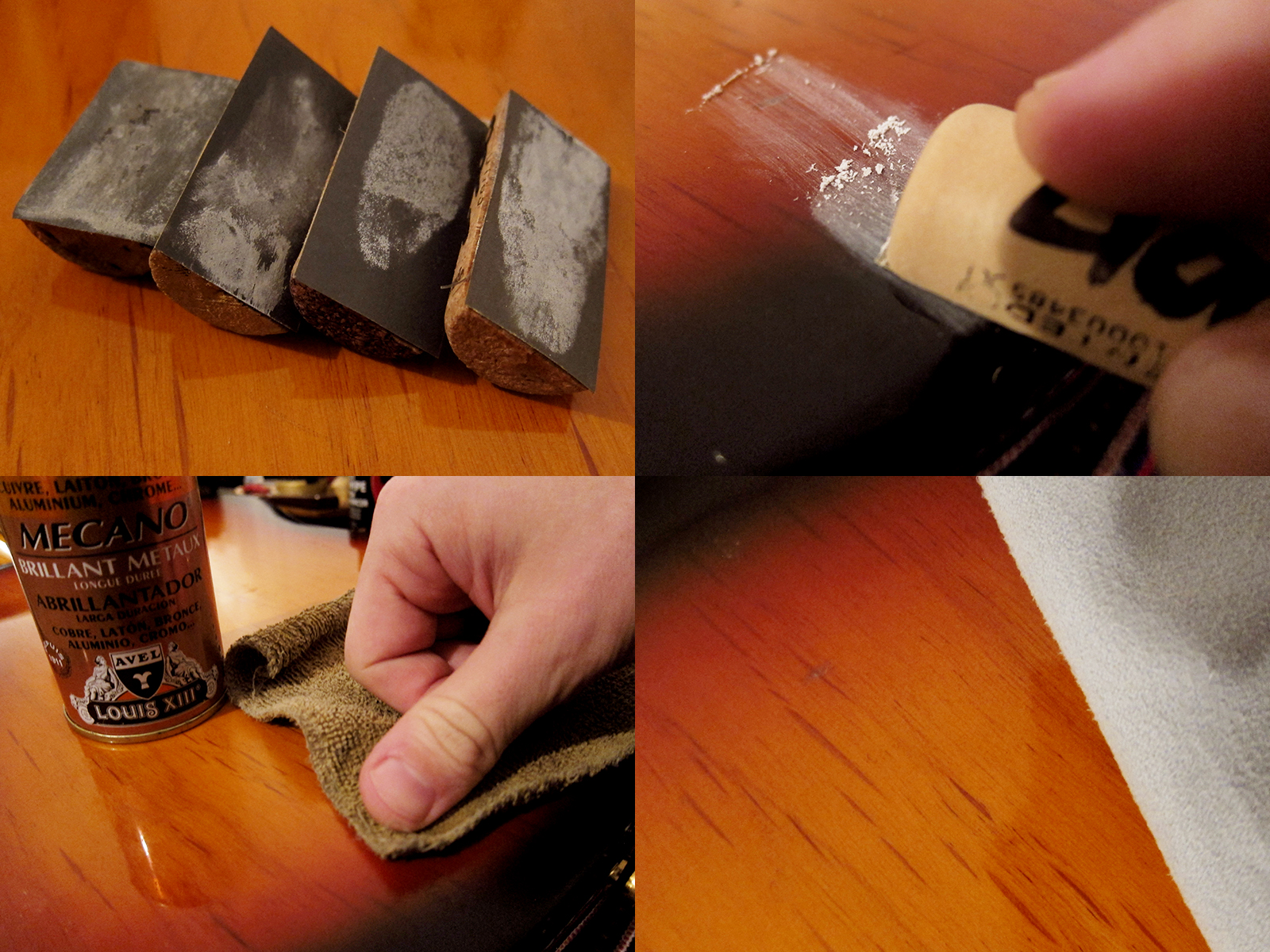
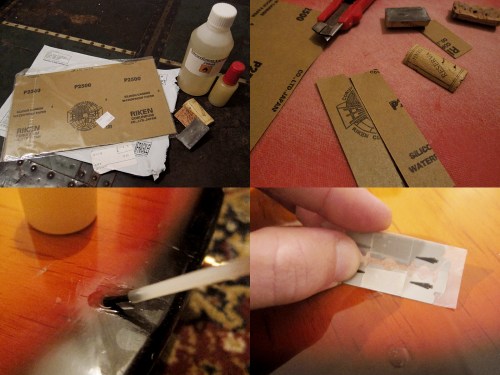
Before I started on any necks I decided to practice on the fairly roadworn body of my old Claescaster. The sandpaper I ordered from eBay came in 1500, 2000, 2500 grit and actually turned out to be made in Japan. I cut wine corks in half and glued sandpaper strips to them to get a straight sanding surface, remember to mark the grit on them otherwise it gets a bit confusing. Next step, apply the lacquer. It dries pretty fast, about 10 min, which is good because you normally need to apply lacquer more than once to really fill the dents. When it’s dry just cut off the access with a razor blade until the surface feels smooth. It’s good to tape around the blade, not only to avoid cutting yourself, but also to not scratch the surrounding surfaces.
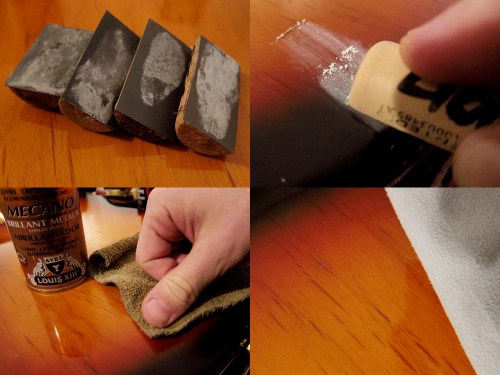
Repairing lacquer damage on guitar
Remember to dip the sandpaper in water before you start sanding, you can really feel the difference especially with the finer grits. I used 400, 800, 1500, 2000 and 2500 grit on my little wine cork sanding blocks. I would have loved to have something even finer. I tried everything I could think of that could have a bit of sanding effect but was finer than 2500 grit. Pencil eraser, sponges, different cloths, in the end I rubbed really hard with metal polish which seemed to work a bit. As a last step I applied a bit of Carnauba wax and a lot of elbow grease and then buffed it up with a fine microfiber cloth.
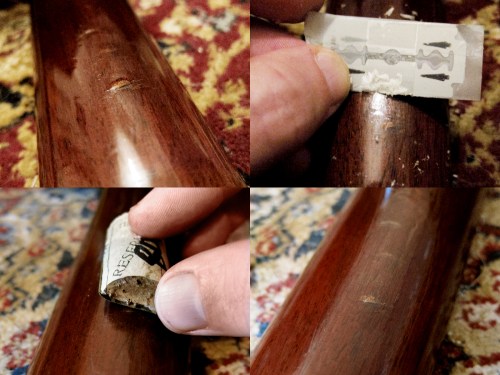
Repairing lacquer damage on guitar
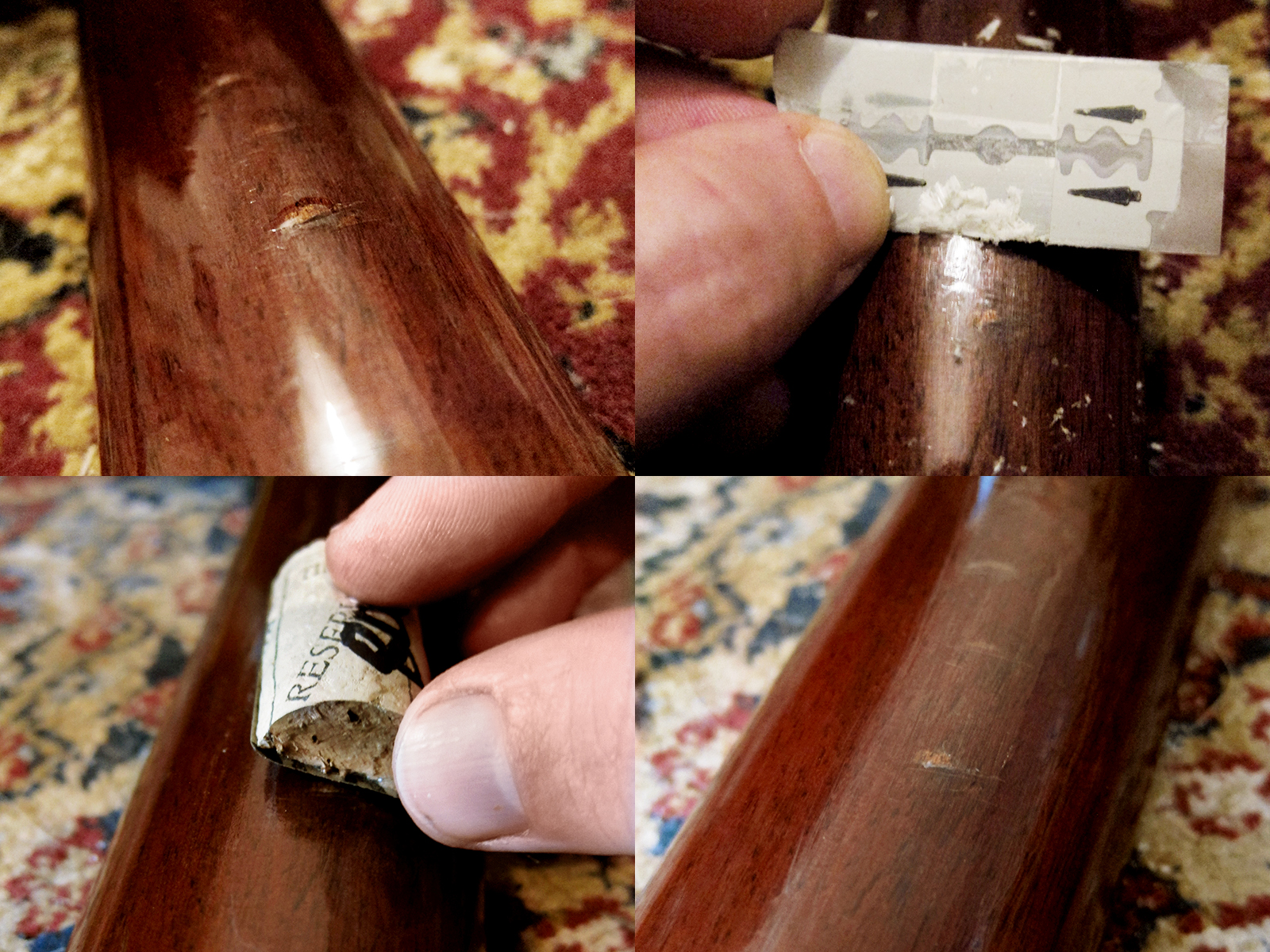
This is the back of the neck of my Morris W-40. The seller didn’t even bother to mention that it had deep cuts in the neck. This took quite a few fills with lacquer to even out the dents but in the end it worked pretty well. You can still see a slight colour change but you can’t feel the dents, which was the main thing for me. The last photo is not of the final polished result, it’s in the middle of sanding, I forgot to take a picture when I was done. I’m very happy with the result on all of the guitar necks I tried to fix. It was also a lot easier to get the sanding smooth and unnoticeable on the back of a neck compared to a guitar body.

Photo of the day

Neil Young in 1967 by Jini Dellaccio

Morris

Morris WL-35 and Morris W-40
1970’s Morris WL-35 and a 1973 Morris W-40

I’m still trying to figure out what I like and what I’m after when it comes to acoustic guitars. It’s a quite new thing for me, to play acoustic. I mentioned in an earlier post that it’s a bit like understanding and appreciating fine wine, you need to train your pallet and know what you are looking for, otherwise wine just taste like wine and acoustic guitars sounds more or less drang drang. I’m not sure if all Morris are as good as the two I got but these sounds better than pretty much anything I have ever heard before. I love the look of the Morris W-40 but it’s not as well sounding as the WL-35. I guess the W-40 has that typical Martin D-45 sound, a really dark bass and still nice highs, but a bit weak on the treble side for me. It’s not that good for finger picking, it’s lacking a bit of volume on the high E and B string, something that might be because of the light string gauge, I’m using 11’s at the moment. I’m going to string it with 12’s and see if the volume improve. The Morris W-40 still has one of the best sounds for open chords playing that I’ve ever heard, so much warmth and body, I guess because of the Brazilian rosewood. The Morris WL-35 is probably a better all-round guitar, finger picking, chords, solo playing, everything sounds good on it. I’m just struggling a bit since it’s so big. I think it’s based on some old Guild model, at least the head looks very Guild inspired. Anyway, I can strongly recommend Morris as a brand to anyone looking for a good sounding high quality built Japan made acoustic.

Morris W-40 1973

Moridaira (Morris Guitars)
Founded in 1967 by Toshio “Mori” Moridaira, the Moridaira factory produced high-quality guitars, including the infamous Morris badged guitar. Moridaira also produced badged guitars for Hohner including Coronado, Futurama, H.S. Anderson, Lotus (some) and Sakai.

Photo of the day

Leonard Cohen blowing smoke rings by Jim Wigler

The smoke ring photograph of Leonard was taken in New York City in the 60′s. I lived at 377 Bleecker Street and Mary Martin, his manager at the time, lived beneath me. I had, a few year earlier, left the Austin Riggs Center in Stockbridge, Massachusetts (an open psychiatric treatment center). One day I heard this awful singing and guitar strumming beneath me and I put the speakers of my stereo face down on the floor and played Mormon Tabernacle choir music. Mary immediately ran upstairs and confronted me. We instantly became friends. She was living with Bob Dylan’s cat, Lord. Through her, I met Leonard and Sheila Campion (who worked with Bob Krasner at The Realist) and the Zappas, Zalman Yanovsky and other 60′s rock luminaries. My father had just sent me a Nikon camera and a few lenses as I had expressed an interest in photography when I left the mental hospital. Mary asked me if I could take some pictures of Leonard, which I did. The first edition of “Spice Box of Earth” has one of my photographs on it, and I did a whole shoot for some German magazine, but they retained the negatives. The smoke ring picture was taken at Peter’s Pot Belly (or something like that) a coffee shop in our neighborhood. The shot was simply serendipitous. It wasn’t planned or anything, I was just taking pictures as he was smoking and talking. – Jim Wigler