Jimi Hendrix past away on this day 44 years ago. If it wasn’t for this awesome guy, I might never had fallen in love with the guitar or dress the way I do, he was a huge influence 20 years ago when I started playing. Earlier Hendrix posts, Guitar of the day and Guitar of the day
On Saturday I found myself a Maya F335G. As mentioned before, I’ve been after a Gibson J-45 or J-50 for quite a while so when I saw this Japan made Gibson J-50 copy I couldn’t resist. It was in a terrible state and strung with 4 nylon strings so I couldn’t test it but I trusted my gut feeling. It doesn’t sound like a Gibson J-50, I didn’t really expect it too either, but it does sound pretty good. I would say that it sounds better than the two Suzuki’s I used to have, the Kiso Suzuki WE-150 and Suzuki Three-S F-120, even though the build quality is pretty much the same. There is a huge step up to my Morris WL-35 and Morris W-40 and my beloved K.Yairi TG-40, both in build quality and sound. Having said that, there is something with this Maya that I really like, it has way more bass then the Suzuki’s and overall a pretty nice and full sound. The only downside is that it feels pretty stiff to play so I will probably put 011’s on it next time I change the strings. According to my previous post about Japanese guitar brands Maya was made by Chushin Gakki in Kobe, Japan, during the 1970-80’s. Even though I really like this guitar I have it listed for sale if anyone is interested in buying it.
Maya F335G made by Chushin Gakki in Kobe, Japan
The previous owner had used a collection of random oversized wood screws to keep the machine heads in place so the first thing I did was to remove them and fill the holes. I polished the frets and oiled the super dry fretboard and then put on a bone nut and saddle which improved the tone quite a lot.
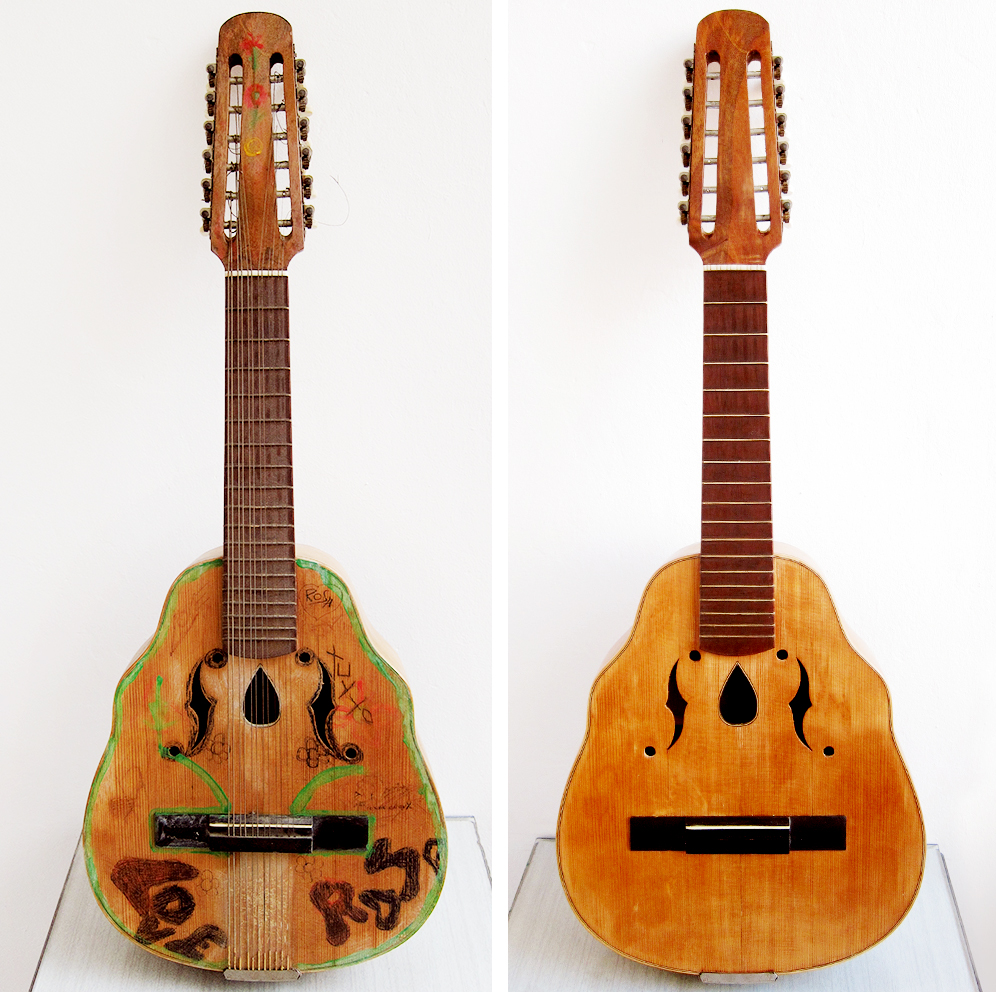
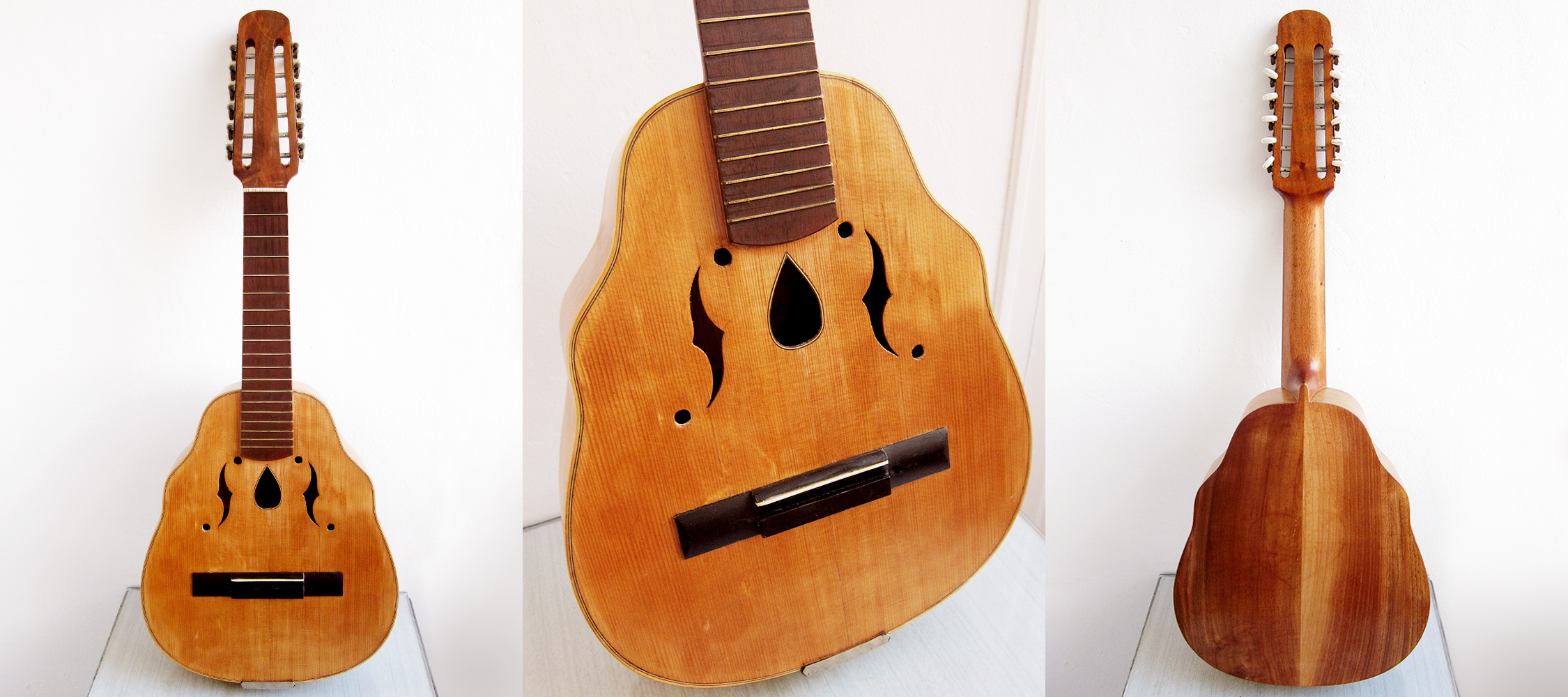
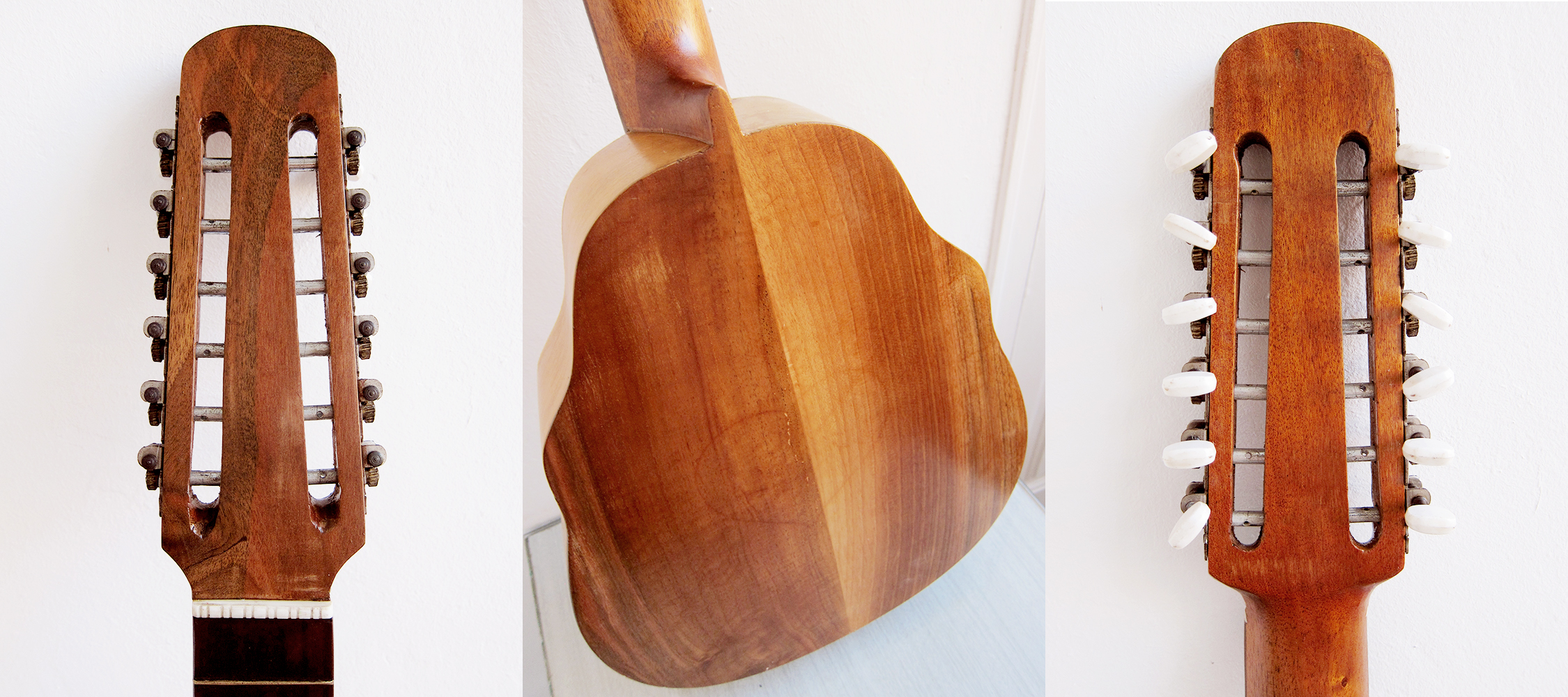
Before and after, a Spanish Laúd, made by Casa Parramon, Barcelona
When Araceli and I first moved to Barcelona we found this Laúd in the streets, we took it home, put it in the back of a wardrobe and completely forgot about it for four years. It was so ugly so we couldn’t have it out, on top of that we didn’t even know if it was a laúd, a bandurria or some other weird Spanish instrument. It was therefore tucked away and quickly forgotten. Until recently when Araceli’s dad Marcos mentioned that he wanted to learn to play a new string instrument, or as he put it, I need something new to make noise on. We suddenly remembered that ugly thing with strings on in the wardrobe and I thought that maybe I could restore it for him. I mentioned earlier that we managed to find a really nice Spanish made Alhambra from the late 1970’s that we gave him for Christmas.
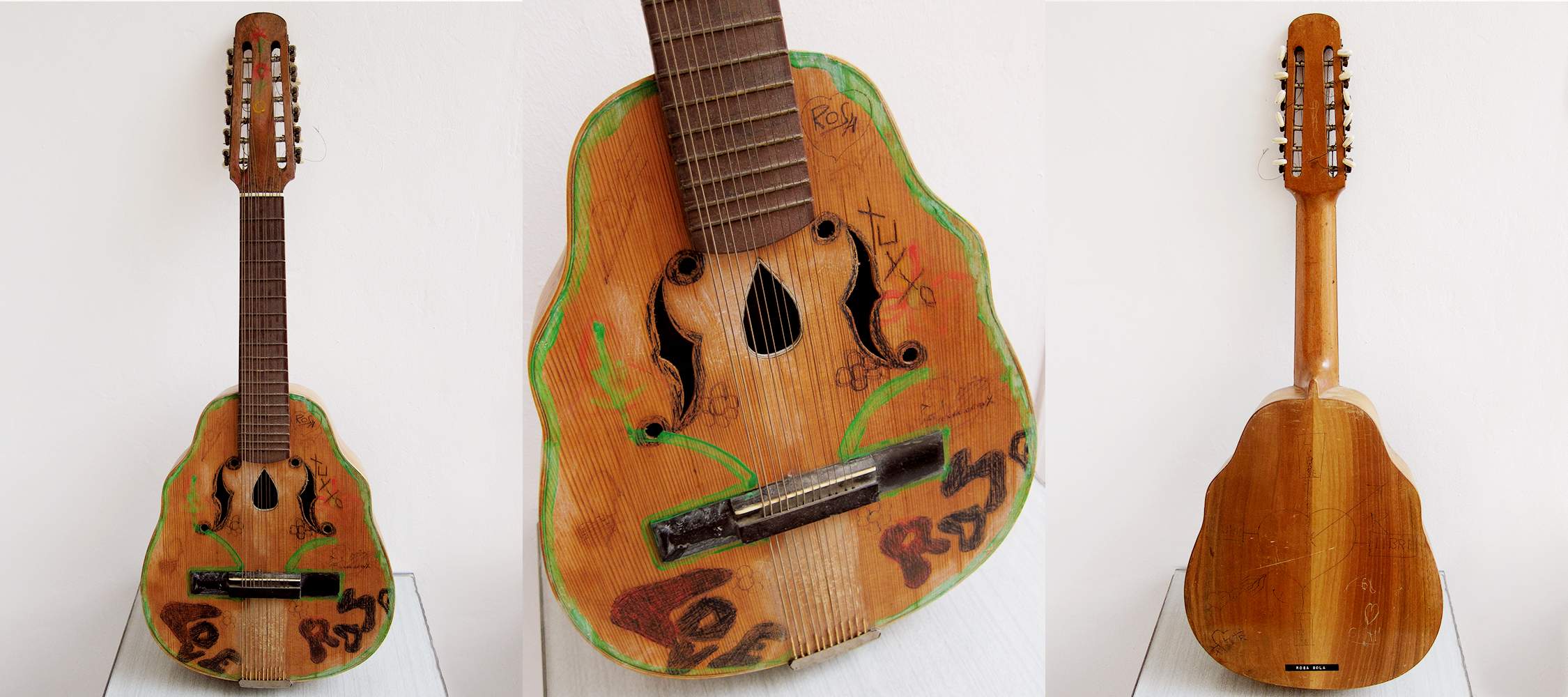
Someone called Rosa Sola had gone crazy bananas, full blown hippie on this poor laúd when we found it
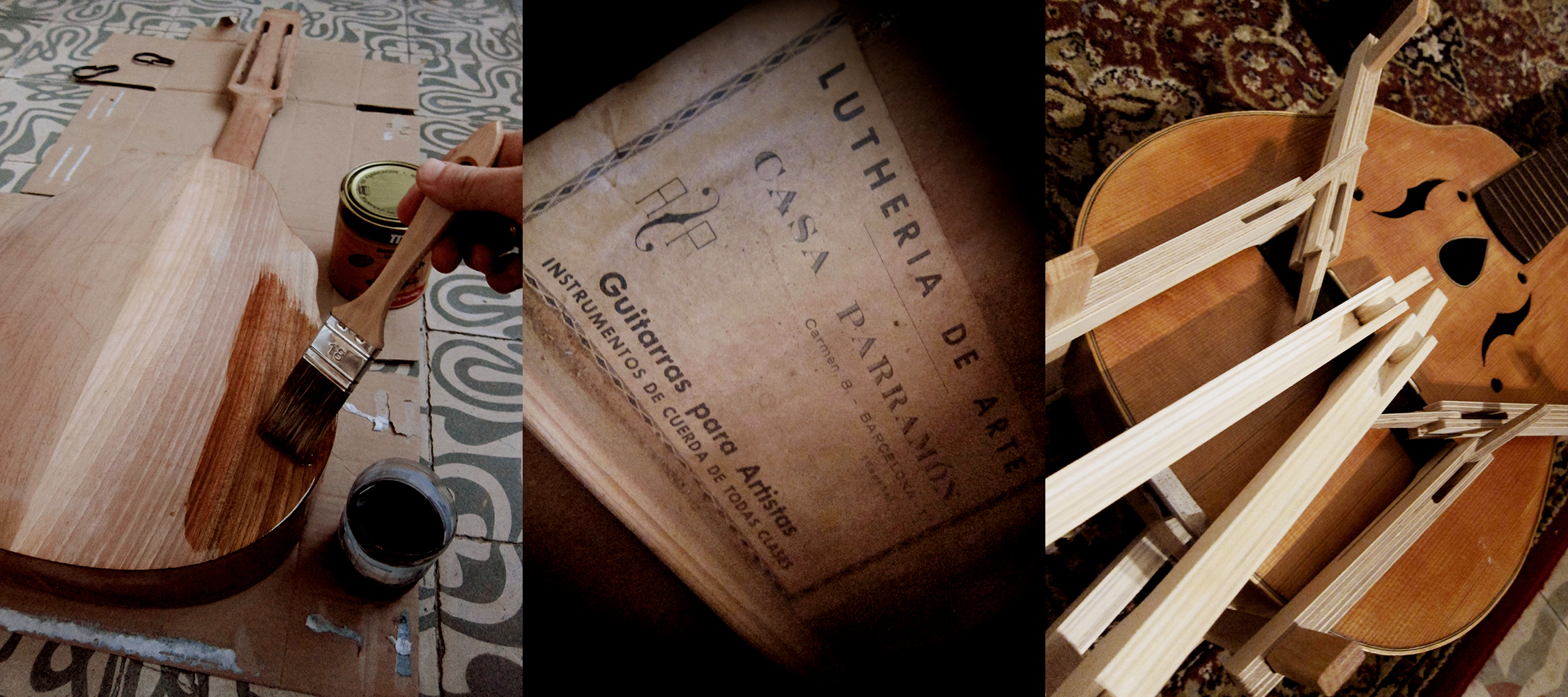
I have no idea how old this laúd is but it was built by Casa Parramon here in Barcelona. The workshop was started in 1897 by Ramon Parramon and I think he mainly built violins. Casa Parramon is actually still in the same place today as they were 117 years ago, C/ Carme 8. Now I think they are mainly building violins again but I guess they would have had time to build both laúds, bandurrias and guitars over the last hundred years.
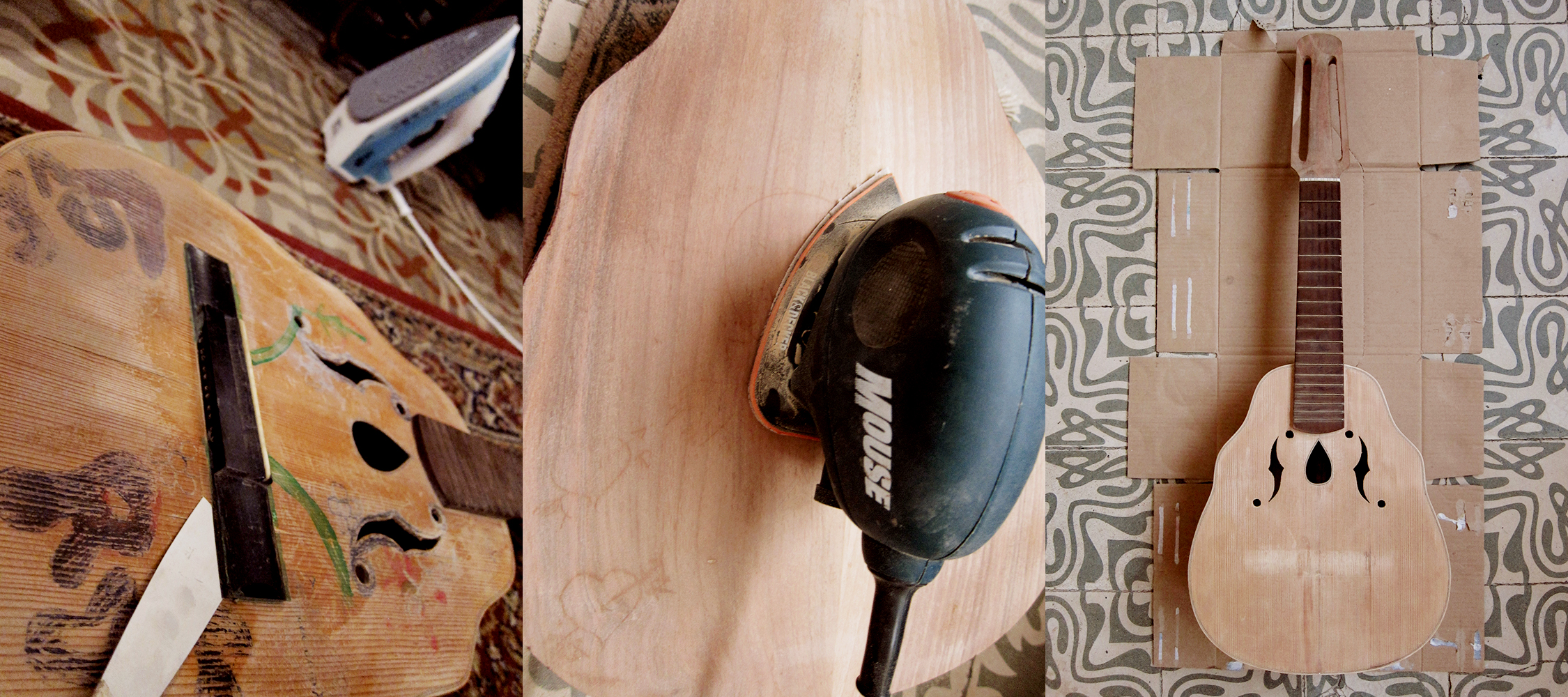
I stripped the laúd completely, took off machine heads, tail piece and bridge. I got the bridge off with a spatula heated on a normal clothes iron, it works like a charm every time. I cleaned and oiled the fretboard and polished the frets. Then I sanded down all the wood with an electric sander, this felt a bit harsh on an instrument but most of the text was actually scratched in to the wood and not painted on so I had to take out the heavy artillery. On top of that, the solid spruce top felt really thick so I thought that the sound might actually benefit from a thinner top. I glued some cracks in the top with my trusty old fish glue and then I waited and waited for the shellac I had ordered from Germany that unfortunately never arrived. I really wanted to use shellac on this instrument, both for practice for myself for future builds and projects, but also for the laúds sake, it felt like the healthiest option. In the end I went and bought normal clear lacquer, or varnish, I’m not really sure what the guy sold me but he said it would work and it did. It applied two coats and sanded lightly in between and it looks ok but I guess if I would have looked even better if I had spent more time on sanding and getting it super smooth in between the coats. I had to paint this at night in poor light and got some drips that should have been taken out properly, I just scraped them off with a razor and then applied new lacquer. I guess I have learnt a few things for the next time. One trick I can share though, that everyone might already know about but anyway. Before I started with the lacquer I marked out where the bridge was going to be and then masked that off with tape so I wouldn’t have to remove the lacquer before I glued the bridge back on and that worked really well.
The final result, Marcos new laúd, now I just have to string it up and try to figure out how it’s tuned
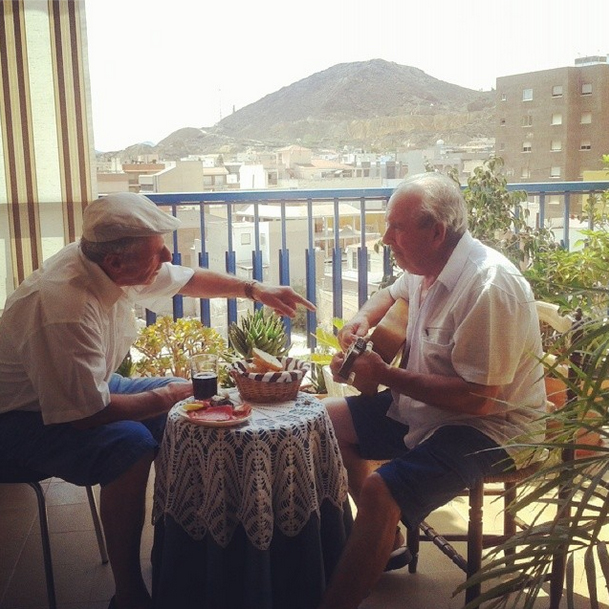
Update: August 16, 2014Marcos seemed very pleased with his new laúd
I recently found a nice looking VOX Les Paul copy that I couldn’t resist. I had decided not to buy any more Les Paul’s after I sold my Westone a few weeks ago but this was just too nice to miss out on. It has a bolt on neck, which you could either hate or love, I’m fairly indifferent myself and you can read why here. The good part with bolt on necks is that they are so easy to adjust. It’s fairly common that older Les Paul and SG guitars with set necks gets a hump over the neck joint, something that can cause buzzing and you have to either raise the action or level the fretboard to get rid of it. The bad part with bolt on necks is the second hand value, a lot of people are still a bit racist when it comes to Gibson copies with a bolt on neck even though Gibson built a few themselves in the early 1980’s. What I fell in love with on this VOX was the flame top and the thickness of the neck, it’s so nice. It feels even fatter than my Tokai Love Rock LS-55 which has a fairly accurate 59′ Les Paul neck. This VOX even have the small head as the real Gibson of the late 1950’s and the pickups sounds pretty close to my old Westone. The only thing that is annoying me a bit is that I haven’t figured out who built it yet. There is no info about VOX in my list of Japanese guitar brands, well there is a Magnavox and a Univox but that’s not the same. The only thing I know is that when VOX stopped making guitars in the UK they moved to Italy before they ended up in Japan. The build quality is not as good as my 1991 Tokai Love Rock LS-55 or my 1980 Greco EG-600C, but it’s easily on the same level as the Westone which was built by Matsumoku. Even though I really enjoy this Les Paul I have too many guitars and is therefore up for sale.
If anyone happens to have more information about Japanese made VOX guitars please get in touch
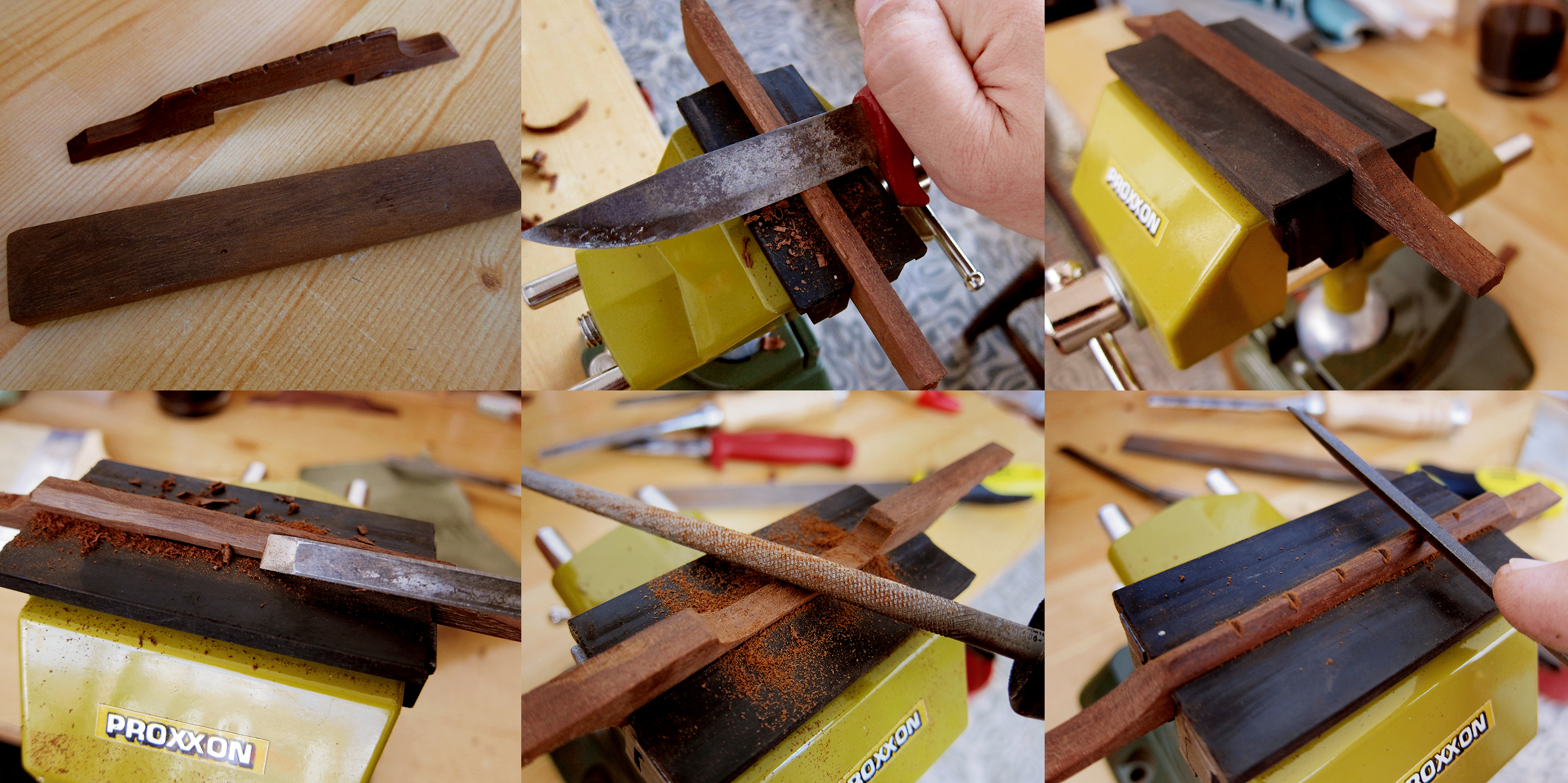
Last weekend I decided to make a new bridge for my 1940’s Levin model 65. I actually did the same thing about a year ago but with less success, you can read about it here. This time I had more tools, better material and at least some knowledge of working with wood.
I started with a rosewood blank that I carved roughly to the right height with my trusty old Mora kniv, a cheap Swedish knife that solves most of my guitar related problems. Then I carved the shape of the edges, I just marked where to start and then carved it in to a rounded slope. I got the top in to a nice triangle shape with a narrow chisel and then cut out the arch in the bottom with a round file. I compared it to the old bridge to get the string spacing right and then just made little groves with a small triangle file. After a bit of lemon oil I was ready to try it out and it worked perfectly.
The final result, a new bridge for not only the oldest Levin I own but the olderst guitar I’ve ever actually had in my hands.
I completely missed the release of The Band – Live at the Academy of Music 1971 last year, I just found it on Spotify. It’s an amazing 4 CD box-set with a DVD and I might actually have to buy it, even though I haven’t bought CD’s for at least 5-6 years. Thank you Robbie, even if just did for the money.
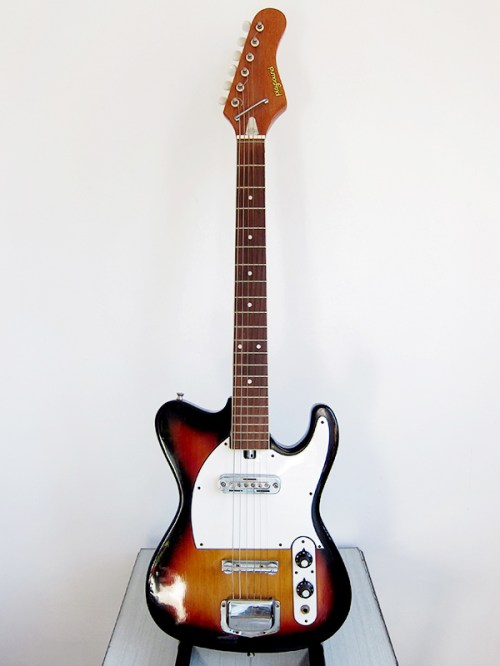
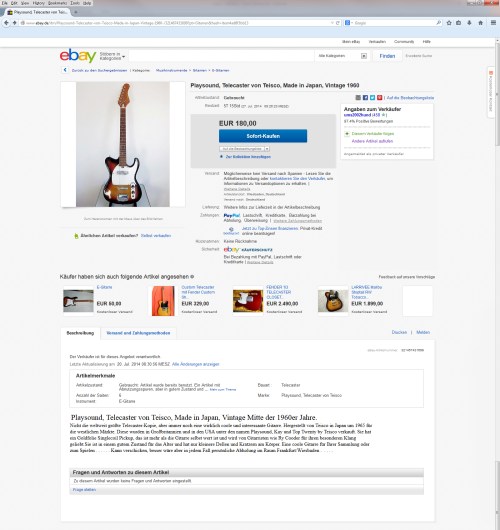
Sometimes you see people using other peoples images when they are selling guitars. I’ve seen a few times that guitars being sold on Guitarristas end up on Milanuncios or some similar site by someone else. In this case I’m not sure if it’s a full blown scam or if the German eBay seller ums2002hund just preferred my guitar to his own. Here you can see my Playsound by Teisco Telecaster copy being sold on eBay, with both my image and my text, directly translated to German from my For sale page. Well it’s technically not my guitar any more since I sold it to my boss about a year ago, he has it here in the office so I’m pretty sure it’s not in Wiesbaden, Deutschland at the moment.
Playsound, Telecaster copy by Teisco, Made in Japan, mid 1960′s Not the worlds greatest Telecaster copy but still a really cool and interesting guitar. Made by Teisco in Japan around 1965 for the Western markets. These were sold in Woolworths in the UK under names like Arbiter, Sonatone, Audition, Playsound, Kay and Top Twenty. In the US they were sold in Wallmart under names like Silvertone, Kent, Beltone, Duke, Encore, Heit Deluxe, Jedson, Kimberly, Kingston, Lyle, Norma, Tulio and World Teisco. It has one gold foil singlecoil pickup, these are worth more than the guitar itself and are favoured by guitarists like Ry Cooder for their special sound. It’s in really good state for the age and only has minor dings and scratches to the body. A cool guitar to add to your collection or to gig with, it might be the only Playsound guitar in Spain. Here you can read more about Japanese guitar brands.
My new Hohner Telecaster, made in Japan in the 1970’s most likely by Morris in the Moridaira factory.
This weekend I received a 1970’s Japan made Hohner Telecaster. These old Hohner’s have a nice solid feel to them and good resonance even though the bodies are made out of plywood, or some form of wood sandwiched together. Having said that, this Telecaster is extremely heavy so maybe they sandwiched a chunk of mahogany together with an ash or alder top layer. This would have put me off if I wasn’t so gay for my old beat up Hohner Strat. This was one of the first Japan made guitars I bought, I found it in a charity shop in Camden in London for £50 in 2009. It’s not the best Strat I have ever played but the neck is really chunky and the pickups sounds really good. It’s the same with the new Hohner Telecaster, pretty nice neck and great pickups. The neck pickup actually sounds a bit like the in-between neck and middle position on a Strat. I would have preferred that the Telecaster neck was a wee bit thicker, but it’s still very playable. Hohner only produced guitars in Japan for a couple of years during the late 1970’s and later moved to Korea like a lot of other brands. I really enjoy this Telecaster but I have too many guitars at the moment and therefore it’s up for sale.
According to my previous post about Japanese guitar brands they were made by Morris in the Moridaira factory. I took my list from Who Made My MIJ Guitar so I hope we can trust his research.
Moridaira (Morris Guitars) Founded in 1967 by Toshio “Mori” Moridaira, the Moridaira factory produced high-quality guitars, including the infamous Morris badged guitar. Moridaira also produced badged guitars for Hohner including Coronado, Futurama, H.S. Anderson, Lotus (some) and Sakai.
One thing that would prove the Hohner connection to Moridaira would be Prince’s Telecaster. He used to play a a H.S. Anderson Mad Cat, as I mentioned in a previous post. Hohner later copied the Mad Cat, first in Japan and later as the Prinz guitar made in Korea by Cort. Those early Mad Cats under Hohner was made by Moridaira. “A little over 500 Mad Cats were made during the ‘70s, including a small batch made OEM for Hohner USA with a Hohner logo in the H.S. Anderson style. Pop artist Prince discovered one of these rare guitars early on in his career, and used it live and on countless hit-records like Purple Rain, 1999, Controversy, etc. for over 30 years now.” Taken from the history page at Mad Cat guitars
I took the guitar a part to look over the electronics and give it a good clean and set it up properly. The Switch is a bit worn so I will order a new one and replace that but the Japanese 500k pots are crackle free so I will keep the rest. This one is wired in an even weirder way than my Greco, with the ground from the bridge going to the first post on the treble pot. There were two big chunks on the back of the neck that was either worn or sanded down, which I didn’t like. I applied some Nitrocellulose lacquer with a sponge for not getting any sharp edges around, which worked pretty well, and then sanded it smooth with 2500 grit paper.
Update: August 30, 2014 I got around to change the 3-way switch so now I finally got to hear the bridge pickup, not bad at all. I also bought 6 new screws that I cut since the original ones were really annoyingly long. When I got this guitar the action was too low for me and when I raised the saddles the screws that are holding them in place almost touched the strings so I decided to replace them with something shorter. I really starting to like this Telecaster now, it has a great twang and feel to it.
My beat up old Hohner Stratocaster, bought cheap in London back in 2009. Notice that the logo is different on these two.
The Claescaster, put together in May 2013 out of a Mighty Mite Swamp ash body, Tonerider Vintage Plus pickups, Wilkinson hardware and a cheap but fairly fat China neck.
Last night I decided to change the pots and install a treble bleed on my new Claescaster, I never liked the feel of the CTS pots I had on. I’m still not sure if I like the new changes or not, in my head it sounded better before but I stupidly forgot to record it so I can’t compare the before and after. I think it had a clearer sound with more highs, now I feel that the neck pickup is more muffled. I’m not sure if this is down to cheaper pots, the treble bleed or the wiring. I changed the wiring too from a more standard wiring to Seymour Duncan’s suggestion for a ’66 wiring which matched what I had seen for the treble bleed. Maybe it has more to do with the changes in wiring than the actual treble bleed because before I had an old 50′s vintage wiring to help with the lack of treble at lower volumes and I was pretty happy with that. I’m so confused with all the different wiring options, I have no idea who’s doing what to whom, and where? I might just have to redo it again and copy the original wiring on my Greco TL-500 or my Fender TL52-75, they both sounds great.
The new Claescaster got a treble bleed and the ’66 wiring, bottom right photo shows the original wiring on my 1979 Greco TL-500
Update: December 27, 2014, Since I had the soldering iron out to fit the electronics in my new home built Claescaster I took the treble bleed out in this one and changed the wiring back to it’s original 50′s vintage wiring









 Claescaster