I just found out that Kazuo Yairi died earlier this month at the age of 81. As I mentioned before, I would love to one day afford a K.Yairi and big reason for that is the philosophy of Mr Yairi himself:
Good materials are hard to find so it’s better to make guitars through limited production by hand instead of mass production. Trees are very important “precious” things so we should make good use of them. Guitars made with “heart” are the best use of trees. Kazuo Yairi
The most beautiful Martin D-45 copies in the world, a 1976 K.Yairi YW-1000
It’s with a heavy heart that I have decided to part with my Hagstrom Viking. I bought the guitar back in 2010 and have unfortunately not had time to play it as much as I wanted, some Japanese Telecasters got in the way. I had three semi-hollow bodied guitars at one point and kept this the longest, I sold the other two last year. I guess the more guitars you have the more you realise what feels good for you to play. For me, fat necked Telecasters feels really nice to play, I’m a bit gay for old Greco Telecasters from the 1970’s. If you are interested in inherit this Hagstrom Viking from the Claes Collection then get in touch. You can read more about it here for sale, or in Spanish here.
Update: April 4, 2014The Hagstrom Viking is now sold to Rafa from Cobarde.
Hagstrom, or Hagström as we call it back home, was founded in 1925 by Albin Hagström in Älvdalen, Sweden. They made amazing electric guitars from 1958 to 1983, played by guys like Elvis Presley, Jimi Hendrix, Noel Redding, Joe Walsh, Dweezil and Frank Zappa to name a few. I have played on a lot of Hagstrom guitars and amps during my teenage years back in Sweden and learned to play bass on my stepdad Sten’s Hagstrom Jazz bass from 1976. I have an fairly mint Hagström HIIN OT from 1975 back in Sweden that I really like. I guess it was out of national pride that I got so excited and bought the Hagstrom Viking when they started to make them again in 2004. They have a few models that are made in the EU, but not in Sweden, and the rest is made in China. I have actually only played my Viking from 2008 so I can’t really comment on the quality of the Chinese Hagstroms today but mine is very well built for the price. I would say that they are better than Gretsch Electromatic, Epiphone and the Ibanez semi-hollow bodied, all in roughly the same price range.
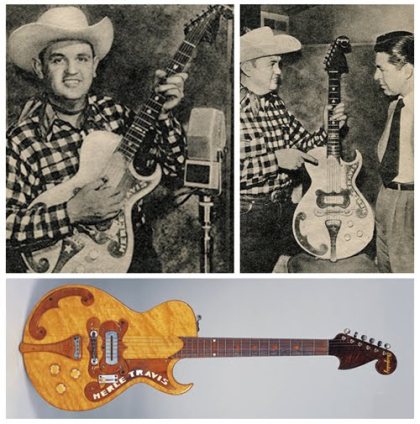
Paul Bigsby died on June 7, 1968. While most guitarists know him because of his wildly popular Bigsby vibrato, most are not aware that Bigsby is widely considered to have crafted the first true solidbody electric guitar. Bigsby was a motorcycle mechanic during the 1940s in Southern California. He became friends with noted country star Merle Travis when the two met at a motorcycle racetrack. Travis discovered that Bigsby was a notorious tinkerer, and asked Paul if he could fix a vibrato tailpiece on a Gibson L-10. Bigsby ended up replacing the vibrato with a better one of his own design. Travis then asked Bigsby in 1946 if he could build an entire electric guitar, complete with pickups that wouldn’t feed back. Using a design from Travis, Paul created what may have been the first solidbody electric guitar. The guitar had a single cutaway and a headstock that featured all the tuning pegs on one side instead of the standard three per side arrangement. This was similar to a design used a centrury before by German luthier Johann Stauffer. It would later show up in a very similar form on the Fender Stratocaster. Taken from National Guitar Museum
Merle Travis guitar built by Paul Bigsby in 1946, the first guitar that Bigsby built
If you want to read more about Paul Bigsby there is plenty of info at Premier Guitar, or you can by the book.
Update: December 18th 2014, I just found this pretty cool video about Paul Bigsby’s third guitar he built in 1949 for “Butterball” Paige
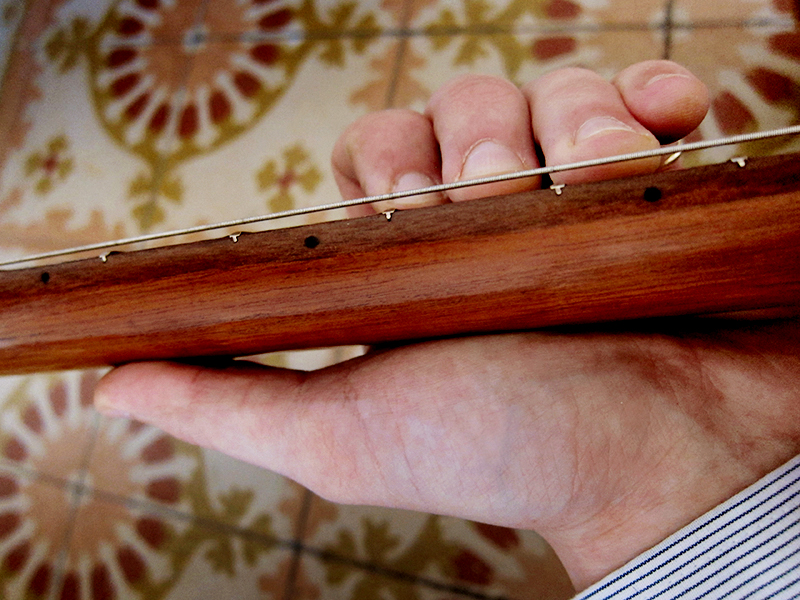
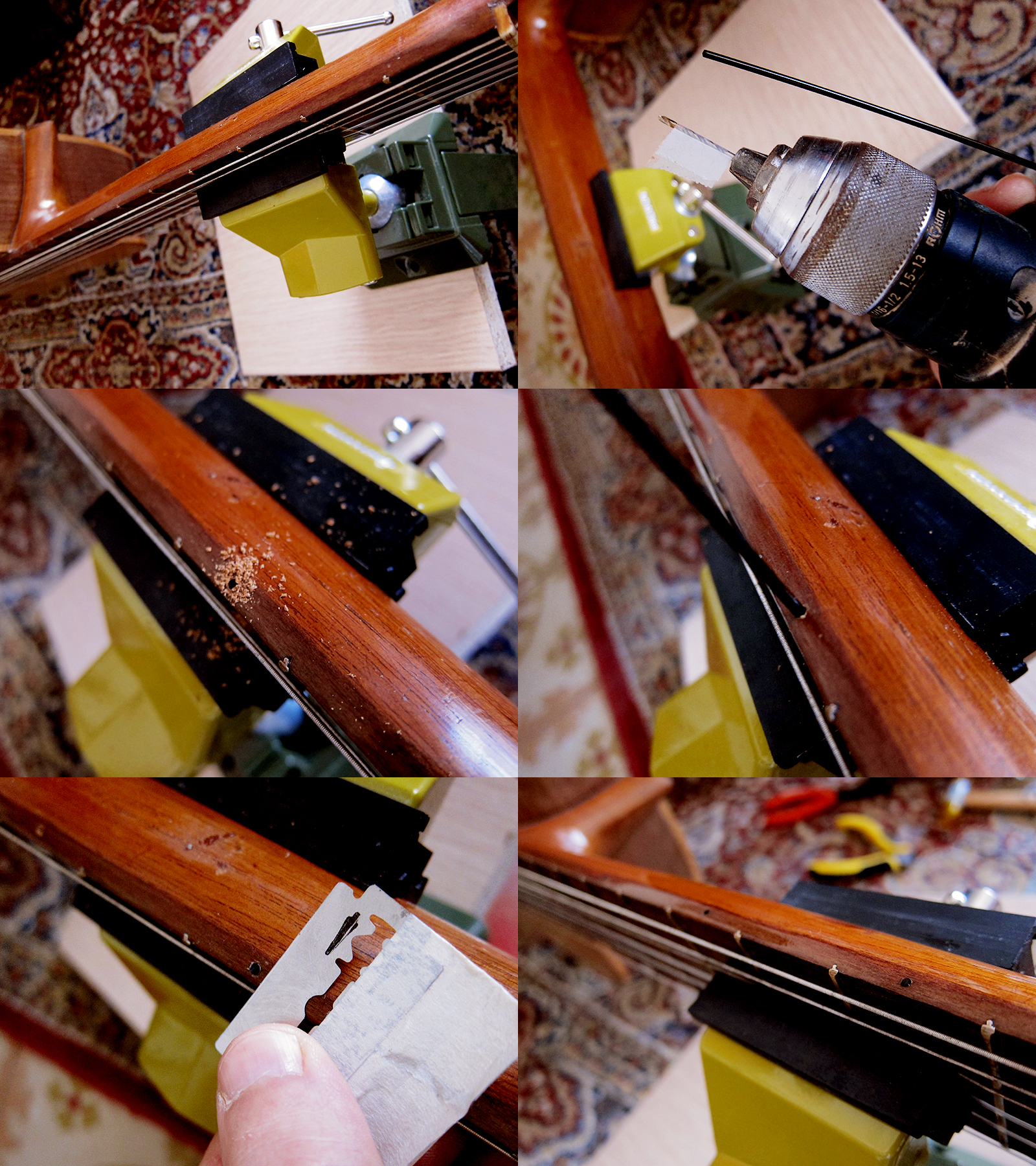
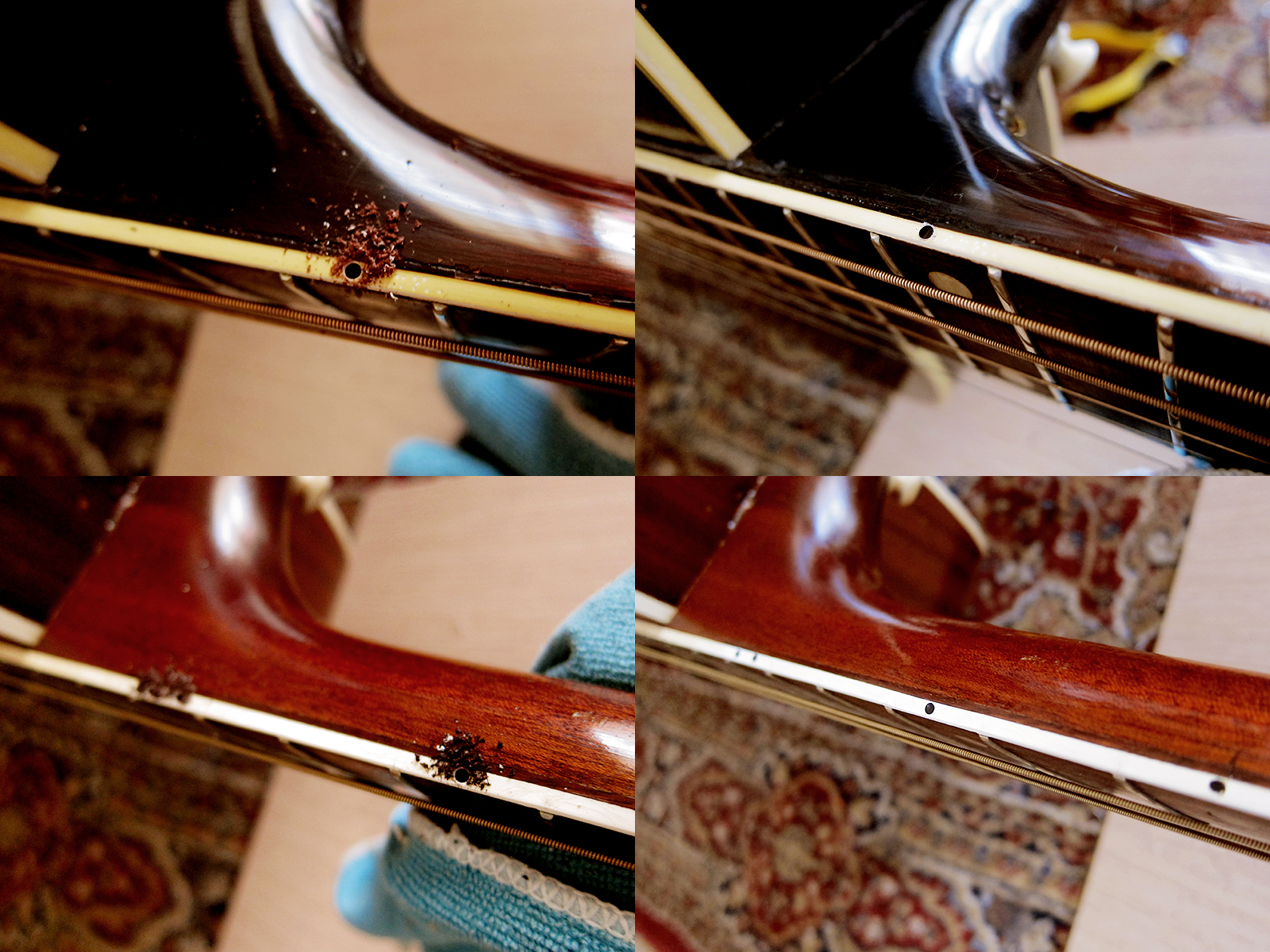
I get really confused when I play on guitars without side dots. You are playing your cowboy chords and everything is fine and then suddenly you want to play a bit of solo up on the 12th fret and you realise that there are no markers above the 5th fret and you have to guess where to put your hand. Well on a 14th fret acoustic guitar you know roughly where the 12th fret is, 2 above where the body and neck joins but say that you need to quickly find the 11th, or 9th fret. For me position markers, or side dots, are essential. Flamenco guitars seems to never have any side dots at all and a lot of Spanish or Classic guitars seems to have forgotten them too. I guess if you are used to it, if you have played your whole life without them maybe it’s fine but I come from the world of electric guitars with clear indications where you are on the neck. My Levin guitars only have side dots up until the 7th fret, it’s just my Goya T-18 that has markers up to the 12th fret, so I decided to change that. I had to order some new Jescar frets from my favourite eBay luthier supplier in the States, Philaluthiertools, so I got some 2mm side dot position markers in black as well. I was a bit scared to drill in to thin strip of binding on my 40-50 years old Levin guitars but after practising on my Francisca Montserrat I felt ready and just did it. It went pretty well, no real drama. It was interesting to see what the fretboards was really made off when you saw the sawdust. Some of the Levin’s had normal rosewood freatboards but the Levin 174 has a ebony fretboard, how fancy pants is that? My dads old Levin LT-16 is supposed to have a rosewood fretboard but I think that sawdust looks very dark for being normal rosewood.
First I installed 3 side dots on my Francisca Montserrat just to warm up. There might be some Flamenco purists saying that I’ve ruined this guitar now but I think it was a fairly discrete modification that will make it hundred times easier for me to play it. I just drilled a 2mm hole, same as the plastic side dot, about 3-4mm deep. I didn’t use any ruler, I felt that my eyes would be the best judge to make a visual estimatation and get them to line up. I made a little mark with a black pen and then when I was happy with that I made a little pilot hole with a nail so the drill wouldn’t slip. I put some super glue in the end of the side dot stick, stuck it in and then cut it off with a pair of pliers. I got it smooth with a razor blade and then sanded it down with 400, 800, 1500, 2000 and 2500 grit paper, the same technique I use for repairing lacquer damage.
All my Levin’s got new side dots installed, here is a 1959 Levin LM-26 on top and a 1966 Levin LT-16 below. I have to say that the dots I put in on the 9th and 12th fret on my dads LT-16 looks better than the original one on the 7th fret that was installed 48 years ago at the Levin factory in Gothenburg.
I’ve always been a huge fan of White Falcons but never really felt I could afford one. They are so over the top Las Vegas bling but still works so well on scruffy looking musicians like Neil Young, see below. I’m not overly keen on newly made acoustic guitars, I believe that everything sounds better after 20 years, but after seeing this I have to admit I have second thoughts. Gretsch has just launched a White Falcon acoustic, and not only does it look awesome, it’s cheap too. Compared to a White Falcon that cost around 3200€ it feels pretty cheap with 550€ for the new Rancher Falcon in white. It’s almost as exciting as when Fender released the Fender Japan TN72G-FT.
Jack White is doing a surprise gig at the South by Southwest festival Austin Texas in 2011 with a custom made Gretsch White Falcon acoustic. When I saw this picture I really felt that I wanted one too. I have an all black Morris WL-35, really Johnny Cash, but imagine to have an all white Gretsch guitar with extra gold. Hmm, gold, I love gold.
When I met my other half Araceli back in 2007 she already new the basic cowboy chords but never really played guitar, I had only heard her strum a handful of times. She told me that she didn’t really like to play on my guitars since I seemed to care so much about them so I thought the best way around that would be to get her a guitar of her own. I also felt that since I had experienced so much joy through music in my life that would be the least I could give to the woman I love. I talked to her family and we agreed to put in 50 Euro each and get her a guitar for her birthday in September 2010. It was down to me to find a suitable guitar within our budget so I started to do some research. I knew that a parlour guitar would be best option, she is pretty small so I thought that a small bodied guitar would be easier for her to handle. I already had an inexpensive parlour a Vintage V880N that I liked but didn’t love so I thought I would try another brand this time and started to read about Tanglewood. People seemed to really like them, especially in the UK, and they had quite a few parlour sized models so it felt like a good start. Since you can’t just walk in to a guitar shop here in Barcelona and try what you are looking for, the shops here are useless and have nothing in stock, I had to rely on reviews and then order the guitar online. In the end I went for the Tanglewood Premier TW133, since I thought she would really like the look of it, or at least I loved the dark wood and the simplicity of it. I also felt that a solid mahogany top and back would give a bit more warmth and body to it compared to most new made parlour guitars which I feel normally lack that. She was really happy with her birthday present and started to play almost daily and soon after we even started a band together called Chest Fever.
Araceli, Chest Fever session, Barcelona 29-04-2012
Tanglewood Premier Historic TW133 ASM
SHAPE: Parlour, TOP: Solid Mahogany, BACK: Solid Mahogany
SIDES; Mahogany, NECK: One Piece Mahogany
FINGERBOARD: Rosewood, BRIDGE: Rosewood
SADDLE: PPS, Compensated, 72mm, NUT: PPS (43mm)
SCALE LENGTH: 650mm, BRIDGE PINS: Black with White Dots
MACHINE HEADS: Chrome open geared (changed to gold Grovers)
FINISH Natural Satin, STRINGS: D’Addario EXP11, 12-53, RRP: £269.95
Gibson’s S-1 was a guitar that tried to find a niche and couldn’t quite succeed. Created in the late 1970s when the guitar company was owned by Norlin, the S-1 was a hybrid’s hybrid. Featuring three single-coil pickups, a four-position chicken head phase selector switch- plus a toggle switch- but only one tone and one volume knob, and a bolt on the neck, the guitar seemed like an attempt to create an American guitar to outdo the Teisco Spectrum. The guitar was sold from 1976 to 1980, but despite getting Ron Wood on board as an endorsee, he had just taken over Mick Taylor’s spot in The Rolling Stones, almost no one was interested in a Gibson that tried to be a Fender by way of Tokyo. It eventually suffered the same ignoble fate as a similarly designed and marketed Gibson, the Marauder. Taken from The National GUITAR Museum
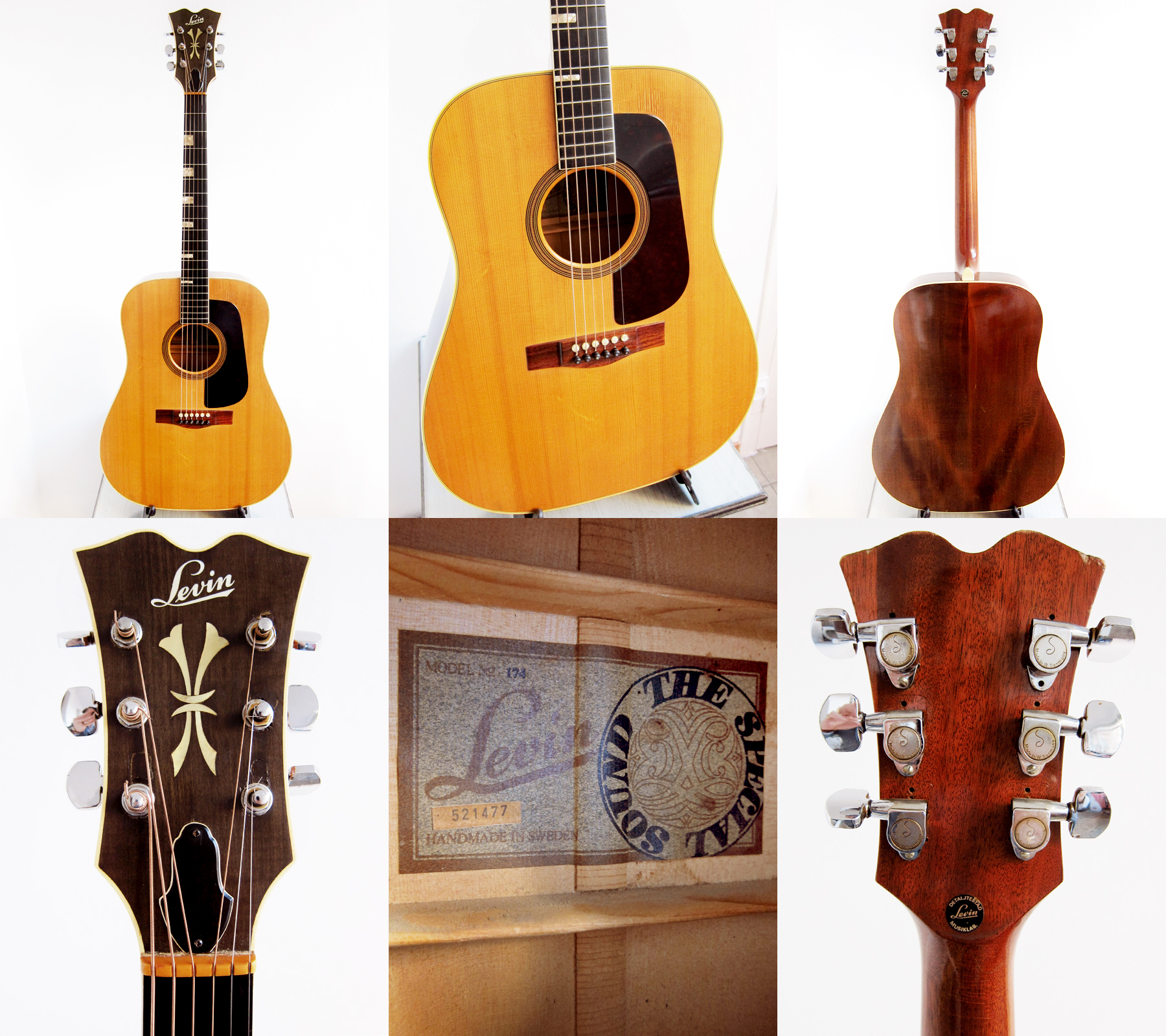
My latest acquisition, a 1972 Levin Model 174. The story how I got this guitar is pretty amazing. I wrote a post about Levin guitars back in August 2013 when I had just started to collect them. In the end of the post I mentioned that I would love to find a Levin Model 174, it’s basically a Levin LT-18 but with a massive head. There is something about that huge head that I find very appealing, I guess it reminds me of old an archtop guitar from 1930-40’s and it’s almost a bit Art Deco. Three months later, in the end of November, I got a comment from a Danish guy called Orla saying that he had one for sale. We started to email each other and he told that a few days earlier he had seen a guy about to throw a guitar case in a skip so he had gone up to him and asked if he could have it instead. Orla took the case home, opened it and found a 1972 Levin Model 174 in pretty good shape inside. He Googled the name and model and pretty soon found my blog post saying that I was looking for one. Since Orla doesn’t play guitar himself, he just wanted to save it from a certain death, he contacted me and offered me to buy it and I’m very grateful that he did. It was a bit scary to buy a guitar from a guy I didn’t know who had contacted me through my blog, it felt a bit fishy somehow. A part of me thought it was a Nigerian email scam in disguise and another part said that I should trust the good in people, especially a Northern neighbour like Orla. In the end I decided that it was an offer I really couldn’t turn down, especially since most of the 174’s I had seen for sale were all Goya labelled and made later in the 1970’s. It took some time to get the guitar down to Spain, we had some logistic issues but finally it arrived about two weeks ago and I was stunned. Since Orla doesn’t play he couldn’t give me any info about what state the guitar was in, he had sent me some pictures but it’s pretty hard to get an idea if it’s even playable from just that. Luckily it was in a really good state and it both sounds and feels great.
Levin Model 174 /Goya Model 174 Goliath size: Body width: 400 mm, body length: 505 mm, body depth: 95/120 mm
Fingerboard width: 43 mm, scale length: 630 mm
Spruce top, flame maple back and sides, 4-ply bound top, single-bound back
Mahogany bolt-on neck with adjustable truss rod
Single-bound headstock with mother-of-pearl inlay
Single-bound ebony fingerboard with bass side pearloid block inlays
Rosewood bridge with individual height adjustable plastic saddles
Nickel plated individual Van Gent tuners with metal buttons
Natural finish and ten year warranty
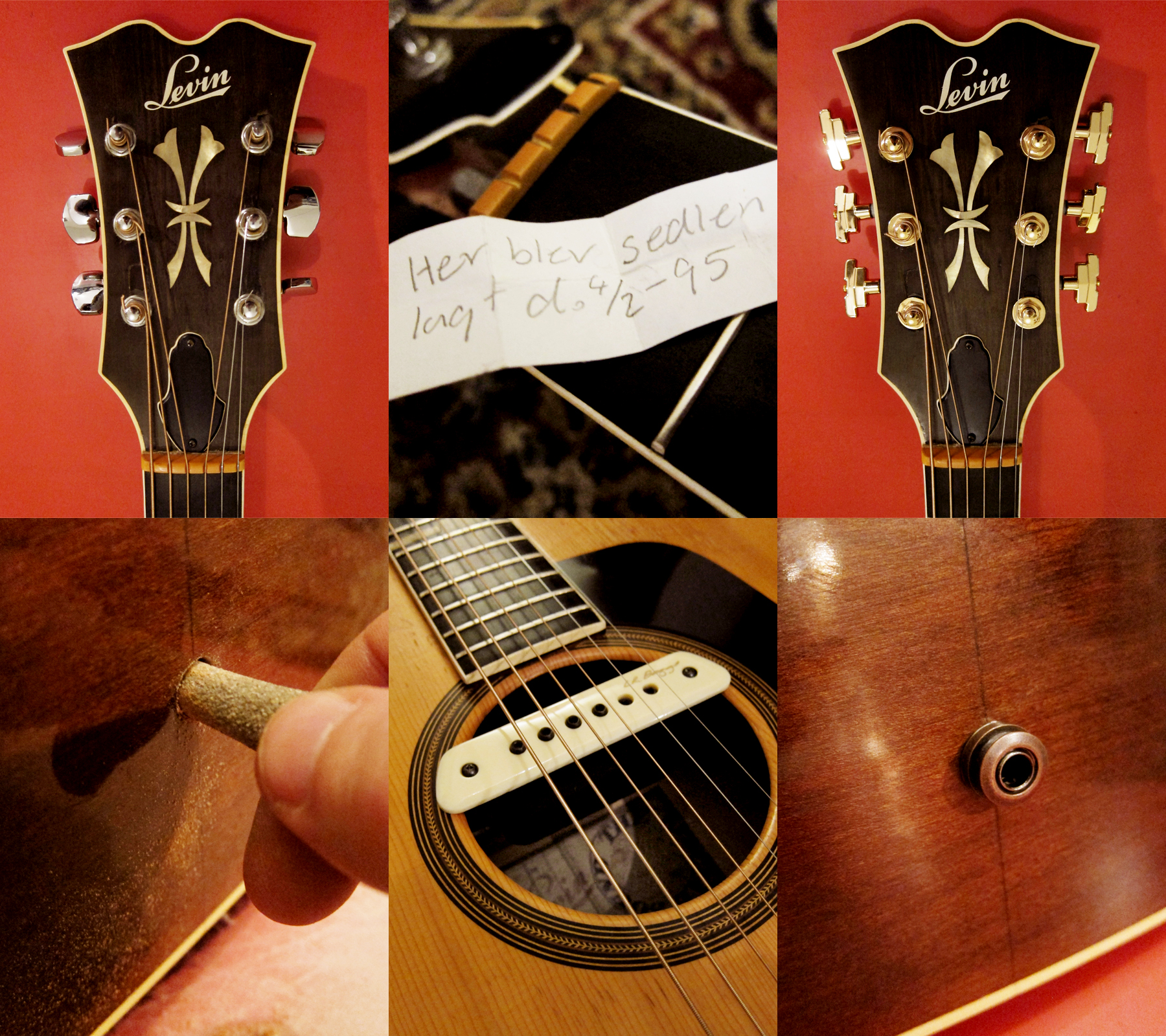
I didn’t have to do much to it, the action was really good as it was. Which was very lucky because this 174 doesn’t have the Levin bolt-on neck system, they stopped with that in the early Seventies. The original Van Gent machine heads had been changed at some point, probably in the 1970’s, to Schaller’s and I really don’t like these type of buttons so I changed them for Wilkinson WJ-309 in gold, to make it look even more Art Deco. I also installed an endpin jack so I can use it live with my LR Baggs M1. I had to clean it a bit, polish the frets and oil the fretboard but overall it was pretty good from the start. There was a note hidden under the trussrod cover saying, Her blev sedlen lagt 4th of February 1995. I assume that’s referring to that the nut was raised a bit 19 years ago, something I need to redo at some point because they seem to have used some paper like material instead of bone.







 Gibson S-1 advert from 1977 with Ron Wood
 Claescaster