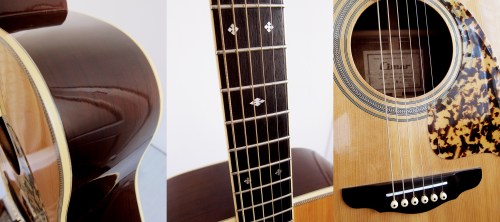
Ibanez V 300 BS, Made in Japan by Fujigen Gakki in 1979
Last month I was asked to find a guitar for my friend Miki’s birthday. His girlfriend Laura thought that I was the man to source an old Japanese acoustic for him, well I found it and she picked it. Last night he received the guitar so now the surprise is over and I can write about it, he seemed very pleased to be a part of the vintage Japanese guitar club. It’s pretty similar in shape and sound to the Ibanez built Cimar D-320 I got for my friend Tomasz back in May. Even though they have a lot in common, this Ibanez felt both fancier and more solidly built. I really like the sound of these 1970-80’s Ibanez and they look pretty unique since they aren’t an obvious Gibson or Martin copy. I can highly recommend them if you find one for a descent price, they tend to be more in the Morris price range than Suzuki which I guess could be because Ibanez is such a famous brand.
An extremely well kept 1979 Ibanez V 300 BS, built in Japan and after spending 36 years in France now lives happily in Barcelona
K. Yairi YW-130 a Martin D-28 copy made in Kani, Japan in 1977
I recently came over a 1977 K. Yairi YW-130, a beautiful Martin D-28 copy. I’ve been looking for a D-28 copy for a while, just out of curiosity to see the difference between the D-35 and D-42 copies that I have. The Morris W-40 and Morris W-50 both have a 3-part back which gives them a lot of bass and punch in the middle so perhaps a Japanese made D-28 copy would be more bell like and balanced, like a real Martin, and I was right. The K. Yairi YW-130 sounds amazing, really clean and even all over, with awesome overtones that sneaks up on you if you let it ring out. It has a solid spruce top, rosewood back and sides with a simple ebony bridge and fretboard. I do love my Morris guitars and I think it’s a great brand, but nothing comes close to K. Yairi. The old K.Yairi TG-40 that I got a year a go is awesome too, but I think I prefer the sound of the new one. Perhaps my acoustic guitar preferences has slightly shifted from the Gibson sound to Martin.
I didn’t have to do anything to the guitar when I got it, I just changed the machine heads to Wilkinson WJ28NGD open gear in gold which I love. It’s a bit worn and have a few dents in the spruce top that I’m planning to figure out how to soften a bit.
I’ve really come to love guitars with the typical Martin volute, just like my Morris W-50, and the double dots on the 7th fret, it’s just beautiful. There is nothing better than a black Ebony fretboard on an acoustic guitar. I thought ebony was like rosewood until I got my Goya T-18 two years ago and it just blow my mind, there is no nicer fretboard material.
K. Yairi YW-130 in a late 1970’s Canadian catalogue, taken from AlvarezYairi
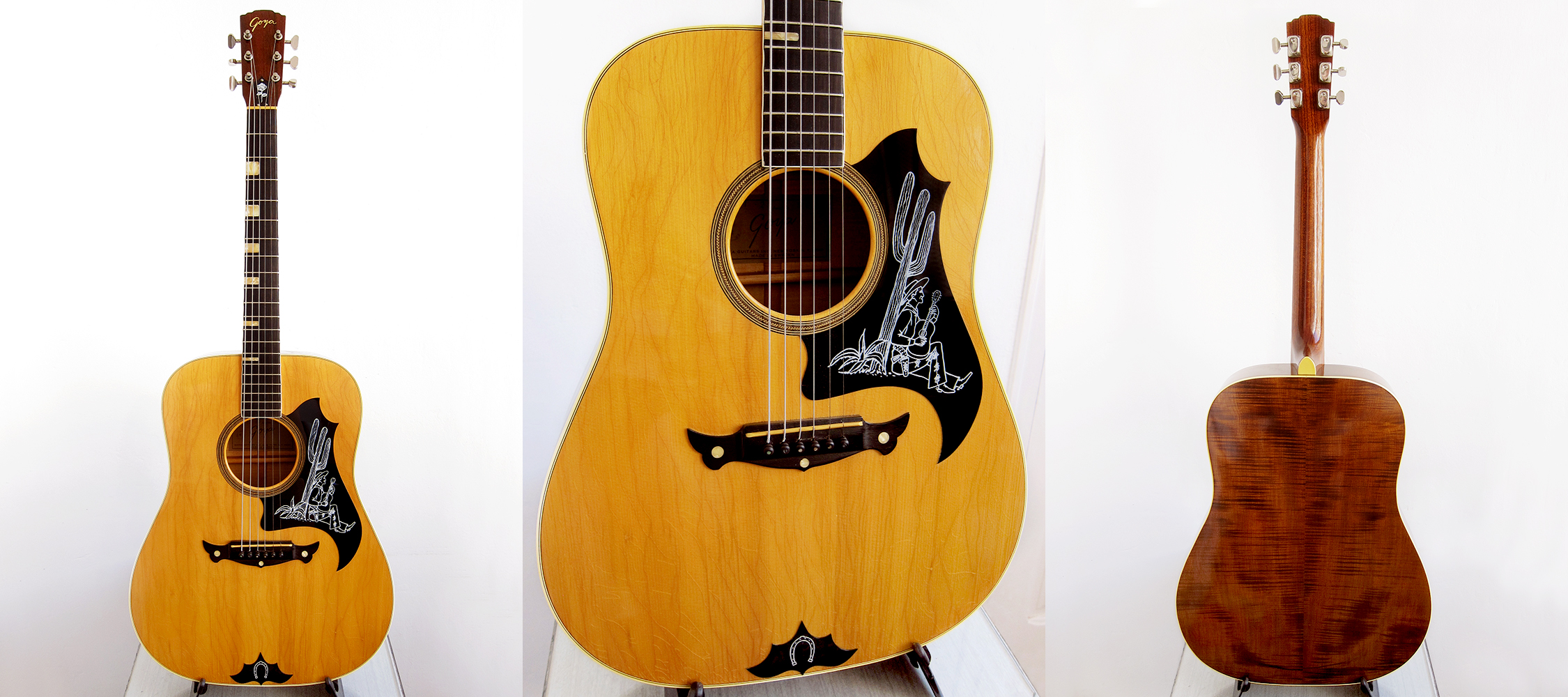
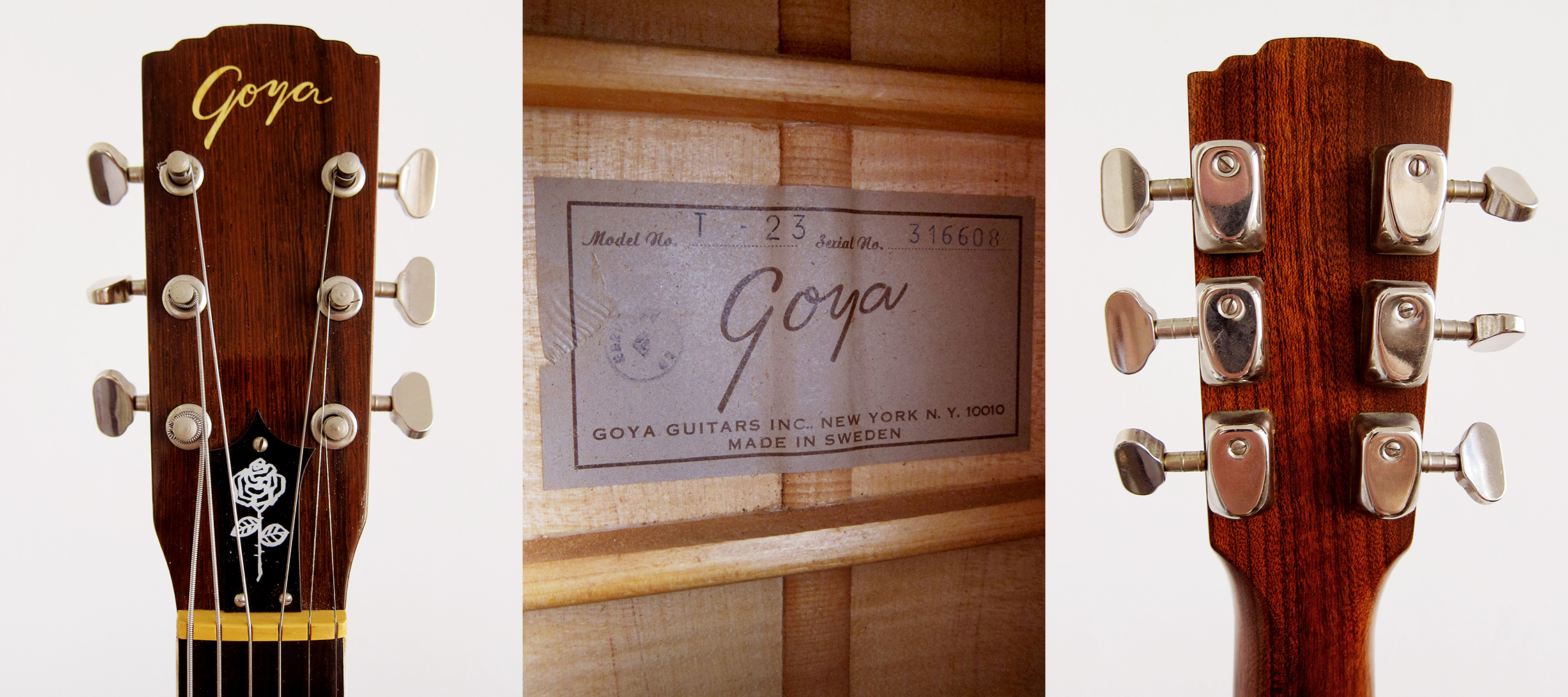
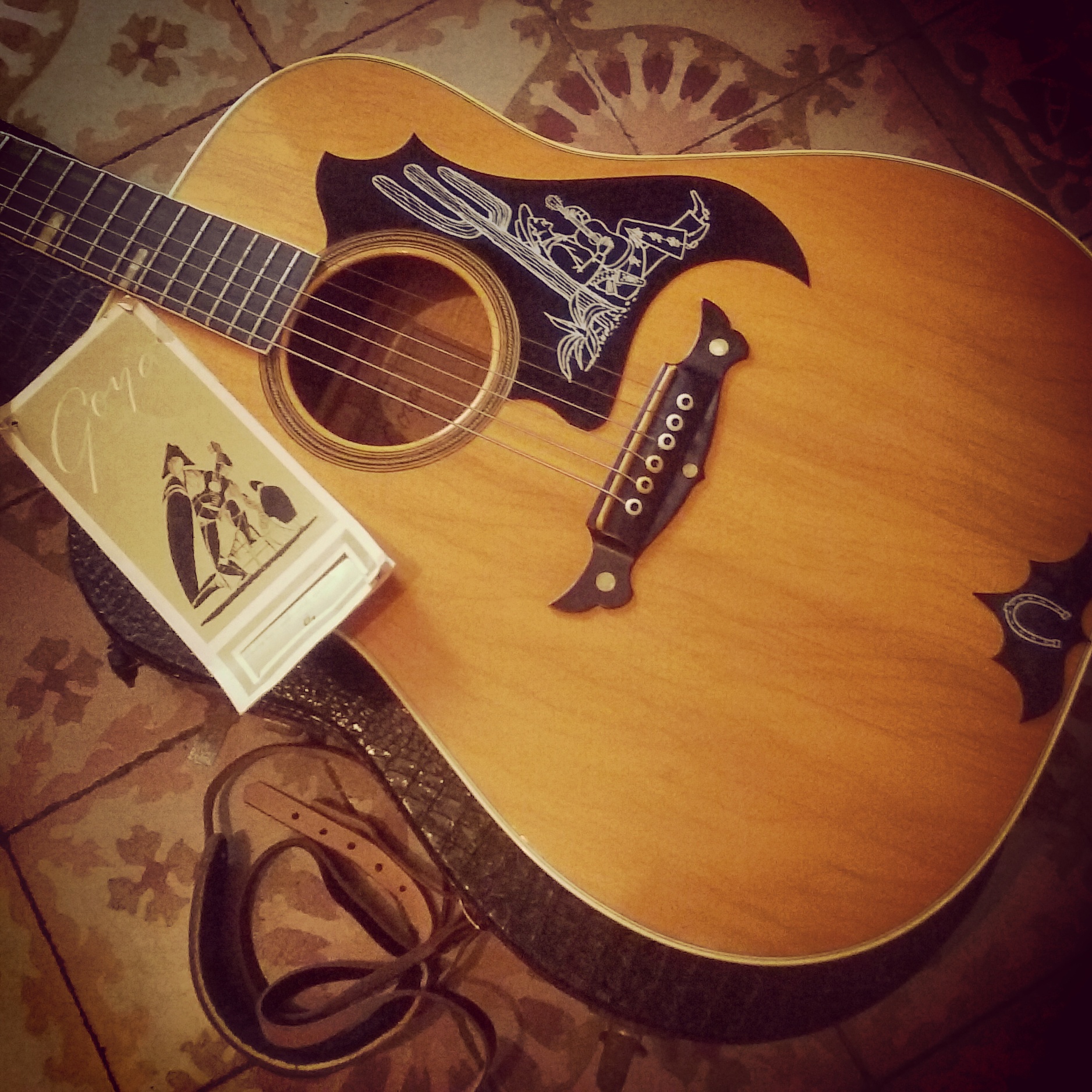
Finally, it took two years but now I’m at last the proud owner of a lovely Goya T-23. When I bought my first Levin back in the summer of 2013 I started to search Vintage Guitars Sweden for different models to study and learn everything I could about Levin. There was 3-4 different guitars that I fell in love with straight away, Levin LM-50 with all it’s bling, Levin De Luxe the king of archtops, Levin 174 which I later found, and of course Levin LT-23, the cowboy version of Levin LT-18. I love my 1966 Goya T-18 so I was pretty sure that this Goya T-23 would sound pretty sweet too, but it sounds even better than I could have imagined. My friend Wolf and I had a little jam last Saturday and it seems like the T-18 and T-23 were made to be played together, I will try to sort a video. I love everything about this guitar, the ebony fretboard with it’s block inlays, the flamed maple back and sides, the amazing cowboy pickguard and plastic details, the bridge shape and most of all, the sound. It has a Gibson like bass response but with a Martin like mid and treble, kind of the best of both worlds. It was well worth the wait, the next holy grail to find would be a Levin LM-50.
I haven’t done any work to this guitar yet, I bought it from a seller in Franklin, Indiana, USA and since it seemed really dry when it arrived I wanted to wait and see how it reacts to the subtropical heat of Barcelona first. Most likely I will have to sand down the heal a bit to get the action down and perhaps even remove the binding on the neck and file down the frets since the fretboard has been dry and shrunk so the frets are poking out a bit. Hopefully the humidity here will help a bit and if not I will sort this issues after the summer. It’s very playable as it is and almost in mint condition with minimal wear.
Levin LT-23/ Goya T-23 Goliath size: Body width: 400 mm, body length: 505 mm, body depth: 95/120 mm. Fingerboard width: 43 mm, scale length: 630 mm. Spruce top with X-bracing, flame maple back and sides, 4-ply bound top, single-bound back. Mahogany bolt-on neck with adjustable truss rod. Single-bound ebony fingerboard with bass side pearloid block inlay. Nickel plated individual Van Gent tuners with metal buttons. Ebony bridge, natural finish and ten year warranty
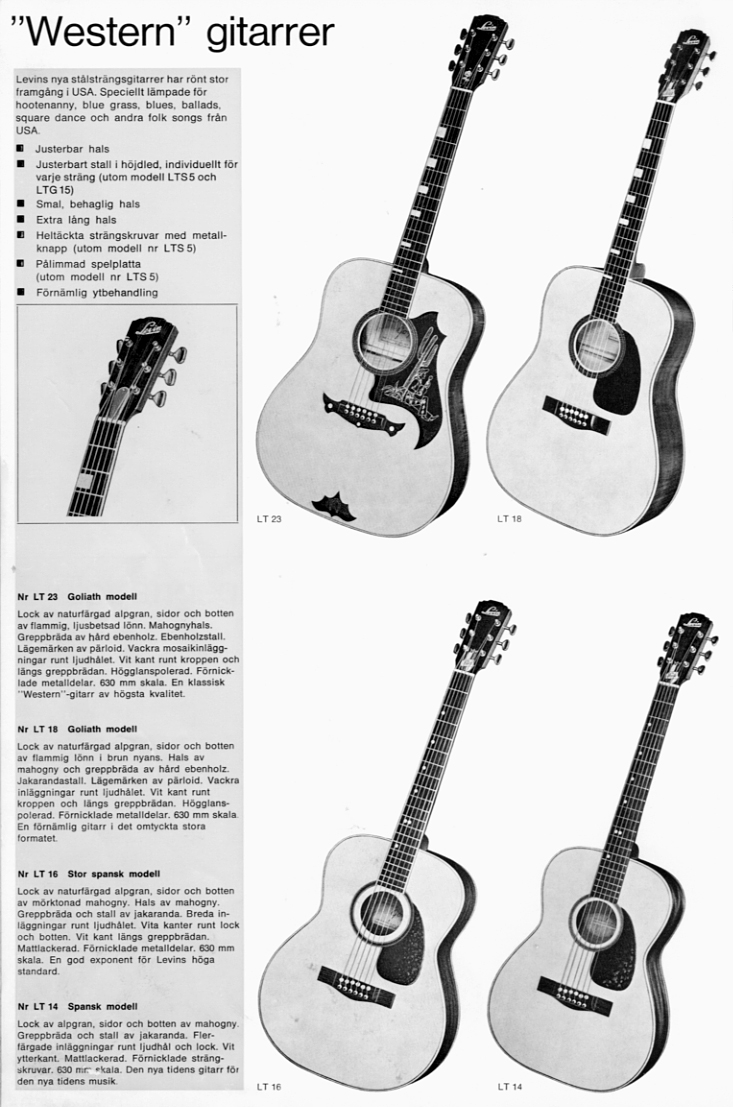
Levin catalogue from 1967. Now I finally have all four of them, the two top as Goya and the bottom two as Levin, but mine are from 1965-66 so they have a proper saddle instead of the adjustable saddle screws. Goya T-23 (1966), Goya T-18 (1966), Levin LT-16 (1966), Levin LT-14 (1965). Taken from Vintage Guitars Sweden
It arrived with the original Goya hang tag, an unused 1960’s leather strap and this awesome looking black alligator hard case that I think is original too. Taken from my Instagram
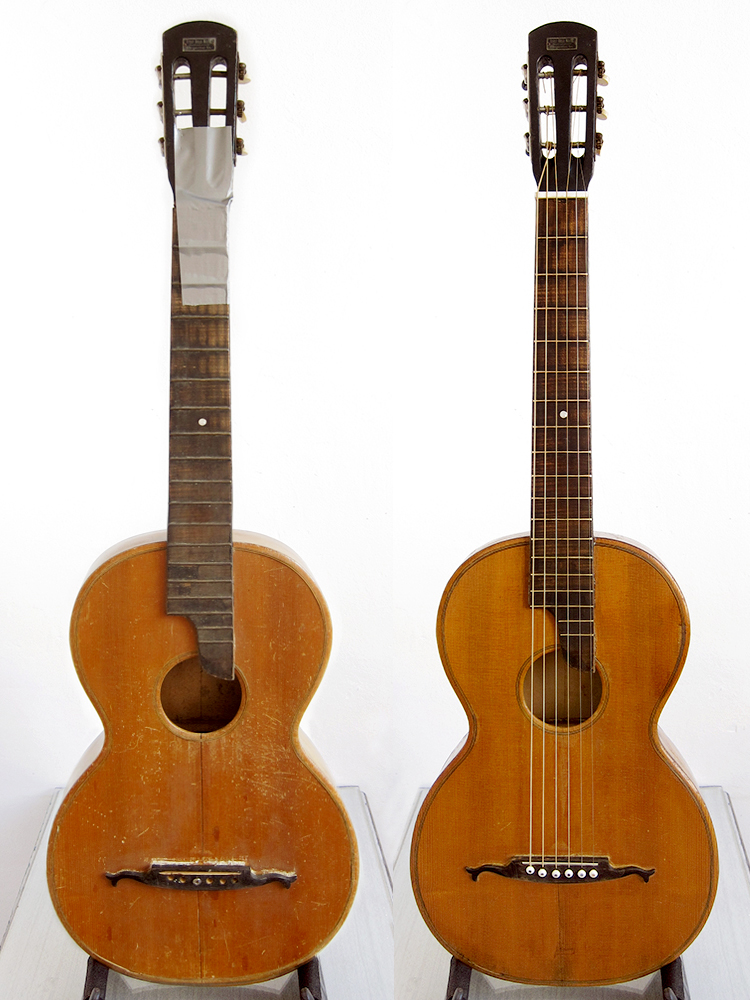
I recently restored a little German parlour that I unfortunately don’t know anything about. The only info the seller gave me was that it was made in Vogtland in perhaps the 1920-30’s. If this would have been a Japanese acoustic or a Levin I would have had a bit more of knowledge but I really don’t know anything about old German parlours. I just bought it to practice my guitar repairing skills and for that it was pretty good, I’ve learned a couple of new things. The idea was to give it to my wife but now we found another one for her so if anyone is interested in buying this then send me an email.
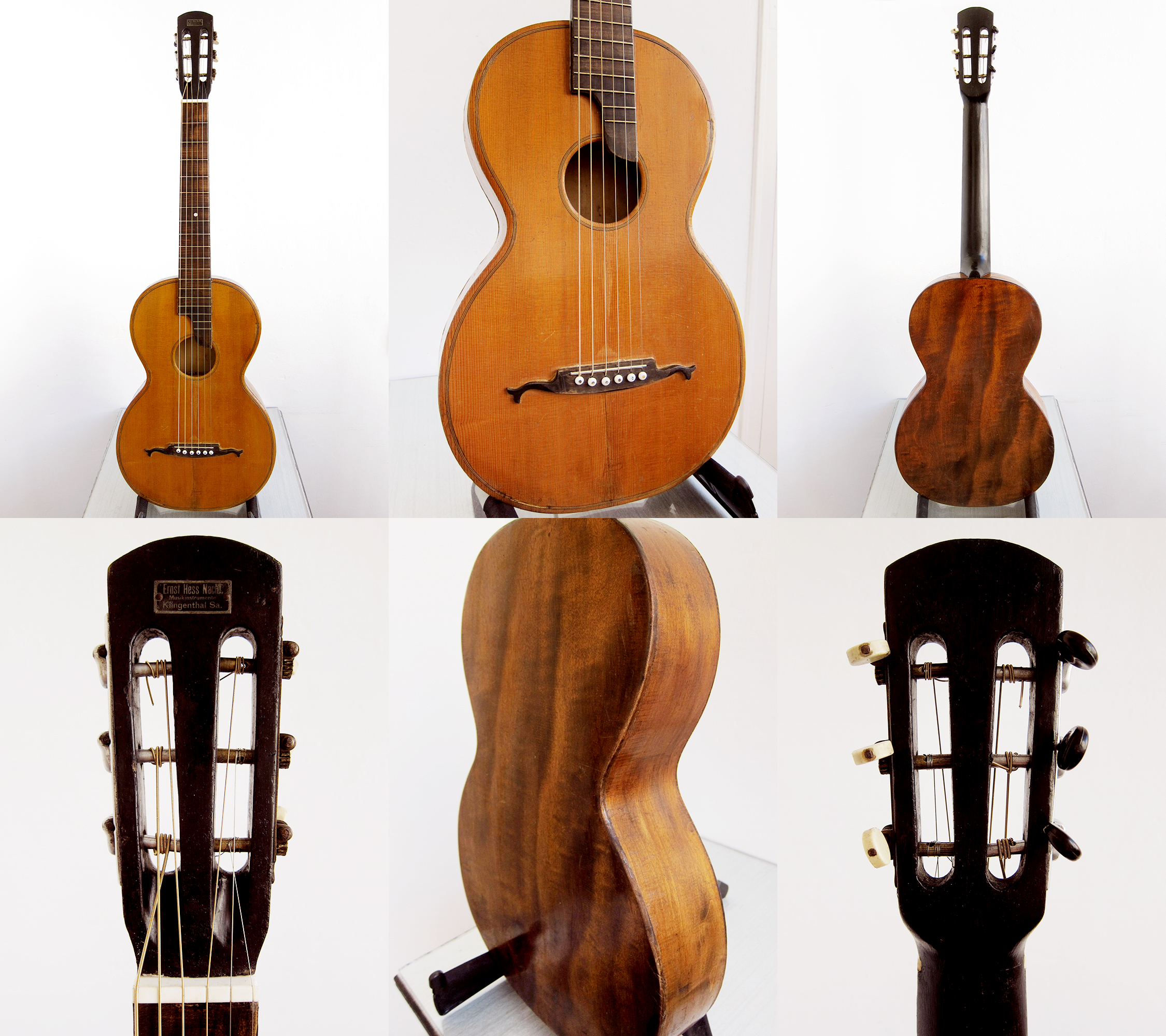
The action is a bit high so it’s ideal for slide playing but you can still play it like a normal guitar if you have light gauged strings on it. It sounds pretty awesome, really clear and loud for being so small. It’s made of all solid woods, spruce top, walnut back and sides and perhaps pine or some other light coloured wood in the neck, I’m not that great at guessing woods. One set of machine heads looks original and seems to be from 1920-30’s and the other is perhaps DDR made from the 1960’s, but both works fine. Overall a pretty nice sounding little guitar with a beautiful patina and the most awesome looking one piece walnut back.
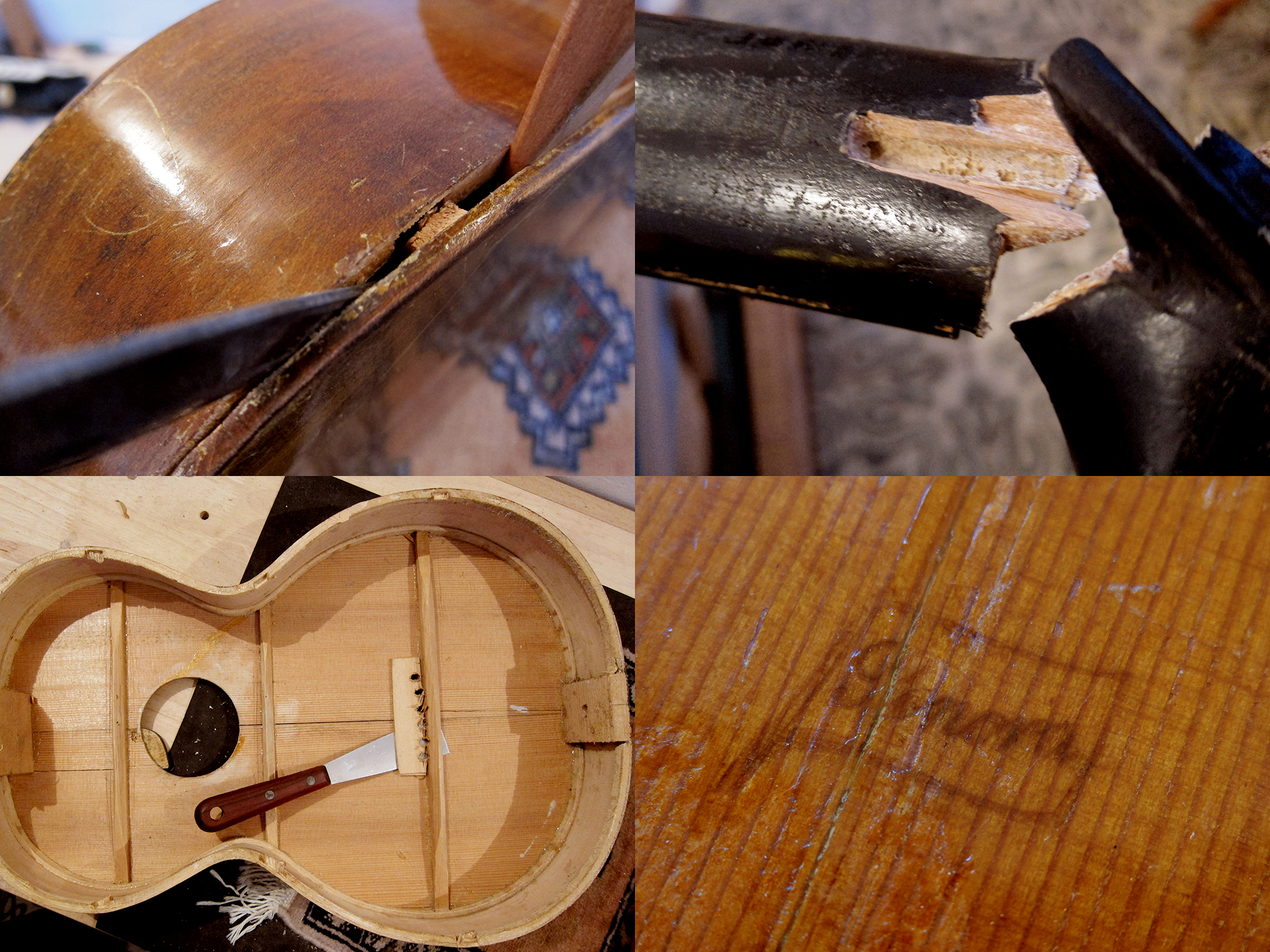
I started with taking the back off so I could re-glue all the braces. It was pretty straight forward to open it, I used a heated spatula and a knife, it worked like charm, I removed all the braces in the same way. The head was broken and pretty much everything that could be lose was lose on it when it arrived. It has a small makers mark under the bridge but I can’t really figure out what it says, if anyone has any ideas please get in touch.
Update: August 27, 2015: The brand is Sonora
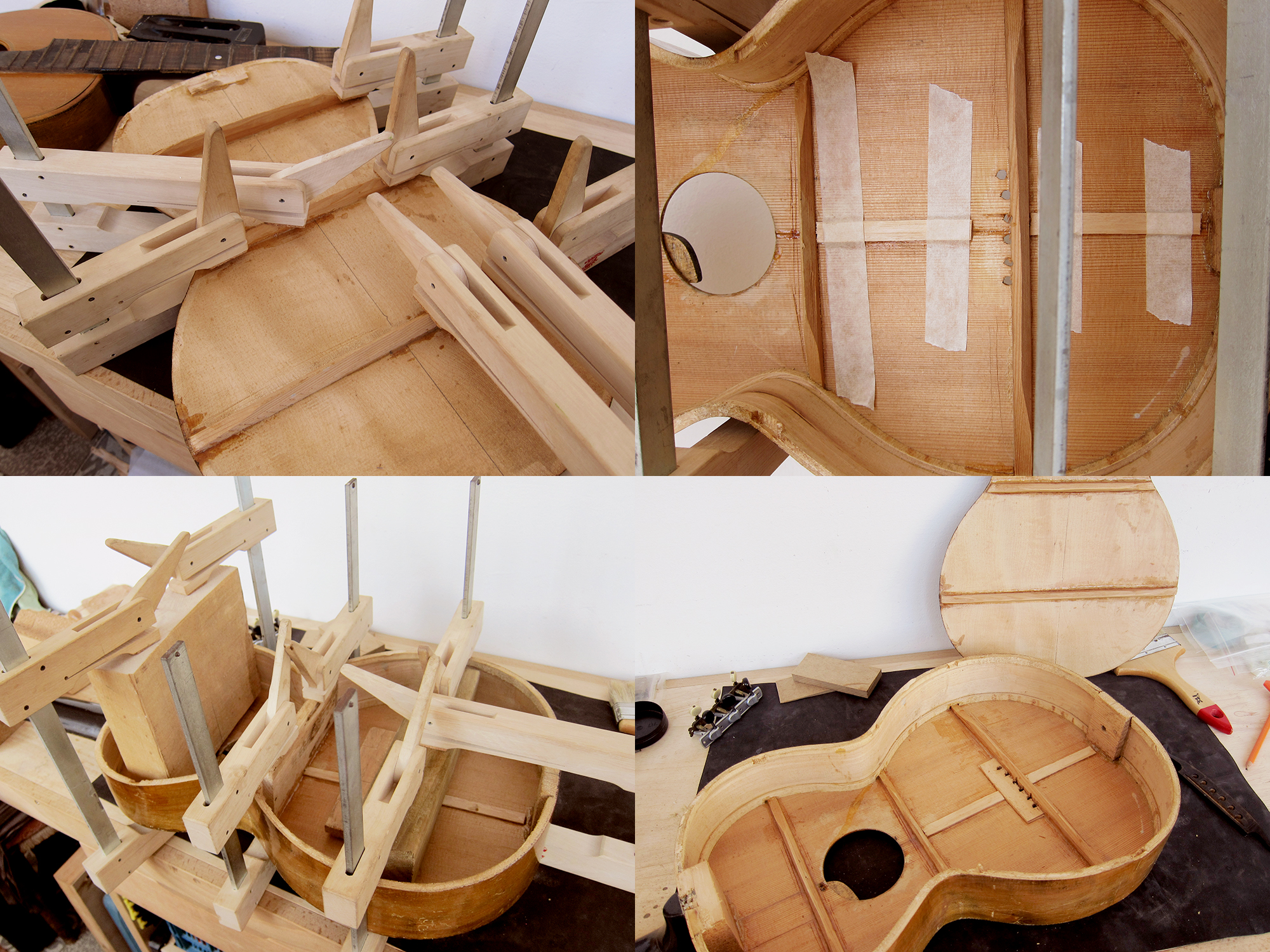
I re-glued all the braces and the two cracks in the top with fish glue. Unfortunately the top had been cracked for so long so I couldn’t get it to close perfectly but at least now it’s solid with two cleats running along the cracks.
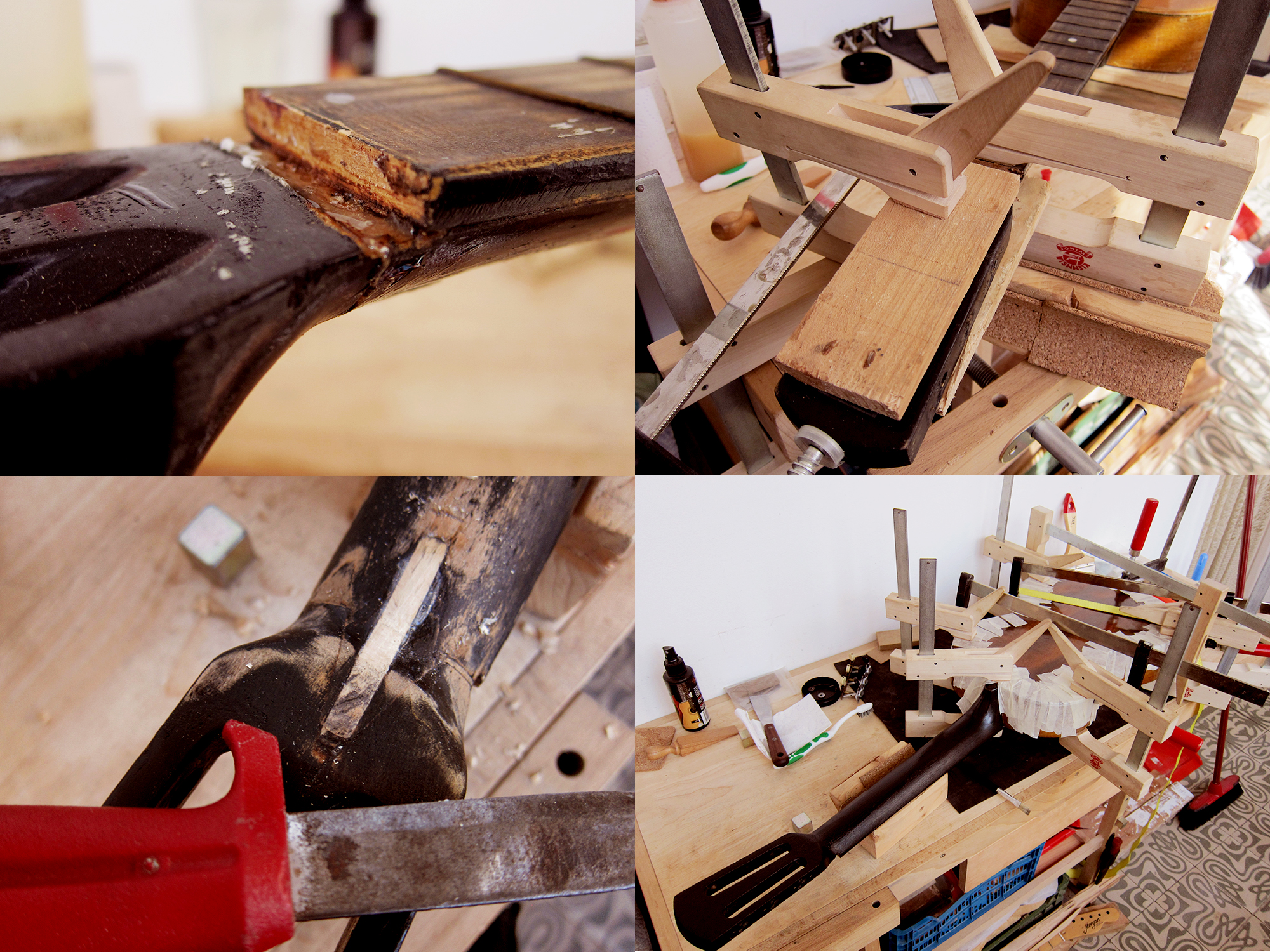
The next step was to glue the head back on. This was a bit harder than the Spanish guitar I glued the head on the week before since the break this time was just under the nut and therefore a lot harder to clamp. I left it for 48 hours and it seems to have worked pretty well so I carved and sanded the back smooth and then painted it black again. I glued the back on and closed the guitar with tape and clamps and this was pretty tricky too, as I’m sure everyone that has ever closed a guitar would know. The sides tend to move outwards so you have to push them in place sideways at the same time as you clamp the top down to the body. A bit fiddly but it worked fine in the end.
Now I just had to make the guitar playable. These old parlours are known for having banana necks since they lack any form of reinforcement in the neck. On top of that they tend to have a hump where the fretboard meets the body. First I heated and steamed the neck under pressure which worked quite well for straighten it out a bit. Then I took out the last 5 frets, sanded down the fretboard, put the frets back and lowered them as much as I could. I painted the fretboard brown and sanded over it to match the rest. After that it was just to level, crown and polish the rest of the frets.
Last night my wife and I got a chance to see Jackson Browne live. It was even better than I had hoped, his voice was so good. Perhaps the selection of songs wasn’t the best, there was a lot of stuff in the second set that I could have done without and I missed some of my favourites from the first two albums but still, he had a great band and his singing was just amazing. If you want you can follow me on Instagram.
Guitarras de artesanía, Artículos J.A.R. Spanish guitar made in Mataró outside Barcelona 1970’s
I found this guitar in a Cash converters last week and felt so sorry for it. It had a broken head, a cracked brace, loose back and looked so sad that I felt I had to save it and bring it back to life. A week later she is up and running and sounds pretty damn sweet.
I couldn’t find any info about the brand so if anyone knows anything more about it then please get in touch. It has a solid spruce top and what looks to me like solid maple back and sides. It says “Guitarras de artesanía” which should indicate hand crafted but I’m not sure, quality wise it feels pretty much like the Juan Estruch I got for my friend Rafa’s birthday. Perhaps all Spanish guitars were more or less hand crafted back then, the big business guitar factories hadn’t really kicked in yet. I have put this guitar up for sale since I mainly play steel string acoustic guitars and on top of that I have a Francisca Montserrat that I really like.
First I had to try to clean her up, I have never seen a top with that much grease and grime. I used a normal furniture spray and a toothbrush, it worked like a charm. When I had cleaned the fretboard I polished the frets and oiled up the fretboard with lemon oil. She came out looking pretty descent after that.
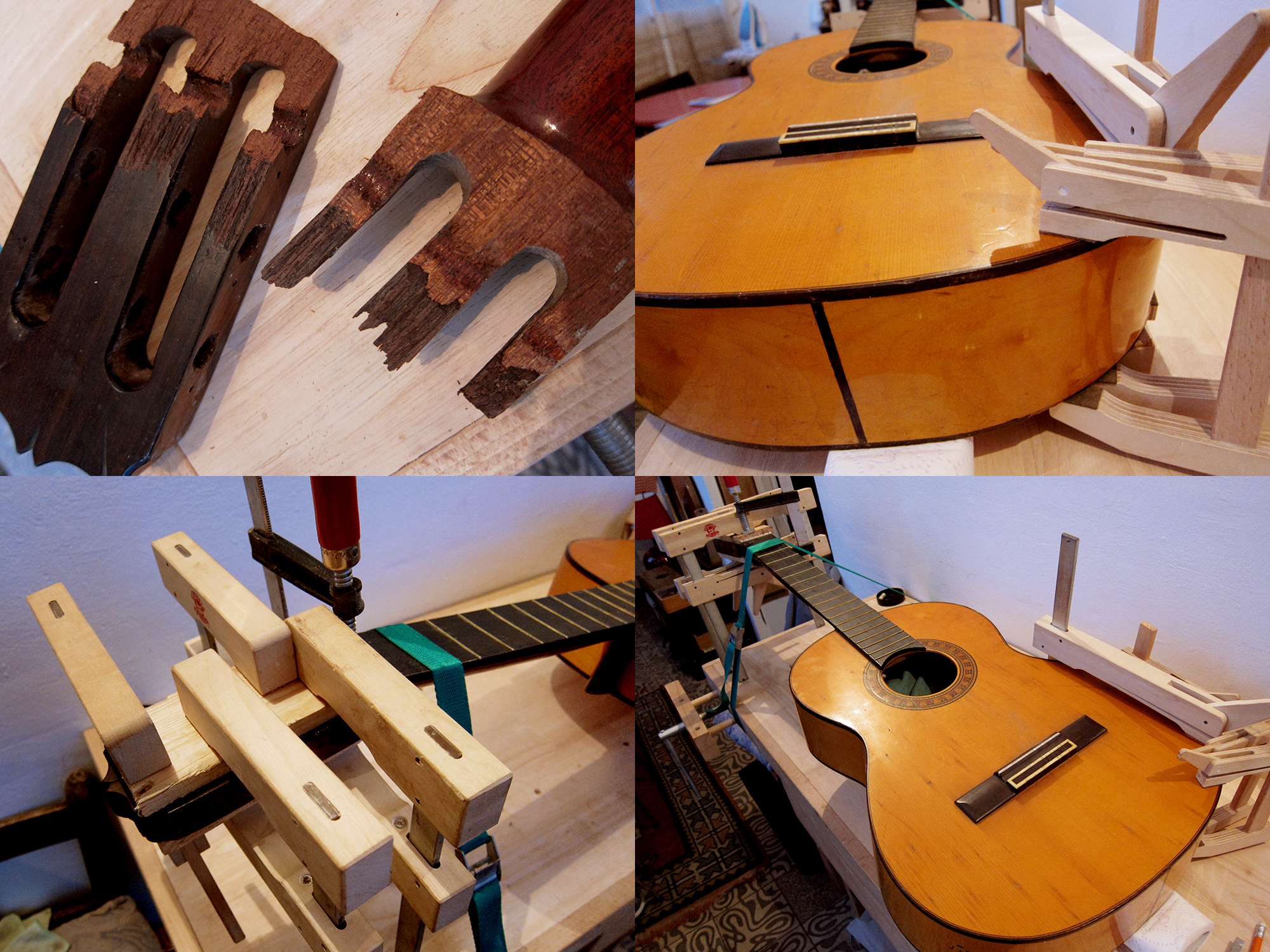
Now I just had to take care of the broken head and glue the back. I have actually never glued a head on before but I assumed that you do something like this. I used to thin pieces of wood on each side to stabilise it and keep things in place, and also for not damaging the head any further with the force of the clamps. I guess it could have worked with normal wood glue too but I used my trusty old fish glue that I use for pretty much everything when it comes to guitars. It came out looking very solid after being clamped for 48 hours. I also glued the open back and a cracked brace, which was pretty straight forward. The machine heads was broken on one side so I replaced them with the leftovers from the Juan Estruch I fixed last year. They don’t match exactly but at least they are from the same time and region, that’s close enough for me. Compared to the state I found her in I think she is looking pretty good. More images can be found here.
Last week I went a bit bananas and got a 12 string Levin. It wasn’t really planned but sometimes you make a best offer on eBay when you are slightly tipsy and then occasionally you become the new owner of some old guitar, like a 1978 Levin W 12-36. I wasn’t even sure if I liked 12 string acoustics or not, I mean they do make a terrible loud noise and seemed a bit too hippie / folk for me, but then I remembered David Crosby who really likes 12 strings and I really liked David Crosby, so that was it. I got it last Friday and played it quite a lot over the weekend and I think I really have grown to like it. I mean you can’t really play it like a normal guitar since it makes too much noise and the notes tend to just eat each other, so you need to space out your strokes a bit. Once you get a hang of it it’s a pretty powerful and interesting instrument to have in the arsenal even if you wouldn’t use it everyday.
I bought the guitar from a German eBay seller,with a name in Spanish, compravender. I’m not sure if he had fixed it up himself or if it came straight from a luthier but the frets were polished and it was well set up so I didn’t have to do anything to it when I got it. The only downside is that the guitar has suffered a broken headstock at some point but it’s really well repaired and seems solid enough.
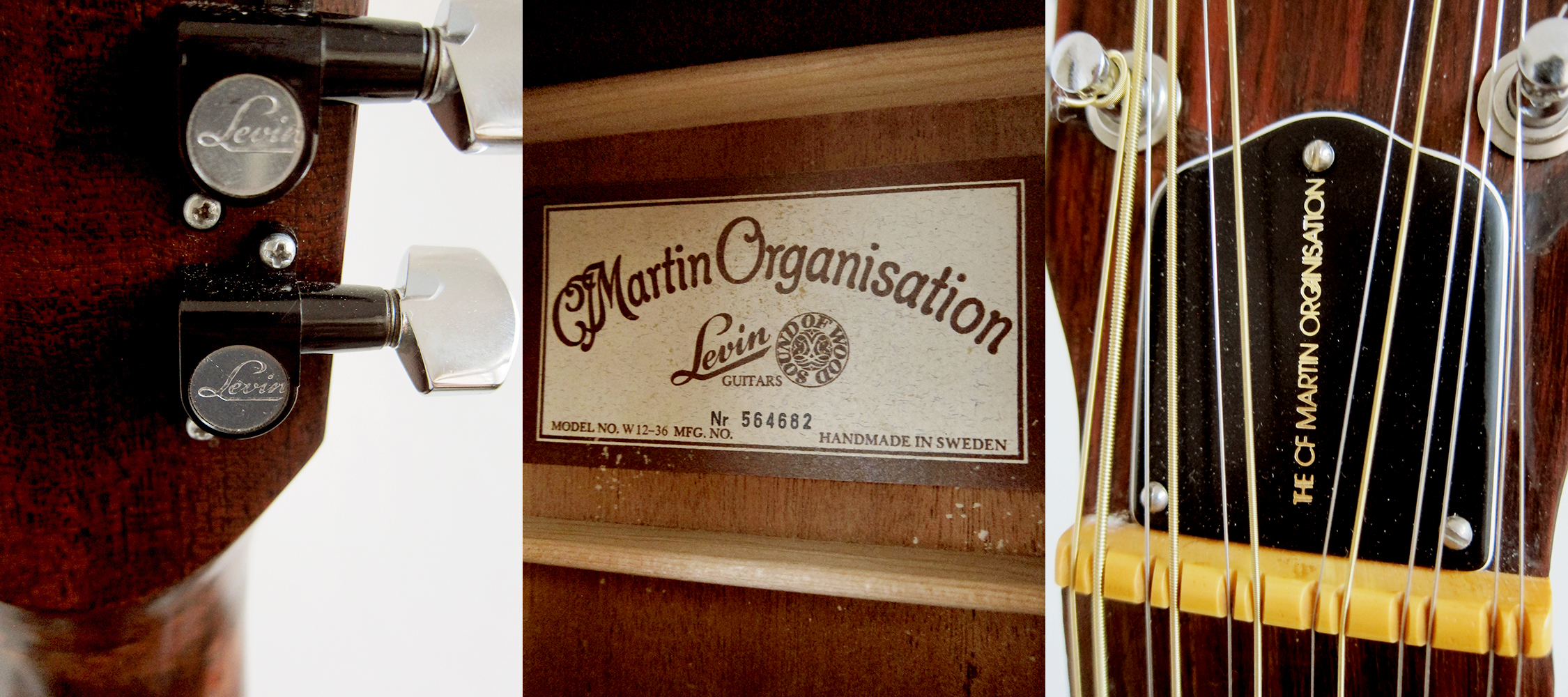
This Levin W 12-36 was made in 1978 and seems to be the latest knows to Vintage Guitars Sweden. This is also the “newest” Levin I have, they stopped making them in 1979. I haven’t seen the Martin Organisation label before, or the CF Martin trussrod cover.
Levin W 12-36
12-string, non-cutaway. Body width: 400 mm, body length: 505 mm, body depth: 95/120 mm, fingerboard width: 52 mm, scale length: 630 mm
Spruce top with X-bracing, mahogany back and sides, 5-ply bound top, single-bound back, mahogany neck with two adjustable truss rods
Black plastic truss rod cover, unbound headstock with decal logo, unbound rosewood fingerboard with mother-of-pearl dot inlay, rosewood bridge.
Black and chrome plated individual Levin Schaller tuners
Natural finish and five year warranty
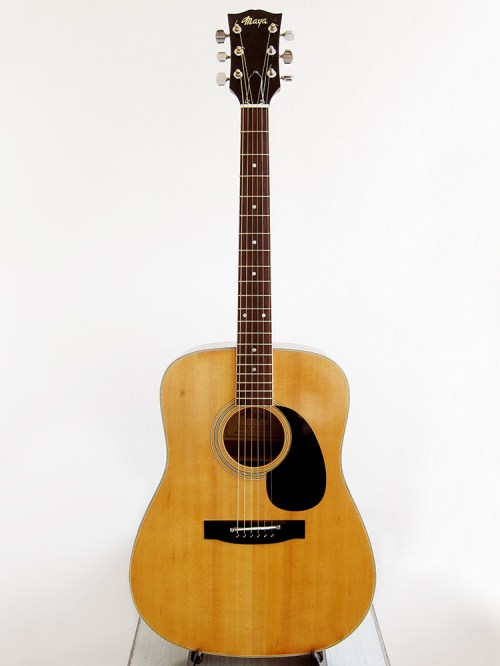
Maya F335G, Dreadnought acoustic, Made in Japan, 1970’s, 200€ SOLD Japan made Gibson J-50 copy in a pretty good state for it’s age. I couple of marks on the spruce top and few knocks on the head but structurally very sound without any cracks. This Maya F334G was made by Chushin Gakki in Kobe, Japan, during the 1970’s. It has a really fat neck, it’s feels great to play, adjustable bridge with both bone nut and saddle. The sound is very full with a great booming bass. If you want more pictures you can check the post I wrote about it.
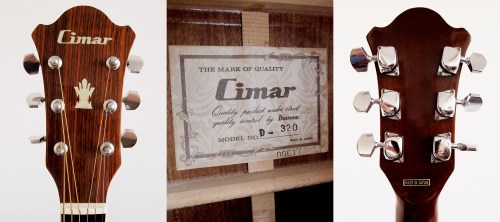
Cimar D-320, Made in Japan in the mid 1980’s by Ibanez
I recently helped my friend Tomasz to find a nice Japanese acoustic and we ended up with this Cimar D-320. Cimar were made by Ibanez in the 1980’s as their cheaper brand and even though I’ve seen them for sale quite often, I had actually never tried one. Ibanez is owned by Hoshino Gakki and based in Nagoya, Aichi, Japan. Hoshino Gakki also had semi acoustic, nylon and steel stringed acoustic guitars manufactured under the Ibanez name. Most Ibanez guitars were made for Hoshino Gakki by the FujiGen guitar factory in Japan up until the mid-to-late 1980s and from then on Ibanez guitars have also been made in other Asian countries such as Korea, China and Indonesia, taken from Wikipedia. I have a feeling this Cimar would be one of the last ones to have been made in Japan and I’m still struggle to see how they could be making inexpensive guitars in Japan in the mid 1980’s, I had a feeling that everything had already been moved to Korea or some other cheaper country. They guitar seems to be pretty solidly built and has a lot of swanky details like the snowflake inlay and herringbone binding which looks great from a distance. The best part is still the sound, I would never have expected it to have such rich bass and great response, especially not for being fully laminated. A pretty great guitar for the price. If you want to know more about different Japanese guitar brands then check my previous post.
Fujigen Gakki Fujigen Gakki began operation in 1960 as a classical guitar manufacturer, moving into the lucrative electric guitar markets in 1962. The company was the largest producer of Japanese guitars during the 1960-1980 period. They were known for producing high quality products, especially for the badged guitar market, which is why the company was selected by so many major American brands. It wasn’t until 1970 that the company began making products for the venerable Ibanez brand, which was an unqualified success. Fujigen Gakki was the main manufacturer of choice for Greco badged guitars in the 1970 to 1980 period. They also produced guitars for major manufacturer Yamaha. Badged guitars made by Fujigen include Antoria, Epiphone, Jason and Mann. Badged guitars that may have been made by Fujigen Gakki were Marlin and St. Moritz.
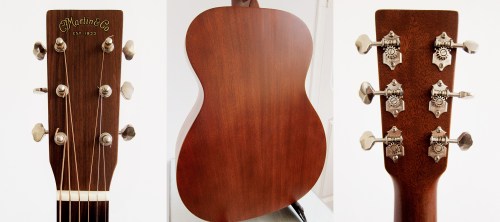
I recently had my friend Rafa’s little Martin 000-15M over for a set up. I didn’t have to do that much to it, just adjust the trussrod and file down the saddle a bit to get the action down. I realised that I have completely mixed up the Martin sizes, I always thought that the 000 was smaller than the 00, apparently it’s the opposite. That means that my dad’s old Levin LT-16 is a copy of a Martin 000, at least size wise, and not a Martin 00. It could be good to know next time I’m looking for some old guitar and they refer to it as being 000 sized, smaller than that is probably not for me. I don’t like jumbo guitars, but I do like the bass response of a good dreadnought sized guitar, and I think that anything smaller than a 000 would most likely sound like a parlour guitar in my ears. These Martins 000-15M have a pretty descent bass response for their size, I guess because of the shape and the all solid Mahogany construction. It’s a beautiful looking guitar, very light and easy to play and with a warm nice sound that I can highly recommend to anyone looking for a new guitar.
 Ibanez V 300 BS, Made in Japan by Fujigen Gakki in 1979
 An extremely well kept 1979 Ibanez V 300 BS, built in Japan and after spending 36 years in France now lives happily in Barcelona
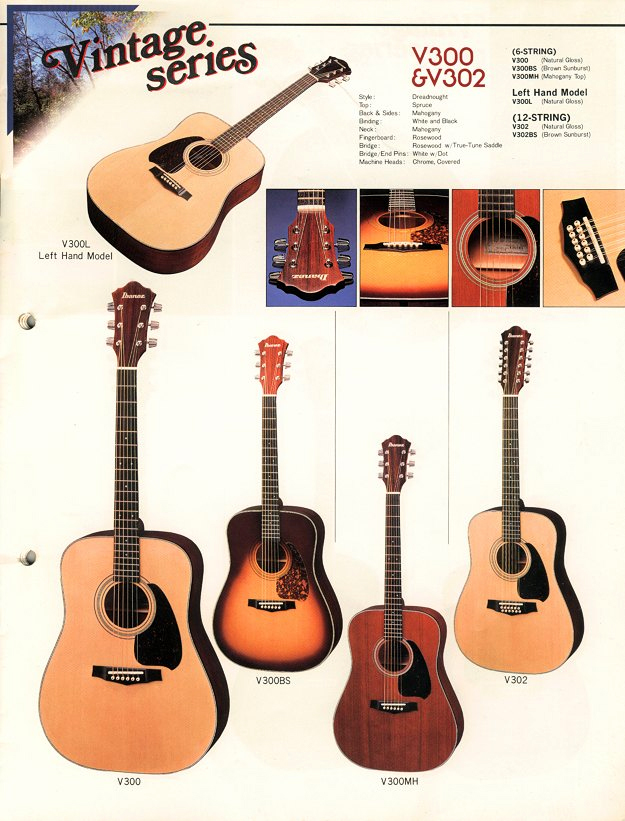 Ibanez catalogue 1983-84 take from Ibanez Guitars









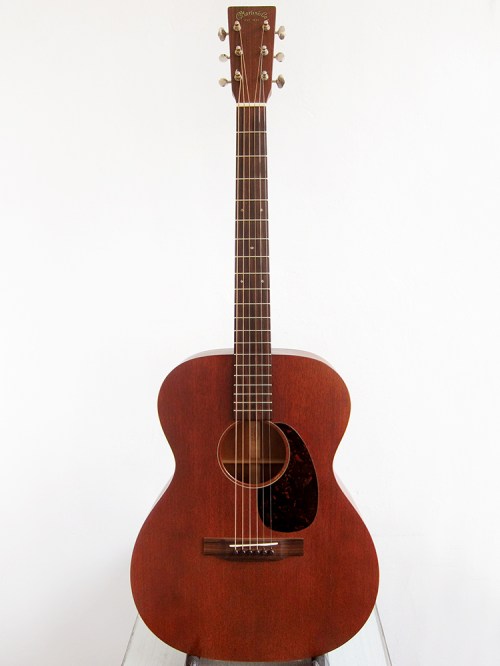 Martin 000-15M, Made in USA 2011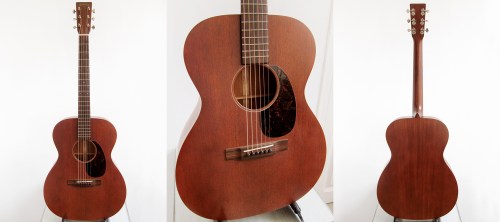
 Claescaster
