Claescaster

Tag: MIJ

Kazuo Yairi

Master Luthier, Kazuo Yairi Dies Aged 81

I just found out that Kazuo Yairi died earlier this month at the age of 81. As I mentioned before, I would love to one day afford a K.Yairi and big reason for that is the philosophy of Mr Yairi himself:

Good materials are hard to find so it’s better to make guitars through limited production by hand instead of mass production. Trees are very important “precious” things so we should make good use of them. Guitars made with “heart” are the best use of trees.  Kazuo Yairi

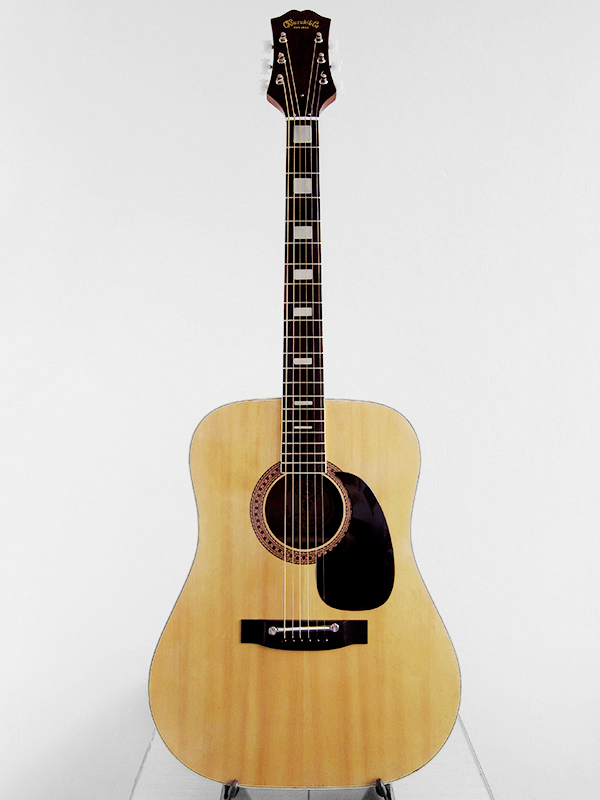
Martin D-45 copy, 1976 K.Yairi YW-1000
The most beautiful Martin D-45 copies in the world, a 1976 K.Yairi YW-1000

Hagstrom Viking

Hagstrom Viking, Tobacco Sunburst 2008Hagstrom Viking, Tobacco Sunburst 2008

It’s with a heavy heart that I have decided to part with my Hagstrom Viking. I bought the guitar back in 2010 and have unfortunately not had time to play it as much as I wanted, some Japanese Telecasters got in the way. I had three semi-hollow bodied guitars at one point and kept this the longest, I sold the other two last year. I guess the more guitars you have the more you realise what feels good for you to play. For me, fat necked Telecasters feels really nice to play, I’m a bit gay for old Greco Telecasters from the 1970’s. If you are interested in inherit this Hagstrom Viking from the Claes Collection then get in touch. You can read more about it here for sale, or in Spanish here.

Update: April 4, 2014 The Hagstrom Viking is now sold to Rafa from Cobarde.

Hagstrom, or Hagström as we call it back home, was founded in 1925 by Albin Hagström in Älvdalen, Sweden. They made amazing electric guitars from 1958 to 1983, played by guys like Elvis Presley, Jimi Hendrix, Noel Redding, Joe Walsh, Dweezil and Frank Zappa to name a few. I have played on a lot of Hagstrom guitars and amps during my teenage years back in Sweden and learned to play bass on my stepdad Sten’s Hagstrom Jazz bass from 1976. I have an fairly mint Hagström HIIN OT from 1975 back in Sweden that I really like. I guess it was out of national pride that I got so excited and bought the Hagstrom Viking when they started to make them again in 2004. They have a few models that are made in the EU, but not in Sweden, and the rest is made in China. I have actually only played my Viking from 2008 so I can’t really comment on the quality of the Chinese Hagstroms today but mine is very well built for the price. I would say that they are better than Gretsch Electromatic, Epiphone and the Ibanez semi-hollow bodied, all in roughly the same price range.

Zappa plays Zappa, Hagstrom ad

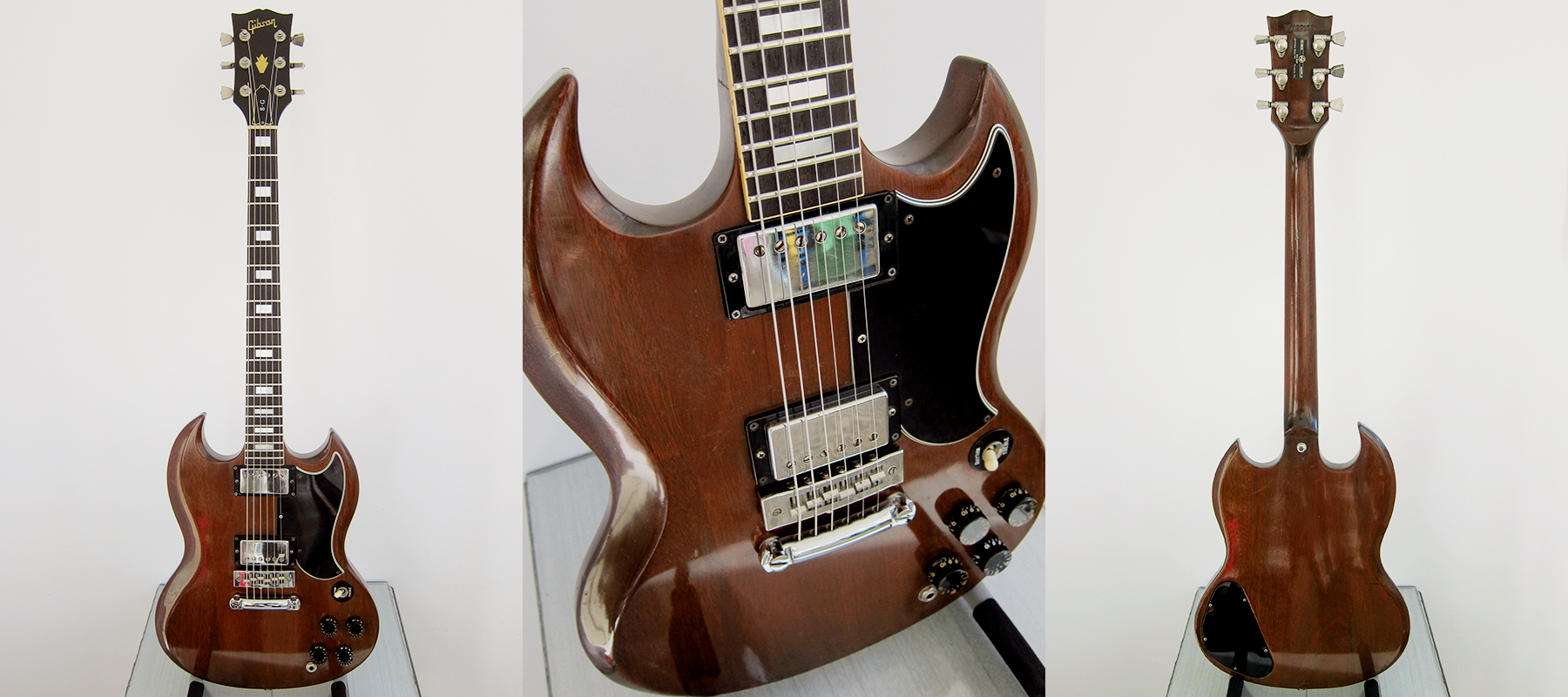
Gibson Walnut SG Standard

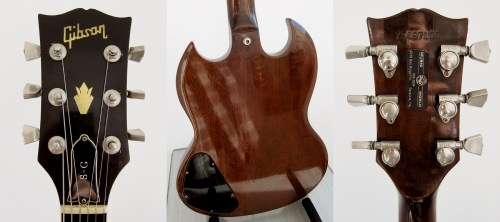
1977 Gibson Walnut SG Standard
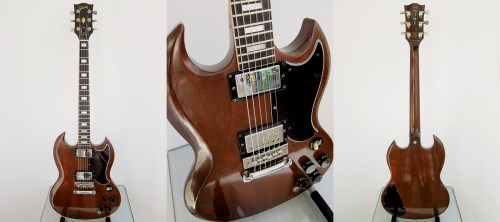
1977 Gibson Walnut SG StandardGibson Walnut SG Standard made in Kalamazoo, USA in 1977

I recently had the pleasure of having an awesome 1977 Gibson Walnut SG Standard at home to play with. Well the idea was to look over the electronics and make sure it was fit to gig with for Patrycja, a friend of Verushka that I sorted the Hondo II bass for. According to The Guitar Dater Project it was made at the Kalamazoo Plant, USA on December 15th 1977, production number 103. It was great that I got a chance to play around with a Gibson Walnut SG Standard from the Seventies, that’s exactly what I was tempted to get myself, see my previous post about Gibson SG. Luckily I tried one before I bought one and I realised straight away that I still prefer Telecasters, SGs have too much neck for me. It was interesting to try a 1970’s Gibson made in USA just to compare it to all the made in Japan copies in my collection. I have to say that the feel and quality of the Japanese guitars are right up there with the American originals.
1977 Gibson Walnut SG Standard
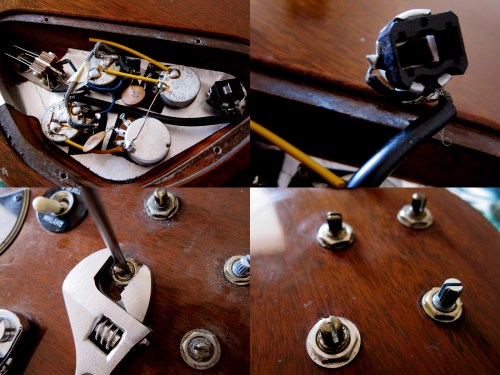
Everything seems to be original, except one pot, so I thought it was unnecessary to change the original jack just because of a bit of crackle so I cleaned it instead. I cleaned all the contact surfaces with wire wool and contact spray, it seems to be enough. I tightened the pots and all the screws on machine heads, strap buttons, pickguard, pickup rings, bridge and polished up the wood a bit.
1977 Gibson Walnut SG Standard
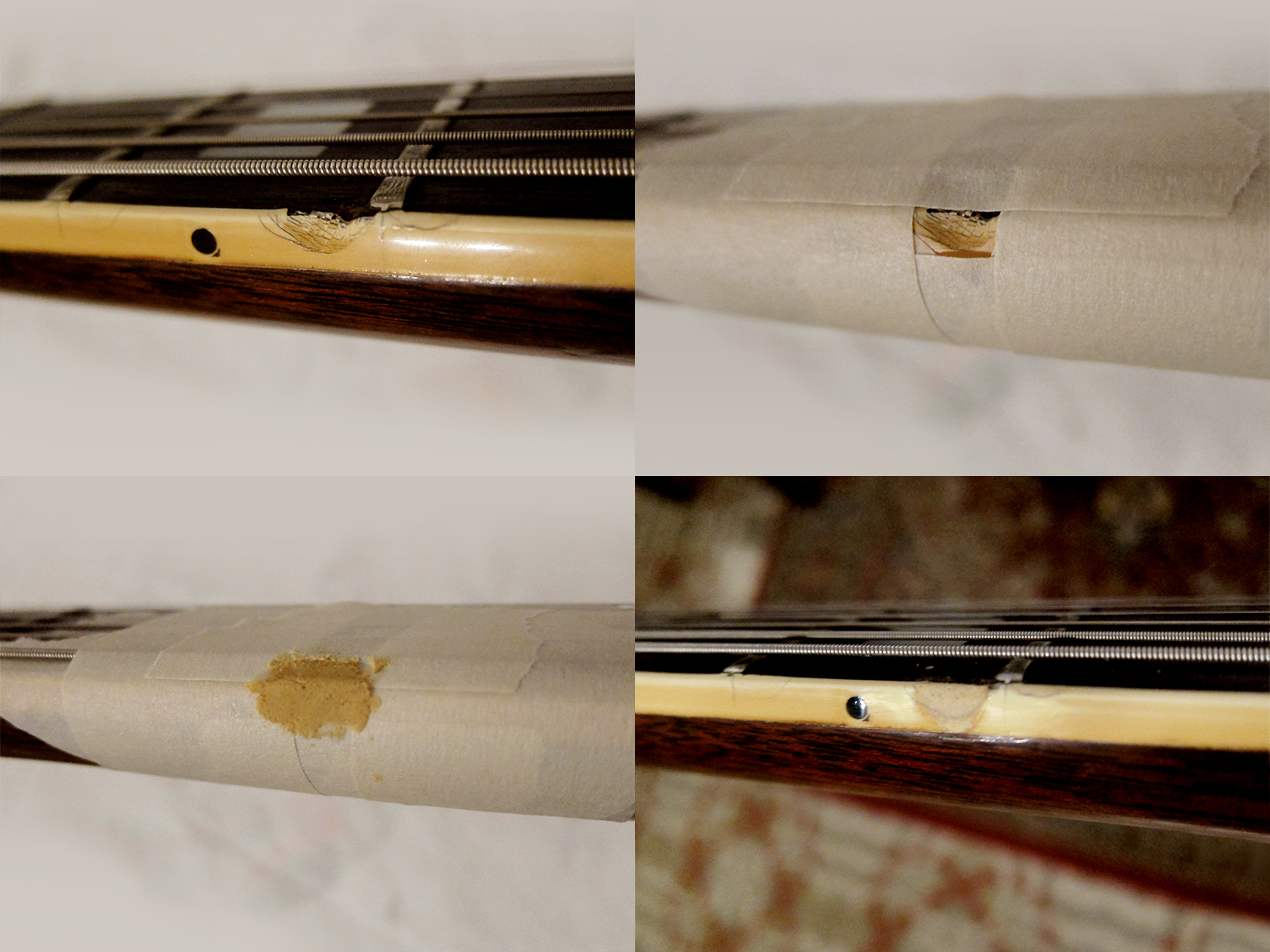
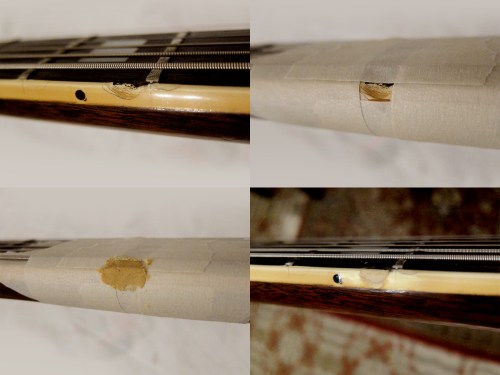
There was a fairly nasty cut in the edge binding on the 5th fret. You could feel it when you played so I masked it off and then filled it with wood filler, that happened to match in colour, then sanded it smooth and dropped a bit of nitro lacquer over it. Unfortunately I forgot to take a picture when it was all done, the last picture is before the lacquer and the final sanding with 2500 grit.
1977 Gibson Walnut SG Standard
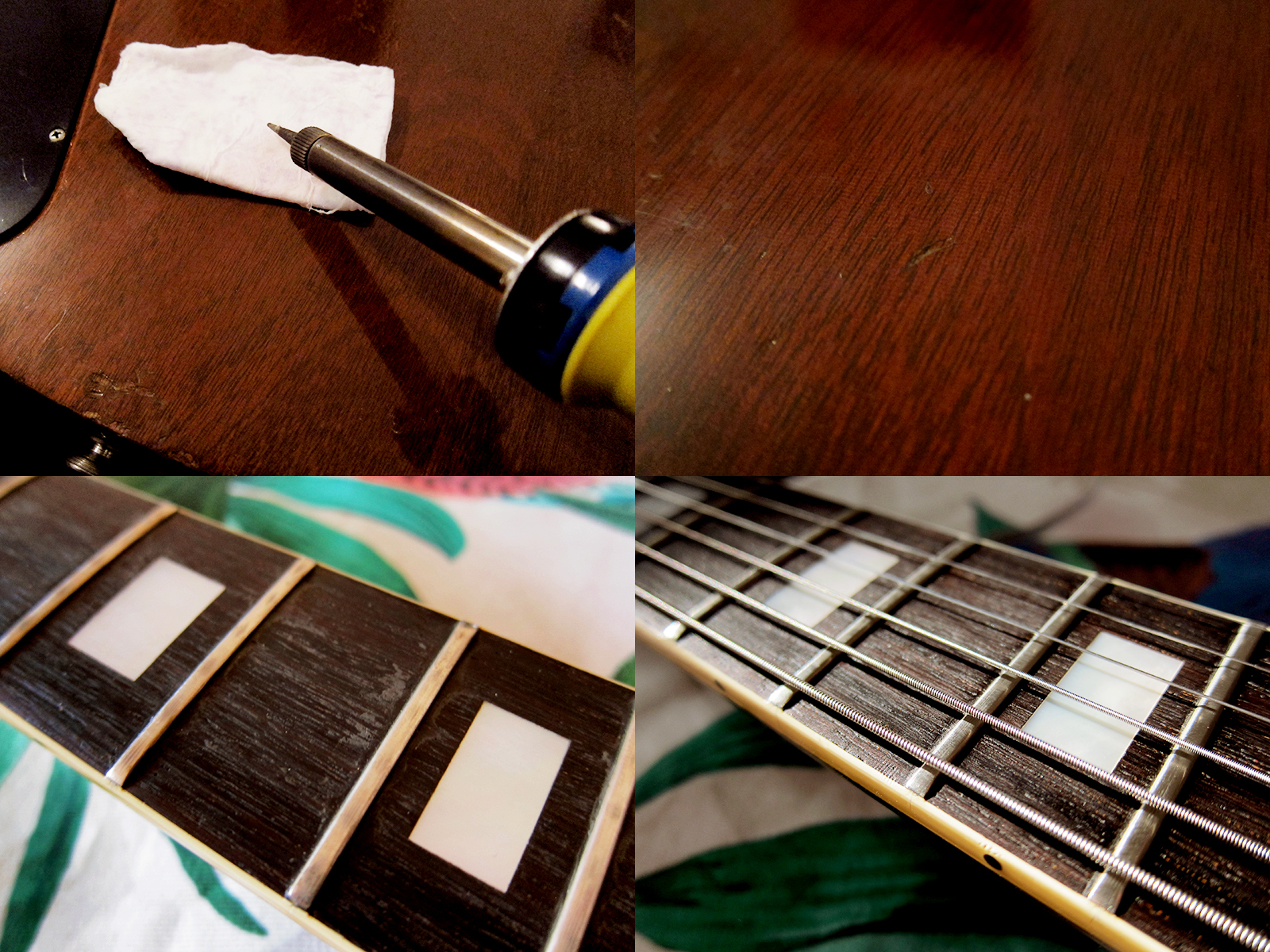
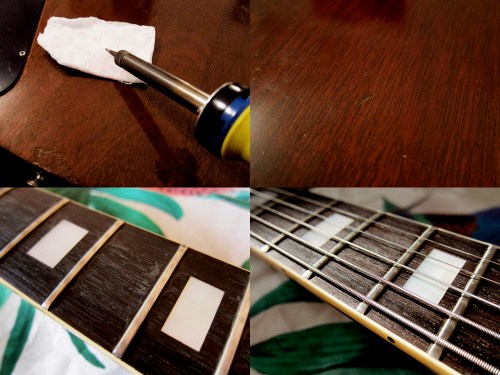
Patrycja wanted to keep the dents and scratches to the body and I agreed, it’s nice when a guitar shows it’s real age. However, nobody likes dents in the back of the neck so I did what I could to soften them a bit. I recently learned a great way of removing dents and scratches, or at least making them stand out less. Use a soldering iron and some wet paper folded up, the steam from the iron will make the wood swell and that way make the dent less deep. Sometimes this works extremely well, especially on surface scratches, and sometimes it makes no difference at all so it’s a bit hit and miss but it’s quick and easy and therefore at least worth a try. Make sure you move the soldering iron and just hold it down for a sec to not damage the surface. The last step was to polish the frets and fretboard, put on some lemon oil and then new strings. The action and intonation was already great so I didn’t have to adjust that.

Roy Buchanan

Roy Buchanan
Roy Buchanan and Nancy, from the 1977 album Loading Zone

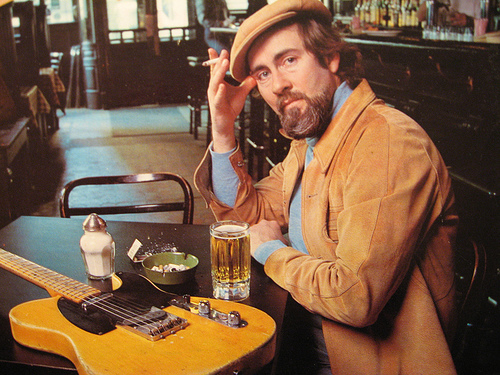
As I’ve mentioned in a previous post I’m a huge fan of Roy Buchanan. I even got myself a Nancy, well it’s a Japanese Fender ’52 re-issue Telecaster from the late 1980’s but close enough. I was watching Youtube documentaries on my lunch and came across Roy Buchanan – P.B.S. Greatest Unknown Guitarist in the World from 1971. Roy’s life story is both sad and quite amazing, you can read more about him if you click the links above. I love the fact that he had give up on music and trained to be a hairdresser when he found Nancy and that he was kicked out of The Hawks for being too weird. This is the song that made me fall in love with him and I’m still not sure if I’m more impressed by his singing or his guitar playing, Roy Buchanan – CC Rider.

Guitars for sale

This is the last acoustic guitar I have left for sale, all the others are gone now. If you’re interested or have any questions just send me an email claesgellerbrink@gmail.com or give me a call 639586158.

Suzuki Three-S F-120
Suzuki Three-S F-120 Dreadnought acoustic, Made in Japan, 1976, 250€ SOLD
A nice Suzuki Violin Co. LTD, Suzuki Three-S F-120 built in Japan in 1976. It’s in really good shape with just a few scratches on the back and sides, nothing that stands out. The tone is great, very clear sounding and it’s really easy to play with low action and no buzzing. It seems to be solid spruce top, nato back and sides, with nato neck and rosewood fingerboard. It looks like it’s a Martin D-18 copy. The neck is straight, no marks on the back and everything works as it should. A well built Japanese acoustic from one of the most famous guitar makers. You can find videos on Youtube here: Suzuki Three-S F-120 and here: Suzuki Three-S F-120 (bonus).

Japanese guitar catalogues

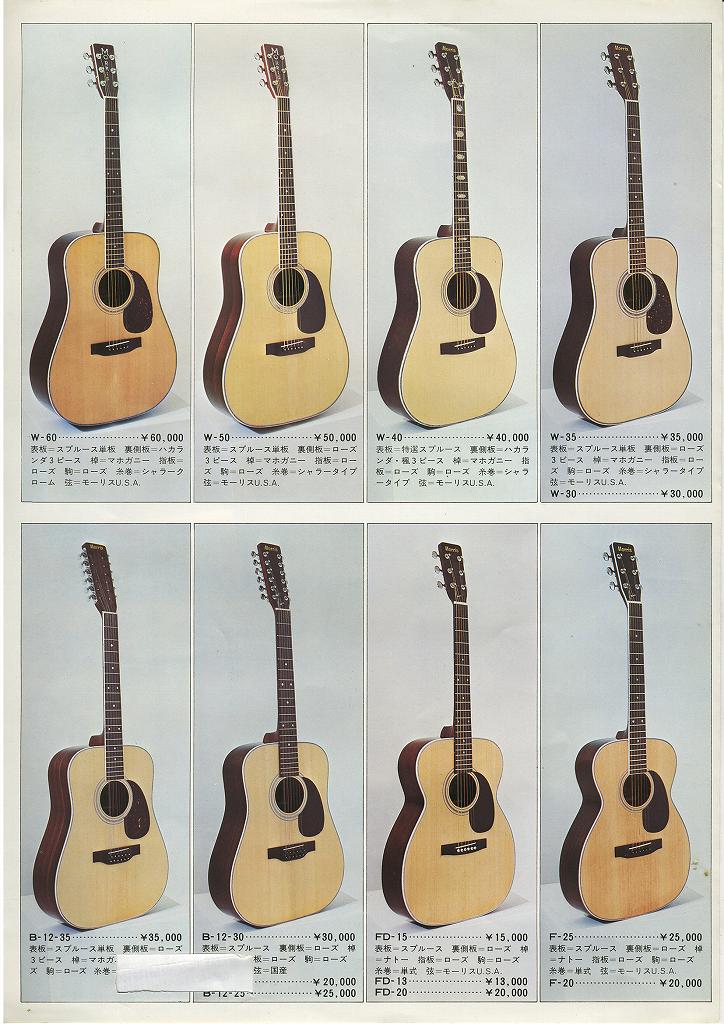
Morris catalogue Japan 1976

I’ve recently come across I pretty good source for old catalogue scans for Japan made acoustic guitars. It’s called oldguitar and has about 50 different Japanese guitar brands represented, some brands has more scans than others and most of them are in Japanese but it still pretty nice to see your guitars in old catalogues. Unfortunately I only managed to find my Morris W-40K. Yairi TG-40 and Suzuki Three-S F-120, my Morris WL-35 and Kiso Suzuki WE-150 seems a bit harder to track down.

Morris W-40 1973
Morris W-40
Made in Japan by Terada 1973

Morris catalogue Japan 1975Morris W-40 in the Morris catalogue for Japan 1975

K. Yairi TG-40 Made in Japan 1977

Yairi TG-40 Japan Catalogue 1970'sYairi TG-40 in a Japan Catalogue from the late 1970’s

Suzuki Three-S F-120
Made in Japan 1976

Suzuki Three-S catalogue USA 1979Suzuki Three-S F-120 in the Suzuki Three-S catalogue for USA 1979

Kiso Suzuki Violin Co. LTD. WE-150
Kiso Suzuki WE-150
Made in Japan 1970’s

Kiso Suzuki Violin Co. LTD. catalogue Japan 1976My Kiso Suzuki WE-150 seems to be a mix of the W-150 and then WH-200 in this catalogue from Japan 1976

Hondo II P-bass

Hondo II P-bass
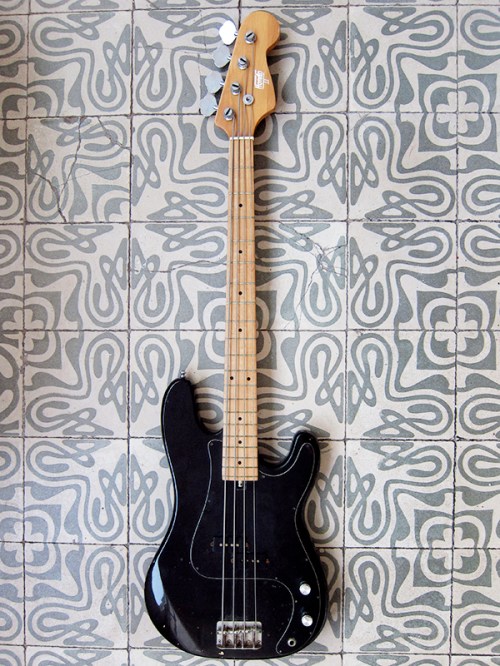
It took 3 months but now it’s finally ready, Verushka’s Hondo II P-bass

We had such a bad luck with the pickups we ordered for Verushka’s Hondo II P-bass. First we ordered a set of Artec P-bass pickups my favourite Hong Kong store EY Parts, but they never arrived, we waited for more than two month and finally got refunded instead. Then we decided to order from Custom World in Holland but that took ages too. Now we got everything we needed, full sized 250K Alpha pots, Orange drop cap, cloth covered wire, new jack and the Artec pickups. I put it together the other night and got it to work fine. I’m still really impressed with these Hondo II basses, the electronics and hardware are pretty cheap but that’s easy to change, and it’s so worth it for these amazing necks.

Hondo II P-bassIt was pretty straight forward to change the electronics. I checked the Seymour Duncan’s wiring diagram for P-basses and followed that instead of the old wiring.

Hondo II P-Bass
Hondo II P-Bass
I really liked the look of the Hondo II I got for Dani but this is ten times better for Verushka, all black just like her

Suzuki Three-S F-120

Suzuki Three-S F-120Suzuki Three-S F-120 Made in Japan in 1976

I recently came across this Suzuki Three-S F-120 that I have fixed up and it’s now for sale. It seems to be a copy of an early Martin D-18, it feels less bulky than most dreadnoughts. Built in 1976 by Suzuki Violin Co. LTD in Nagoya Japan. It’s a beautiful guitar in a really good shape for being almost 40 years old. It’s very easy to play with low action and it has a great tone, very warm and rich.

Suzuki Three-S F-120I took the machine heads a part, cleaned, polished and oiled them before I put them back together. I polished the frets and oiled the fretboard and then made a new compensated saddle in bone. Now it sounds and plays great.

Suzuki Three-S F-120Suzuki Three-S F-120
I have another Suzuki for sale, however, these guitars were not made by the same company. Both were originally building violins so both are called Suzuki Violin Co. LTD but they were based in different parts of Japan. Kiso-Suzuki manufactured guitars in the region of Kiso-Fukushima. Nagoya Suzuki manufactured guitars in the region of Nagoya. 

Suzuki Three-S F-120I finally found an old catalogue for it. It seems to be spruce top, nato back and sides and nato neck with rosewood fingerboard

Morris

Morris WL-35 and Morris W-40
1970’s Morris WL-35 and a 1973 Morris W-40

I’m still trying to figure out what I like and what I’m after when it comes to acoustic guitars. It’s a quite new thing for me, to play acoustic. I mentioned in an earlier post that it’s a bit like understanding and appreciating fine wine, you need to train your pallet and know what you are looking for, otherwise wine just taste like wine and acoustic guitars sounds more or less drang drang. I’m not sure if all Morris are as good as the two I got but these sounds better than pretty much anything I have ever heard before. I love the look of the Morris W-40 but it’s not as well sounding as the WL-35. I guess the W-40 has that typical Martin D-45 sound, a really dark bass and still nice highs, but a bit weak on the treble side for me. It’s not that good for finger picking, it’s lacking a bit of volume on the high E and B string, something that might be because of the light string gauge, I’m using 11’s at the moment. I’m going to string it with 12’s and see if the volume improve. The Morris W-40 still has one of the best sounds for open chords playing that I’ve ever heard, so much warmth and body, I guess because of the Brazilian rosewood. The Morris WL-35 is probably a better all-round guitar, finger picking, chords, solo playing, everything sounds good on it. I’m just struggling a bit since it’s so big. I think it’s based on some old Guild model, at least the head looks very Guild inspired. Anyway, I can strongly recommend Morris as a brand to anyone looking for a good sounding high quality built Japan made acoustic.

Morris W-40 1973

Moridaira (Morris Guitars)
Founded in 1967 by Toshio “Mori” Moridaira, the Moridaira factory produced high-quality guitars, including the infamous Morris badged guitar. Moridaira also produced badged guitars for Hohner including Coronado, Futurama, H.S. Anderson, Lotus (some) and Sakai.

K. Yairi

K.Yairi YW-1000
The most beautiful Martin D-45 copies in the world, a 1976 K. Yairi YW-1000

I’m extremely happy with the two Morris I have and think that Terada is one of the better acoustic guitar builders in Japan. Having said that, I think everyone that is in to Japanese acoustics dream of owning a K. Yairi, at least I do. Unfortunately they are a bit too expensive for me, I’m sure they are worth it but you can get an old Martin, Gibson or Guild for that money. One thing that I really like with Yairi is that they use the year of the Emperor of Japan to determine the production year of their instruments, how awesome is that. See the list below.

http://youtu.be/ky56o9gBDR4
Good materials are hard to find so it’s better to make guitars through limited production by hand instead of mass production. Trees are very important “precious” things so we should make good use of them. Guitars made with “heart” are the best use of trees.  Kazuo Yairi

When was my Yairi made?
By reading the number stamped on the heel block of your Yairi, you can tell in which year it was made. The first two numbers correspond to the year of the Emperor of Japan at that time, see chart below. The second two numbers refer to the month of production. Taken from The Fellowship of Acoustics

A.D.       Emperor                Year
1970      Shōwa                    45
1971                                      46
1972                                      47
1973                                      48
1974                                      49
1975                                      50
1976                                      51
1977                                      52
1978                                      53
1979                                      54
1980                                      55
1981                                      56
1982                                      57
1983                                      58
1984                                      59
1985                                      60
1986                                      61
1987                                      62
1988                                      63
1989       Heisei                    1
1990                                      2
1991                                      3
1992                                      4
1993                                      5
1994                                      6
1995                                      7
1996                                      8
1997                                      9
1998                                      10
1999                                      11
2000                                      12
End of Emperor Date Code
2001                                       01
2002                                       02
2003                                       03
2004                                       04
etc.

Emperor Shōwa and future Emperor Heisei on 10 April 1959