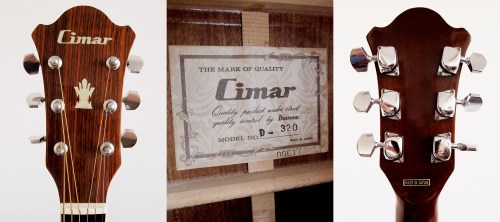
Cimar D-320, Made in Japan in the mid 1980’s by Ibanez
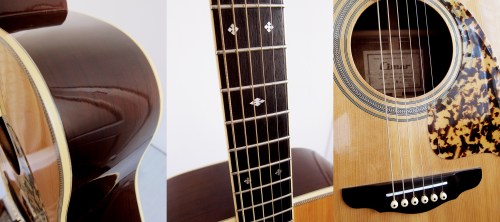
I recently helped my friend Tomasz to find a nice Japanese acoustic and we ended up with this Cimar D-320. Cimar were made by Ibanez in the 1980’s as their cheaper brand and even though I’ve seen them for sale quite often, I had actually never tried one. Ibanez is owned by Hoshino Gakki and based in Nagoya, Aichi, Japan. Hoshino Gakki also had semi acoustic, nylon and steel stringed acoustic guitars manufactured under the Ibanez name. Most Ibanez guitars were made for Hoshino Gakki by the FujiGen guitar factory in Japan up until the mid-to-late 1980s and from then on Ibanez guitars have also been made in other Asian countries such as Korea, China and Indonesia, taken from Wikipedia. I have a feeling this Cimar would be one of the last ones to have been made in Japan and I’m still struggle to see how they could be making inexpensive guitars in Japan in the mid 1980’s, I had a feeling that everything had already been moved to Korea or some other cheaper country. They guitar seems to be pretty solidly built and has a lot of swanky details like the snowflake inlay and herringbone binding which looks great from a distance. The best part is still the sound, I would never have expected it to have such rich bass and great response, especially not for being fully laminated. A pretty great guitar for the price. If you want to know more about different Japanese guitar brands then check my previous post.
Fujigen Gakki Fujigen Gakki began operation in 1960 as a classical guitar manufacturer, moving into the lucrative electric guitar markets in 1962. The company was the largest producer of Japanese guitars during the 1960-1980 period. They were known for producing high quality products, especially for the badged guitar market, which is why the company was selected by so many major American brands. It wasn’t until 1970 that the company began making products for the venerable Ibanez brand, which was an unqualified success. Fujigen Gakki was the main manufacturer of choice for Greco badged guitars in the 1970 to 1980 period. They also produced guitars for major manufacturer Yamaha. Badged guitars made by Fujigen include Antoria, Epiphone, Jason and Mann. Badged guitars that may have been made by Fujigen Gakki were Marlin and St. Moritz.
A really well kept Suzuki Three-S F-120. Built in 1978 by Suzuki Violin Co. LTD in Nagoya Japan.
I recently found another Suzuki Three-S F-120. These are great little Japanese built guitars that I can highly recommend. Really sweet tone and pretty descent build quality for being so inexpensive. Of course they can’t compare to Morris or K. Yairi but next to Aria, Maya, Shiro or the normally Suzuki’s they are great. It’s a simple Martin D-18 copy built in 1978 by Suzuki Violin Co. LTD in Nagoya Japan. What always surprises me with these Suzuki Three-S F-120 is how light they are compared to a lot of Japanese dreadnoughts from the 1970’s that can feel pretty heavy and bulky. Unfortunately this one was sold straight away so I only got time to fix it up and make a Youtube video of it before it was gone. If you want to know more about different Japanese guitar brands then check my previous post.
Suzuki Three-S F-120 in an old Japanese catalogue from 1979. It has spruce top, might actually be solid, with a laminated nato back and sides. Nato neck with a really dark rosewood fingerboard and bridge, it almost looks like ebony.
I recently changed the machine heads on my 1970’s Japan made Morris W-50 to Wilkinson WJ28NGD open gear in gold and I couldn’t be happier
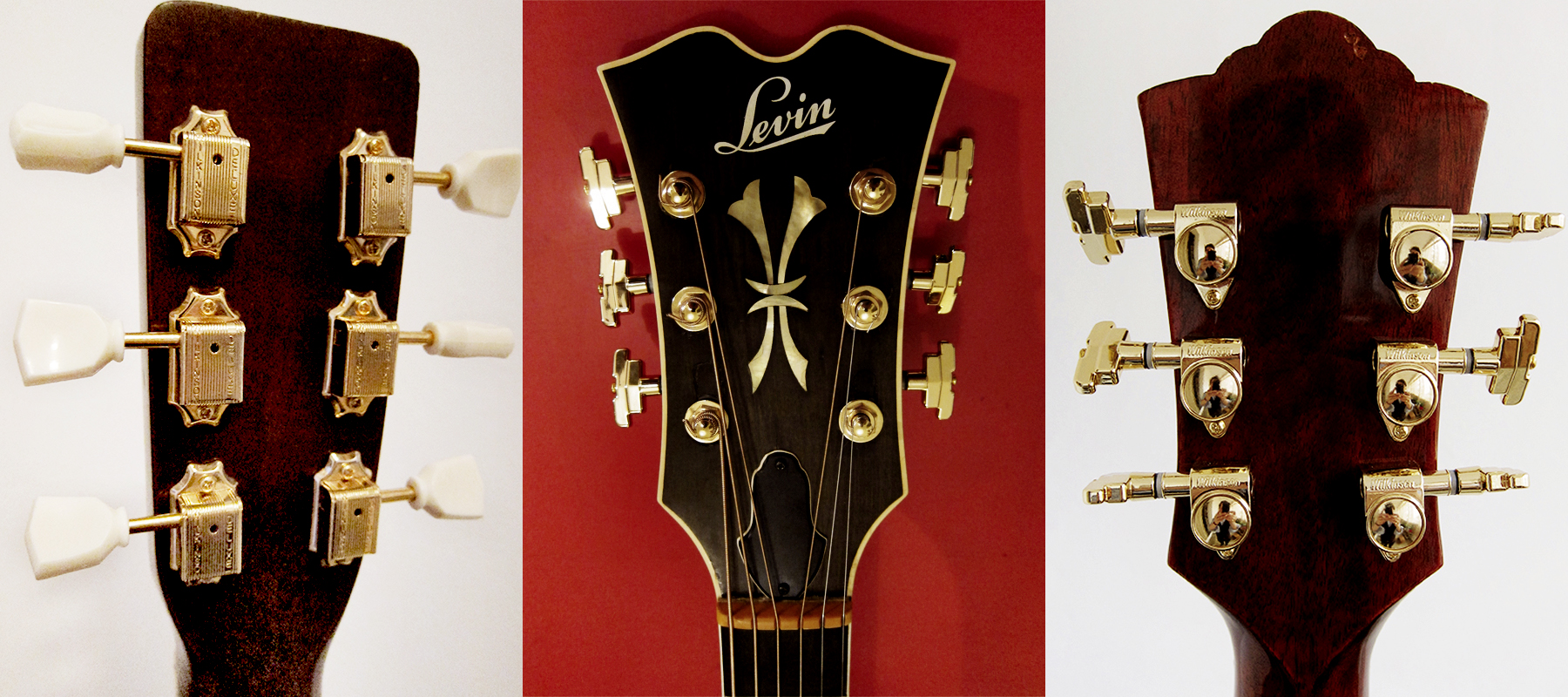
I have said it before but it’s worth mentioning again, I really like Wilkinson hardware for my guitars. I have their vintage bridge with compensated brass saddles on numerous of my Telecasters and their machine heads on even more acoustics and electrics. So far I have tried the following models, WJ01GD, WJ44CRGD, WJ309GD and now WJ28NGD on my new Morris W-50. Wilkinson machine heads are cheap, good quality, accurate and the gold doesn’t seem to fade straight away. They are made in Korea and was first distributed through John Hornby Skewes & Co. Ltd. but now you can find them pretty much everywhere. I bought mine from Axesrus which turned out to be really nice and helpful guys. The best part is that now you can get Wilkinson machine heads with either 8 mm or 10 mm bushings which is perfect since a lot of the Japan made acoustics comes with 10 mm holes. I don’t just randomly change the machine heads on all my guitars but I can’t stand the horrible bulky 1970’s closed machine heads in chrome that most Japanese guitars comes with. How much nicer doesn’t the Morris W-50 look now with these delicate open gear tuners in gold?
Some guitars that got the Wilkinson treatment. Morris W-40 with Wilkinson’s WJ44CRGD which comes with cream buttons, not that horrible green tinted ones. My Levin 174 and K. Yairi TG-40 got upgraded with the amazing looking Art Deco inspired WJ309GD
Gibson J-50 Deluxe, made in Kalamazoo, Michigan, between 1970-72
As mentioned before I have been dreaming of a Gibson J-50 for years now and last week I finally managed to find one. Of course I would have preferred a 1940’s or 1950’s one but it’s hard to even afford one from the 1960’s with today’s vintage guitar prices, and I really don’t approve of the adjustable bridge they used in the mid 1960’s. They changed from round shouldered to square shouldered around 1969 and at the same time got rid of the horrible adjustable bridges. Gibson reached a lot of low marks in the late 1960’s with laminated backs and sides, plastic bridges, massive bridge plates and double X-braces to stiffen up the tops and making sure that they wouldn’t belly or break. I knew when I bought this J-50 that it might not sound like James Taylor’s, not just because it’s not a round shoulder, but also because of the double X-bracing and the general build quality of a 1970’s Gibson. Even though it doesn’t sound like James Taylor’s J-50 I really like the sound of it and it’s very pleasing on the eye too, at least for me. I love the simplicity of the small black drop shaped pickguard and the grain of the top is just amazing. It’s a Gibson J-50 Deluxe with the original Gibson Deluxe machine heads, made at the Kalamazoo plant between 1970-72, apparently it’s impossible to date it any closer.
It has had a neck reset at some point and it seems like the bridge has been re-glued too, which could mean that it’s one of the earlier ones that perhaps came with an adjustable bridge and someone changed it to a normal rosewood bridge. I bought the guitar from a gentleman in Oxford, England where it had lived for the past 15 years but before that it came from Oklahoma, USA, where the repairs where made at some point. The bridge plate seems to be a really thin, delicate and made of spruce, perhaps that’s been updated too since these where know for having massive tone killing blocks of wood under the bridge. It has the double X-bracing which I guess has it’s pros and cons like any other form of bracing. It’s an extremely light and well sounding guitar, I don’t know how they managed to build it so light since these are supposed to be really heavy. Gibson got tired of all the returns which cost them a lot of money so in order to increase profit they started to build their acoustics thicker and heavier until they were built like tanks and could survive any beating. These are known as the Norlin era Gibson guitars, but it’s important to remember that even though Norlin took over in 1969, the old owners CMI kept control over the Gibson production up to 1974, so I guess that’s when the real dip in quality happened. As with any vintage guitar of any brand, there are good ones and there are bad ones. Not all Levin guitars are good, but all of the 12 I have sounds amazing so perhaps some brands are more even in the quality than others. I feel that I was lucky with this Gibson J-50 Deluxe and managed to find an extremely light built and very well sounding example. I wished that the bass was a bit deeper, it still has the Gibson bass response, but since the mid range and trebles are so good I’m still very pleased with my new guitar.
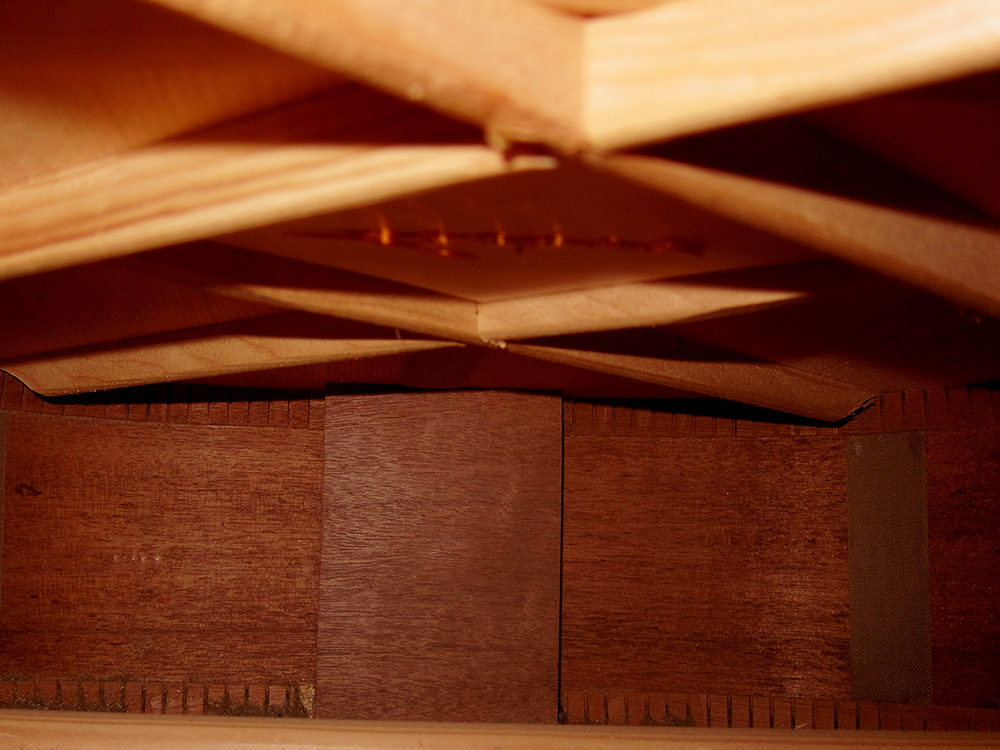
A picture of the inside, beautiful solid mahogany back and sides, with the dreaded double X-bracing. It actually sounds better than expected and since the braces are fairly thin and delicate, together with the thin spruce bridge plate, it’s a very light and resonant guitar with great sustain. Except for a little worn patch on the neck after a capo and two tiny cracks in the top where the pickguard has shrunk it’s in very good state for being 45 years old. The neck reset and general set up it had before it left Oklahoma has made it an extremely easy guitar to play with fantastic low action. It has 011 gauge strings on in the clip below, I guess with 012’s it will sound even richer.
I recently got myself a Morris W-50, my third Morris and it sounds as good as the other two. Solid spruce top and it looks like the back and sides are solid Brazilian rosewood and quilted maple. It was pretty beat up when I got it from Guitar Hiro in Madrid with plenty of dents and a cracked back but now I’ve fixed it up a bit and it’s playable again. It’s a nice Martin D-42 copy with snowflake inlays and the typical Martin volute where the head and neck meet. Nice inlays all around and a beautiful 3-piece back with flamed maple and rosewood. I guess it was made around 1976 since they changed to hexagon inlays in the 1979 catalogue and then renamed them from W-50 to TF around 1983.
TF Morris W-50, Made in Japan around 1976
Morris Japan catalogue 1976
There was a bit of work needed on this guitar. The back was cracked in the binding just below the heel which made the whole neck tilt forward causing a pretty high action. I cleaned out the crack, someone had put some super glue in there, filled it with fish glue that I let really sink in and connect with the neck block, clamped it and left if for 48 hours. Now it seems really solid and the action got so low that I had to make a new higher bone saddle for it. There was a lot of dents and marks on the back of the neck so I filled them with nitro lacquer and sanded it smooth and buffed it up with metal polish, here you can read more about how to repair lacquer damage. The only thing left now is to ad some gold machine heads so I ordered a set of open back Schaller ST6 this morning and will fit strap button and an endpin jack tonight.
I recently changed the machine heads on my 1970’s Japan made Morris W-50 to Wilkinson WJ28NGD open gear in gold and I couldn’t be happier
Moridaira (Morris Guitars) Founded in 1967 by Toshio “Mori” Moridaira, the Moridaira factory produced high-quality guitars, including the infamous Morris badged guitar. Moridaira also produced badged guitars for Hohner including Coronado, Futurama, H.S. Anderson, Lotus (some) and Sakai.
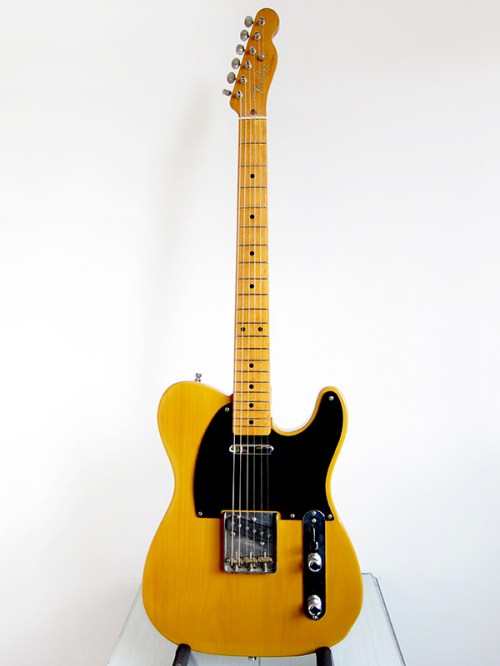
Fender Telecaster TL52-75, ’52 re-issue, Made in Japan by FujiGen between 1987-1989
In loving memory of Nancy, my Fender Telecaster TL52-75, that was sold last night. I miss her already but I’m glad she went to a good home. She lives in Zaragoza now with Juan and I’m sure she will get more love than I could ever give her. Two guitars have left me in the same week, I think I’m still in shock, sad but kind of happy at the same time.
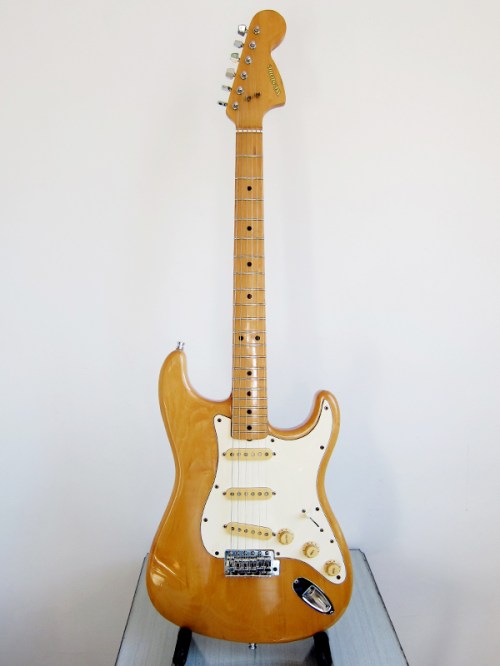
Westone Stratocaster copy, made in Japan by Matsumoku in 1979
This weekend my Westone Stratocaster found a new owner. It felt kind of sad, I don’t normally miss guitars that I sell, well that’s I lie, I have missed all of the guitars I’ve sold but normally not this much. Oh well, I needed to make room for my new Tokai Silver Star SS-36 so it had to go. I have had two Westone guitars, a Strat and a Les Paul copy and I really liked both of them. Westone built Fender and Gibson copies in the late 1970’s before they started on their own heavy metal influenced creations of the 1980’s that owned the brand it’s name. You can read more about the brand Westone here. I have to say that the quality was pretty good for being a less known brand from the Matsumoku factory. I’ve always claimed that FujiGen was better than Matsumoku but I start to think that might have been more about when and not so much where. There was a huge change in Japanese guitars around 1975, not just the quality but perhaps more about how well they managed to copy the big American brands.Therfor a Greco guitar from 1978 would be better built than one from 1972, not just because the first was made by FujiGen but because it was made after 1975. You can read more about in my earlier post, Are all Japanese guitars good? I think what I would miss most of the Westone Strat is the Sen ash body, the wood was amazing and without any doubt the heaviest and most solid Strat I have ever seen with a fantastic sustain. The pickups were pretty great too, not Grey Bobbin pickups like on my Tokai Silver Star SS-36, but still, pretty sweet sounding. The pickups were pretty great in the Westone Les Paul too, maybe there was something special about these late 1970’s Matsumoku built Westone guitars.
Westone Les Paul copy, made in Japan by Matsumoku in 1970’s
Matsumoku Matsumoku is one of the Japanese manufacturers that did not survive long after the heyday of the 1970’s guitar market despite having a long tradition of quality stringed instrument craftsmanship. Matsumoku produced guitars for major manufacturers Greco, Guyatone and Yamaha. Matsumoku made Arai, Aria, Aria Pro II and Aria Diamond badges, with Aria being their primary badge for a majority of this time frame. Badged guitars known to have been made by Matsumoku include Apollo, Arita, Barclay, Burny, Capri, Columbus, Conrad, Cortez (electrics only), Country, Cutler, Dia, Domino, Electra, Epiphone, Granada, Hi Lo, Howard, Ibanez, Lindberg, Lyle, Luxor, Maxitone (this guitar differs from Tama’s Maxitone badge), Mayfair, Memphis, Montclair, Pan, Pearl (electrics only), Raven, Stewart, Tempo, Univox ,Vantage, Ventura, Vision, Volhox, Washburn (in 1979 and 1980), Westbury, Westminster and Westone. Possible Matsumoku badges include: Bruno, Crestwood, Conqueror, Eros, Mako, Memphis, Orlando and Toledo. Taken from my previous post about Japanese guitar brands
When arrived to the office on Monday morning I noticed that Yuma, one of the eBay sellers that I follow from Japan, had added a new guitar, a 1979 Tokai Silver Star SS-36. I’ve always admired, well admired is not strong enough, I’ve always been totally gay for the 3-tone sunburst that Fender used in 1970’s. I even built the Claescaster because of this, since I couldn’t find a Telecaster with the right colour I decided to assemble one myself. For the past two years I’ve been looking at different Japanese big headed Stratocasters with the 3-tone 1970’s sunburst and black pickguard and was pretty convinced that a Greco SE-500 would be my next electric guitar or perhaps a late Seventies Fernandes Burny but they never seemed to have necks that were fat enough. I was in touch with a couple of the Japanese sellers and asked which brand had the fattest neck and got this reply, none. One seller explained that most Japanese guitars have fairly flat necks since the Japanese have small hands, which sounded a bit racist but whatever the reason is, most Japan made guitars had soft profiled necks up until now. I’ve played a couple of Crafted in Japan Fenders with great V-profile but that’s just in the last couple of years, none of the Japanese guitars that I’ve tried from 1970-80’s has had any baseball bat necks. This was a beautiful looking Tokai Silver Star with great grain showing through the 3-tone sunburst. I asked the seller about the neck and he replied that it wasn’t super fat, more of a soft U-profile, well that sounded close enough to me. The truth is that I’ve really missed the sound of the Fernandes RST-50 ’57 that I had for a short while. The Grey Bobbin pickups just sounded so amazingly good but I could never really come to terms with the small head or the fact that the guitar was black. Eric Clapton’s Blackie in all honour but they look pretty bland and boring to me, I like wood coloured or 3-tone sunburst guitars. My head started to think, well what could be better than Greco’s Maxon pickups, well the Ferndandes grey bobbin pickups, any day. Who was making Fernades in the late Seventies, well Tokai. Does that mean that this Tokai Silver Star will have some form of similar pickups? I tried to do some research but before I had even come to any conclusion I was the happy owner of a 1979 Tokai Silver Star SS-36. It was a Monday morning, I was a bit hungover, most of my guitar purchases has been made in that state, or perhaps when I’m drunk. I tend to be really concerned about money, I like to plan ahead, save for a rainy day, and then suddenly I sit there in front of the computer drunk or hungover without any filters whatsoever and just thinking GAS, GAS, GAS.
To be honest I didn’t know that much about Tokai, a part of me has always classed it like Ibanez, kind of bellow Greco in terms of quality. Then again, I can’t really say that I have felt a huge difference in quality between the Fender Japan made by FujiGen or the ones by Tokai, but everyone seems to prefer the Made in Japan to the later Tokai built Crafted in Japan. I have a 1991 Tokai Love Rock LS-55 Les Paul copy that is awesome but that doesn’t mean that an entry level Strat from 1979 would be equally good, but luckily it was. The Tokai Silver Strat SS-36 was the cheapest in the line of the late Seventies Fender copies that Tokai made but I think the main difference between the top and the bottom was if they had 3 or 4 screws bolt-on-necks, how many pieces of wood was used for the bodies and the quality of machine heads and hardware, and less about the pickups. Or perhaps these are the shittiest pickups Tokai produced and they still sound awesome.
Tokai (Tōkai Gakki) Tōkai Gakki was founded in 1947 and is based in Hamamatsu, Japan. Tokai began production of acoustic guitars in 1965 and by 1968 was producing electric guitars for the American market. Tokai still exists as guitar manufacturer. Tokai made guitars for Fernandes, Mosrite and Fender Japan. Tokai badged guitars included the house brand Tokai as well as Cat’s Eyes, Conrad, Drifter, Hondo, Love Rock, Mosrite, Sigma and Silver Star. Possible badges include Artist Ltd., Gaban, Gallan, Gession and Robin. It’s suggested that Tokai made Hummingbird acoustics as well, but if these were related to those made by Humming Bird I haven’t quite sorted out yet. Taken from my previous post about Japanese guitar brands
Fender replicas were started in 1977 officially. These were great guitars too. Using good quality wooden material with great craft man ship. “Springy Sound” Stratocaster replicas and the “Breezy Sound” Telecaster replicas are superior to the original Fender. Tokai has own factory and has built guitars for many famous known brands such as Fernandes and Fender Japan. For that mean, Tokai is only one original electric guitar manufacturer in Japan. (Note: Fender Japan used many sub constructors such as Fujigen, Dyna, Tokai, and Terada. The JV and E serial were made by Fujigen. Tokai made has “Made in Japan” under serial number in cursive handwriting). Taken from Music-Trade Japan
The guitar has a really nice soft U-shaped 1-piece maple neck with a nut width of just 40.6 mm, which didn’t feel that different to me. The body is 4 pieces Sen (Japanese ash) with poly lacquer in the classic 1970’s Fender 3-tone sunburst, which I truly love. I’m not sure if the pickups are similar to the L-5000 Vintage Arched PP Grey Bobbin pickups that the Fernandes RST-50 ’57 had or just some other grey bottom pickups. I tried to find some more information about them but they are just refereed to as grey bottom Tokai PU at Music-Trade Japan. Tokai Was building Fernandes at this time so I assume they would have used similar pickups for both. Either way, I love the pickups in this Tokai and it sounds almost as good as the Fernades did. I added an extra spring to the tremolo block since I never use the wammy bar and prefer a more solid hardtail feel, just like a real late 1970’s Fender Stratocaster.
I will try to get a new video up soon where I play a bit louder so you can hear the pickups properly, I was worried about the neighbours, and ideally play a bit better.
Well here it is, I might not play any better, but at least it is a more of it. I changed the string to 010, always Ernie Ball Regular Slinky, raised the action and fitted a 4th spring to the tremolo. Not sure what difference it made sound vice but it made it felt better to me playing.
I have a couple of more guitars for sale now so if you’re interested or have any questions just send me an email claesgellerbrink@gmail.com or give me a call 639586158.
Hohner Telecaster, Made in Japan, Moridaira factory, 1970’s, 500€ SOLD A great Telecaster copy in a good shape for age but with some dings to the bottom of the body. Frets are in great condition and there isn’t a single mark on the back of the neck. It’s a pretty heavy Telecaster with great sustain and nice feel to it. The pickups sounds awesome and everything is working fine, all original except for the 3-way switch that wasn’t working properly so I replaced it with a new one. Really fast and smooth neck, lovely to play. A great sounding guitar with amazing sustain and great Japanese build quality. Made in Japan by Morris in the Moridaira factory, where H.S. Anderson made the Mad Cats that Prince uses. You can read more about the guitar here and here is a Youtube clip.
VOX Les Paul, Made in Japan, 1970’s, 350€ SOLD This is the first Japan made VOX guitar I’ve found in Spain. It’s a pretty decent copy of a 1958′ Les Paul with a great feeling fat neck and narrow head. The body has a lovely grain and the guitar is in pretty good shape for the age with a couple scratches and a few dents. Frets show some wear but are still fine and everything is working perfectly. The humbuckers have a nice tone too them, not too heavy or muffled. A pretty versatile and nice guitar to play with great Japanese build quality. You can read more about the guitar here and here is a Youtube clip.
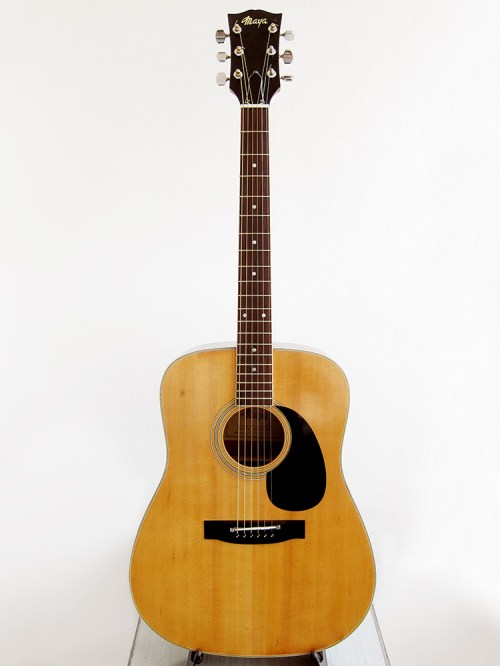
Maya F335G, Dreadnought acoustic, Made in Japan, 1970’s, 250€ SOLD Japan made Gibson J-50 copy in a pretty good state for it’s age. I couple of marks on the spruce top and few knocks on the head but structurally very sound without any cracks. This Maya F334G was made by Chushin Gakki in Kobe, Japan, during the 1970’s. It has a really fat neck, it’s feels great to play, adjustable bridge with both bone nut and saddle. The sound is very full with a great booming bass, you can listen to it here. If you want more pictures you can check the post I wrote about it.
Fender Telecaster TL52-75, ’52 re-issue Made in Japan, FujiGen 1987-1989. 900€ SOLD In mint condition, all original, without any doubts the best Telecaster I have ever played. Imported straight from Japan. The only reason for selling is because I prefer fat 70’s necks. There is no way to find the production year of these A-serial Telecaster with the serial number on the bridge plate. However, it must have been made between 1987 and 1989 since it’s a TL52-75. They were called TL52-70 between 1984-1986 and then changed to TL52-700 in 1990. You can read more about the guitar here and listen to it in this Youtube clip.
Westone Stratocaster, Made in Japan, Matsumoku factory, 1979, 400€ SOLD An amazing Stratocaster copy from 1979 made in Japan by Matsumoku. In really good shape for age but with some dings and scratches to the body. Frets are in great condition and there isn’t a single mark on the back of the neck. The wood in the body is amazing, without any doubt the heaviest and most solid Strat I have ever seen with fantastic sustain. Really nice tone in the pickups and everything is working fine, the original 3-way switch has been replaced with an Oak Grigsby 5-way switch. Really fast and smooth neck, lovely to play. A great sounding guitar with amazing sustain and great Japanese build quality.Here is some more info about the Westone brand. Here is a Youtube clip with the guitar.
On Saturday I found myself a Maya F335G. As mentioned before, I’ve been after a Gibson J-45 or J-50 for quite a while so when I saw this Japan made Gibson J-50 copy I couldn’t resist. It was in a terrible state and strung with 4 nylon strings so I couldn’t test it but I trusted my gut feeling. It doesn’t sound like a Gibson J-50, I didn’t really expect it too either, but it does sound pretty good. I would say that it sounds better than the two Suzuki’s I used to have, the Kiso Suzuki WE-150 and Suzuki Three-S F-120, even though the build quality is pretty much the same. There is a huge step up to my Morris WL-35 and Morris W-40 and my beloved K.Yairi TG-40, both in build quality and sound. Having said that, there is something with this Maya that I really like, it has way more bass then the Suzuki’s and overall a pretty nice and full sound. The only downside is that it feels pretty stiff to play so I will probably put 011’s on it next time I change the strings. According to my previous post about Japanese guitar brands Maya was made by Chushin Gakki in Kobe, Japan, during the 1970-80’s. Even though I really like this guitar I have it listed for sale if anyone is interested in buying it.
Maya F335G made by Chushin Gakki in Kobe, Japan
The previous owner had used a collection of random oversized wood screws to keep the machine heads in place so the first thing I did was to remove them and fill the holes. I polished the frets and oiled the super dry fretboard and then put on a bone nut and saddle which improved the tone quite a lot.
 Cimar D-320, Made in Japan in the mid 1980’s by Ibanez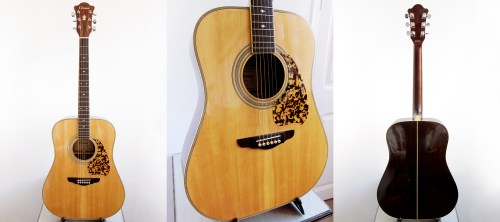








 Claescaster
