Claescaster

Tag: Japanese guitars

VOX, Made in Japan

VOX Les Paul Made in Japan 1970'sVOX Les Paul Made in Japan 1970’s 

I recently found a nice looking VOX Les Paul copy that I couldn’t resist. I had decided not to buy any more Les Paul’s after I sold my Westone a few weeks ago but this was just too nice to miss out on. It has a bolt on neck, which you could either hate or love, I’m fairly indifferent myself and you can read why here. The good part with bolt on necks is that they are so easy to adjust. It’s fairly common that older Les Paul and SG guitars with set necks gets a hump over the neck joint, something that can cause buzzing and you have to either raise the action or level the fretboard to get rid of it. The bad part with bolt on necks is the second hand value, a lot of people are still a bit racist when it comes to Gibson copies with a bolt on neck even though Gibson built a few themselves in the early 1980’s. What I fell in love with on this VOX was the flame top and the thickness of the neck, it’s so nice. It feels even fatter than my Tokai Love Rock LS-55 which has a fairly accurate 59′ Les Paul neck. This VOX even have the small head as the real Gibson of the late 1950’s and the pickups sounds pretty close to my old Westone. The only thing that is annoying me a bit is that I haven’t figured out who built it yet. There is no info about VOX in my list of Japanese guitar brands, well there is a Magnavox and a Univox but that’s not the same. The only thing I know is that when VOX stopped making guitars in the UK they moved to Italy before they ended up in Japan. The build quality is not as good as my 1991 Tokai Love Rock LS-55 or my 1980 Greco EG-600C, but it’s easily on the same level as the Westone which was built by Matsumoku. Even though I really enjoy this Les Paul I have too many guitars and is therefore up for sale.

VOX Les Paul Made in Japan 1970'sVOX Les Paul Made in Japan 1970'sIf anyone happens to have more information about Japanese made VOX guitars please get in touch


Playsound by Teisco, Made in Japan 1960′s

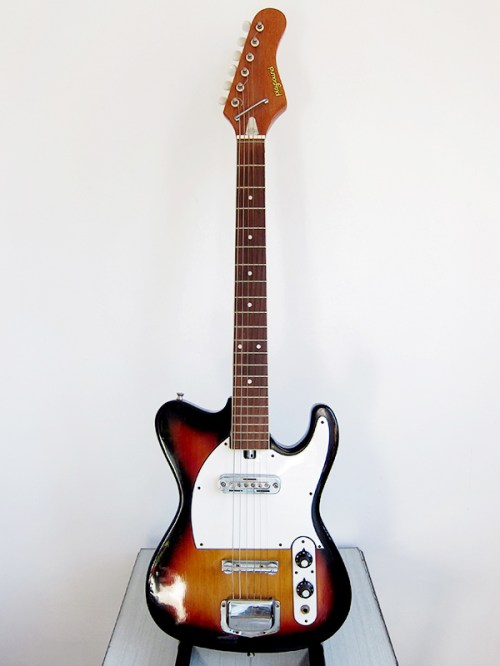
Playsound, by Teisco, Made in Japan, 1960’s

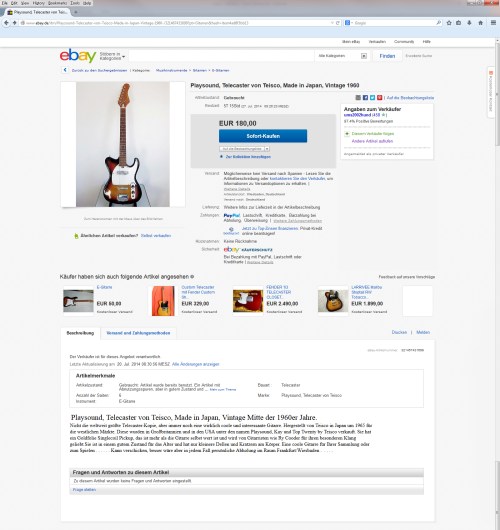
Sometimes you see people using other peoples images when they are selling guitars. I’ve seen a few times that guitars being sold on Guitarristas end up on Milanuncios or some similar site by someone else. In this case I’m not sure if it’s a full blown scam or if the German eBay seller ums2002hund just preferred my guitar to his own. Here you can see my Playsound by Teisco Telecaster copy being sold on eBay, with both my image and my text, directly translated to German from my For sale page. Well it’s technically not my guitar any more since I sold it to my boss about a year ago, he has it here in the office so I’m pretty sure it’s not in Wiesbaden, Deutschland at the moment.

Playsound, Telecaster copy by Teisco, Made in Japan, mid 1960′s

Playsound, Telecaster copy by Teisco, Made in Japan, mid 1960′s
Not the worlds greatest Telecaster copy but still a really cool and interesting guitar. Made by Teisco in Japan around 1965 for the Western markets. These were sold in Woolworths in the UK under names like Arbiter, Sonatone, Audition, Playsound, Kay and Top Twenty. In the US they were sold in Wallmart under names like Silvertone, Kent, Beltone, Duke, Encore, Heit Deluxe, Jedson, Kimberly, Kingston, Lyle, Norma, Tulio and World Teisco. It has one gold foil singlecoil pickup, these are worth more than the guitar itself and are favoured by guitarists like Ry Cooder for their special sound. It’s in really good state for the age and only has minor dings and scratches to the body. A cool guitar to add to your collection or to gig with, it might be the only Playsound guitar in Spain. Here you can read more about Japanese guitar brands.

Japanese guitar brands: Greco

Greco Spacey Sounds TE-500N, Greco Les Paul Custom EG-600C, Greco Spacey Sounds TL-500The Greco family, Greco Spacey Sounds TE-500N 1977, Greco Les Paul Custom EG-600C 1980, Greco Spacey Sounds TL-500 1979

I’m so in love with my Greco‘s, every time I pick one up it hits me how good they feel to play. They might not be the best built guitars to ever come out of Japan but they all have something special, here is a list of Japanese guitar brands. I only have 3 in the 500-series and I have never tried anything in the 1000-series so I can only speak about the cheaper Greco models. I would say that the best built Japanese electric I own is my Fender TL52-75 and the best acoustic would be the K.Yairi TG-40 or my Morris W-40. Having said that, there is something that makes me like my Greco’s more than all the others, more than my Fender, my Tokai LS-55 and even the fabulous Fernandes RST-50 I sold that I really liked, and still miss a bit. There is a resonance in the wood on my Greco’s, especially on my Greco TL-500, that I haven’t felt in my other Japanese guitars. I’m not sure if it’s down to the brand, the factory or their age. All three were made in the late 1970’s by FujiGen, I have actually never tried a Matsumoku made Greco, they changed factory around 1974-75. In my opinion FujiGen built better guitars than Matsumoku, having said that this could be down to years rather than factories, read about it here: Are all Japanese guitars good? I have two Westone guitars made by Matsumoku and three Greco’s and one Fender made by FujiGen and I feel that later are way better, again could be down to brands and years rather than factories. The Hohner Strat I have might have been built by Morris, but out of the cheapest materials around, before they started up H.S. Anderson and all of that. Now I’m seriously considering extending the Greco collection with a nice late 1970’s Strat, ideally a Greco SE-500 in a three-tone sunburst, just like my Claescaster.

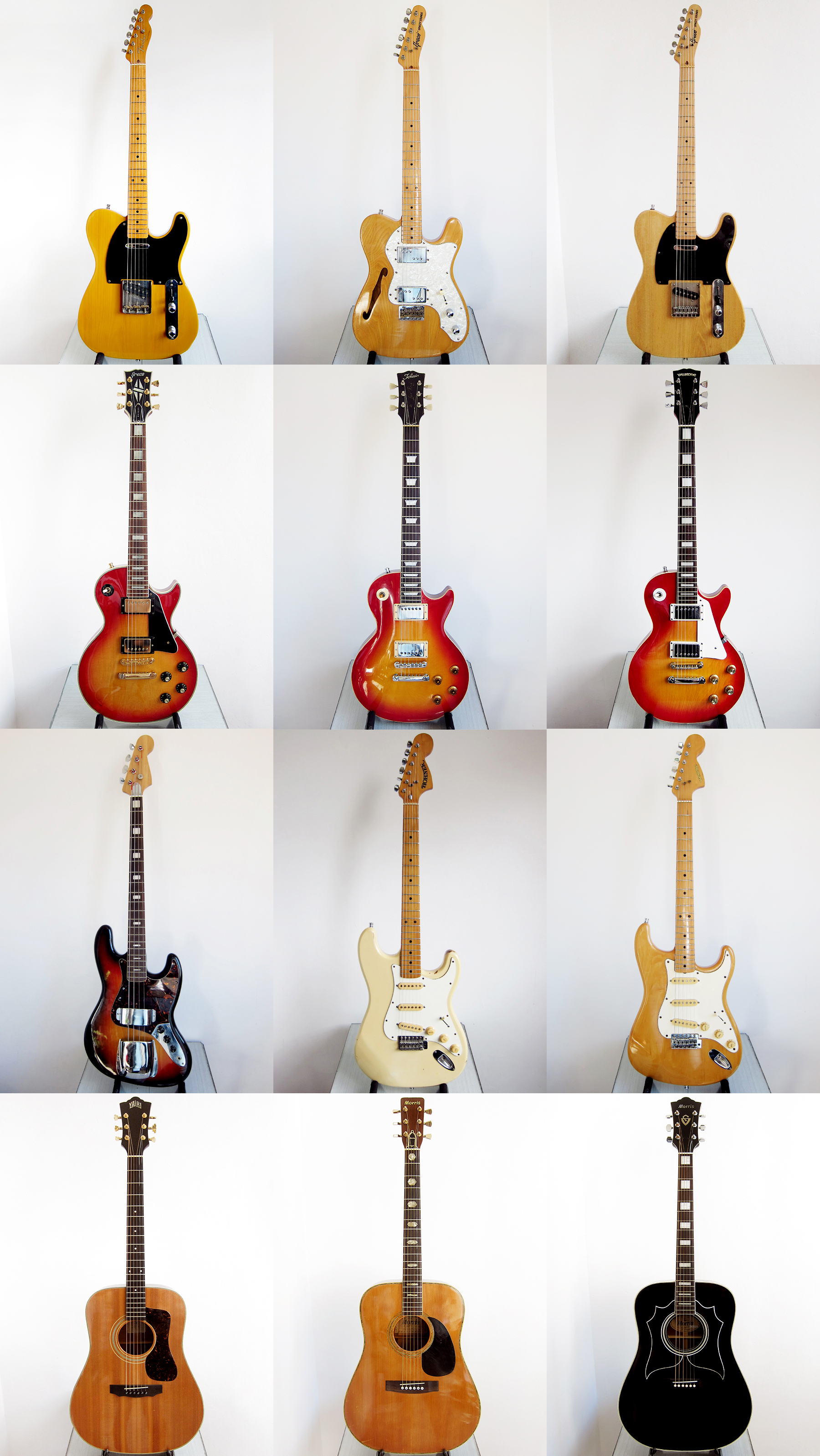
Japanese guitars, MIJ, Made in JapanI have sold some of my Japanese guitars so this is more or less what’s left, from left to right: Fender Telecaster TL52-75 1987, Greco Spacey Sounds TE-500N 1977, Greco Spacey Sounds TL-500 1979, Greco Les Paul Custom EG-600C 1980, Tokai Love Rock LS-55 1991,  Westone Les Paul 1970′s, Jazz Bass 1978, Hohner Stratocaster 1970′s, Westone Stratocaster 1979, K.Yairi TG-40 1977, Morris WL-40 1973, Morris WL-35 1980′s

Radius gauge

Understand radius
My Westone Stratocaster is getting the strings adjusted to the 7.25″ radius of the fretboard

I recently received my Understring Radius Gauge set from the friendly Portuguese luthier supplier Guitars & Woods. If I had only bought this before I ordered four new sets of Jescar frets from Philaluthiertools. I stupidly thought that most of my old Japanese guitars had a radius of 9.5″, they didn’t feel as curved as my Fender Telecaster TL52-75, which I knew had a radius of 7.25″. It turned out that both my Greco Teles and Hohner and Westone Strats had a vintage radius of 7.25″, so now I have to order new frets for them. I have never really cared about adjusting the strings after the radius, I read somewhere that Eric Clapton and others had the saddles flat so I thought I could have that too but when I received my Greco Spacey Sounds TL-500 back in September and it had really well adjusted action set after the radius I instantly fell in love. It’s such a difference on a Strat or Tele with a 7.25″ radius, you can really see and feel the curve. I adjusted all the guitars I could according to their radius and in most cases I had to raise the string height on the D and G string, which makes them really snappy and twangy, it sounds and feels awesome on my Telecasters.

Fernandes The Revival RST-50 ’57

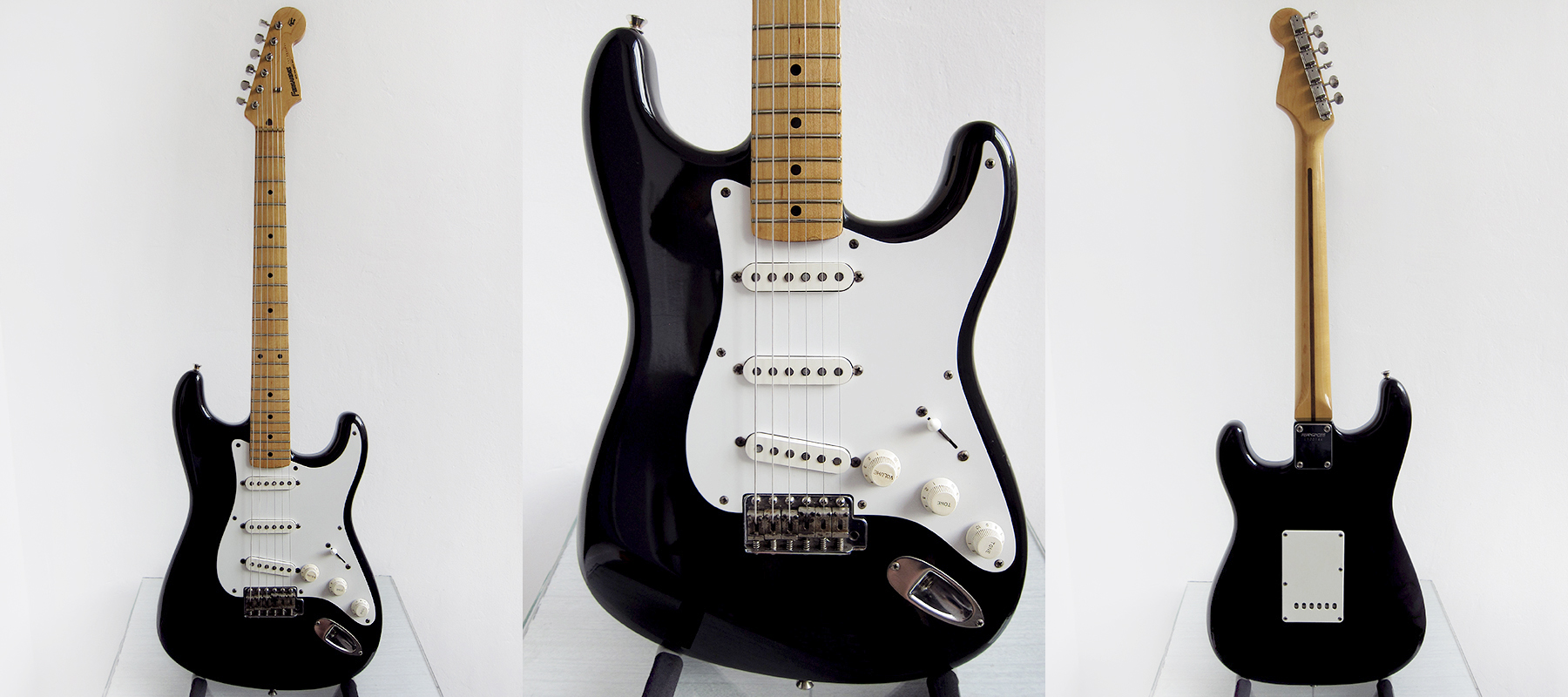
Fernandes The Revival '57 Stratocaster
Fernandes The Revival RST-50 ’57 Stratocaster
Made in Japan, 1988

We were up in Vitoria last weekend for the Azkena rock festival, I had to see The Black Crowes, and I managed to find this little beauty in a Cash converter. It’s a Fernandes The Revival RST-50 ’57 Stratocaster made in Japan probably in 1988. It’s a bit of detective work left to do, I’m still not sure if these were made in the FujiGen or the Tokai factory. It’s most likely made in 1988, well if you can trust Guitar world crazy in Japan, but he seems to know his stuff. The number on the back plate has nothing to do with the year but the first digit of the number stamped on the neck seems to indicate the production year, at least during the 1980’s. Mine has #Y80801 and ’57 stamped and the heal so that should be a Fernades RST-50 ’57 Strat from 1988. However, this guy on eBay claims that Fernandes changed from the proper Fender head to a sharpier head in 1986. He claims that mine should have been made between 1982-85 since it has “Electric Sound Research Group” under the Fernandes The Revival logo on the headstock. I think I’ll go with the Guitar world crazy guy, he seems to know a thing or two. We can be pretty sure that the material is the following, both Guitar world crazy and Music-Trade Japan says the same. The RST-50 ’57 were made between 1981-90, came with Revival Logo, had a 3-piece alder body a Small head and a 1-piece maple neck, poly lacquer, L-5000 Vintage Arched PP Gray Bobbin pickups, separate Diecast & FSRG Press saddle. However, then it says that from 1984 the pickups changed to VS-2 and the saddle to non press marked which is weird since mine clearly has “Revival F.S.R.G” stamped on them. It has quite a lot of fret wear but since the neck felt so amazing I couldn’t resist. Now I finally have an awesome “Blackie” copy so you all can call me Claes Clapton from now on.

Update 2013-07-06
Fernandes have found a new dad. She got adopted this Saturday by a lovely sound engineer, that happened to live two streets away from me, so she could be the jewel in his growing collection of Japanese guitars. I wish the best to both of you.

Fernandes The Revival '57 Stratocaster

Fernandes The Revival '57 Stratocaster

Fernandes The Revival '57 Stratocaster

Are all Japanese guitars good?

I would say yes and no. Most of the early Japanese guitars I have tried have a rather “toy guitar” feel to them. My Playsound from the late 1960’s is fun to play but it’s a pretty horrible copy of a Telecaster. A lot of Japanese acoustic guitar manufactures jumped on the bandwagon and started to make electric guitars in the mid Sixties since that seemed to be what the kids wanted, here you can read more about Japanese guitar brands. Some of them managed to make pretty decent copies of American Fender’s and Gibson’s and others came up with pretty elaborate and creative designs of their own but in general they weren’t that good guitars. Most of the guitars made in the 1960’s didn’t have that great wood and the hardware was normally pretty weak but sometimes the pickups could be all right. Ry Cooder still prefers the Japanese gold foil pickups for his slide guitars and they have been quite popular in American surf music too, this could simply be because that was what people could afford back in the days. It’s important to remember that a lot of the Japanese guitars in the Sixties were mainly made as cheap entry level instruments for the West, not as elaborate copies of the real deal for professionals as they later became in the Seventies and eighties. Some early Fender and Gibson copies are horrible just because they didn’t have any real American instruments to copy, they had to rely on photos and come up with their own solutions to solve the problems that Leo Fender and the boys had already figured out back in the fifties.
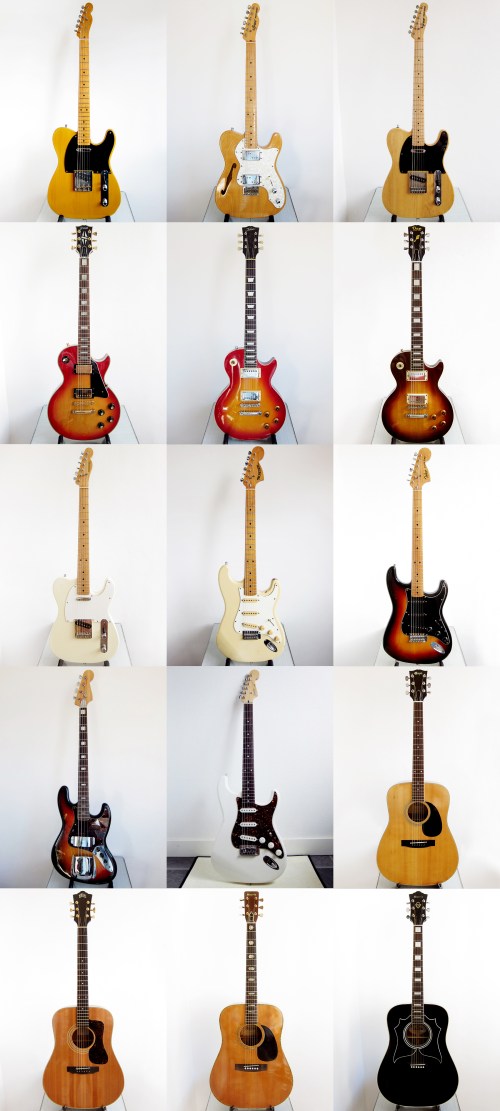
Japanese guitars, MIJ, Made in Japan
The Japanese collection at the moment: Fender Telecaster TL52-75 1987, Greco Spacey Sounds TE-500N 1977, Greco Spacey Sounds TL-500 1979, Greco Les Paul Custom EG-600C 1980, Tokai Love Rock LS-55 1991, VOX Les Paul 1970′s, Hohner Telecaster 1970’s, Hohner Stratocaster 1970′s, Tokai Silver Star SS-36 1979, Jazz Bass 1978, Fender Squier 1993, Maya F335G 1970’s, K.Yairi TG-40 1977, Morris WL-40 1973, Morris WL-35 1970’s

The big change came around 1972-74, this is also when most Japanese guitar manufacturers started to put serial numbers on their instruments. Lack of serial numbers could be a good indicator of the quality, or rather the lack of quality, of an instrument but not always. There are amazing Matsumoku made Greco’s that were made in the early Seventies that lack serial numbers. I would say that most Japanese guitar makers, or at least the successful ones, started to get it right around 1972-74. Especially the Fender copies but also the Les Pauls started to really feel and sound like the real deal around this time. Most copies in the sixties were either Stratocasters / Telecasters or SG’s / 335’s, and unfortunately most of them were pretty cheaply made. In the early Seventies Stratocasters kept being popular but most makers started to try to make Les Paul’s now as well, most with bolt on neck, and some with pretty good result. Some makers kept on making low cost instruments for export and others started to make amazing quality instruments that wasn’t particularly cheap at the time. The model number is often a giveaway of the original price so my Greco Spacey Sounds TE-500N would have cost ¥50 000 back in 1977 when it was made, that’s around $500. This is not true for all brands but a lot of them started in the mid-70’s to price the instruments after the model number, or rather the other way around, and this is probably the easiest way of determining the quality of a Japanese instrument. I’m not sure what an American made Gibson Les Paul Custom cost back in the mid-70’s but if one of Greco’s top of the line like the EG-1500 cost ¥150 000 that would have been a huge investment back then, around $1500. The second hand value today, at least for the famous brands like Greco, Tokai, Ibanez and Fernandes, is roughly what they cost new. A Greco EG-500 Les Paul copy tend go for 500-700€ on eBay, the same for Tokai and Fernandes, slightly less for unknown brands. A Les Paul tend to be worth a bit more than a Stratocaster, I guess because they made more Stratocasters so they are more common or maybe it’s just because Les Paul’s are more popular today. Rare models, don’t trust people who say that the guitar they are selling is rare on eBay, I mean really rare and high end models tend to cost like a real Fender or Gibson from that time.

So what is so good with Japanese guitars? I would say the wood and the craftsmanship. Americans got really sloppy and so did the European manufactures when the productions became too big in the Seventies. Cheap Japanese made guitars, at least after the mid-Seventies, are still really well made. They tend to have good solid wood, great weight and sustain and an amazing quality feel to them. This is of course not true for all of them but at least the Japanese guitars I have played have had a great feel to them. When they made budget instruments in Japan during the Seventies and the Eighties they didn’t cut cost on wood and workmanship, only on hardware and electronics and that’s fairly cheap and easy to upgrade yourself. The best guitars I have are all made in Japan around 1980, that seems to be the height of Japanese guitar manufacturing.
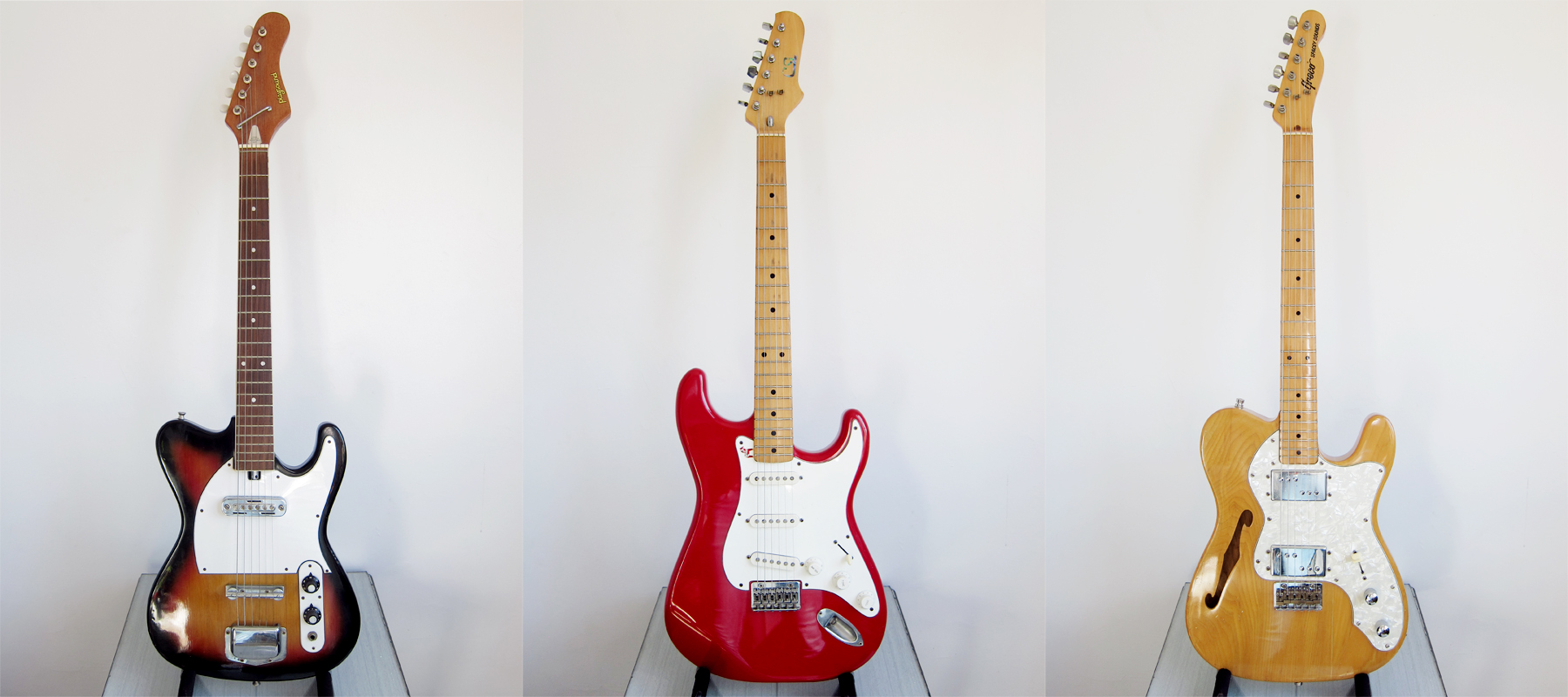
Japanese guitars Playsound (Teisco) 1960’s, CSL (Charles Summerfield Ltd) 1980’s, Greco Spacey Sounds TE-500N 1977

The Playsound guitar was labeled as Audition on the amp and Playsound on the guitar, a beginners set made by Teisco in the Sixties and sold by Woolworth in the UK. I found the whole kit very cheap in a charity shop in South Woodford, UK, the first guitar I bought to collect rather than play. CSL was made by Ibanez in the Fujigen factory and relabeled CSL (Charles Summerfield Ltd) for their UK import. I found it in a second hand shop in Spain in a terrible state so I bought it and cleaned it up and gave it as a present to cheer my girlfriend up after a hospital stay, so techincally not part of my guitar collection. Pretty classic Ibanez head from the 1980’s so clearly made after the 1977 lawsuit. Amazing neck, good feel in general but pretty weak pickups and cheap hardware. The Greco was imported straight from Japan last year, the first guitar I actually bought from outside EU. Amazing Fujigen built Thinline copy, strong original Maxon pickups but not too dark for being humbuckers and with a really fat neck, just as I like it.