Claescaster

Tag: Japanese acoustics

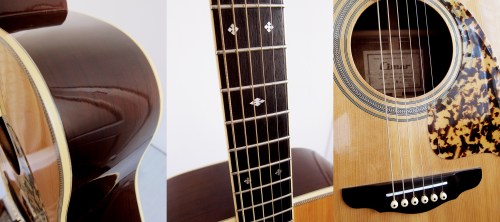
K. Yairi YW-1000

K. Yairi YW-1000 Made in Japan 1973K. Yairi YW-1000, made in Japan in 1973

Since it’s my 35th birthday today I’m going to post this guitar even though it’s not 100% ready yet, it was my birthday present to myself. As I mentioned earlier I recently became the proud owner of a 1973 K. Yairi YW-1000. It’s something I’ve dreamed of for many years and after a bit of hassle it finally arrived. The previous owner didn’t really give much of a description so I wasn’t really sure what to expect. Luckily it sounds at least as good as I had hoped for, if not better and it’s structurally fine. Having said that, there were a couple of things that I wasn’t overly excited about, like the bridge and the scratches on the top. I don’t mind worn guitar but there is one big scratch that is still a real eyesore for me, I’m sure I will get used to it and not even see it in a few weeks. The bridge is a chapter for itself, I really don’t know what has been going on there. It has been removed at some point and re-glued, it also has two screws that I doubt were supposed to be there and on top of that someone has added a bit of rosewood to make it higher and topped it of with a fret as the saddle instead of a normal slot and bone saddle. As soon as the wood shops open again here in Barcelona, a lot of shops are closed in August, I will get a piece of ebony and create a new bridge from scratch. Since I couldn’t wait a whole month to play the guitar I lowered the bridge and cut a saddle slot and installed a bone saddle for now, which has worked fine. It’s a beautiful guitar, it’s smells wonder full and sounds even better. This is my third K. Yairi and I have to say that it’s without any doubt the best Japanese acoustics I’ve played so far. I really love my K. Yairi YW-130 and K. Yairi TG-40 but nothing sounds as good as this K. Yairi YW-1000.

K. Yairi YW-1000 Made in Japan 1973K. Yairi YW-1000 Made in Japan 1973K. Yairi YW-1000 Made in Japan 1973It’s worn and has few scratches but nothing too serious, except for the bridge as mentioned before. I changed the machine heads to Wilkinson WJ28NGD open gear in gold, the original ones were in gold too but most of it had worn off and on top of that they were really heavy. I love all the abalone binding and the hexagon inlays in the ebony fretboard. I’m so gay for bling on guitars, the more the better, perhaps I’m the Liberace of guitars.

K. Yairi YW-1000 Made in Japan 1973As soon as I got the guitar I removed the fret, lowered the bridge by sanding it down and then I cut a proper saddle slot. Apparently the top of the bridge is rosewood on an ebony base so I had to paint the top black to match the rest. The bridge works fine but I’m not happy with how it looks so I will try my best to carve a new one in ebony and replace it.

The fist video is with the old makeshift rosewood bridge that the guitar came with, the second video is with the new ebony bridge that I carved myself from scratch, you can read about it here.

K. Yairi YW-1000

1973 K. Yairi YW-1000K. Yairi YW-1000 Made in Japan 1973, Taken from my Instagram

I did it, finally I found myself a K. Yairi YW-1000. This has been a goal of mine for years, or at least since October 2013. You never see them for sale in Europe and to buy one from the US or Japan would set you back at least $1500-2000 plus import taxes and the risk that it gets confiscated in customs, some countries are really picky about Brazilian rosewood crossing their boarders. This K. Yairi YW-1000 was made in the 48th year of Emperor Shōwa, meaning 1973, I love the Emperor based serial numbers. I will write a lot more about this guitar when I got it all set up, I need to re-glue the bridge first.

Ibanez V 300

Ibanez V300 BS Made in Japan 1979Ibanez V 300 BS, Made in Japan by Fujigen Gakki in 1979

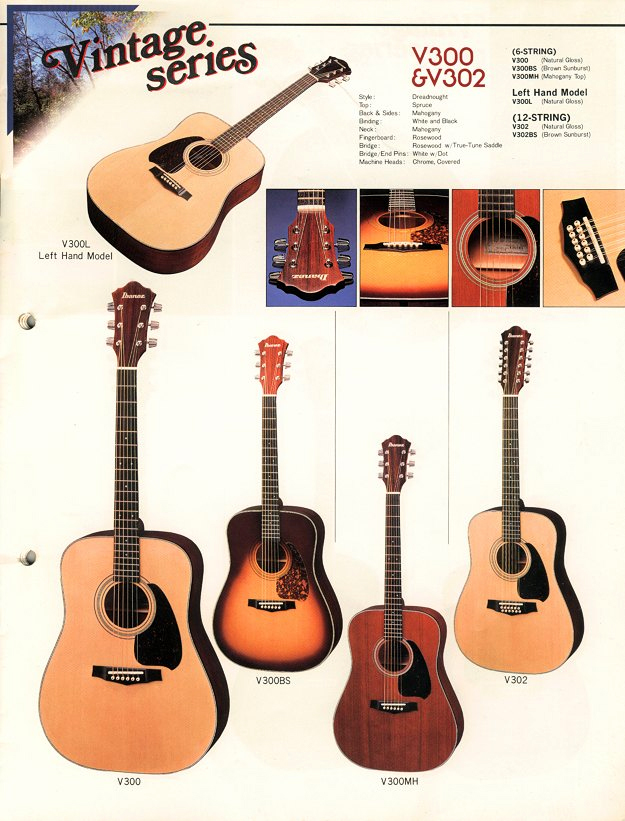
Last month I was asked to find a guitar for my friend Miki’s birthday. His girlfriend Laura thought that I was the man to source an old Japanese acoustic for him, well I found it and she picked it. Last night he received the guitar so now the surprise is over and I can write about it, he seemed very pleased to be a part of the vintage Japanese guitar club. It’s pretty similar in shape and sound to the Ibanez built Cimar D-320 I got for my friend Tomasz back in May. Even though they have a lot in common, this Ibanez felt both fancier and more solidly built. I really like the sound of these 1970-80’s Ibanez and they look pretty unique since they aren’t an obvious Gibson or Martin copy. I can highly recommend them if you find one for a descent price, they tend to be more in the Morris price range than Suzuki which I guess could be because Ibanez is such a famous brand.

Ibanez V300 BS Made in Japan 1979An extremely well kept 1979 Ibanez V 300 BS, built in Japan and after spending 36 years in France now lives happily in Barcelona

Ibanez catalogue 1983-84Ibanez catalogue 1983-84 take from Ibanez Guitars

K. Yairi YW-130

K. Yairi YW-130 Made in Japan 1977K. Yairi YW-130 a Martin D-28 copy made in Kani, Japan in 1977

I recently came over a 1977 K. Yairi YW-130, a beautiful Martin D-28 copy. I’ve been looking for a D-28 copy for a while, just out of curiosity to see the difference between the D-35 and D-42 copies that I have. The Morris W-40 and Morris W-50 both have a 3-part back which gives them a lot of bass and punch in the middle so perhaps a Japanese made D-28 copy would be more bell like and balanced, like a real Martin, and I was right. The K. Yairi YW-130 sounds amazing, really clean and even all over, with awesome overtones that sneaks up on you if you let it ring out. It has a solid spruce top, rosewood back and sides with a simple ebony bridge and fretboard. I do love my Morris guitars and I think it’s a great brand, but nothing comes close to K. Yairi. The old K.Yairi TG-40 that I got a year a go is awesome too, but I think I prefer the sound of the new one. Perhaps my acoustic guitar preferences has slightly shifted from the Gibson sound to Martin.

K. Yairi YW-130 Made in Japan 1977K. Yairi YW-130 Made in Japan 1977I didn’t have to do anything to the guitar when I got it, I just changed the machine heads to Wilkinson WJ28NGD open gear in gold which I love. It’s a bit worn and have a few dents in the spruce top that I’m planning to figure out how to soften a bit.

K. Yairi YW-130 Made in Japan 1977I’ve really come to love guitars with the typical Martin volute, just like my Morris W-50, and the double dots on the 7th fret, it’s just beautiful. There is nothing better than a black Ebony fretboard on an acoustic guitar. I thought ebony was like rosewood until I got my Goya T-18 two years ago and it just blow my mind, there is no nicer fretboard material.

K. Yairi YW-130 1970's catalogueK. Yairi YW-130 in a late 1970’s Canadian catalogue, taken from AlvarezYairi

Guitars for sale

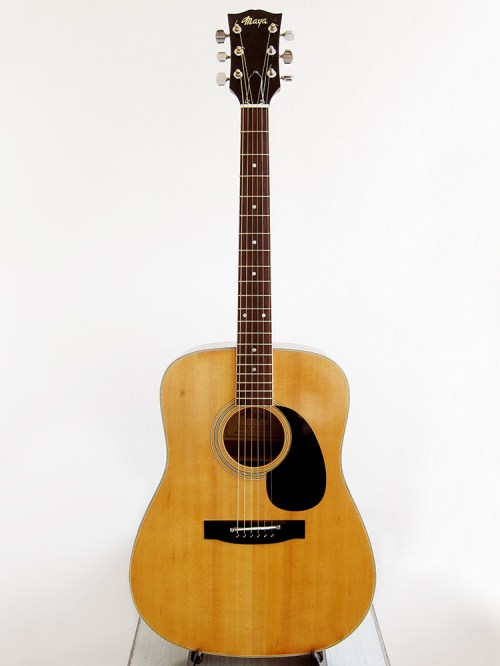
Maya F335G, Dreadnought, Made in Japan, 1970’sMaya F335G, Dreadnought acoustic, Made in Japan, 1970’s, 200€ SOLD
Japan made Gibson J-50 copy in a pretty good state for it’s age. I couple of marks on the spruce top and few knocks on the head but structurally very sound without any cracks. This Maya F334G was made by Chushin Gakki in Kobe, Japan, during the 1970’s. It has a really fat neck, it’s feels great to play, adjustable bridge with both bone nut and saddle. The sound is very full with a great booming bass. If you want more pictures  you can check the post I wrote about it.

There are a couple of more guitars for sale here

Cimar D-320

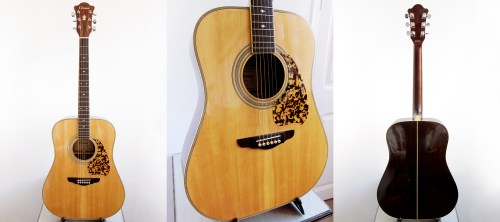
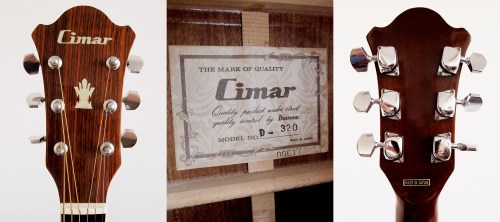
Cimar D-320 by Ibanez, Made in JapanCimar D-320, Made in Japan in the mid 1980’s by Ibanez

I recently helped my friend Tomasz to find a nice Japanese acoustic and we ended up with this Cimar D-320. Cimar were made by Ibanez in the 1980’s as their cheaper brand and even though I’ve seen them for sale quite often, I had actually never tried one. Ibanez is owned by Hoshino Gakki and based in Nagoya, Aichi, Japan. Hoshino Gakki also had semi acoustic, nylon and steel stringed acoustic guitars manufactured under the Ibanez name. Most Ibanez guitars were made for Hoshino Gakki by the FujiGen guitar factory in Japan up until the mid-to-late 1980s and from then on Ibanez guitars have also been made in other Asian countries such as Korea, China and Indonesia, taken from Wikipedia. I have a feeling this Cimar would be one of the last ones to have been made in Japan and I’m still struggle to see how they could be making inexpensive guitars in Japan in the mid 1980’s, I had a feeling that everything had already been moved to Korea or some other cheaper country. They guitar seems to be pretty solidly built and has a lot of swanky details like the snowflake inlay and herringbone binding which looks great from a distance. The best part is still the sound, I would never have expected it to have such rich bass and great response, especially not for being fully laminated. A pretty great guitar for the price. If you want to know more about different Japanese guitar brands then check my previous post.

Cimar D-320, Made in Japan in the mid 1980's by Ibanez

Fujigen Gakki
Fujigen Gakki began operation in 1960 as a classical guitar manufacturer, moving into the lucrative electric guitar markets in 1962. The company was the largest producer of Japanese guitars during the 1960-1980 period. They were known for producing high quality products, especially for the badged guitar market, which is why the company was selected by so many major American brands. It wasn’t until 1970 that the company began making products for the venerable Ibanez brand, which was an unqualified success. Fujigen Gakki was the main manufacturer of choice for Greco badged guitars in the 1970 to 1980 period. They also produced guitars for major manufacturer Yamaha. Badged guitars made by Fujigen include Antoria, Epiphone, Jason and Mann. Badged guitars that may have been made by Fujigen Gakki were Marlin and St. Moritz.

Suzuki Three-S F-120

Suzuki Three-S F-120 Made in Japan #780721
A really well kept Suzuki Three-S F-120. Built in 1978 by Suzuki Violin Co. LTD in Nagoya Japan.

I recently found another Suzuki Three-S F-120. These are great little Japanese built guitars that I can highly recommend. Really sweet tone and pretty descent build quality for being so inexpensive. Of course they can’t compare to Morris or K. Yairi but next to Aria, Maya, Shiro or the normally Suzuki’s they are great. It’s a simple Martin D-18 copy built in 1978 by Suzuki Violin Co. LTD in Nagoya Japan. What always surprises me with these Suzuki Three-S F-120 is how light they are compared to a lot of Japanese dreadnoughts from the 1970’s that can feel pretty heavy and bulky. Unfortunately this one was sold straight away so I only got time to fix it up and make a Youtube video of it before it was gone. If you want to know more about different Japanese guitar brands then check my previous post.

Suzuki Three-S F-120 Made in Japan #780721

Suzuki Three-S catalogue USA 1979
Suzuki Three-S F-120 in an old Japanese catalogue from 1979. It has spruce top, might actually be solid, with a laminated nato back and sides. Nato neck with a really dark rosewood fingerboard and bridge, it almost looks like ebony.

Maya F335G, Made in Japan

Maya F335G, Made in Japan 1970'sMaya F335G, Made in Japan 1970’s

On Saturday I found myself a Maya F335G. As mentioned before, I’ve been after a Gibson J-45 or J-50 for quite a while so when I saw this Japan made Gibson J-50 copy I couldn’t resist. It was in a terrible state and strung with 4 nylon strings so I couldn’t test it but I trusted my gut feeling. It doesn’t sound like a Gibson J-50, I didn’t really expect it too either, but it does sound pretty good. I would say that it sounds better than the two Suzuki’s I used to have, the Kiso Suzuki WE-150 and Suzuki Three-S F-120, even though the build quality is pretty much the same. There is a huge step up to my Morris WL-35 and Morris W-40 and my beloved K.Yairi TG-40, both in build quality and sound. Having said that, there is something with this Maya that I really like, it has way more bass then the Suzuki’s and overall a pretty nice and full sound. The only downside is that it feels pretty stiff to play so I will probably put 011’s on it next time I change the strings. According to my previous post about Japanese guitar brands Maya was made by Chushin Gakki in Kobe, Japan, during the 1970-80’s. Even though I really like this guitar I have it listed for sale if anyone is interested in buying it.

Maya F335G, Made in Japan 1970's Maya F335G, Made in Japan 1970's Maya F335G made by Chushin Gakki in Kobe, Japan

Maya F335G, Made in Japan 1970's The previous owner had used a collection of random oversized wood screws to keep the machine heads in place so the first thing I did was to remove them and fill the holes. I polished the frets and oiled the super dry fretboard and then put on a bone nut and saddle which improved the tone quite a lot.

K. Yairi TG-40

K. Yairi TG-40 Made in Japan 1977K.Yairi TG-40 a Guild D-40 copy from 1977. Every K.Yairi guitar is given birth in Kani, a small community in the beautiful mountainside area of Honshu, Japan.

My new K.Yairi TG-40 has finally arrived, after 40 days stuck in Spanish customs. I have mentioned earlier that it’s a lot easier to import things from Japan to Spain compared to buying things from the US, well that was a lie. I have bought three electric guitars, mainly Greco’s from an eBay seller called Tokyowax. They all arrived within 48 hours so I stupidly assumed that everything from Japan would arrive quickly and without any problems, but no. Tokyowax uses DHL Express and they tend to deliver things within 2-5 days and you pay the taxes straight to them when they deliver the guitar. It wasn’t that easy with EMS Japan, that package went straight to customs in Madrid and spent 40 days in their lazy company. How can anything take that long? K. Yairi could probably have built me a new guitar in that time, if he was still alive. It seems like the only option now when buying guitars on eBay is to use the Global Shipping Program, that worked for my Goya 163 at least. Anyway, the guitar is amazing so it was well worth waiting for.

K. Yairi TG-40 Made in Japan 1977

It has a really nice tone with great bass response. It easily has the best bass of all my acoustics, even better than my Morris W-40 which has that Martin D-45 bass sound, this is nicer and a lot clearer. I guess it sounds like an old Guild D-40, at least if I can trust the Youtube clips I have seen since I haven’t had the chance to play one myself. It actually reminds me a bit of a Gibson Jumbo, like I mentioned in my Gibson J-45/J-50 post: “The Yairi TG-40 is a Guild D-40 copy, which was introduced in the Sixties as a competitor to Gibson’s J-45. The Guild D-40 became famous as the Bluegrass guitar for their even response over all the strings and I really like the sound of them, it’s actually not too far off from a Sixties Gibson J-45. With a bit of luck it’s going to be an awesome Yairi copy of an Guild which might sound a bit like a Gibson.”

K. Yairi TG-40 Made in Japan 1977I didn’t have to do much to it, it was ready to play when I got it. However, the pickguard was loose so I had to remove that, clean it up and then glue it back again with my trusty fish glue. When the strings was off I quickly polished the frets and oiled the ebony fretboard. I also installed a jack for my LR Baggs M1 and a strap button.

I bought this K.Yairi TG-40 from a really nice eBay seller called montebell86 who was a pleasure to deal with. The guitar was listed as “Taniguchi Gakki” Japanese guitar shop original model, very rare. Solid spruce top, sides and back in solid mahogany, neck in Honduras mahogany, bridge and Fretboard in black ebony. The label states it was made in 1977 but the serial number starts with 51 which was the 51st year of Emperor Shōwa and puts it to 1976.

K. Yairi TG-40 Made in Japan 1977K. Yairi TG-40 Made in Japan 1977I got this K.Yairi TG-40 fairly cheap since the pickguard needed to be reglued and one machine head wasn’t working properly. It also has two cracks, one on each side that has been professionally repaired and can’t be seen from the outside. Since the machine heads needed to be replaced I decided to change them for Wilkinson WJ-309 in gold, just like I did on my Levin 174

Here is a quick little comparison between the K.Yairi TG-40 and my Morris W-40, they sound pretty similar and I don’t think I would be able to tell them apart in a blind test. Well the Morris has a bit more bass and is a slightly weaker on the treble side, I feel that the Yairi is more even over all the strings.

Yairi TG-40 Japan Catalogue 1970'sK.Yairi TG-40in the Japanese catalogue from the late 1970′s. List price ¥60.000, around 420€, which must have been a fortune back in 1977. Then again, this was a fairly cheap guitar for being K Yairi, the top model cost ¥200.000, about 1400€.

Japanese guitar catalogues

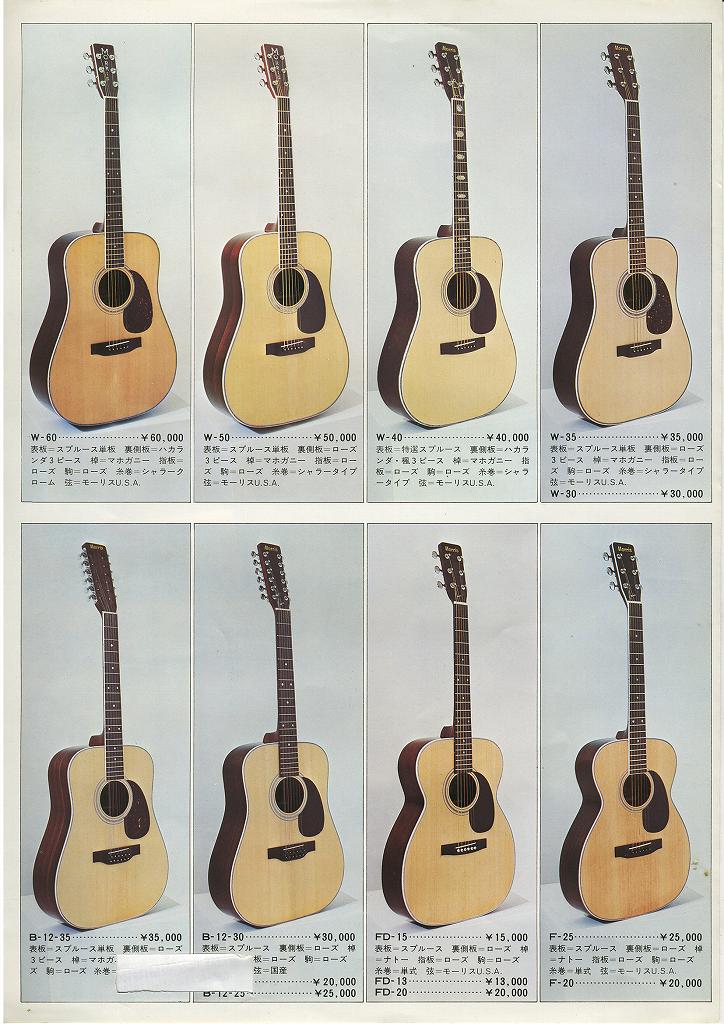
Morris catalogue Japan 1976

I’ve recently come across I pretty good source for old catalogue scans for Japan made acoustic guitars. It’s called oldguitar and has about 50 different Japanese guitar brands represented, some brands has more scans than others and most of them are in Japanese but it still pretty nice to see your guitars in old catalogues. Unfortunately I only managed to find my Morris W-40K. Yairi TG-40 and Suzuki Three-S F-120, my Morris WL-35 and Kiso Suzuki WE-150 seems a bit harder to track down.

Morris W-40 1973
Morris W-40
Made in Japan by Terada 1973

Morris catalogue Japan 1975Morris W-40 in the Morris catalogue for Japan 1975

K. Yairi TG-40 Made in Japan 1977

Yairi TG-40 Japan Catalogue 1970'sYairi TG-40 in a Japan Catalogue from the late 1970’s

Suzuki Three-S F-120
Made in Japan 1976

Suzuki Three-S catalogue USA 1979Suzuki Three-S F-120 in the Suzuki Three-S catalogue for USA 1979

Kiso Suzuki Violin Co. LTD. WE-150
Kiso Suzuki WE-150
Made in Japan 1970’s

Kiso Suzuki Violin Co. LTD. catalogue Japan 1976My Kiso Suzuki WE-150 seems to be a mix of the W-150 and then WH-200 in this catalogue from Japan 1976