Claescaster

Tag: eBay

How to… Repair lacquer damage

I really like worn guitars, well it’s hard to avoid when most of my guitars are 30-40 years old, the oldest guitar I got is my little Levin from 1942. However, there is one thing that I can’t stand, marks and dents on the back of the neck. Some little imperfection that you feel every time you move you hand up and down the neck. I’m not sure if it’s related to my slight OCD but it annoys me so much that I tend not to play any of my guitars that doesn’t have perfect smooth necks. The worst used to be my Greco Les Paul, it had a dent in the neck and I complained so much when I bought that I actually got it cheaper. When I received my Goya T-18 and my Morris W-40 and realised that they both had really bad marks on the back of the neck I just wanted to cry. Then I thought about it and came to the conclusion that I can’t be the only one that has issues with this, so I checked some Youtube videos to learn how to fix it and then ordered everything I needed. It’s actually really easy to fix yourself, well as soon as you find good lacquer and sandpaper with a grit fine enough, that turned out to be impossible around here. I managed to find a eBay seller that sold Nitrocellulose lacquer fairly cheap and was willing to ship to Spain. The sandpaper I had to order from China, I couldn’t find anything finer than 800 in Barcelona. After a months waiting and some feeble practice runs on less loved guitars I was finally ready to try to fix all dents, marks and imperfections on the back of my guitar necks. It went really well, or as well as it could with just 2500 grit, ideally I would have liked to have something much finer for really getting the shine back, especially on flat surfaces like bodies, the necks looked pretty good anyway.

Repairing lacquer damage on guitar
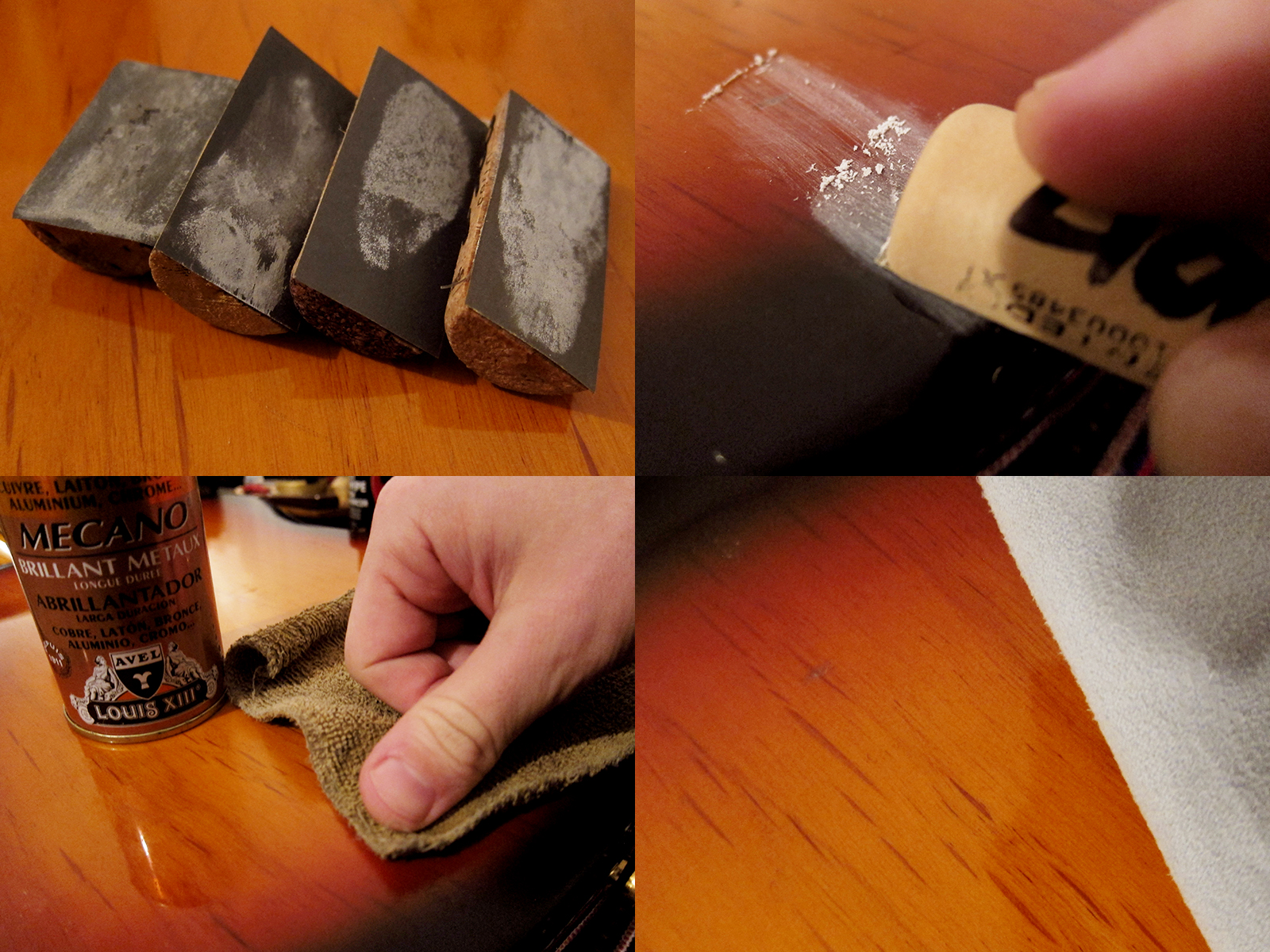
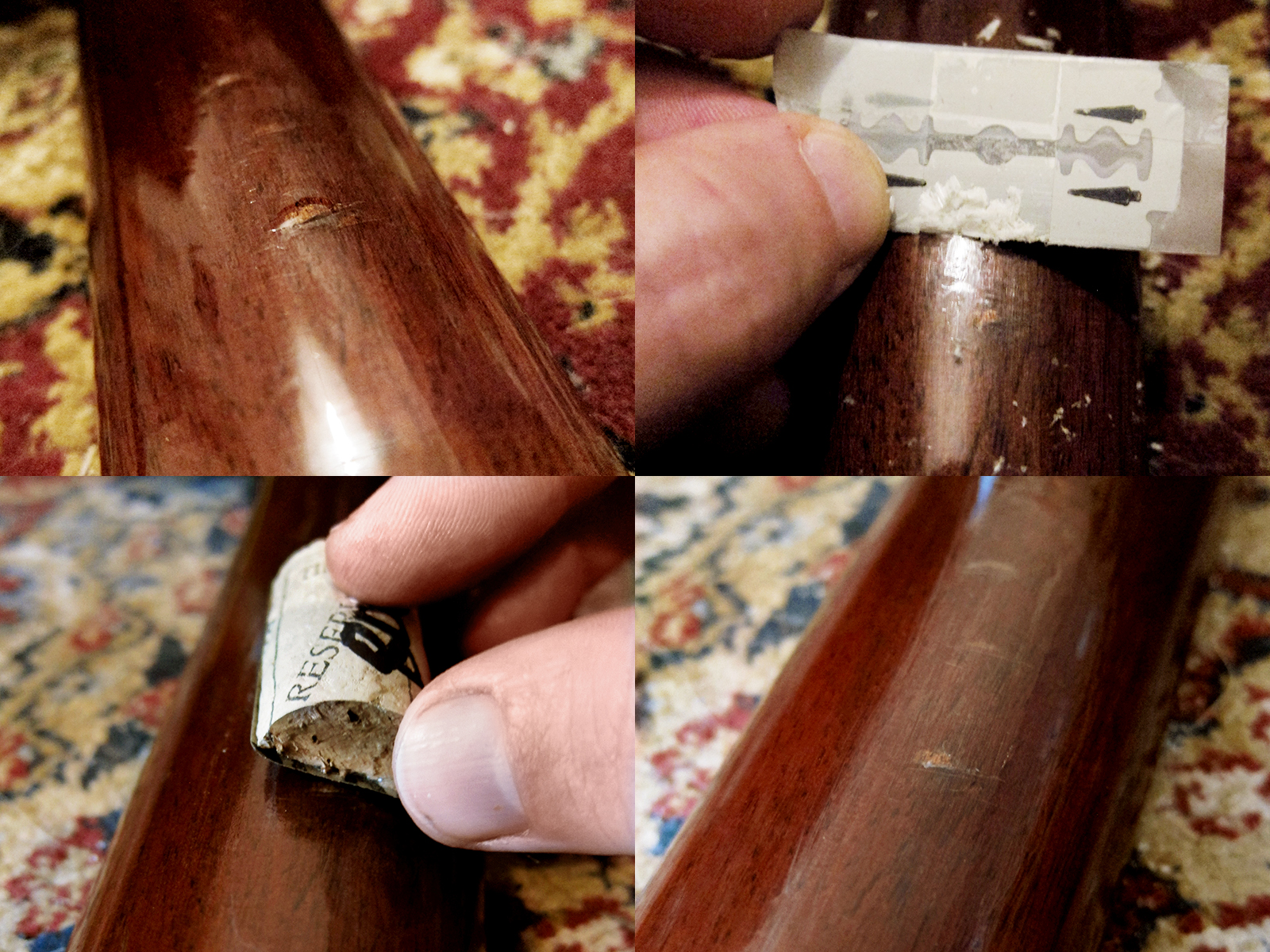
Before I started on any necks I decided to practice on the fairly roadworn body of my old Claescaster. The sandpaper I ordered from eBay came in 1500, 2000, 2500 grit and actually turned out to be made in Japan. I cut wine corks in half and glued sandpaper strips to them to get a straight sanding surface, remember to mark the grit on them otherwise it gets a bit confusing. Next step, apply the lacquer. It dries pretty fast, about 10 min, which is good because you normally need to apply lacquer more than once to really fill the dents. When it’s dry just cut off the access with a razor blade until the surface feels smooth. It’s good to tape around the blade, not only to avoid cutting yourself, but also to not scratch the surrounding surfaces.
Repairing lacquer damage on guitar
Remember to dip the sandpaper in water before you start sanding, you can really feel the difference especially with the finer grits. I used 400, 800, 1500, 2000 and 2500 grit on my little wine cork sanding blocks. I would have loved to have something even finer. I tried everything I could think of that could have a bit of sanding effect but was finer than 2500 grit. Pencil eraser, sponges, different cloths, in the end I rubbed really hard with metal polish which seemed to work a bit. As a last step I applied a bit of Carnauba wax and a lot of elbow grease and then buffed it up with a fine microfiber cloth.
Repairing lacquer damage on guitar
This is the back of the neck of my Morris W-40. The seller didn’t even bother to mention that it had deep cuts in the neck. This took quite a few fills with lacquer to even out the dents but in the end it worked pretty well. You can still see a slight colour change but you can’t feel the dents, which was the main thing for me. The last photo is not of the final polished result, it’s in the middle of sanding, I forgot to take a picture when I was done. I’m very happy with the result on all of the guitar necks I tried to fix. It was also a lot easier to get the sanding smooth and unnoticeable on the back of a neck compared to a guitar body.

Bridge Pins

Most guitars come with plain plastic bridge pins and I never really thought that changing them would effect the tone, but it does. To be honest I wasn’t sure how much difference it would make to change the nut or saddle either but there I was proven wrong straight away. I’ve heard so much talk about how superior bone is to plastic and thought it was nonsense, until I actually tried for myself. Now most of my guitars have bone or Tusq nuts, both electrics and acoustics. I changed to Tusq on my Claescaster and was sold straight away, it really felt and sounded different. The only acoustic I’ve had to change nut on was the Suzuki and that guitar sounded way better with a bone nut. It’s weird but acoustics for me, up until the last couple of month, have always sounded good or bad but without any nuances. I guess what I’m trying to say is that just like with a fine red wine you need train your pallet to really understand and appreciate all the flavours and subtle differences. I have been buying more acoustics lately and really listened to them while playing and have come to realise more and more what I like and not like with acoustics. It’s not just down to brand, shape and woods, no guitar sounds the same and there is a lot subtle differences. I think that age is very important factor, I really do believe that wood needs time to open up and that it affects the sound a lot, hence why a lot of modern guitars sounds more or less the same to me. I ordered 12 bone bridge pins and 12 ebony from rockcarvings a Chinese eBay seller that was really cheap, $9.90 for 12 ebony pins. I changed the pins on my Morris W-40 first and made a little sound clip with the plastic, bone and ebony bridge pins to really be able to hear the difference. There is a difference, maybe not as big as changing the saddle to bone, but still. In my opinion the bone pins sounded too clear and sparkly on that guitar, they lacked a bit of bottom which could be more about the quality of these Chinese pins than the material itself. The Morris has a lot of warmth and bottom, which is the reason why I love that guitar so much, so I wanted to keep that rather than give it more treble. The ebony pins were perfect, they just gave such a solid tone, both playing chords and solo. I changed my dad’s Levin LT-16 to ebony as well and put on a new compensated bone saddle, which made wonders to the tone and playability. I will try the bone pins on some other guitars but I have a feeling that I will order more ebony pins in the near future. Here is a list from Maury’s Music with the tonal qualities of different bridge pin materials. I wish I could have found Mammoth or Walrus because that seems awesome but eBay only allowed for Tusq, bone, ebony and horn.

  • Tusq can add a moderate amount of treble, sustain, clarity and volume to your guitar.
  • Bone offers everything Tusq provides, but in bigger doses.
  • Ebony can add bass and warmth to your guitar, along with a signifigant increase in sustain and volume.
  • Buffalo Horn sounds almost identical to bone, and is a great choice if you want a dark looking pin with bone tone.
  • Walrus Jawbone offers the fundamental tone of bone but with better overtones and fatter harmonics.
  • Mammoth Ivory can add sustain, volume, and a transparent richness to your guitar, with an increase in harmonics and overtones.
  • Walrus Ivory provides the greatest increase in volume, sustain and clarity among all the pin choices.

1973 Morris W-40 and 1966 Levin LT-16 with new ebony bridge pins

Morris W-40

Morris W-40 1973
Morris W-40 1973

My new found love just arrived to the office, a 1973 Morris W-40. I have been looking for a Japan made Martin D-45 copy for a while and I’m really glad I went for a Morris. I have never played a guitar that sounds this good, amazing tone with really low action. She is a bit more worn than I expected, which doesn’t really bother me that much since the wood looks so good. I might put some gold tulip machine heads on her tonight, if my Gibson PMMH-025 fits. This Monday is just getting better and better. First I got to celebrate my girlfriends birthday, which meant getting up at 5.45 am and prepare breakfast in bed for her, and then I got this baby delivered and she arrived in one piece. Thank you Monday.

Greco Spacey Sounds TL-500

Greco Spacey Sounds TL-500
Greco Spacey Sounds TL-500, Made in Japan by FujiGen in August 1979

Yesterday the newest member of my Greco family arrived from Japan. I went a bit bananas last week when I saw that my favourite eBay seller Tokyowax was selling a Greco Spacey Sounds TL-500 so I bought it straight away. These Greco TL-500 are pretty rare, there are about 3-4 Greco TE-500, the Thinline version, for sale on eBay at the moment but I have only seen 2-3 Greco TL-500 for sale in the last two years. I’m not sure if they produced more Thinline copies in late Seventies than normal Telecasters or if people refuse to sell them, but you rarely see these and when you do they are normally very expensive. I got mine fairly cheap since one of the string ferrules on the back was missing. Well I shouldn’t really call it cheap and now the import tax from Japan had increased as well, I had to pay 95€ instead of the normal 75-80€.  I didn’t have to do much to her, everything was pretty well set up already. The frets looked pretty bad so I polished them, oiled the machine heads, tightened all the screws and restrung her. She plays amazingly, even better than my old mistress, my Greco Spacey Sounds TE-500 Thinline copy. It might seem weird that I put my old “Nancy”, my Fender Telecaster TL52-75, up for sale and then bought a new one the same week. The truth is that even though I love my Japan made Fender, I don’t dare to use it since it’s in such a good state. I prefer guitars that are older than me and have a couple of battle scars already. I guess I’m also a bit gay for late 1970’s Greco guitars.

Greco Spacey Sounds TL-500

Greco Spacey Sounds TL-500
The body has quite a few marks on it but the back of the neck is like new and that’s the only thing I really care about.

Greco Spacey Sounds TL-500
The frets looked pretty bad so I masked the fretboard and polished them with 400 and 800 grit and then wire-wool. It looked like they had put the frets on before they applied lacquer to the neck and then after 35 years of playing half of it had worn off. The electronics seemed to be in good order and the guitar sounded awesome when I plugged it in so no reason to mess with that.

Greco Spacey Sounds TE-500N, Greco Spacey Sounds TL-500, Greco Les Paul Custom EG-600C
Greco Spacey Sounds TE-500N 1977, Greco Les Paul Custom EG-600C 1980, Greco Spacey Sounds TL-500 1979

Hondo II P-bass

Hondo II P-Bass
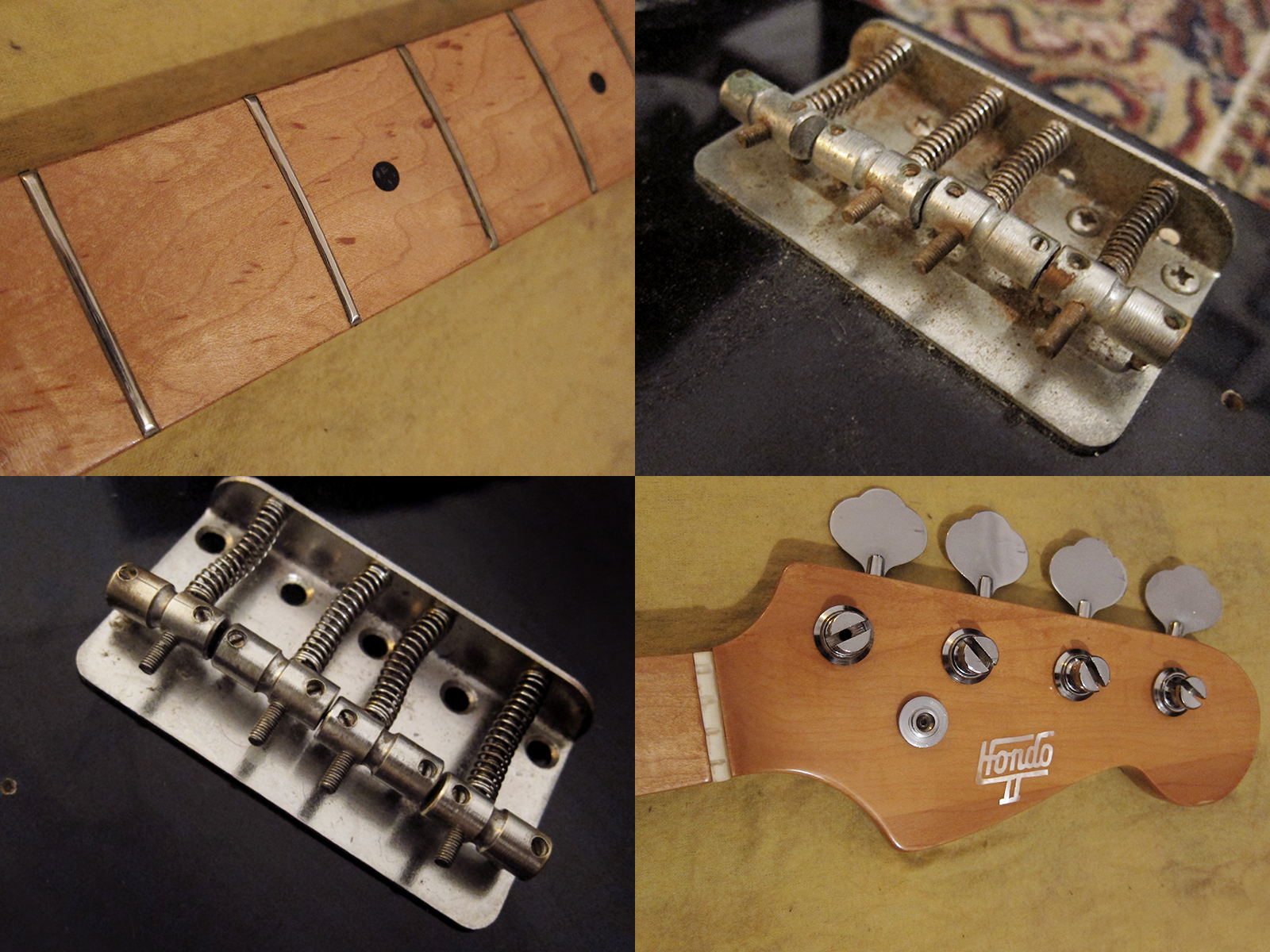
Hondo II P-bass copy, it’s a bit roadworn but the neck is in a really good state and it feels great to play.

Hondo II P-Bass
The machine heads could do with being replaced too, it seems like Hondo II have great necks but cheap hardware and electronics.

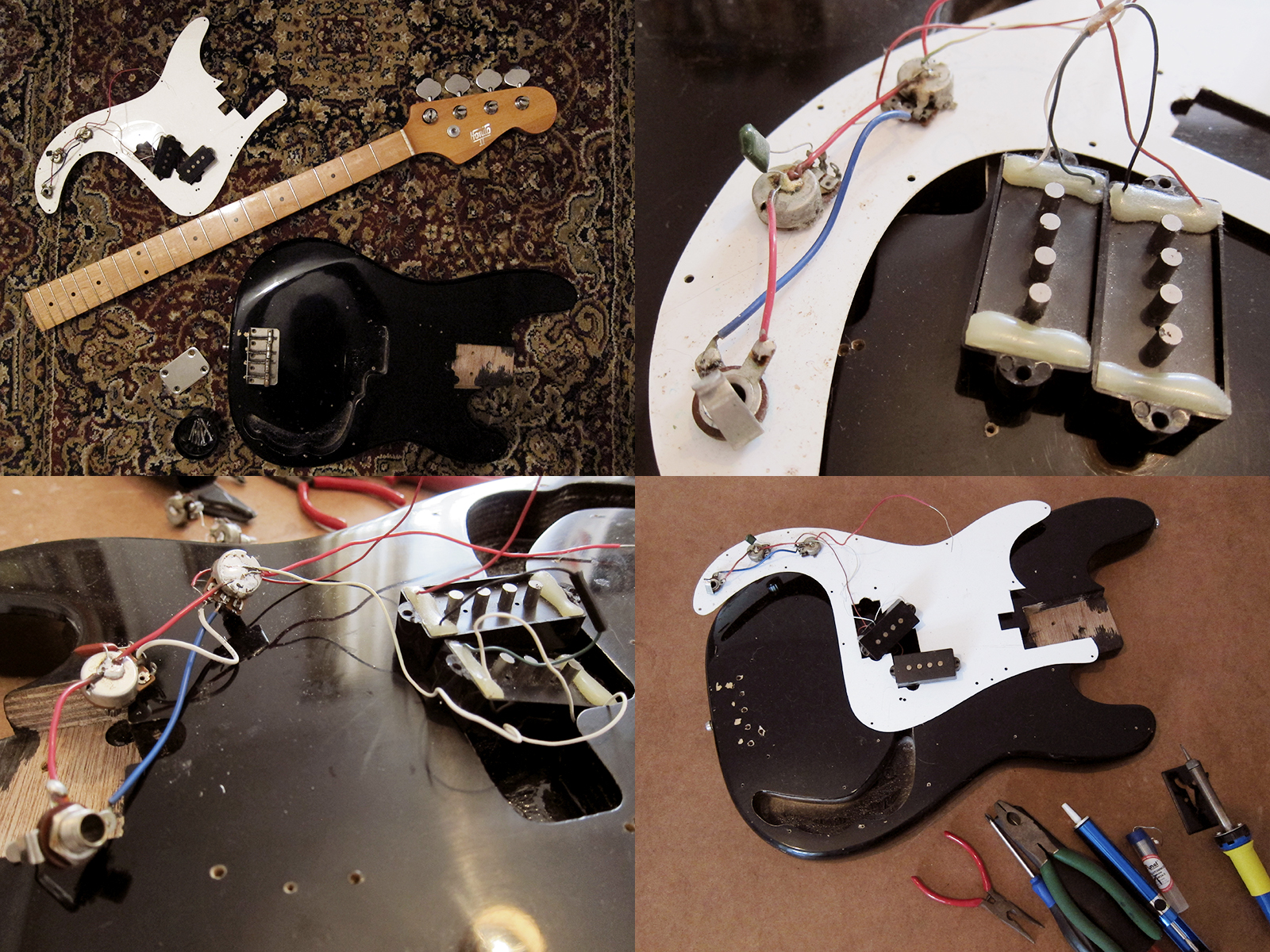
As I mentioned before I got a Hondo II P-bass for my colleague Verushka, she plays in an awesome punk group called Sect. The bass arrived last week and I took it home and had a look at it. It was sold as untested so I presumed that nothing worked, and I was right. The wood seems really solid and good, just like the Hondo II I got for Dani a few months back but the electronics seemed to be pretty bad. I took it a part and cleaned it, polished all the metal and then started to go through the electronics. It turned out that the pickups doesn’t work. Or rather they work, but the output is so low that you can hardly hear them. We ordered a new set of Artec P-bass pickups, new pots and jack from my favourite Hong Kong store EY Parts so as soon as they arrive I can get the bass sorted.

Hondo II P-Bass
I cleaned it, polished the frets and all the hardware with wire wool and metal polish. I have to say that this cheap little bottle of Harley Benton Hardware Polish has proven to be extremely worth the 1.90€ I paid for it. I put in a little shim when I assembled it, just like I did with Dani’s and it made wonders to the action. Now it’s really low and easy to play.

Hondo II P-Bass
I took all the electronics apart, cleaned the jack, cut the ends of all the wires and replaced the mini pots with some newer mini pots I had at home, I did everything I could to make sure that all the connections would be as good as possible but it didn’t help. Well I got rid of the extremely loud humming noise that was there before but the pickups are still way too weak for being usable. Let’s see what it sounds like when the new full size pots, jack and Artec pickups arrive.

Guitar strings

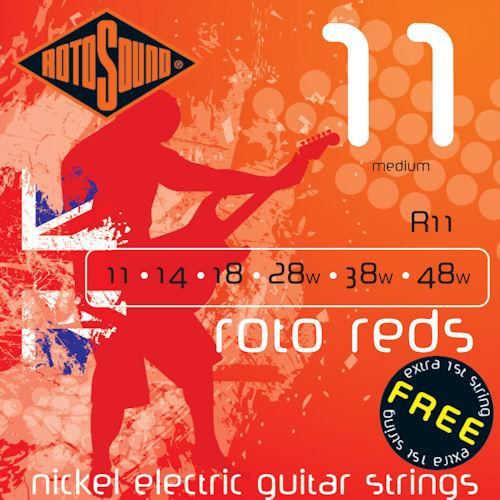
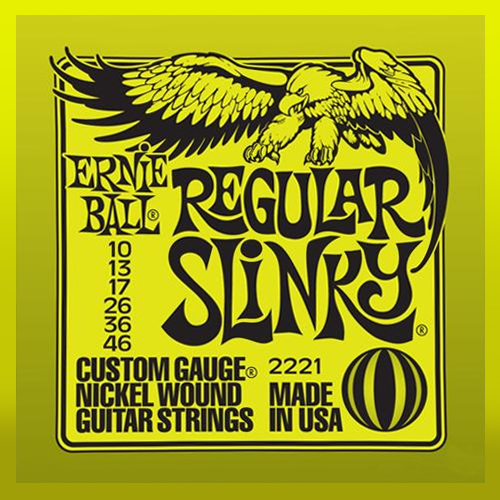
How do you chose what strings to use? Do you listen to others, read reviews or actually try all the brands available? In my case I guess it has been a combination of what others are using, what I’ve read good things about and what I actually realised that I like. I don’t really know much about different materials or how some type of strings affect the sound in certain ways. I guess a big part for me has always been the price since I’m a hard hitter and tend to break strings a lot. When I was young I was poor and had to stick to the cheaper brands and now when I’m older and less poor I have too many guitars to afford to string them up with the best brands. I’ve always been stuck in the middle and changed brands many times depending on what’s affordable and popular in the country I’ve been living. I used Rotosound (Roto Reds 11-48) while I lived in the UK and now in Spain I’ve changed to Ernie Ball (Regular Slinky 10-46). The main reason why I changed from 11’s to 10’s was because I felt that I was old enough to use what I wanted and not care about what everyone else said. My whole life people around me have told me that the thicker the better, and that you are less of a man if you play on anything thinner than 11’s. Remember that Billy Gibbons uses 08’s and still has a pretty descent tone on his ‘Pearly Gates’ 1959 Les Paul. When I started to use 10’s my guitar playing changed completely, not only could I play faster but I also started to bend more and play in ways that I hadn’t been able to or bothered with before. My Telecasters stringed with 10’s are pure country heaven and way much more fun than before. I still use 11’s on my Hagström Viking and the Gretsch copy I have. At the moment I’m using Martin M175 (80/20 Custom Light Bronze Acoustic Strings 11-52) on my acoustics. Mainly because my girlfriend Araceli liked 11’s on her parlour guitars and it was easier to buy the same strings in bulk for both of us but also because I like to play acoustic like I play electric and don’t want to feel held back with too thick string gauge. I’m planning to put a set of 12’s or 13’s on one of my Dreadnoughts just to try if it really makes a world of difference to the tone. I would love to know what others are using and why. Please write a comment below and let me know.

Roto Sound roto reds 11
I used these for years but have now given up on 11’s

Ernie Ball Regular Slinky 10-46
My new found favourites, so smooth and easy to play without being too flimsy. I tend to buy them in bulk on eBay from USA

Martin acoustic guitar 11-52
Araceli and I tend to stick to these since you can get a 3-pack for 9,90€ from Thomann

Peavey electric guitar strings

Peavey acoustic guitar strings
I’m not proud to admit it but I do use Peavey’s discount strings occasionally. In Alfasoni you can get them for 2€ and they are perfect when you break a string or you just need to string up a guitar that you don’t use that much.

L.R. Baggs M1

I just ordered myself a L.R. Baggs M1 and I really hope it’s as good as people say. I have only tried cheap magnetic soundhole pickups so far, like Artec and Belcat and they worked ok both of them but sounded a bit thin, hopefully the M1 will be more full and warm without sounding muffled or muddy. I have an old Shadow humbucker from the 1970’s that I kind of like but it’s a bit too dark for dreadnought guitars. The undersaddle ARTEC PP-607 I installed in the parlour was way too uneven when played hard, and a bit thin sounding as well. My favourite magnetic pickup is still the old Japanese 1960’s one that my dad fitted in his Levin LT-16. I got the L.R. Baggs M1 new from dont_tell_the_wife_guitars on eBay and it only cost $139.00 with free shipping so I felt it was worth a try. If it’s good enough for David Gilmour then I’m sure it will be just fine for me.

Update 2013-09-10
I just received my new L.R. Baggs M1 and it looks awesome. Cheap, quick shipping and no customs issues, couldn’t be better. I noticed that the M1 Passive doesn’t have a volume control but I’m pretty sure I can live without since I have never used that on any of my acoustic pickups. I’m really excited about rehearsing with Chest Fever on Thursday so I can try it out loud. I hope it sounds as good as it looks. 

Update 2013-09-20
Last night I finally got to play the L.R. Baggs M1 loud, we had to cancel the rehearsal last week since Araceli’s and I celebrated 6 years together. I fitted it in my Kiso Suzuki WE-150 and it sounded pretty good, well it sounded just like the Suzuki does unplugged. It was the first pickup I have ever tried that could handle my hard hitting solo playing and I’m really impressed with how responsive it is, loud enough when picking and not too loud when strumming. I can’t wait to put it in an even better guitar and really hear it’s full potential.

Levin LT-16 1966
The Japanese pickup fitted in my dad’s old Levin LT-16 from 1966

A nice example of L.R. Baggs M1

http://youtu.be/D-xM2rzPydg?t=1m6s
David Gilmour playing L.R. Baggs M1, skip to 1:06

Levin model 65

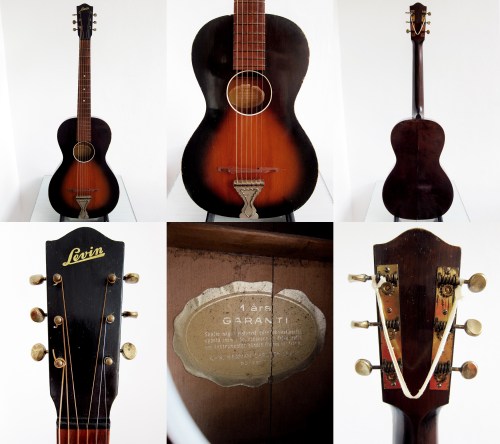
Levin Model 65 parlour guitar Made in Sweden 1942

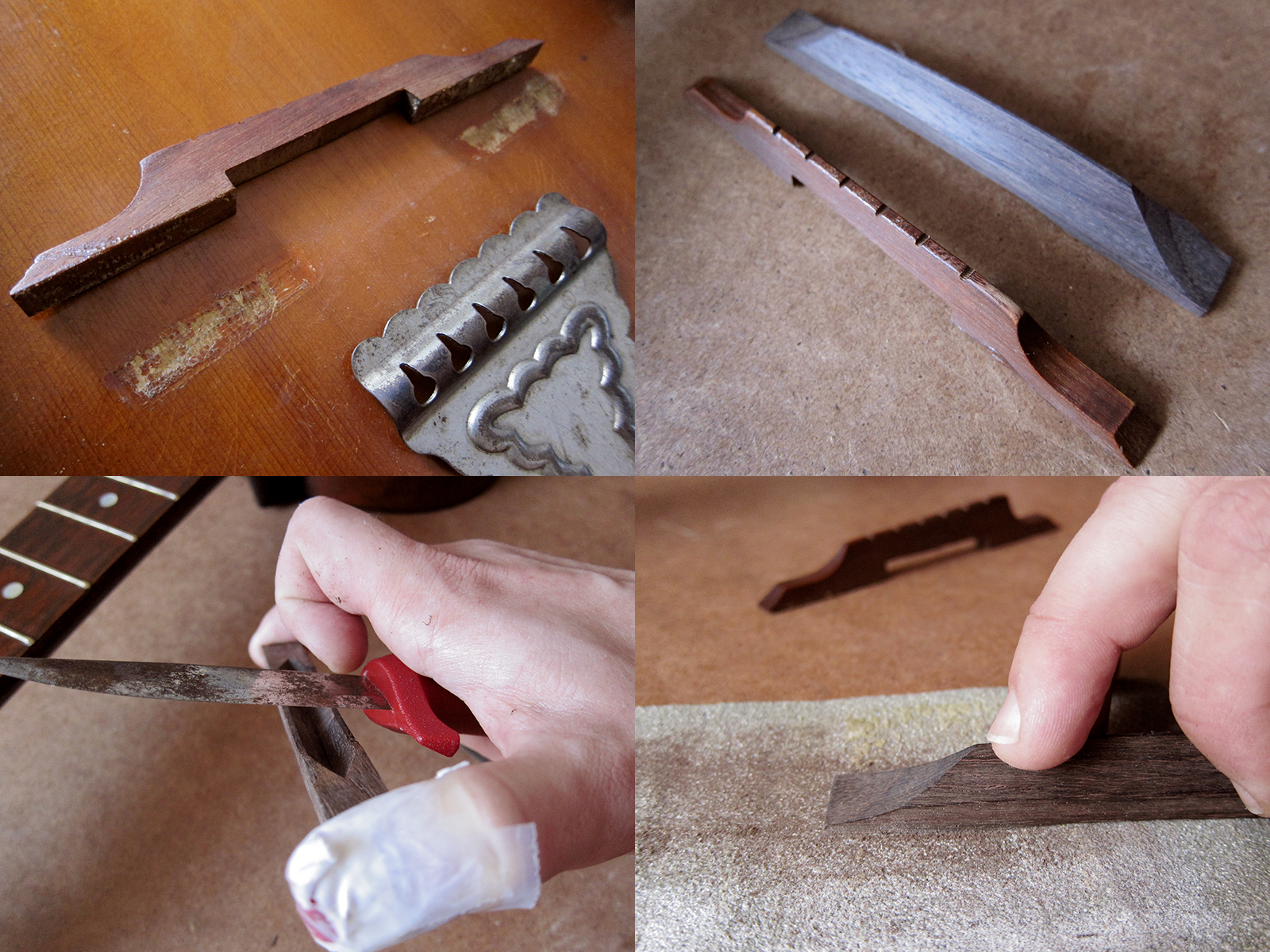
Last weekend I decided to try to improve the playability a bit on my little parlour Levin model 65 from 1942. It doesn’t have an adjustable trussrod, few guitars did before the 1960’s, and would probably benefit from a neck reset but I thought I should start with the easy things first. Like making a new bridge that is a bit lower and that way get the action down and it worked really well. The easiest would have been to just file down the original bridge but I felt I rather make a new one than mess with the old one.

Update: July 31, 2014
I actually carved a new bridge from scratch, you can read about it here: How to… carve a bridge, that worked out ten times better.

Levin Model 65 parlour guitar Made in Sweden 1942

Levin Model 65
Body width: 315 mm
Spruce top, birch back and sides.
Unbound top, back and headstock.
Unbound walnut fingerboard with mother-of-pearl dot inlay
Rosewood bridge, brass tuners, nickel plated tailpiece
Dark brown finished neck, back & sides.
Sunburst finished top and one year warranty

Levin Model 65 parlour guitar Made in Sweden 1942
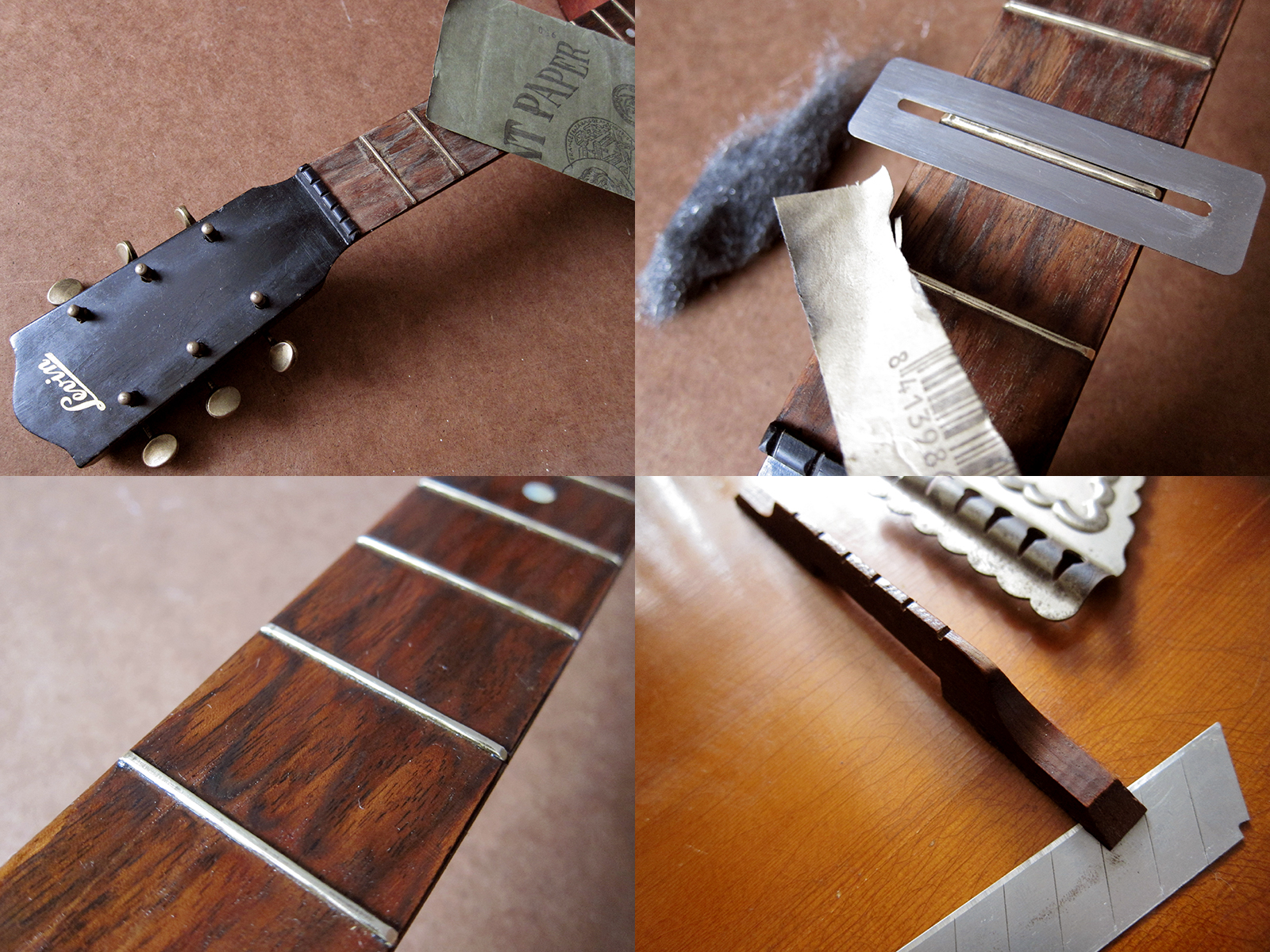
Since the strings were off I thought I mights as well even out the fretboard a bit and polish the frets. I cleaned the edges of the frets with a toothbrush and then oiled up the fretboard with lemon oil. I managed to cut through the old glue with a razor blade and that way get the old bridge off.

Levin Model 65 parlour guitar Made in Sweden 1942
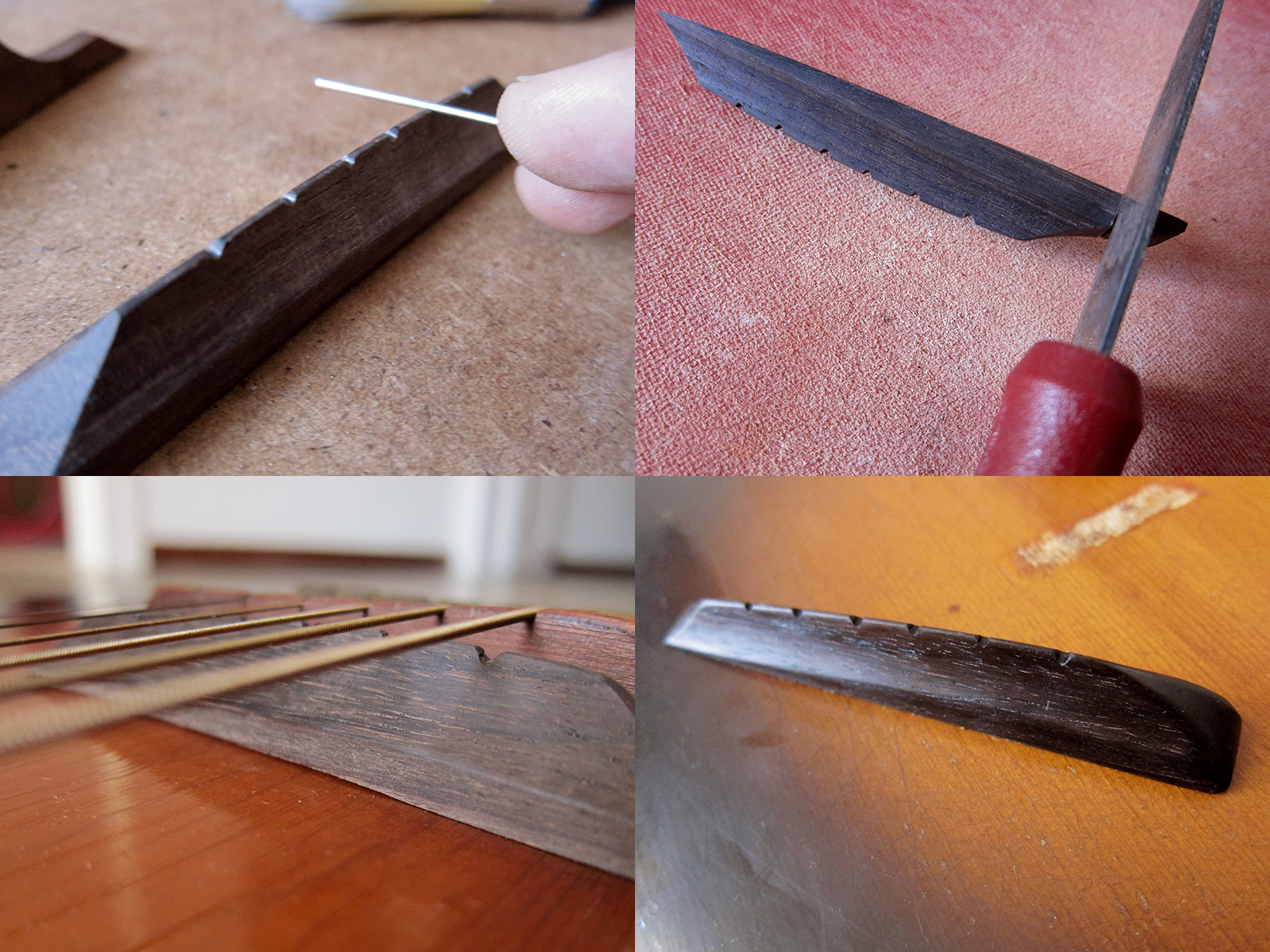
I think this bridge has been re-glued a couple of times since 1942 and that’s why some of the nitro lacquer came off. It’s hard to tell, it might have looked like that for 60 years under the bridge, who knows. Either way there isn’t much to do about it so I will just try to ignore it for now. If I can’t stand it I can always put the original bridge back. I got a cheap replacement rosewood bridge from eBay, straight from China for 3.50€. Now I just had to get the angle right, Levin always has their floating bridges in an angle, maybe it’s the same for all floating bridges. I copied the old bridge to get the angle right and started to make it as low as possible. Of course I cut my thumb after about 12 sec and had to rethink my methods of getting the bridge lower. In the end it was a combination of knife, a Swedish Morakniv of course, and sandpaper before I oiled it up with lemon oil to get it dark and nice. I read on Swedish forum that a great trick to get this parlour guitars to sound less jangly or rattly is to mute the tail piece. Apparently the main reason why these small bodied guitars sound like they do is because of the rattling tail piece. I muted mine with half a black sock that I tucked in so you can’t see it and it really made wonders to the sound. It’s a lot warmer and more woody now.

Levin Model 65 parlour guitar Made in Sweden 1942
I copied the string spacing from the old bridge, made a notch with a knife and then filed it down with folded fine sandpaper and a round file. I also realised that since I had to take so much off in the bottom on the high E side, the bridge looked really unbalanced so I cut of a chunk on the other side and rounded off all the edges to try to create a nice looking bridge.


Hondo II P-bass

Hondo II P-bass

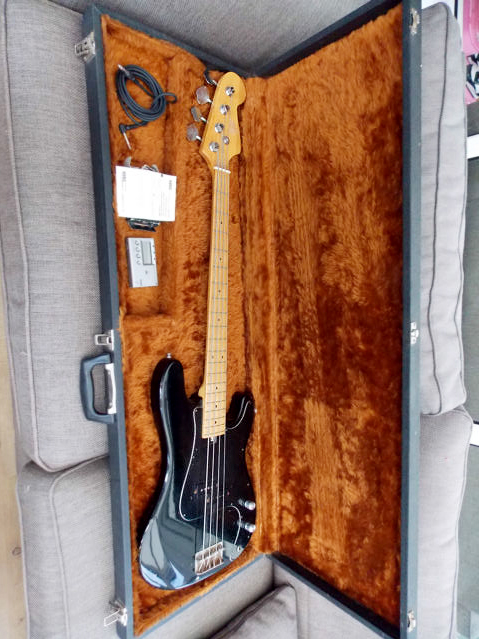
I just bought another Hondo II P-bass on eBay, this time for my work colleague Verushka from the Barcelona based punk band Sect. The listing stated that the bass was untested so hopefully it doesn’t work and I got a lot of work to do before it’s ready to be played. Dani is selling his Hondo II but Verushka and I decided that black was more her and then we found this beauty.

Hobbs Music P-bass

Hobbs Music
Dani has decided to put the Hobbit up for sale. It’s a really nice bass that I helped him to fix up, more about that here.