Claescaster

Tag: acoustic guitars

How to… Repair lacquer damage

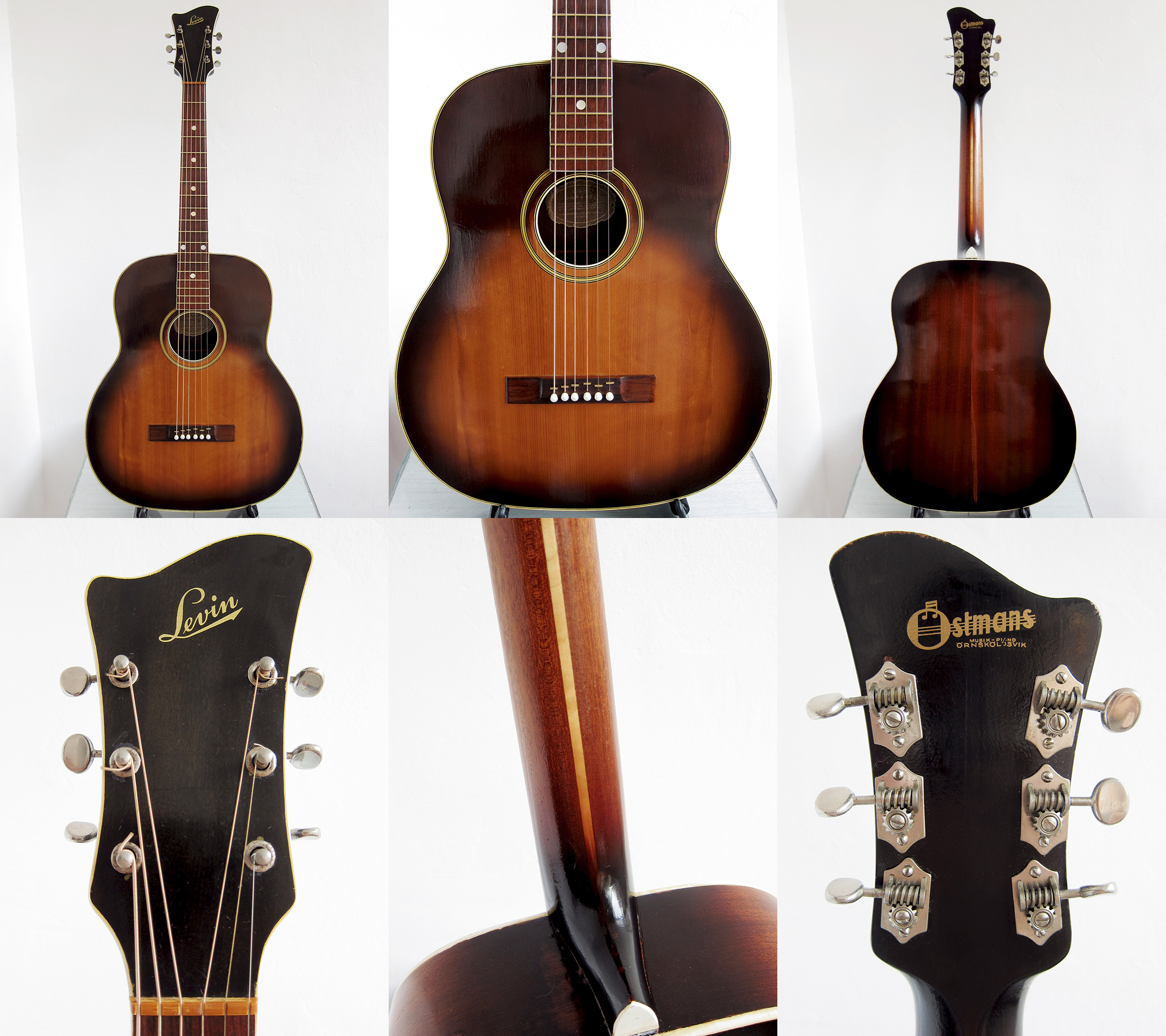
I really like worn guitars, well it’s hard to avoid when most of my guitars are 30-40 years old, the oldest guitar I got is my little Levin from 1942. However, there is one thing that I can’t stand, marks and dents on the back of the neck. Some little imperfection that you feel every time you move you hand up and down the neck. I’m not sure if it’s related to my slight OCD but it annoys me so much that I tend not to play any of my guitars that doesn’t have perfect smooth necks. The worst used to be my Greco Les Paul, it had a dent in the neck and I complained so much when I bought that I actually got it cheaper. When I received my Goya T-18 and my Morris W-40 and realised that they both had really bad marks on the back of the neck I just wanted to cry. Then I thought about it and came to the conclusion that I can’t be the only one that has issues with this, so I checked some Youtube videos to learn how to fix it and then ordered everything I needed. It’s actually really easy to fix yourself, well as soon as you find good lacquer and sandpaper with a grit fine enough, that turned out to be impossible around here. I managed to find a eBay seller that sold Nitrocellulose lacquer fairly cheap and was willing to ship to Spain. The sandpaper I had to order from China, I couldn’t find anything finer than 800 in Barcelona. After a months waiting and some feeble practice runs on less loved guitars I was finally ready to try to fix all dents, marks and imperfections on the back of my guitar necks. It went really well, or as well as it could with just 2500 grit, ideally I would have liked to have something much finer for really getting the shine back, especially on flat surfaces like bodies, the necks looked pretty good anyway.

Repairing lacquer damage on guitar
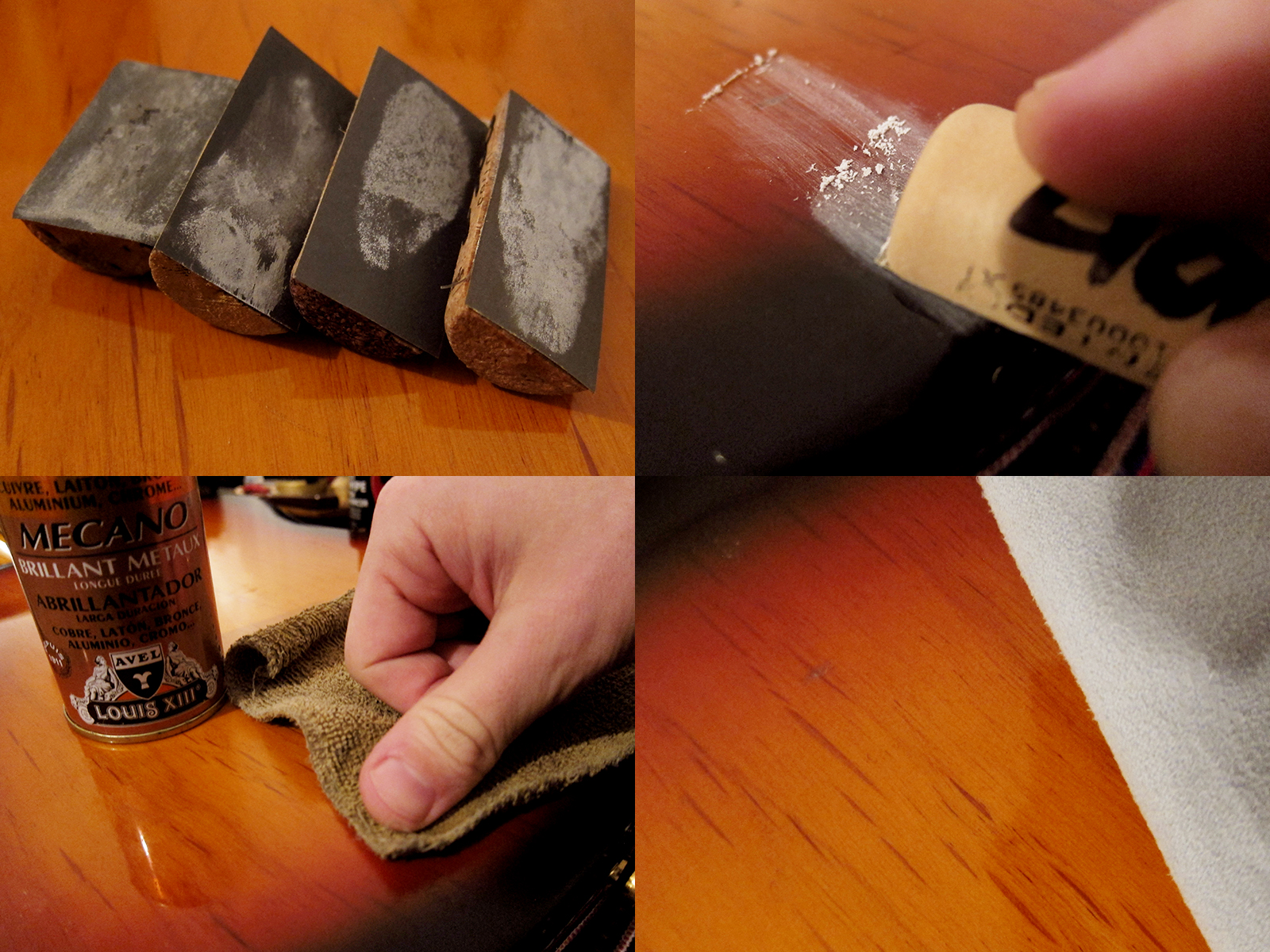
Before I started on any necks I decided to practice on the fairly roadworn body of my old Claescaster. The sandpaper I ordered from eBay came in 1500, 2000, 2500 grit and actually turned out to be made in Japan. I cut wine corks in half and glued sandpaper strips to them to get a straight sanding surface, remember to mark the grit on them otherwise it gets a bit confusing. Next step, apply the lacquer. It dries pretty fast, about 10 min, which is good because you normally need to apply lacquer more than once to really fill the dents. When it’s dry just cut off the access with a razor blade until the surface feels smooth. It’s good to tape around the blade, not only to avoid cutting yourself, but also to not scratch the surrounding surfaces.
Repairing lacquer damage on guitar
Remember to dip the sandpaper in water before you start sanding, you can really feel the difference especially with the finer grits. I used 400, 800, 1500, 2000 and 2500 grit on my little wine cork sanding blocks. I would have loved to have something even finer. I tried everything I could think of that could have a bit of sanding effect but was finer than 2500 grit. Pencil eraser, sponges, different cloths, in the end I rubbed really hard with metal polish which seemed to work a bit. As a last step I applied a bit of Carnauba wax and a lot of elbow grease and then buffed it up with a fine microfiber cloth.
Repairing lacquer damage on guitar
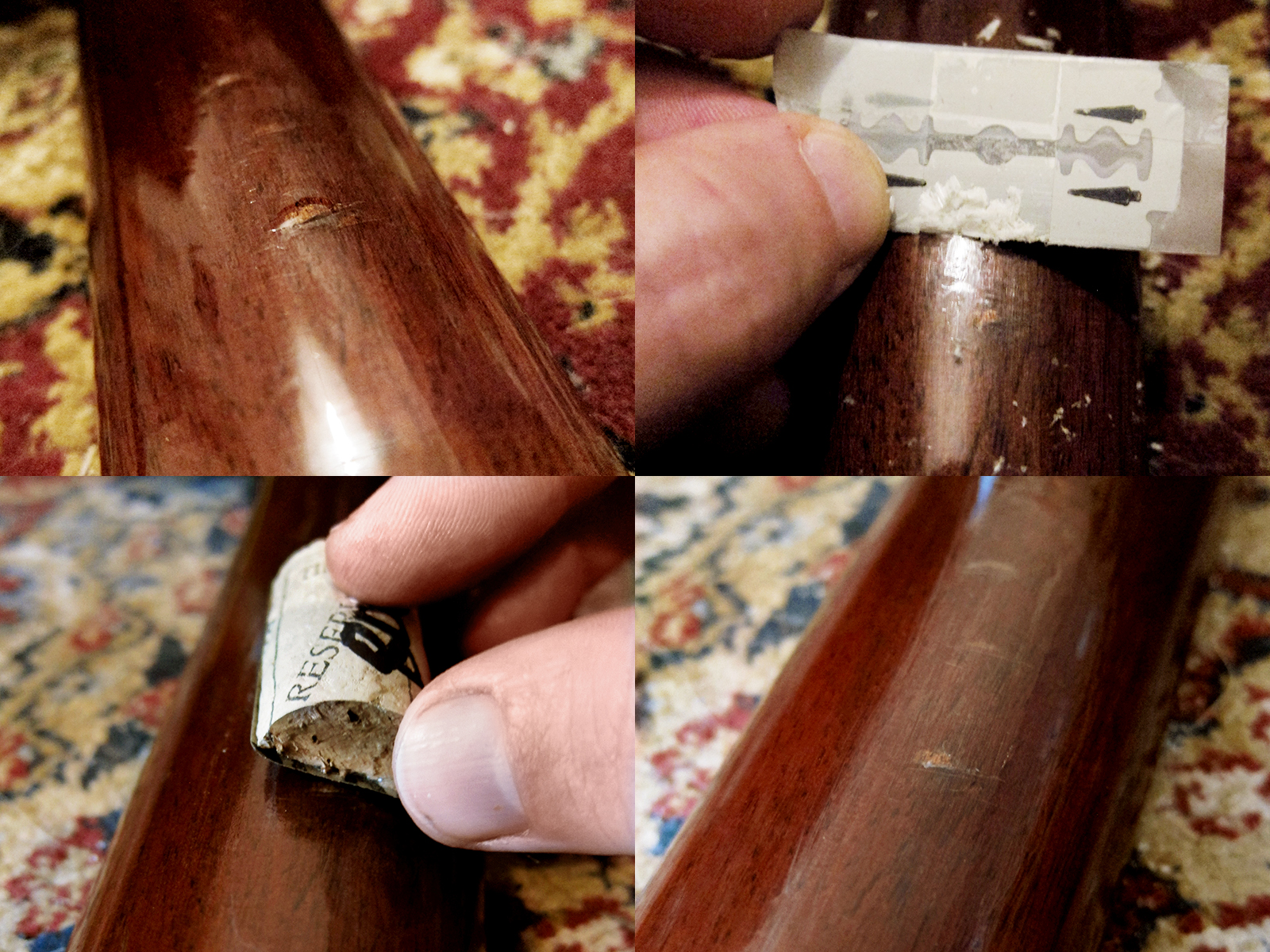
This is the back of the neck of my Morris W-40. The seller didn’t even bother to mention that it had deep cuts in the neck. This took quite a few fills with lacquer to even out the dents but in the end it worked pretty well. You can still see a slight colour change but you can’t feel the dents, which was the main thing for me. The last photo is not of the final polished result, it’s in the middle of sanding, I forgot to take a picture when I was done. I’m very happy with the result on all of the guitar necks I tried to fix. It was also a lot easier to get the sanding smooth and unnoticeable on the back of a neck compared to a guitar body.

Morris

Morris WL-35 and Morris W-40
1970’s Morris WL-35 and a 1973 Morris W-40

I’m still trying to figure out what I like and what I’m after when it comes to acoustic guitars. It’s a quite new thing for me, to play acoustic. I mentioned in an earlier post that it’s a bit like understanding and appreciating fine wine, you need to train your pallet and know what you are looking for, otherwise wine just taste like wine and acoustic guitars sounds more or less drang drang. I’m not sure if all Morris are as good as the two I got but these sounds better than pretty much anything I have ever heard before. I love the look of the Morris W-40 but it’s not as well sounding as the WL-35. I guess the W-40 has that typical Martin D-45 sound, a really dark bass and still nice highs, but a bit weak on the treble side for me. It’s not that good for finger picking, it’s lacking a bit of volume on the high E and B string, something that might be because of the light string gauge, I’m using 11’s at the moment. I’m going to string it with 12’s and see if the volume improve. The Morris W-40 still has one of the best sounds for open chords playing that I’ve ever heard, so much warmth and body, I guess because of the Brazilian rosewood. The Morris WL-35 is probably a better all-round guitar, finger picking, chords, solo playing, everything sounds good on it. I’m just struggling a bit since it’s so big. I think it’s based on some old Guild model, at least the head looks very Guild inspired. Anyway, I can strongly recommend Morris as a brand to anyone looking for a good sounding high quality built Japan made acoustic.

Morris W-40 1973

Moridaira (Morris Guitars)
Founded in 1967 by Toshio “Mori” Moridaira, the Moridaira factory produced high-quality guitars, including the infamous Morris badged guitar. Moridaira also produced badged guitars for Hohner including Coronado, Futurama, H.S. Anderson, Lotus (some) and Sakai.

K. Yairi

K.Yairi YW-1000
The most beautiful Martin D-45 copies in the world, a 1976 K. Yairi YW-1000

I’m extremely happy with the two Morris I have and think that Terada is one of the better acoustic guitar builders in Japan. Having said that, I think everyone that is in to Japanese acoustics dream of owning a K. Yairi, at least I do. Unfortunately they are a bit too expensive for me, I’m sure they are worth it but you can get an old Martin, Gibson or Guild for that money. One thing that I really like with Yairi is that they use the year of the Emperor of Japan to determine the production year of their instruments, how awesome is that. See the list below.

http://youtu.be/ky56o9gBDR4
Good materials are hard to find so it’s better to make guitars through limited production by hand instead of mass production. Trees are very important “precious” things so we should make good use of them. Guitars made with “heart” are the best use of trees.  Kazuo Yairi

When was my Yairi made?
By reading the number stamped on the heel block of your Yairi, you can tell in which year it was made. The first two numbers correspond to the year of the Emperor of Japan at that time, see chart below. The second two numbers refer to the month of production. Taken from The Fellowship of Acoustics

A.D.       Emperor                Year
1970      Shōwa                    45
1971                                      46
1972                                      47
1973                                      48
1974                                      49
1975                                      50
1976                                      51
1977                                      52
1978                                      53
1979                                      54
1980                                      55
1981                                      56
1982                                      57
1983                                      58
1984                                      59
1985                                      60
1986                                      61
1987                                      62
1988                                      63
1989       Heisei                    1
1990                                      2
1991                                      3
1992                                      4
1993                                      5
1994                                      6
1995                                      7
1996                                      8
1997                                      9
1998                                      10
1999                                      11
2000                                      12
End of Emperor Date Code
2001                                       01
2002                                       02
2003                                       03
2004                                       04
etc.

Emperor Shōwa and future Emperor Heisei on 10 April 1959

Lowden guitars

I’m not a huge fan of the look of the Lowden guitars, a bit modern and fat looking for me, but the sound is very impressive. Here are two clips where George Lowden talks about different tone woods which I found very interesting. It’s amazing how different combinations of wood can change the sound so much.

“Designing and building guitars is a matter of the wood choice first, the design second and the workmanship third. All woods give slightly different tonal responses and I will often advise players which might suit them best according to their playing style.” George Lowden


How to… fit a LR Baggs M1

Morris W-40 1973 My new Martin D-45 copy, a Morris W-40 Made in Japan by Terada in 1973

There was a bit of work that needed to be done when I first got my Morris W-40. First of all I polished the frets, cleaned her up and oiled the fretboard. Then I needed to take care of the action which was too low, imagine that on an acoustic guitar. There was a slight forward-bow on the neck which made a bit of rattle when I played solos in the middle of the neck, at least when I hit the strings hard. I adjusted the trussrod and gave her a slight bow the other way, meaning that cowboy chords still sound beautiful and the action is still very low for being an acoustic around the 12th fret. I changed the machine heads to a pair of Grover tulip copies in gold, maybe not the best ones but it looked so much nicer than the original plain ones in chrome. Then I fitted a strap button in gold, I can’t stand having to tie the strap to the head of the guitar. I’m still waiting for the Nitrocellulose lacquer I ordered so I can fill in the three dents on the back of the neck, which is going to be a new adventure since I have never done anything like it before. Last step was to fit my new L.R. Baggs M1 soundhole pickup. I’m getting pretty used to fit endpin jacks on acoustic guitars now so it was pretty straight forward even though it was a bit more hard work on this one. I’m not sure if it was because the wood is older, or the type of wood used in this, it’s Brazilian Rosewood and maple in the 3-piece back, Now it plays and sounds amazing, I’m really pleased with it.

Fitting LR Baggs M1
I prefer to fit the endpin jacks by hand, with a small round file and then even out the hole with sandpaper when it’s big enough

Morris W-40 1973
Morris W-40 1973

Morris W-40 Made in Japan by Terada in 1973, just look at that Brazilian Rosewood and maple 3-piece back

Hank Williams 1941 Martin D-28

Hank Williams 1941 Martin D-28 Neil Young

This Old Guitar – Hank Williams 1941 Martin D-28
A one hour radio program of an interview with Neil Young on CD called Companion contains extensive insight into Prairie Wind’s recording, as well as, much other interesting stuff. In the interview by JODY DENBERG, Neil is asked about the Martin guitar that belonged to Hank Williams.

NEIL YOUNG: Yeah. I bought it from, uh, uh, off a friend of mine Grant Boatwright put me together with, uh, this fellow Tut Taylor he had an old, uh, collection of guitars. And, uh, I went down there and there it was, and he took it out of the back and brought it out and I bought it. I couldn’t believe that I could buy it. That I, you know, but I did. And now I have it. And, you know, I’ve got it for a while and I’m taking care of it.

JODY DENBERG: But you’re generous with it. You’ve lent it to some of your friends?

NEIL YOUNG: You know, Bob Dylan was using my bus. He, he didn’t have his own tour bus yet. And he was just getting into using buses, and, uh, so I let him use mine and, uh, when I gave it to him I, I told him that, uh, Hank was in the back and that if he wanted to use Hank, that Hank would be there for him. And so I don’t know what he did with it, but he had it with him for a long time. And I don’t know what he wrote or what he did, but I know, you know, something must have happened back there. Taken from Bob Dylan’s gear

Hank Williams 1941 Martin D-28 Neil Young

Morris W-40

Morris W-40 1973
Morris W-40 1973

My new found love just arrived to the office, a 1973 Morris W-40. I have been looking for a Japan made Martin D-45 copy for a while and I’m really glad I went for a Morris. I have never played a guitar that sounds this good, amazing tone with really low action. She is a bit more worn than I expected, which doesn’t really bother me that much since the wood looks so good. I might put some gold tulip machine heads on her tonight, if my Gibson PMMH-025 fits. This Monday is just getting better and better. First I got to celebrate my girlfriends birthday, which meant getting up at 5.45 am and prepare breakfast in bed for her, and then I got this baby delivered and she arrived in one piece. Thank you Monday.

Martin D-45

Bob Dylan 1975 with A. Ginsberg playing a Martin D-45
Bob Dylan in 1975 with A. Ginsberg playing a Martin D-45

Neil Young Martin D-45
Neil Young in 1971 playing his Martin D-45 which was given to him by Stephen Stills in 1969

I just found my Japan made Martin D-45 copy that I was looking for, at least for now. I have managed to became the very proud owner of a 1973 Morris W-40, which is as close to a Martin D-45 that my budget could allow. Ideally I would have liked a Yairi YW- 1000 but they tend to go for 1000-2000€ so I had to settle for a Morris W-40. I’ve read a lot of good things about Morris, at least the ones made in the 1970’s so hopefully I will not only look like Neil Young, I will sound like him too, or maybe not. It doesn’t have the vertical logo, which is a shame but those tend to cost 500-600€ if you get one straight from Japan and are pretty rare here in Europe. Well at least it has hexagon mother of pearl inlays and the beautiful 3-part back with Brazilian rosewood and maple. Let’s see how good it sound and looks when it arrives next week. Here are some random photos I found of other Morris W-40.

Morris W-40
Some random Morris W-40 pictures I found online. Moridaira (Morris Guitars). Founded in 1967 by Toshio “Mori” Moridaira, the Moridaira factory produced high-quality guitars, including the infamous Morris badged guitar.

Levin Model 13 Ambassadör

Levin Model 13 Ambassadör Made in Sweden 1950

I have recently befriended Roger Häggström, a great luthier in Örnsköldsvik, Sweden. He is also the man behind my Levin Model 13 Ambassadör. It’s been great to hear from the man himself what he did to it to get it to play and feel so good. He created a new bridge and made new brass saddles to get it to intonate better, refretted it with brass frets, reset the neck, fixed up some cracks and touched up the lacquer. I think he did a great job, just look at it. I have so much things to learn but I’m really happy taking it one step at the time and who knows, maybe one day I will be as awesome as Roger. Here is his site GammelGura

Levin Model 13 Ambassadör
Body width: 400 mm, body length: 480 mm, scale length: 640 mm
Spruce top, walnut back and sides, 4-ply bound top, single-bound back
Mahogany neck with non-adjustable T-shaped duraluminum truss rod
Single-bound rosewood fingerboard with 18 frets and pearloid dot inlay
Single-bound headstock, rosewood bridge, nickel plated individual tuners
Sunburst finish and ten year warranty

Yamaha FX-310

Yamaha FX-310
An Indonesian made Yamaha FX-310 from the late 1990’s

My Art Director at work, the new proud owner of the White Falcon copy, asked me if I could bring his old Yamaha FX-310 back from the dead. There was a fair share of cleaning involved and then I tightened the screws and oiled the machine heads, polished the frets and oiled the fretboard and then I tried to correct the neck angle. I’m not sure if it was because the guitar has been without strings for so long and was missing the string tension but the action was so low that that everything just buzzed. I tried to correct the angle of the neck with the trussrod but it made no difference, it was as loose as it could be. I had to make the saddle higher but since it had the piezo pickup built in to the bottom of the saddle I couldn’t just change it for a new one. In the end I cut a matchstick in half and put under it, I guess bone or some other material would have been better for the tonal qualities but since they saddle was made of plastic anyway I don’t think it would have made any difference. It actually plays pretty well now and sounds really good for have been made in Indonesia. I’m not sure if all Yamaha’s sounds and plays this well but I was pretty impressed. When I started to play guitar 20 years ago a lot of my friends had Yamaha’s and other inexpensive Far East made acoustic guitars but I was fortunate enough to learn to play on my dad’s old Levin LT-16 so I never really tried any of these Yamaha’s back in the early 1990’s.