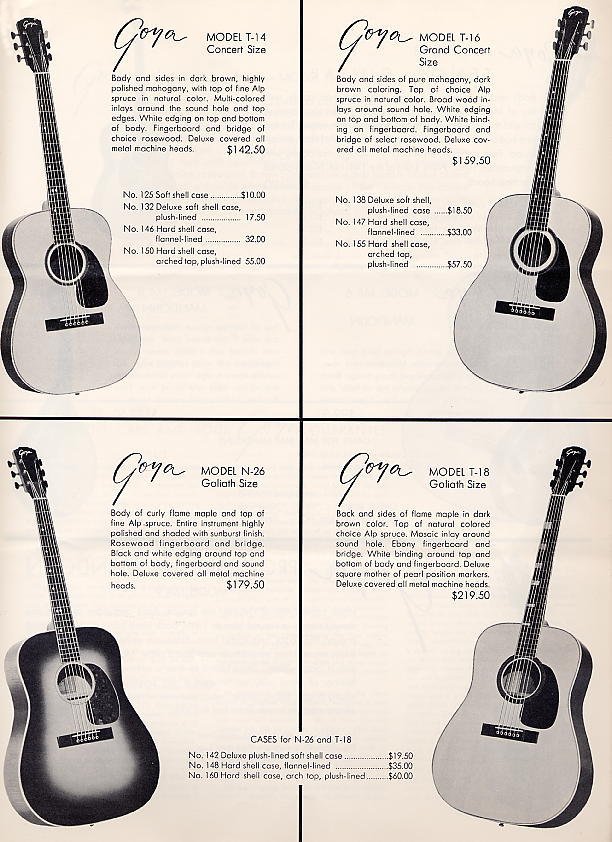
I’m very excited about my future Goya T-18 from 1966. I managed to find one in a fairly good state for a reasonable sum on eBay and couldn’t resist. I’ve decided that from now on I’m just buying Swedish made Levin acoustics, they were called Goya in the US. Since I haven’t received the guitar yet, it will probably spend a week or to in the customs office in Madrid, I have to stick to looking at old catalogues and dream. They have a review of a Goya T-18 from 1965 in the latest issue of Acoustic Guitar, under Great acoustics, 1965 Goya T-18 by Teja Gerken. I need to find a copy so I can get an idea of what I’ve got myself in to. It can’t be that different from my dad’s old Levin LT-16 also from 1966, which is among the best acoustic guitars I’ve ever played. The Levin LT-16 or Goya T-16, has alp spruce top and mahogany back and sides while the Levin LT-18 or Goya T-18, has alp spruce top and flame maple back and sides. The LT-18/T-18’s Goliath size is also a bit bigger than LT-16/T-16’s Grand Concert size so let’s see how the size in combination with maple instead of mahogany affects the sound. The LT-18/T-18The LT-18/T-18 was top of the line in the mid Sixties and cost $219.50 new in 1965.
Levin’s Goya catalogue from 1965. Next I will have to find a Goya N-26 or Goya N-22 in sunburst from the mid 1960’s.
Last weekend I decided to try to improve the playability a bit on my little parlour Levin model 65 from 1942. It doesn’t have an adjustable trussrod, few guitars did before the 1960’s, and would probably benefit from a neck reset but I thought I should start with the easy things first. Like making a new bridge that is a bit lower and that way get the action down and it worked really well. The easiest would have been to just file down the original bridge but I felt I rather make a new one than mess with the old one.
Update: July 31, 2014 I actually carved a new bridge from scratch, you can read about it here: How to… carve a bridge, that worked out ten times better.
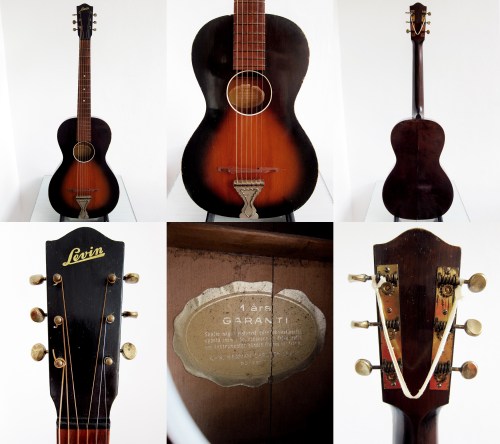
Levin Model 65
Body width: 315 mm
Spruce top, birch back and sides.
Unbound top, back and headstock.
Unbound walnut fingerboard with mother-of-pearl dot inlay
Rosewood bridge, brass tuners, nickel plated tailpiece
Dark brown finished neck, back & sides.
Sunburst finished top and one year warranty
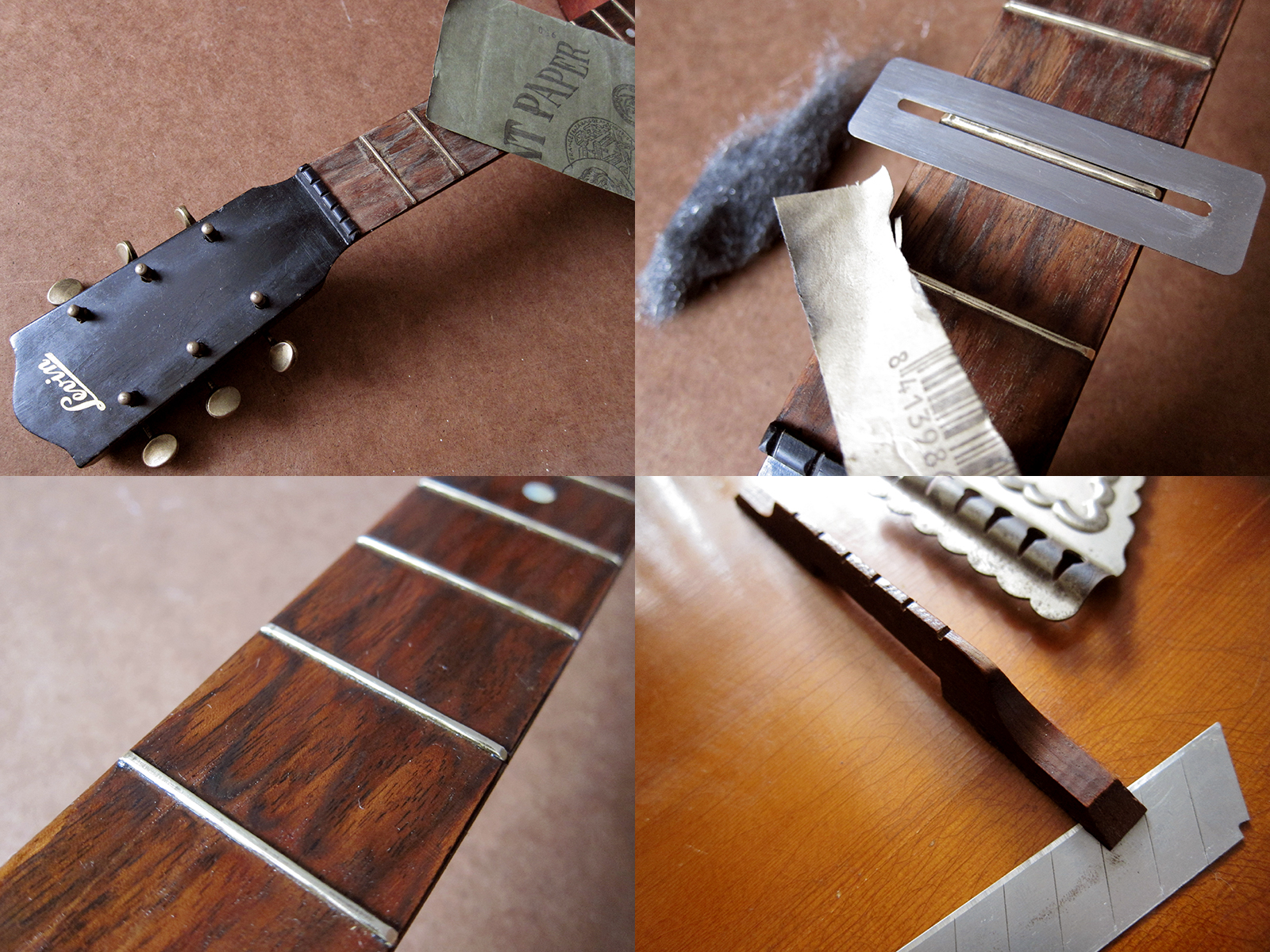
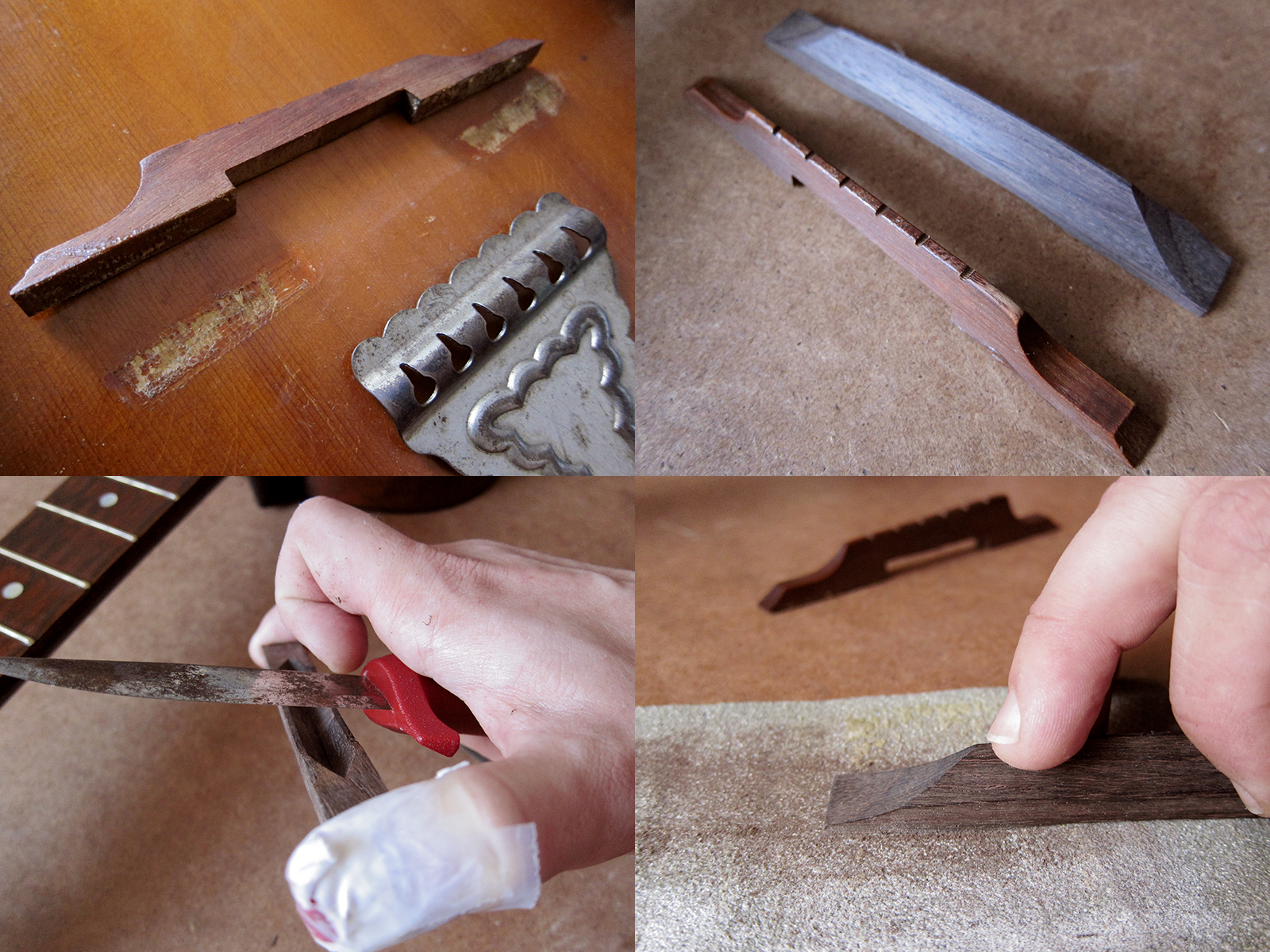
Since the strings were off I thought I mights as well even out the fretboard a bit and polish the frets. I cleaned the edges of the frets with a toothbrush and then oiled up the fretboard with lemon oil. I managed to cut through the old glue with a razor blade and that way get the old bridge off.
I think this bridge has been re-glued a couple of times since 1942 and that’s why some of the nitro lacquer came off. It’s hard to tell, it might have looked like that for 60 years under the bridge, who knows. Either way there isn’t much to do about it so I will just try to ignore it for now. If I can’t stand it I can always put the original bridge back. I got a cheap replacement rosewood bridge from eBay, straight from China for 3.50€. Now I just had to get the angle right, Levin always has their floating bridges in an angle, maybe it’s the same for all floating bridges. I copied the old bridge to get the angle right and started to make it as low as possible. Of course I cut my thumb after about 12 sec and had to rethink my methods of getting the bridge lower. In the end it was a combination of knife, a Swedish Morakniv of course, and sandpaper before I oiled it up with lemon oil to get it dark and nice. I read on Swedish forum that a great trick to get this parlour guitars to sound less jangly or rattly is to mute the tail piece. Apparently the main reason why these small bodied guitars sound like they do is because of the rattling tail piece. I muted mine with half a black sock that I tucked in so you can’t see it and it really made wonders to the sound. It’s a lot warmer and more woody now.
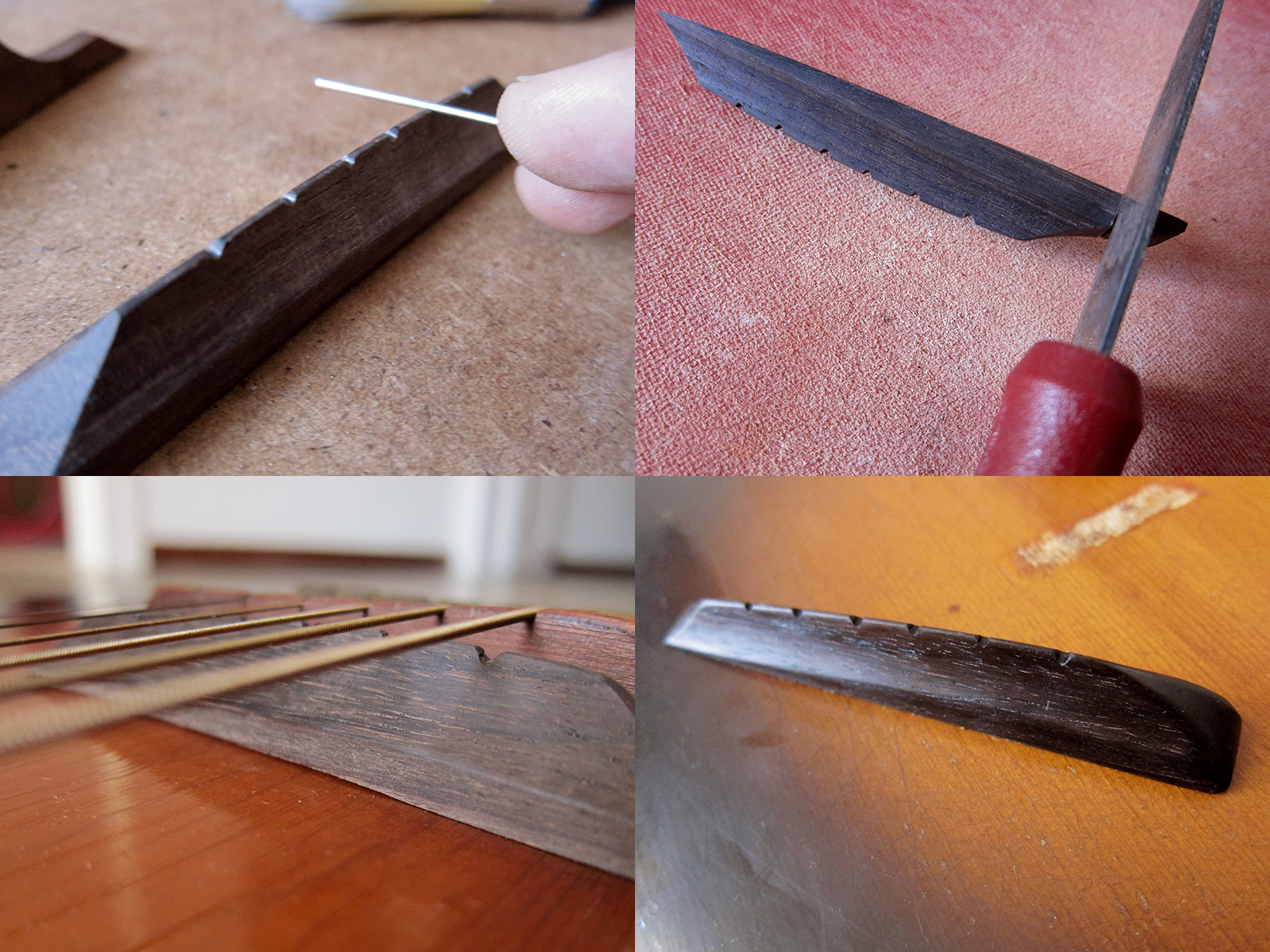
I copied the string spacing from the old bridge, made a notch with a knife and then filed it down with folded fine sandpaper and a round file. I also realised that since I had to take so much off in the bottom on the high E side, the bridge looked really unbalanced so I cut of a chunk on the other side and rounded off all the edges to try to create a nice looking bridge.
I’m after a Japan made Martin D42/D45 copy. If anyone happens to see one for sale, please let me know. It doesn’t have to be a Alvarez or Yairi, Morris, Mountain, Suzuki, Aria and pretty much anything else would do as long as it’s made in Japan in the 1970’s or early 1980’s. However, it has to have the hexagon inlays and binding around the top and soundhole.
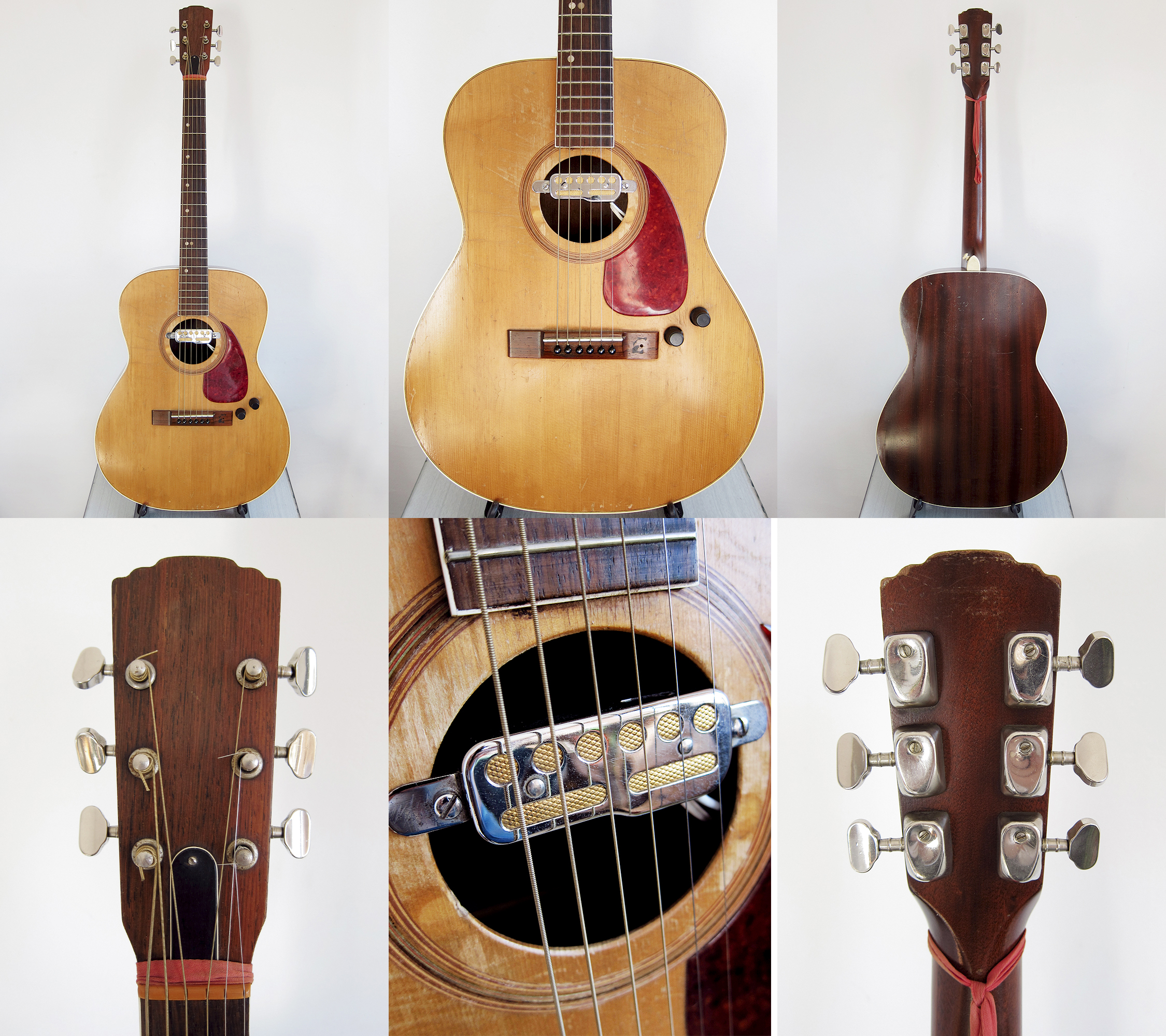
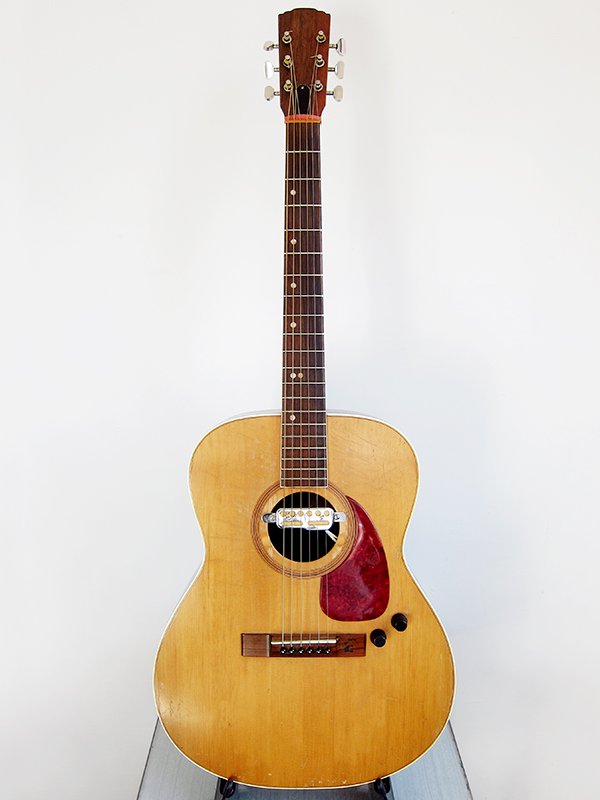
When I grew up back in Sweden we always had this old acoustic guitar standing in a corner. It was from my father and I never knew what make it was or how old it could be, my mum just told me that my dad bought it second hand in the early Seventies. Someone had sanded off the name on the headstock and taken off the sticker inside before my dad had bought it. I learned to play on this guitar and it’s still one of my favourites because of the thin neck and slightly smaller body. I recently had an epiphany and found out what guitar it is. About a month ago my girlfriend and I was watching a film and suddenly I got this weird feeling that I actually knew what make my dad’s acoustic guitar is, I recognised the head shape. I was convinced, it’s an old Levin. I have always thought that it was a Japanese guitar since the pickup looks like one of those Japanese gold foil pickups from the Sixties. I stopped the film and started to search for Sixties Levin guitars and managed to find a very similar one in a vintage guitar shop in Stockholm. I found some more info on the model and now even the serial number on top of the head made sense. It is a Levin LT-16 made in Göteborg, Sweden in 1966. The nickel plated individual Van Gent tuners with metal buttons can be found on Hagström guitars from this time as well. I wish that we would have taken better care of it over the years and that I wouldn’t have been so hard with the pic when I first learned to play but at least now after more than four decades of family confusion we know what it is. It’s a Swedish Levin.
Levin LT-16 / Goya T-16 Grand Concert size: Body width: 380 mm, body length: 480 mm, body depth: 98 mm
Fingerboard width: 43 mm, scale length: 630 mm
Spruce top, mahogany back and sides, 4-ply bound top, single-bound back
Mahogany bolt-on neck with adjustable truss rod
Single-bound rosewood fingerboard with bass side pearloid dot inlay.
Rosewood bridge, nickel plated individual Van Gent tuners with metal buttons
Matte natural finish and ten year warranty




 Claescaster