Claescaster

Category: Made in USA

Gibson J-45 / J-50

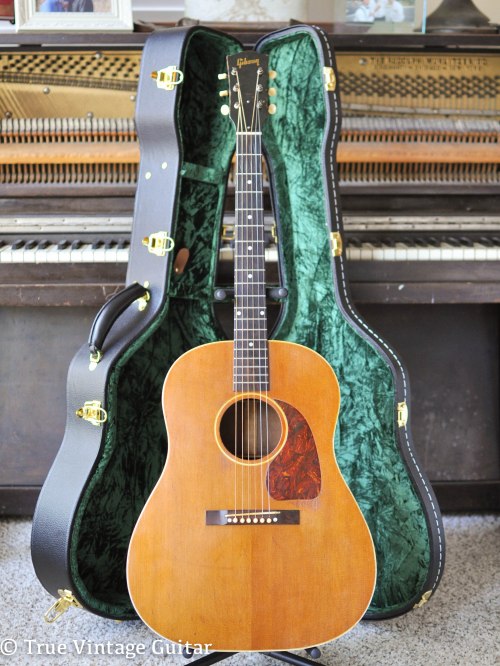
originalMy new dream guitar, an old Gibson J-50

A year ago when I started to buy acoustic guitars I had no idea what the difference between a Gibson or Martin was or how different body shapes, models and tone woods affected the sound. I could easily have told you who was playing a Telecaster, Stratocaster or Les Paul while listening to a song but I could never have told you if someone was playing an acoustic Gibson, Guild or Martin. Over the year I have added 6 Levin guitars to my collection and 5 Japanese acoustics, two of them sold by now, and played a lot of new made Chinese and Korean guitars and I have come to following conclusion. My favourite acoustic guitar is an old Gibson J-45. This is nothing new, I realised that last summer after seeing Kris Kristofferson, I did a post about it with some great acoustic guitar demo’s to prove my point. There is something very special with the old Gibson Jumbos, it doesn’t really matter if it’s a J-45, J-50, Southern Jumbo or Advanced Jumbo, they all have that special booming bass sound. If you listen to any acoustic Jackson Browne, early James Taylor or even Bob Dylan you will understand what I mean straight away. There was a lot of Country players that favoured this sound before the singer and songwriters of the Sixties and Seventies. Two modern examples that I really like is Gillian Welch and Daniel Romano, he is actually playing something more modern like a Gospel but the bass is still there. If you listen to Dan Tyminski and hear his 1946 Martin D-28 I’m sure you would want a wartime Martin straight away but still, there is something special with the Gibson Jumbo sound. I’m not even sure if I would prefer a Gibson J-45 or a J-50, actually I really like the Southern Jumbo too with their fretboard inlays, so I guess as long as it’s old, worn and sounds like a Gibson Jumbo I would be happy. I mentioned earlier that I recently ordered a 1977 K.Yairi TG-40, which I have very high hopes for. I bought it straight from Japan and unfortunately it got stuck in the Spanish customs and has been there since the 12th of April. The Yairi TG-40 is a Guild D-40 copy, which was introduced in the Sixties as a competitor to Gibson’s J-45. The Guild D-40 became famous as the Bluegrass guitar for their even response over all the strings and I really like the sound of them, it’s actually not too far off from a Sixties Gibson J-45. With a bit of luck the customs will release my guitar soon and with even more luck it’s going to be an awesome Yairi copy of an Guild which might sound a bit like a Gibson.

Bob Dylan Gibson J-50
Bob Dylan with his worn old Gibson J-50 in the early Sixties. The Gibson J-45 and J-50 is more or less the same guitar, it was just that they used nicer looking wood for the soundboard on the J-50 so they wouldn’t have to paint it in sunburst to cover up any imperfections.

Enjoy the sound of James Taylor’s Gibson J-50
Ad of the day

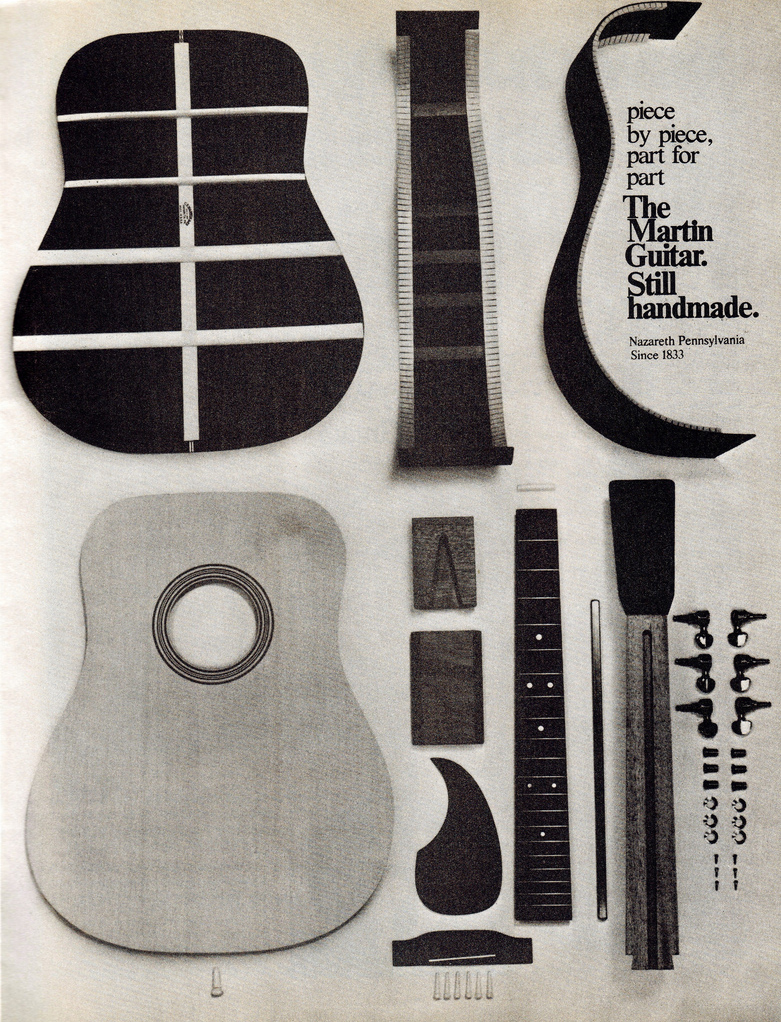
Martin guitar ad from Guitar Player Magazine, September 1974
Martin guitar ad from Guitar Player Magazine, September 1974. I love how few parts an acoustic guitar has.

Fender Factory Tour 1959

Fender Fullerton Factory 1959
The Fender Fullerton Plant at 500 South Raymond Avenue in 1959

After including a tour of the K. Yairi factory yesterday I came to think of a video I saw about a year ago, a tour of the Fender Fullerton plant in 1959. Enjoy!

1959 8mm Film by Forrest White. Digital Film Restoration by CinePost http://www.posthouse.com Edited by Ross Lenenski. Read the story behind this film in “Fender: The Inside Story,” by Forrest White available at Amazon: http://www.amazon.com/Fender-Inside-S… Music by Russell Eldridge

Paul Bigsby

Paul Bigsby
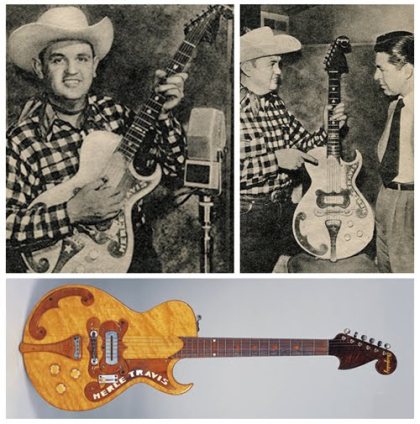
Paul Bigsby died on June 7, 1968. While most guitarists know him because of his wildly popular Bigsby vibrato, most are not aware that Bigsby is widely considered to have crafted the first true solidbody electric guitar. Bigsby was a motorcycle mechanic during the 1940s in Southern California. He became friends with noted country star Merle Travis when the two met at a motorcycle racetrack. Travis discovered that Bigsby was a notorious tinkerer, and asked Paul if he could fix a vibrato tailpiece on a Gibson L-10. Bigsby ended up replacing the vibrato with a better one of his own design. Travis then asked Bigsby in 1946 if he could build an entire electric guitar, complete with pickups that wouldn’t feed back. Using a design from Travis, Paul created what may have been the first solidbody electric guitar. The guitar had a single cutaway and a headstock that featured all the tuning pegs on one side instead of the standard three per side arrangement. This was similar to a design used a centrury before by German luthier Johann Stauffer. It would later show up in a very similar form on the Fender Stratocaster.
Taken from National Guitar Museum

Merle Travis Paul Bigsby guitar
Merle Travis guitar built by Paul Bigsby in 1946, the first guitar that Bigsby built

THE STORY OF PAUL BIGSBY - FATHER OF THE MODERN ELECTRIC SOLIDBODY GUITAR by Andy Babiuk
If you want to read more about Paul Bigsby there is plenty of info at Premier Guitar, or you can by the book.

Update: December 18th 2014, I just found this pretty cool video about Paul Bigsby’s third guitar he built in 1949 for “Butterball” Paige

Randy Parsons

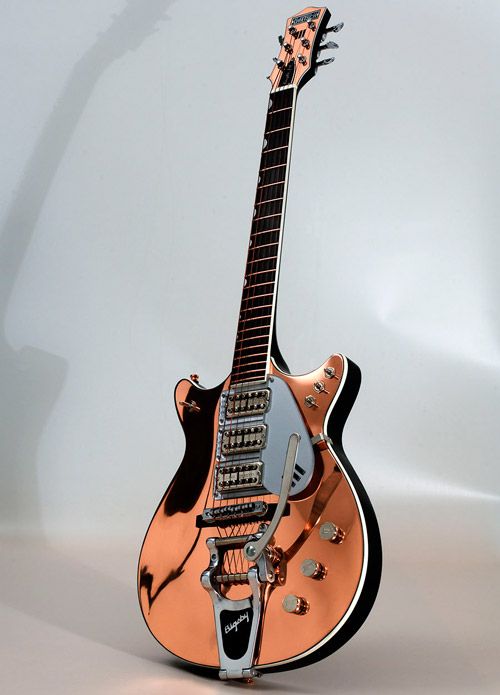
randy-parson-triple-jet
The Triple Jet with a copper top, built for Jack White in 2006 by Randy Parson

Randy Parsons is an awesome luthier, he is the man behind Jack White’s guitars. I’ve been reading a bit about him and he seems to have a really nice approach to guitar building. Here is a nice article from Premier Guitar.

Jack White’s Parsons Red Vampire
Jack White’s Parsons Red Vampire with cow skull bracing, TV Jones pickups, built-in MXR Micro Amp pedal, and African bloodwood/holly neck are hallmarks of luthier Randy Parsons’ macabre creation for the equally macabre Jack White.

Jack White with Parsons Green Machine from It might get loud
Jack White with Parsons The Green Machine from the 2008 documentary It Might Get Loud.

Ernie Ball Slinky Acoustic

Ernie Ball Super Slinky 11-52

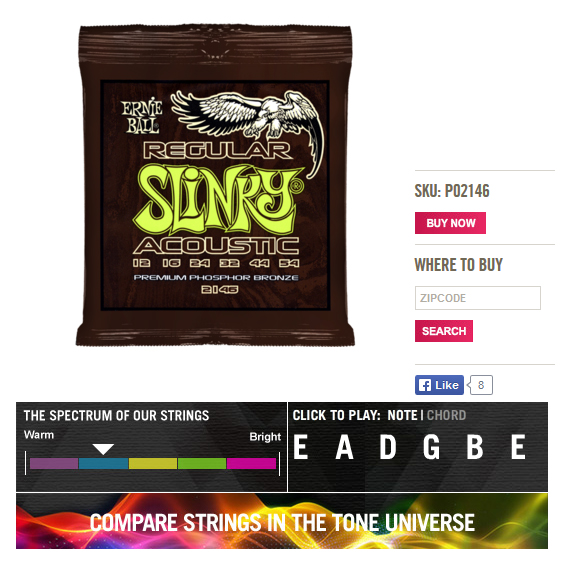
I have recently started to use Ernie Ball strings for my acoustic guitars as well, I mentioned in a previous post about guitar strings that I now solely use Ernie Ball Regular Slinky 10-46 for my electric guitars. I still find it hard to know what to choose, I mean you can’t buy all the strings on the market and try them one by one, or I guess you can but it would cost quite a lot. On top of that, you can’t even have different strings on different guitars and that way hear the difference, unless you have a lot of guitars that sound very similar but I don’t. What I like with Ernie Ball is that they have nice tone and still doesn’t feel stiff, or too flimsy for that matter. I also like that you can listen to how the different strings sound on their website, I found that quite useful when I decided between their Earthwood strings and their Acoustic Slinky. I have only used them for a couple of weeks but so far I really like them, they sound a lot better than the cheap Martin strings I used before. I hope I don’t change my mind because I just bought 12 sets from an eBay seller in the US, 6 sets of  Ernie Ball’s Acoustic Slinky Phosphor Bronze 011 for Araceli and 6 sets of 012 for me.

Ernie Ball Regular Slinky 12-54

Gibson Walnut SG Standard

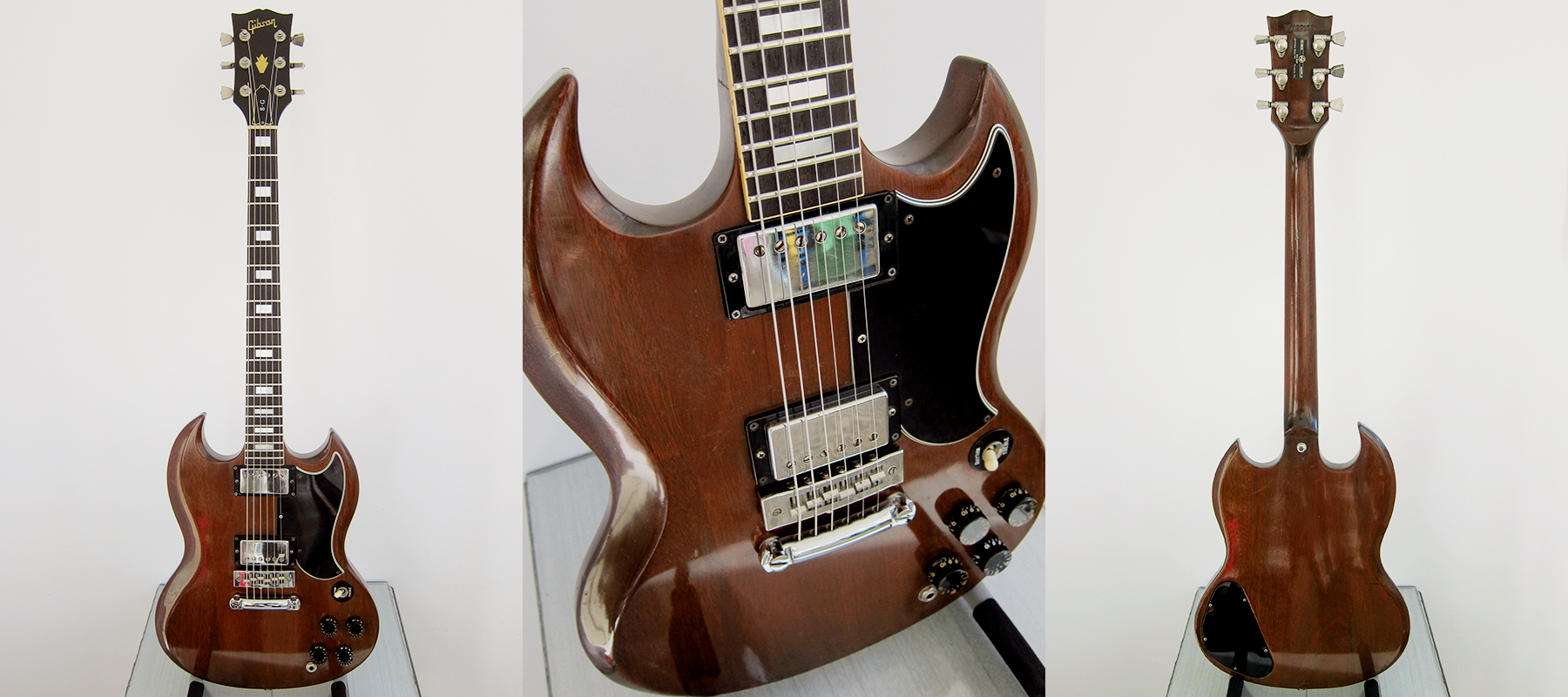
1977 Gibson Walnut SG Standard
1977 Gibson Walnut SG StandardGibson Walnut SG Standard made in Kalamazoo, USA in 1977

I recently had the pleasure of having an awesome 1977 Gibson Walnut SG Standard at home to play with. Well the idea was to look over the electronics and make sure it was fit to gig with for Patrycja, a friend of Verushka that I sorted the Hondo II bass for. According to The Guitar Dater Project it was made at the Kalamazoo Plant, USA on December 15th 1977, production number 103. It was great that I got a chance to play around with a Gibson Walnut SG Standard from the Seventies, that’s exactly what I was tempted to get myself, see my previous post about Gibson SG. Luckily I tried one before I bought one and I realised straight away that I still prefer Telecasters, SGs have too much neck for me. It was interesting to try a 1970’s Gibson made in USA just to compare it to all the made in Japan copies in my collection. I have to say that the feel and quality of the Japanese guitars are right up there with the American originals.

1977 Gibson Walnut SG Standard
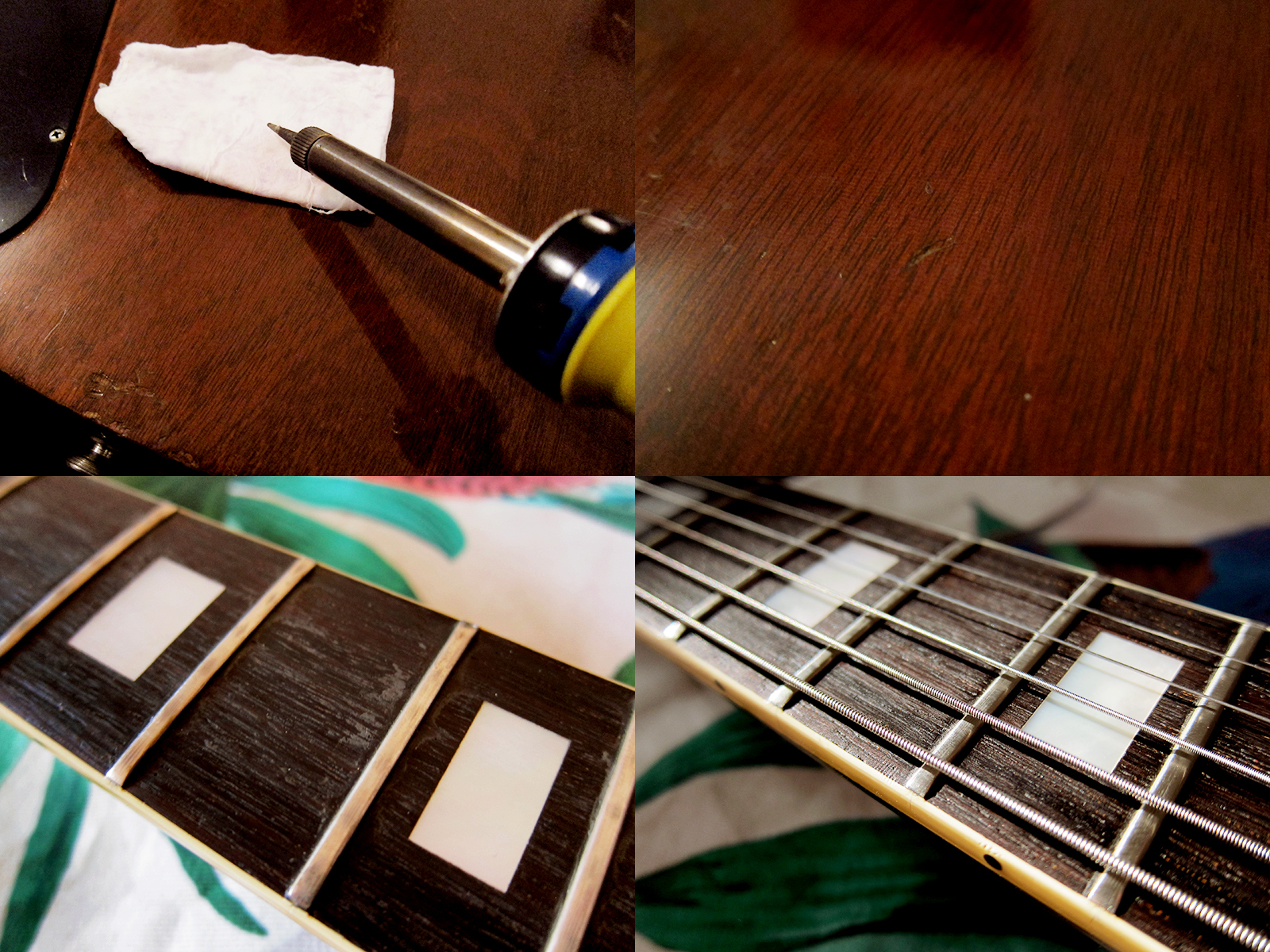
Everything seems to be original, except one pot, so I thought it was unnecessary to change the original jack just because of a bit of crackle so I cleaned it instead. I cleaned all the contact surfaces with wire wool and contact spray, it seems to be enough. I tightened the pots and all the screws on machine heads, strap buttons, pickguard, pickup rings, bridge and polished up the wood a bit.

1977 Gibson Walnut SG Standard
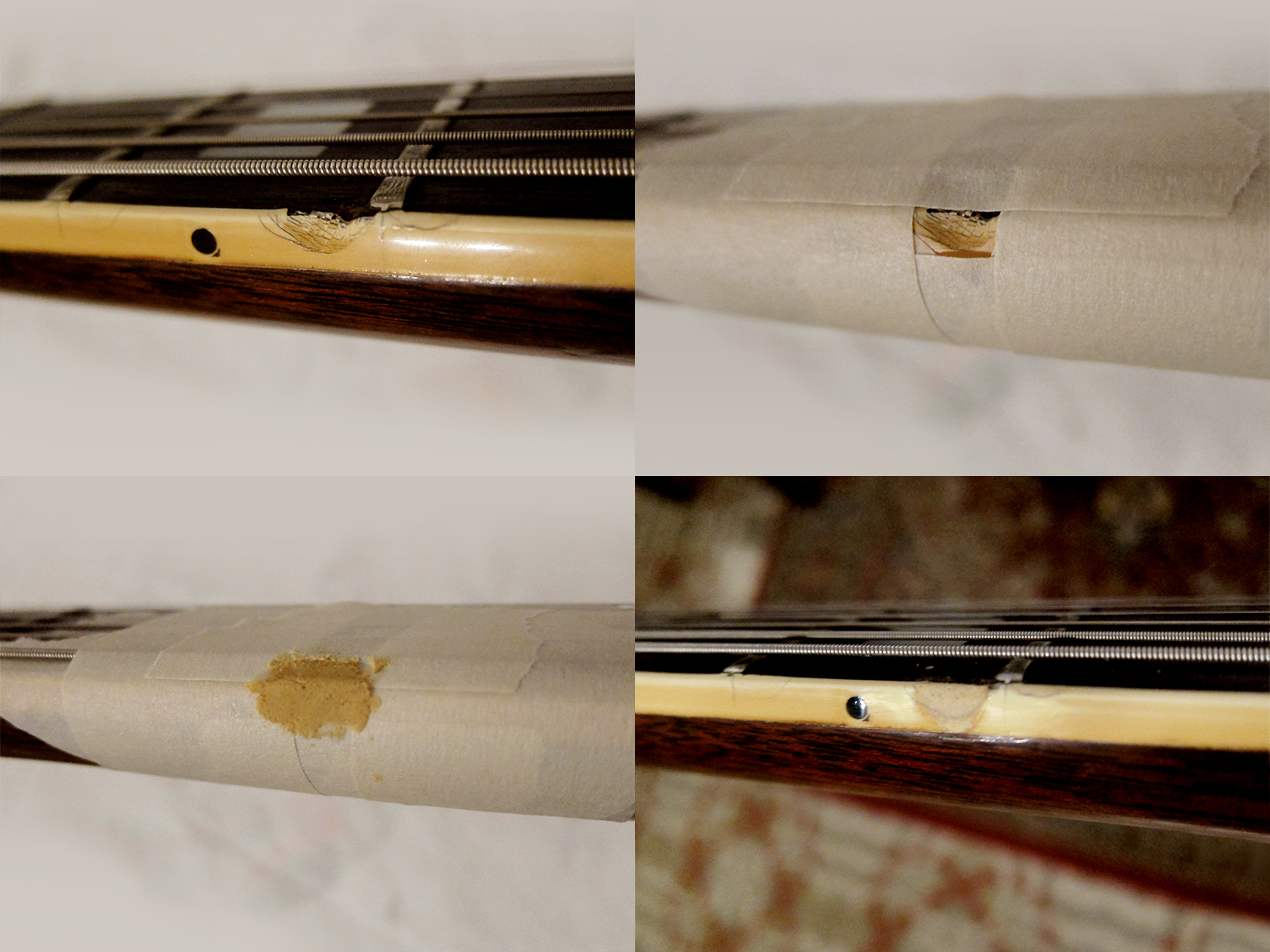
There was a fairly nasty cut in the edge binding on the 5th fret. You could feel it when you played so I masked it off and then filled it with wood filler, that happened to match in colour, then sanded it smooth and dropped a bit of nitro lacquer over it. Unfortunately I forgot to take a picture when it was all done, the last picture is before the lacquer and the final sanding with 2500 grit.

1977 Gibson Walnut SG Standard
Patrycja wanted to keep the dents and scratches to the body and I agreed, it’s nice when a guitar shows it’s real age. However, nobody likes dents in the back of the neck so I did what I could to soften them a bit. I recently learned a great way of removing dents and scratches, or at least making them stand out less. Use a soldering iron and some wet paper folded up, the steam from the iron will make the wood swell and that way make the dent less deep. Sometimes this works extremely well, especially on surface scratches, and sometimes it makes no difference at all so it’s a bit hit and miss but it’s quick and easy and therefore at least worth a try. Make sure you move the soldering iron and just hold it down for a sec to not damage the surface. The last step was to polish the frets and fretboard, put on some lemon oil and then new strings. The action and intonation was already great so I didn’t have to adjust that.

Gibson SG

Gibson SG Gibson advertisement Solid Hit 1961

Gibson SG Custom and Gibson SG Standard 1961 catalogue
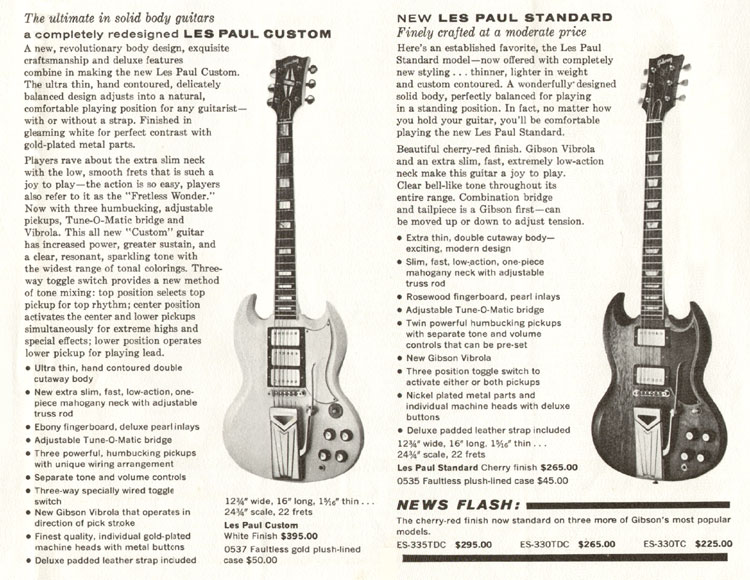
Solid hit. Gibson SG Custom and Gibson SG Standard from the 1961 catalogue, They looked a lot less evil back then

I have always had a weird love – hate relationship with the Gibson SG. Even though I really like both AC/DC and Black Sabbath the SG has kind of been ruined, or rather over exposed, through Angus and Toni. A bit like the Fender 52′ Telecaster which feels a lot like Bruce Springsteen and Keith Richards, even though neither actually plays a 52′. I have just seen too many young boys playing rock riffs on a Cherry SG Standard or SG Special for considering owning one myself. On top of that my woman thinks they look evil, EVIL I tell you. Then again, imagine an early Seventies walnut SG Deluxe or Custom in it’s worn wood colour. That’s pretty sexy, or even sexier a fancy pants white SG custom with gold hardware. The only problem is that they tend to come with 3 pickups and I can’t play guitars with 3 pickups, I end up hitting the middle one all the time. That’s why I prefer Telecasters instead of Stratocasters, even though I love the sound of the Strats middle pickup, I just keep hitting it and I it’s in the way when I’m trying to chicken / hybrid / whatever you want to call it, pick with my fingers.

1961 Gibson SG/Les Paul Custom
An original 1961 Gibson SG/Les Paul Custom

GIBSON SG 1970 catalogue

GIBSON SG 1972 catalogue

I’ve been quite tempted for a while to get myself an old Greco, Ibanez or Tokai SG, ideally white and gold but with just 2 pickups, as explained above. The problem is that most of the Japanese SG’s that shows up on eBay are early 1970’s ones and I don’t think they will live up to my expectations. I doubt that a bolt on neck cherry Avon or Columbus SG copy will stand a chance next to for an example my Greco EG-600 Les Paul Custom from 1980, which makes it a bit silly even if you could get one for 150€.

1972' Greco SG-400
Greco catalogue from 1972, just look at the white and gold Greco SG-400

Keith Richards playing Midnight Rambler on a white Gibson SG Custom at the Nicaragua Benefit, Jan 18th 1973 © Lynn Goldsmith

Jimi Hendrix on a white Gibson SG Custom

Now we are talking, Keith and Jimi on a white Gibson SG Custom. The guys below looks pretty cool too, even if they went for the more classic Cherry instead of Walnut or white. Well I guess Eric Clapton doesn’t count since he went bananas and had someone on acid paint his.

Duane Allman Gibson SG 1961
Duane Allman with his 1961 Gibson SG

Pete Townsend Gibson SG
Pete Townshend playing a Gibson SG in 1966

George Harrison from The Beatles’ 1964 Gibson SG
George Harrison 1964 Gibson SG

Eric Clapton's
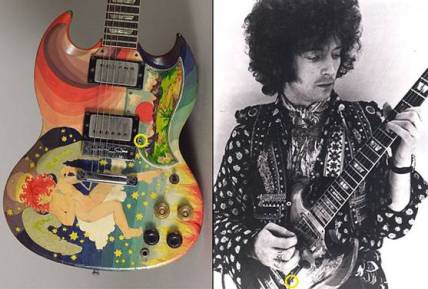
Eric Clapton’s “The Fool” a 1964 Gibson SG

Acoustic guitar demo

After watching Kris Kristofferson the other day I got really curious and wanted to know what a Gibson Southern Jumbo really sounds like. I know that Jackson Browne plays a lot of these old Gibson guitars and they sound amazing when he plays them but what is the difference between a Southern Jumbo, J-50 and J-45? I’ve never played a real Gibson acoustic or a proper Martin and doubt I ever will in this town since people are so extremely unfriendly in the guitar shops here, that’s why I have to buy everything online. Luckily I managed to find these great demo’s so I could finally hear the difference between them all and unfortunately it’s not always a good thing. I’ve always loved the Hummingbirds and been looking for a Japan made copy for some time but it the originals sound this thin and boring then I’m not sure how good a copy will sound, even if it’s made in Japan. Maybe I have to rethink this again, I mean the Southern Jumbo sounds the best. Full and deep but not muffled when strummed like the SJ-200 or some of the other Jumbo’s. When I saw that awesome Youtube concert with Dan Tyminski the other day I thought that his 1946 Martin D-28 was the best sounding guitar in the world and wanted to find a copy of that, I doubt I can afford a real Martin from the 1940’s. I guess all guitar shapes have their purpose in life, I just need to find the one that is right for me.

1952 Gibson Southern Jumbo

1964 Gibson J-50

1944 Gibson J-45

2012 Gibson SJ-200

1978 Gibson Hummingbird

1959 Martin D-28

1947 Martin 00-21