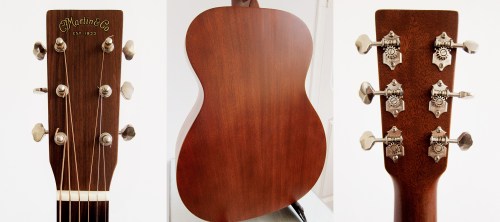
I recently had my friend Rafa’s little Martin 000-15M over for a set up. I didn’t have to do that much to it, just adjust the trussrod and file down the saddle a bit to get the action down. I realised that I have completely mixed up the Martin sizes, I always thought that the 000 was smaller than the 00, apparently it’s the opposite. That means that my dad’s old Levin LT-16 is a copy of a Martin 000, at least size wise, and not a Martin 00. It could be good to know next time I’m looking for some old guitar and they refer to it as being 000 sized, smaller than that is probably not for me. I don’t like jumbo guitars, but I do like the bass response of a good dreadnought sized guitar, and I think that anything smaller than a 000 would most likely sound like a parlour guitar in my ears. These Martins 000-15M have a pretty descent bass response for their size, I guess because of the shape and the all solid Mahogany construction. It’s a beautiful looking guitar, very light and easy to play and with a warm nice sound that I can highly recommend to anyone looking for a new guitar.
Gibson J-50 Deluxe, made in Kalamazoo, Michigan, between 1970-72
As mentioned before I have been dreaming of a Gibson J-50 for years now and last week I finally managed to find one. Of course I would have preferred a 1940’s or 1950’s one but it’s hard to even afford one from the 1960’s with today’s vintage guitar prices, and I really don’t approve of the adjustable bridge they used in the mid 1960’s. They changed from round shouldered to square shouldered around 1969 and at the same time got rid of the horrible adjustable bridges. Gibson reached a lot of low marks in the late 1960’s with laminated backs and sides, plastic bridges, massive bridge plates and double X-braces to stiffen up the tops and making sure that they wouldn’t belly or break. I knew when I bought this J-50 that it might not sound like James Taylor’s, not just because it’s not a round shoulder, but also because of the double X-bracing and the general build quality of a 1970’s Gibson. Even though it doesn’t sound like James Taylor’s J-50 I really like the sound of it and it’s very pleasing on the eye too, at least for me. I love the simplicity of the small black drop shaped pickguard and the grain of the top is just amazing. It’s a Gibson J-50 Deluxe with the original Gibson Deluxe machine heads, made at the Kalamazoo plant between 1970-72, apparently it’s impossible to date it any closer.
It has had a neck reset at some point and it seems like the bridge has been re-glued too, which could mean that it’s one of the earlier ones that perhaps came with an adjustable bridge and someone changed it to a normal rosewood bridge. I bought the guitar from a gentleman in Oxford, England where it had lived for the past 15 years but before that it came from Oklahoma, USA, where the repairs where made at some point. The bridge plate seems to be a really thin, delicate and made of spruce, perhaps that’s been updated too since these where know for having massive tone killing blocks of wood under the bridge. It has the double X-bracing which I guess has it’s pros and cons like any other form of bracing. It’s an extremely light and well sounding guitar, I don’t know how they managed to build it so light since these are supposed to be really heavy. Gibson got tired of all the returns which cost them a lot of money so in order to increase profit they started to build their acoustics thicker and heavier until they were built like tanks and could survive any beating. These are known as the Norlin era Gibson guitars, but it’s important to remember that even though Norlin took over in 1969, the old owners CMI kept control over the Gibson production up to 1974, so I guess that’s when the real dip in quality happened. As with any vintage guitar of any brand, there are good ones and there are bad ones. Not all Levin guitars are good, but all of the 12 I have sounds amazing so perhaps some brands are more even in the quality than others. I feel that I was lucky with this Gibson J-50 Deluxe and managed to find an extremely light built and very well sounding example. I wished that the bass was a bit deeper, it still has the Gibson bass response, but since the mid range and trebles are so good I’m still very pleased with my new guitar.
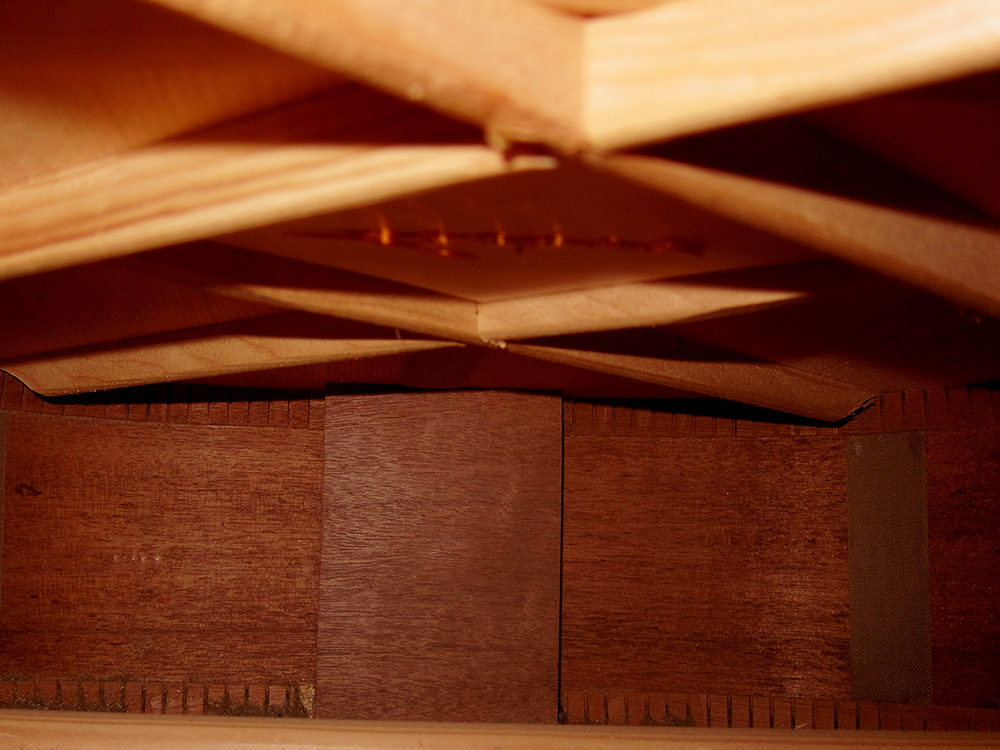
A picture of the inside, beautiful solid mahogany back and sides, with the dreaded double X-bracing. It actually sounds better than expected and since the braces are fairly thin and delicate, together with the thin spruce bridge plate, it’s a very light and resonant guitar with great sustain. Except for a little worn patch on the neck after a capo and two tiny cracks in the top where the pickguard has shrunk it’s in very good state for being 45 years old. The neck reset and general set up it had before it left Oklahoma has made it an extremely easy guitar to play with fantastic low action. It has 011 gauge strings on in the clip below, I guess with 012’s it will sound even richer.
Fender Stratocaster, Made in USA at the Fullerton plant in 1979
This weekend I restored my 1979 Fender Stratocaster to it’s original state. One pot has been changed at some point and I needed to put in a new 5 ways switch but the rest seems to be all original. Well the middle pickup is a bit of a mystery, I’m not sure if it’s a Fender pickup or if it’s something completely different, either way it sounds awesome. It has staggered pole pieces, something that Fender stopped with in the mid 1970’s so I would say that it’s either an older Fender or a newer Japanese pickup. I really like the look of the guitar now, a classic late 1970’s 3 tone sunburst hardtail Fender Stratocaster. The guitar is for sale here.
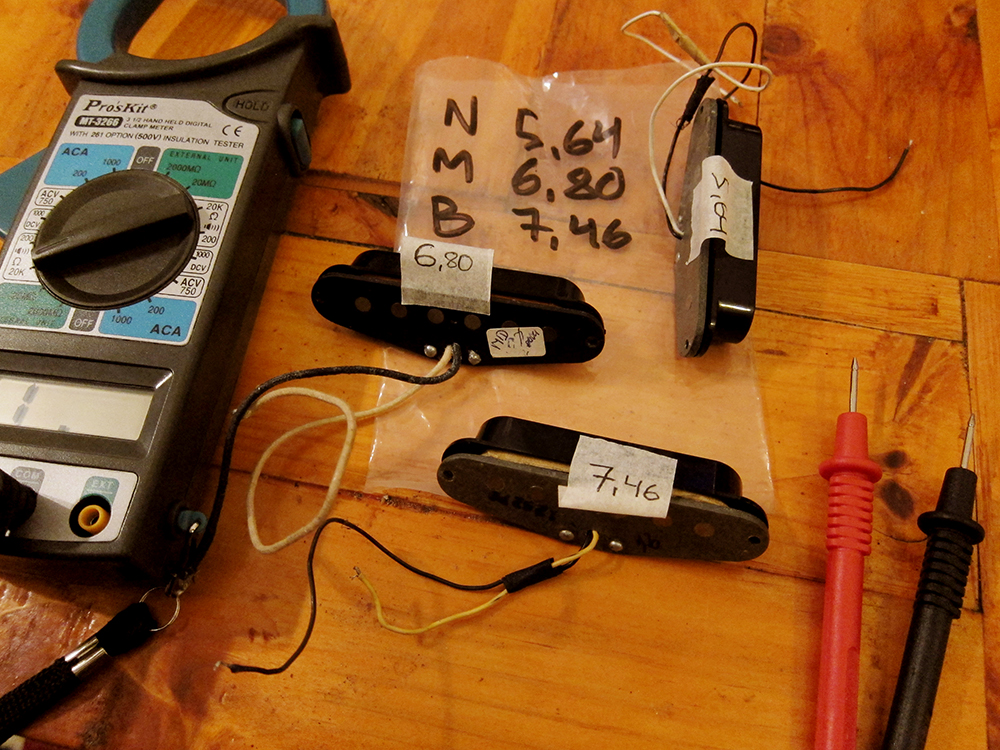
First I had to check that the original pickups even worked. After getting pretty strong readings I decided to install them, now I knew in which order to put them too since they weren’t marked with neck, middle and bridge.
I filled the old holes from the gold Gotoh machine heads with a tooth pick and normal wood glue, it worked really well. When I removed the terrible shielding job that was done before I could for the first time see the serial number, this body was made on a Monday in the 5th week of 1979. The neck is from 1978 which makes sense if it was put together early the following year. I have to go through the soldering again though, there is something that isn’t right. I noticed when I had put it back together that there something wrong with the middle pickup, it sounded like a wah wah stuck in one position. Well first thing I realised was that the switch was the wrong way around so that has been flipped now, then after a lot of detective work I figured out what was wrong. The middle pickups wires was the other way around, the white was the ground and the black was going to the switch. There was also an extra capacitor on the second tone pot that I had to remove. Now everything works perfectly and it sounds awesome, I really love this guitar. Thanks again to Dating Late 1970’s Fender Stratocasters for all the useful information.
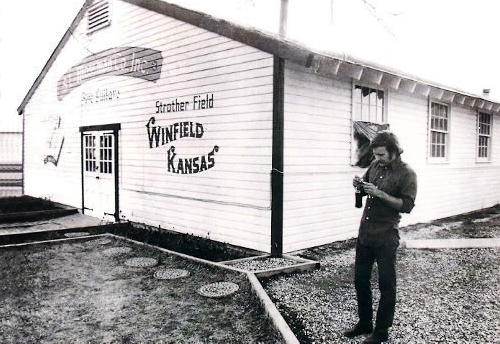
I have recently come across another American guitar maker that was previously unknown to me. I mentioned Grammer guitars earlier, this time it’s Mossman guitars that I’ve fallen in love with. One of the guitar builders that I follow on Instagram, kawvalleyguitars in Kansas, kept posting images of Mossman guitars he had done neck resets on, which awoke my curiosity. After a bit of Googleing I realised that quite a few artists liked Mossman guitars, including John Denver, Eric Clapton, Albert Lee, Doc Watson, Hank Snow, Cat Stevens and Merle Travis. Stuart Mossman got fed up with all the plywood guitars that was pumped out of the big factories in the 1960-70’s and decided to start building his own guitars with real tone woods and proper craftsmanship, and so S.L Mossman Guitars were born in Winfield, Kansas.
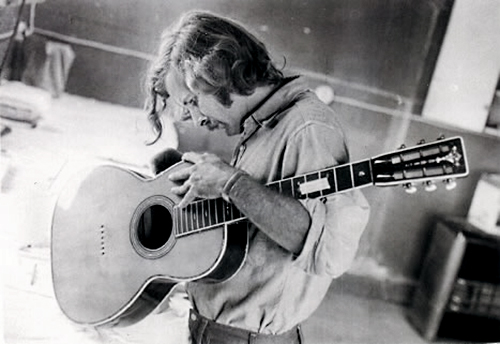
Stuart Mossman in Winfield, Kansas. Here you can read more about the Mossman story
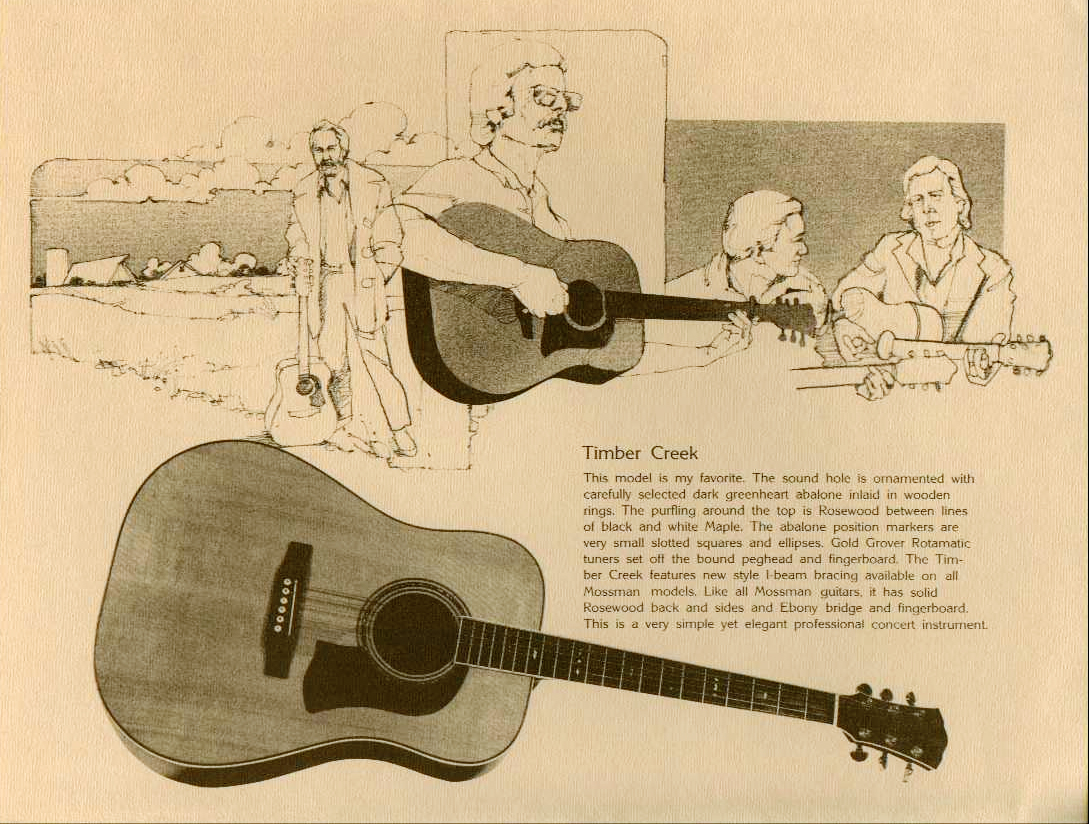
This could be the most awesome guitar brochure ever printed, the 1979 Mossman Catalogue, taken from David Hylander Guitar Works
Fender Stratocaster, made at the Fullerton plant in 1979
I have always loved the 1970’s Fenders with the classic 3-tone sunburst. I guess it started when I first picked up the guitar and fell in love with the big headed Strats but nowadays I’m probably more in to Telecasters, even though they are way to expensive and hard to find. That was the main reason why I put my Claescaster together, to have a Telecaster that looked like late 1970’s Fender but for a lot less money. I actually bought a Tokai Silver Star back in October for the same reason, that I’m completely gay for 1970’s Fender 3-tone sunburst. So when I was down south for Christmas and walked past a small guitar shop in Lorca and saw a 1979 Fender Stratocaster in the window I couldn’t resist. It was the only second hand guitar they had in the whole shop, vintage guitars are really tricky business in the south of Spain since people aren’t really used to pay more money for something old when they can get something brand new for less. The price was ok and I could even live with 1980’s looking Seymour Duncan hot rails, switches and all, and since I really like gold hardware that wasn’t an issue either. The problem was, is it real, is it a US made Fender Stratocaster from the late 1970’s? The man in the shop said yes, the serial number on the head starts with S8, that is 1978, and it says made in the USA under, what more do you need to know? I tried to explain that there are a few other numbers on an old Fender that you have to check to be sure, and that the decal on the head is very easy to fake and stick on yourself. The man would hear none of this, he was sure he knew more about old guitars that this weird foreigner that had just walked in to his shop, on top of that, he really trusted the guy that he was selling it for. I said I had to think about it and left. I went home and started to read everything I could find about late 1970’s Fenders and found this site, Dating Late 1970’s Fender Stratocasters, extremely helpful.
I spent the whole Christmas just thinking about the guitar, was it worth it even if I couldn’t know for sure that it was made in 1978, or if it was even a real Fender? On the morning of the 26th we got the seller to travel in to the guitar shop with the original pickups, that was my first demand, if I saw them then hopefully I would be convinced that it was real. When we arrived to the shop the guitar was still there in the window and I was presented with a shoebox with all the original hardware, machine heads, bridge and pickups. I felt fairly sure that it was the real deal, I mean who would bother to bring in a box with old Fender stamped hardware for a fake guitar? I asked one last time if the old man in the shop had any proof that the guitar was real and he got really annoyed, saying that I could either take it or leave it. I managed to calm him down and explained that it would be a fairly common procedure to take the neck off if you sell old Fenders, or at least show the bottom of the pickguard, especially since there are a few questionable late 1970’s Fenders circulating in Spain that I’m 99% sure weren’t made at the Fullerton plant in the USA. The man just kept saying that it says USA on the head, that means it’s not made in Mexico, I had to explain that they didn’t start to make Fenders in Mexico until 10 years later, after the Fullerton plant had closed down and Fender had moved to Corona. He wasn’t convinced, and neither was I, but after seeing the pickups which pointed at 1979 and seeing the original hardcase which is the type Fender introduced in 1979 I felt that it was close enough, and bought it. I’m glad I did because as soon as I returned to Barcelona and I could take the guitar apart I found the proof needed. Even though I really like this guitar I have it listed for sale if anyone is interested in buying it.
Ideally I would have liked to find a few more stamps in the neck pocket but they have either been sprayed over or there used to be a sticker that have fallen off. The neck has a serial number on the end that points at 1978 so together with the S8 serial on the head I guess it was made in 1978. The serial number under the pickguard points at 1979, just like the original pickups. The pots are unfortunately the general CTS pots that can’t be traced and the body has been shielded, which I didn’t want to remove, so I couldn’t find any numbers there. The matching stamp on the heel and neck pocket is the quality stamp Fender used in the late 1970’s. The Seymour Duncan pickups sounds way better than I expected, a bit too hot for more liking perhaps but still pretty nice. I haven’t decided if I’m going to keep it like this for a while or return it to it’s former glory with it’s original pickups and hardware.
Fender had grey bottom pickups up until 1979 and then introduced black bottoms without serial numbers in 1980. I’m not sure if the bridge pickup is from 1980 and the others from 1979 or if it has been changed sometime in the last 35 years. The 3 screws neck plate and the saddles has the correct numbers and they machine heads looks like they should too. The original hardcase is actually way lighter and easier to carry than I expected, it has grown on me even if it looks a bit plastic and 1980’s for my normal taste. My first guitar was a Japan made 1993 Fender Squier with a rosewood fretboard and even though I prefer maple fretboards these days, there is something quite nice about a rosewood Strat. I also really like that it’s a hardtail, I never use the tremolo so I prefer a hardtail any day of the week, they feel more like a Telecaster too. All in all, this was not only my first USA made instrument but a pretty awesome guitar on it’s own that made me fall in love with Stratocasters again. Thanks again to Dating Late 1970’s Fender Stratocasters for all the useful information.
As mentioned before, there are two guitars that I really would like to own. The first would be a Gibson J-50, ideally from before 1970. The Second would be a mid 1970’s K. Yairi YW-1000, the most beautiful Martin D-45 copy ever made. Having said that, I might have to add a third guitar in my list of holy grails, a Grammer Guitar. Imagine to find an original, before Ampeg took over, The Grammer Guitar RG&G, built by Billy and the boys in Nashville, Tennessee. Here you can read the history of the Grammer Guitar, it’s a pretty interesting story, especially if you like country music as I do. In the mid 1960’s Billy Grammer, a musician himself, decided to make an affordable flat top guitar for his friends in the Country music business. He took a Gibson J-45 and a Martin D-18 apart, studied their bracing pattern and how they were built and then made a copy with the best of both worlds, The Grammer Guitar. Maybe the reason I like them so much is because they remind me of my big headed Levin guitars from the 1970’s.
The Last Grammer Guitar made by RG&G, built in 1968 on 715 Poplar Avenue in Nashville, Tennessee
I’m not much of a Joe Bonamassa fan but he plays a 1969 Grammer Johnny Cash model, I mainly respect him for taking his vintage guitars on tour and using them instead of just collection them. The Guitar Of The Week part on the Joe Bonamassa’s site is well worth a visit if you like old guitars.
Joe Bonamassa’s 1969 Grammer Johnny Cash model, here is a Youtube clip of him playing it live
Here is Billy when he was young and awesome
And here is Billy when he is old and blind, but still kind of awesome
Even though I love the Louvin Brothers I have to say that this must be the ugliest guitar I’ve ever seen. Satan is Real is a great album but the cover is just not good enough to put on a Martin, just look at the devil. I could have bought it for the kitsch value and because I like Ira and Charlie, but not for $4,666.00. I found it in the Martin Guitar Anthology eBook that I posted earlier. You can read more about the guitar here Martin D-28 Louvin Brothers.
The Fretboard Journal’s Martin Guitar Anthology eBook After nearly ten years of publishing, the FJ has amassed quite an array of stories featuring iconic Martin guitars and Martin artists. We decided to partner with Martin to share some of these great stories once again (a few have been out-of-print for years now). Included are the full-length (and, in some cases, out-of-print) features on Tony Rice, David Crosby, Loudon Wainwright III and many others. We’ve also included the latest edition of Martin: The Journal of Acoustic Guitars, their in-house magazine filled with more Martin tales. We hope you like this eBook anthology and stay tuned for future editions featuring your favorite brands and artists.
I completely missed the release of The Band – Live at the Academy of Music 1971 last year, I just found it on Spotify. It’s an amazing 4 CD box-set with a DVD and I might actually have to buy it, even though I haven’t bought CD’s for at least 5-6 years. Thank you Robbie, even if just did for the money.
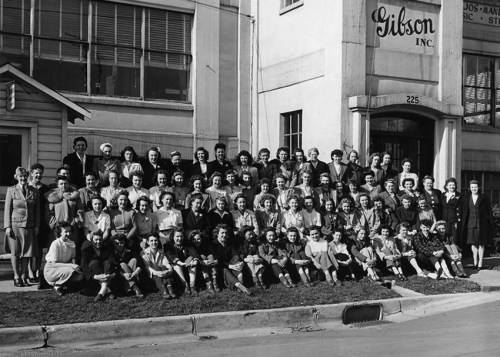
The book revolves around the interviews of a dozen women who appeared in the Gibson Guitar Company’s 1944 workforce photograph. Prior to my discovery of these women, Gibson had claimed in Wartime advertisements and in a 1973 company history authored by its WWII personnel director that it ceased producing guitars during the War. The younger members of its workforce had left to serve the military War effort. The remaining seasoned craftsmen repaired some instruments but, because of their limited numbers and wartime restrictions on the use of raw materials, were unable to construct new musical instruments. I discovered that the female workforce produced nearly 25,000 instruments during the war. Taken from Banner Gibson
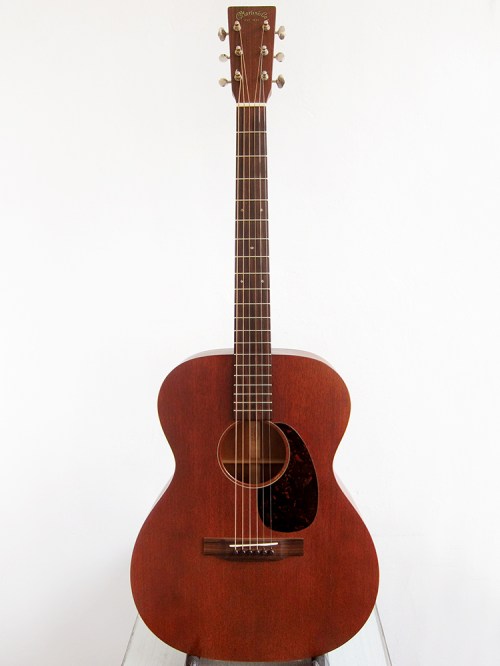 Martin 000-15M, Made in USA 2011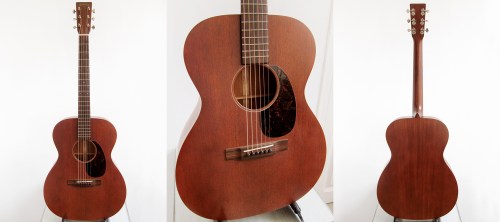










 The Last Grammer Guitar made by RG&G, built in 1968 on 715 Poplar Avenue in Nashville, Tennessee
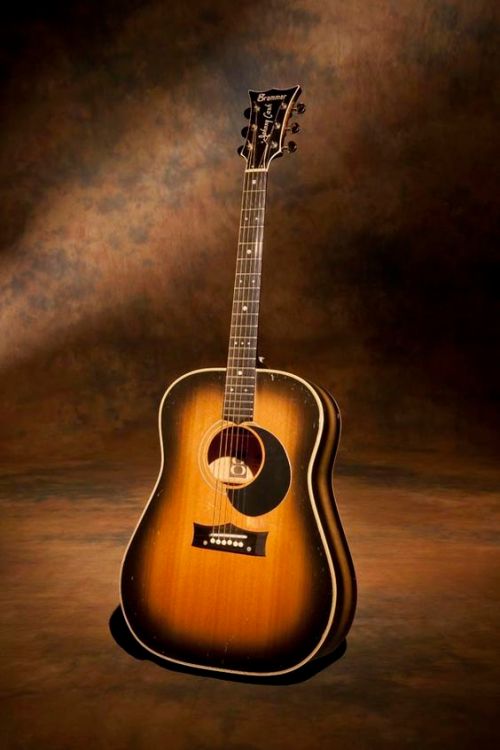 Joe Bonamassa’s 1969 Grammer Johnny Cash model, here is a


 Claescaster