Guitar of the day
 Buddy Holly’s 1944 Gibson J-45
Buddy Holly’s 1944 Gibson J-45
How to change a potentiometer
When I found my Tokai Love Rock it had a broken shaft on one of the potentiometers so I’ve been planning to change that for the last month or two. This weekend I finally got around to do it. I changed the broken one for a Alpha 500k pot, not the most expensive replacement but I had heard quite good things about Alpha so I thought I would give it a try. I have no experience what so ever when it comes to soldering so I decided to play it safe and move one cable at the time from the old to the new pot. My main concern was of course that I would get confused and not manage to get all the bits back in the right place. Everything went fine, well maybe not the cleanest soldering but pretty good for being my first time. I should of course have scratched the new pot with a bit of sandpaper to get the solder to stick better, I didn’t think of that until after.
 I changed the pot one cable at the time to not mess anything up
 The final result, my newly fitted Alpha 500 k pot. Perhaps not the cleanest soldering but OK for being my first time.
 Tokai Love Rock with 4 brand knew knobs, straight from China via eBay.
How to do a 50’s vintage wiring mod for Telecaster
When I had to soldering iron out I thought I might as well sort some other stuff too. I’ve been reading about different ways of keeping the tone on a Telecaster when you turn the volume down and decided to go for the old 50’s vintage wiring on my Claescaster. It’s a really easy procedure since you just need to move one cable but when I opened the Claescaster up I realised that it wasn’t wired like the standard Telecaster, not according to Seymour Duncan’s excellent wiring diagrams, so I had to move the capacitor and another cable as well. The capacitor is the worlds biggest Orange drop but it does the trick, I might go for something smaller and a bit more suitable when I build the new Claescaster.
 The cables I swapped around on the Claescaster. It sounds great now and keeps the tone when you turn the volume down.
How to solder a endpin jack for acoustic guitars.
I found this nice old Shadow humbucker pickup for acoustic guitars when I was back in Sweden. I have a 12 string guitar from the 70’s that I bought cheap from an old Jazz musician and I had completely forgotten that it was equipped with a Shadow pickup. I brought the pickup back to Barcelona and have spent some time trying to figure out how to fit it in my Cort that I normally use for rehearsals. I bought a gold endpin jack and then I just needed to solder a mini jack cable to connect it. The question was, how the hell do I do that? I found and old RCA to mini jack cable that I decided to slaughter for this project but couldn’t find any info online how to connect it. I tried every single combination I could think of but just couldn’t get any sound out of it. Then it hit me, of course, a guitar cable has only on cable inside and then the shield around, so I have to make something similar to this. I twined the left and right together and then the same with the shield from both and it worked perfectly. It might not be the best cable in the world but it was what I got at home and it seems to work fine.
 Standard RCA to mini jack.
 I connected the left and right and then twined the shield together
 The left and right soldered together to the shortest pin and then the shield to the longest.
 Shadow humbucker pickup for acoustic guitars, newly fitted on my old Cort.
Late last night I bought a new body for the Claescaster, or rather I got the first part of my new Claescaster. The idea is to build a new guitar from scratch with the best bits I can afford after the specifications of a Seventies Fender Telecaster. I have thought about this for a while and I really don’t like the grain and look of my Morgan Telecaster, especially not now when she has darkened so much since I moved to Spain, and now I found my ideal body. It’s a Mighty Mite Swamp ash body in 3 tone sunburst and I haven’t seen any Mighty Mite bodies, not even on their website, in this lovely red sunburst.
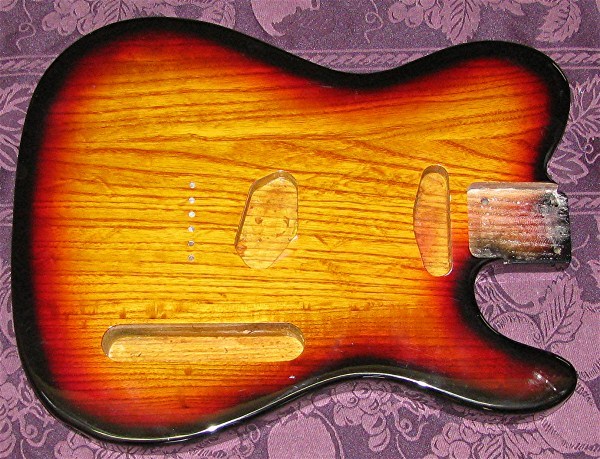 Mighty Mite Swamp ash Telecaster body in 3 tone sunburst
It’s quite heavy for being a modern body, around 3.2 kg, which I really like. Most modern bodies I’ve seen weighs 1.5-2.5 kg, does all guitarist have back problems or why doesn’t anyone want heavy guitars any more? Or maybe it’s just the quality and density of the wood that has changed over the years and you can’t find proper wood nowadays. I’m going to build a nice blackguard Seventies Telecaster out of this with gold hardware, just because I love gold. I can’t afford a real Seventies Fender so the best I can do is to create my own, and I think I might enjoy building it too. I bought it from AZGuitarParts a US eBay seller so let’s see how it goes with import tax to Spain, I shouldn’t have to pay anything since it cost under 150€ but you never know. I bought all the gold hardware for the Claescaster from the US 2 years ago but that was a smaller package so it slipped through customs just fine, I just have to wait and see how it goes this time. I can’t afford to buy a new neck, pickups and all the hardware now so this is going to be my ongoing project over the spring. First I’m going to just change the body, meaning unsolder and move all the hardware, pickups and pots from the Claescaster and take that neck too. Then when I get some more money I will start to collect and exchange all the bits with parts I really like. Cloth covered wires, CTS pots, Oak switch and some swanky pickups, I was thinking of the Tonerider Vintage Plus, in gold of course. I also think it could be a good idea to practice soldering on the old Morgan pots and pickups so I don’t buy anything new and expensive and ruin it straight away. Then in a couple of month I will suddenly have two guitars, my Morgan Telecaster in it’s original form and the new Claescaster, a Swamp ash 1970’s Fender Telecaster copy built from scratch by me. My secret plan is to force my first born to learn how to play guitar on my old Claescaster and when they turn 20 they will inherited the new Claescaster. “Here is a guitar that I built 20 years ago and have been playing heavily ever since just too keep it warm, I built it for you”. How nice would that be, damn it, why didn’t my dad build me any guitars.
 Fender Telecaster Sunburst 1977, the inspiration for the new Claescaster
Update May 6, 2013: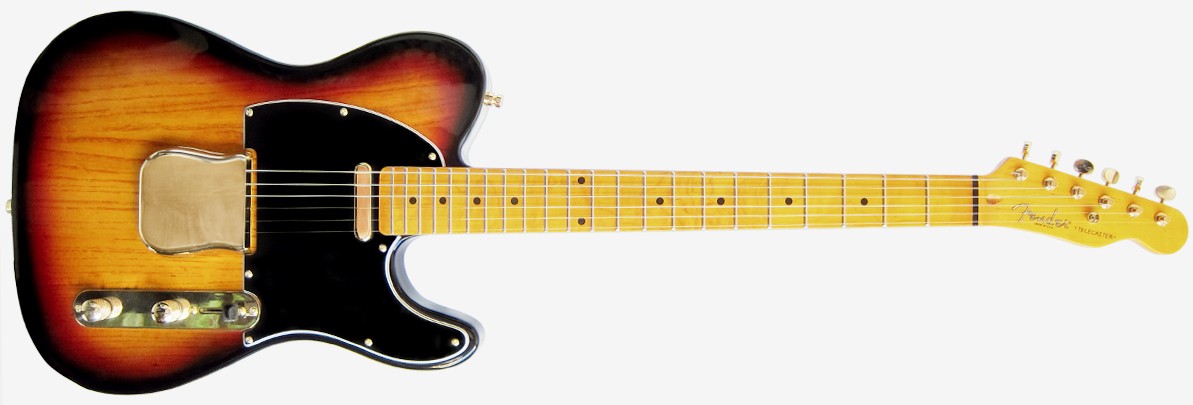 This is what the final Claescaster came to look like
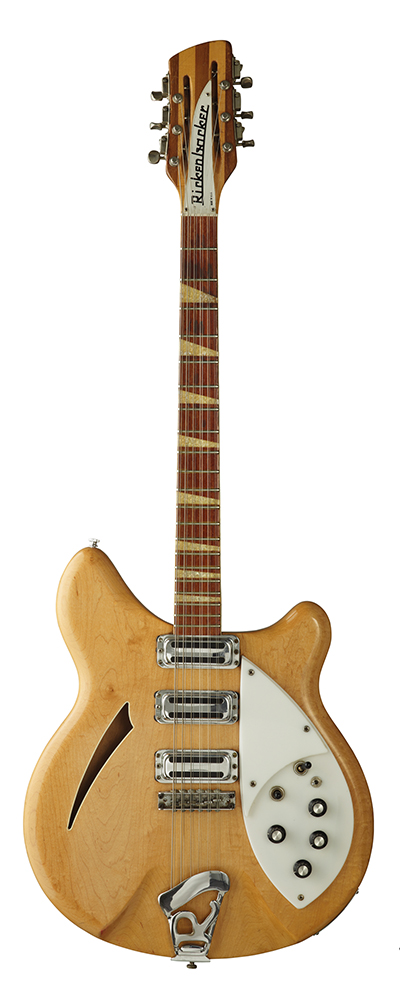
Roger McGuinn’s 1964 Rickenbacker 360-12

If you want to know what the tonal qualities are in different woods, what’s the best body wood for your next guitar building project, or maybe you are just curious to figure out what your guitar is made of. Then check out Alan Ratcliffe’s wood guide. I think my favourite is still Swamp Ash, probably just because the name sounds so awesome. I’m planning to build a new Claescaster soon, from scratch this time, and therefore I’m researching different suppliers of “licensed” Fender replacement parts, Warmoth, All parts, Musikraft, WD, Mighty Mite etc. It seems like US eBay is the best option for bodies, but then you might get hit with unnecessary import taxes and the shipping to Europe is quite high. I found this quite cheap UK seller but they only sell unfinished bodies and I would prefer to have it finished. I’m not sure if I trust this Hong Kong seller but that would be the cheapest option without any doubt, 107€ including shipping. The search continues…
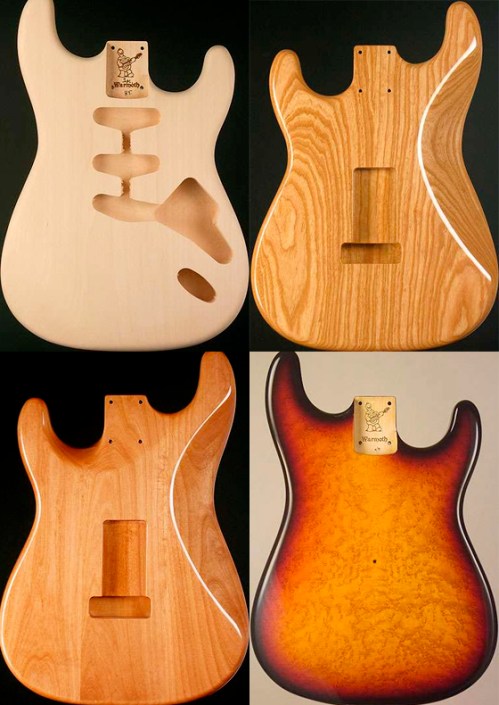 Basswood, Swamp Ash, Alder, Birdseye Maple
Sometimes I wish I was stinking rich so I could buy all the guitars in the world. Then I realise that my life would probably not be that much better just because I had a million guitars. I wouldn’t have time to play them all and after a while I guess nothing really impress you. If you have a couple of Jimi Hendrix Strats in your collection then the Strats that you have that didn’t use to belong to Hendrix would probably feel pretty boring in comparison. I don’t have any really expensive guitars in my collection. Mainly because I’m not rich enough to buy a 1952 Telecaster, a 1964 L Series Strat or a 1958 Sunburst Les Paul, but also because it would be pretty pointless. When would you actually take out an instrument and play it if it was worth ten thousands of Euros? You would be so scared that something happened to it that you just kept it in a vault, like John Entwistle did. Guitars are meant to be played, and adored, but mainly played. I prefer to have guitars that I can use, bring to gigs and rehearse with, as well as hang on the wall and adore at home. Therefore I think guitars for around 500€ are ideal, at least for me. If you know what you are doing you can still get amazing Japanese guitars for 500€, especially on eBay. Expensive enough for having descent quality but cheap enough to replace if something happened to them so you really dare to use them.
 A nice example of a guitar worth around 500€, well maybe more like 600-700€. Greco Les Paul Custom EG-600C, Made in Japan, FujiGen 1980
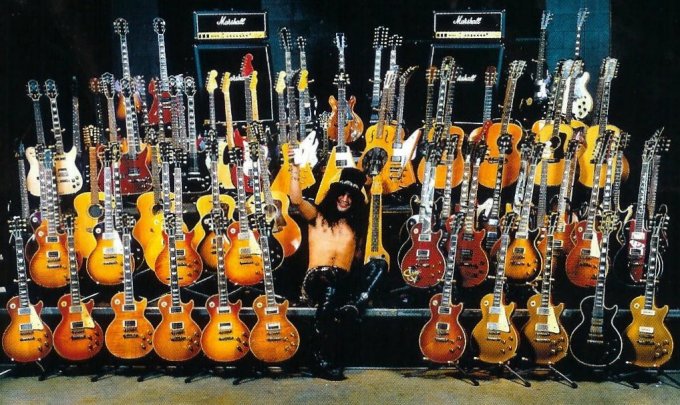 A small part of Slash’s guitar collection
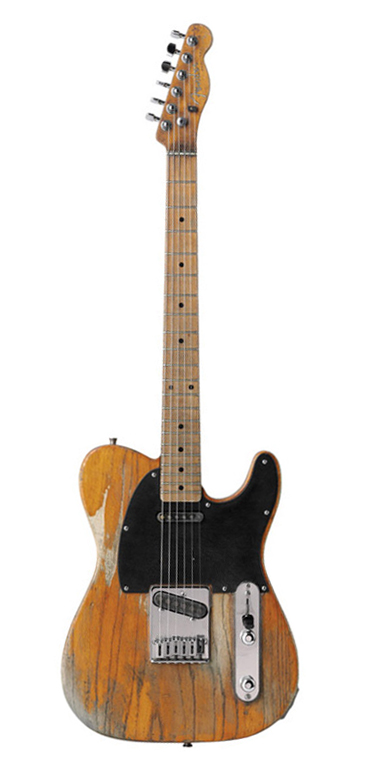
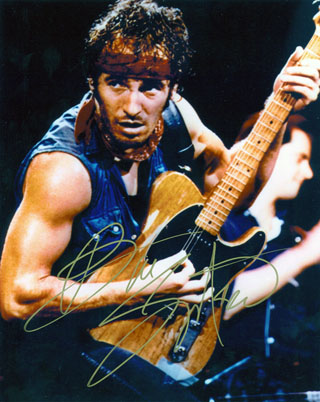
Bruce Springsteen’s 50’s Fender Esquire
Buy American! The electric guitar was invented in the USA so there is no surprise that they used to produce the finest guitars in the world. However, in the Seventies as competition grew stronger Fender and the big boys started to focus more on market shares and suddenly quantity became more important than quality. At the same time the Japanese factories really stared to get a hang on building amazing copies of American instruments with more eye for details than the Americans themselves in some cases. Epiphone, Gibson, Fender and Grestch all moved part of their production to Japan for the amazing quality offered to a lower price. The list of world domination on the guitar building market used to be USA, Europe, Japan, Korea, Taiwan, China etc. Now things started to change and Japan took over a big part of both USA and Europe’s production. Japan was never really that cheap, well they did produce super cheap instruments too, but the top brands was still quite expensive so in order to increase their profit most of the Japanese manufacturers moved parts of the production to Korea in the Eighties. Suddenly a Japanese copy of and American guitar was now being produced in Korea. As the Eighties became the Nighties even the Korean workers started to feel expensive and production was moved to Taiwan, China or in some cases even Singapore, Indonesia or India. Japan is still the best guitar builders in the Far East but as their prices increased more and more people settled for number two, which used to be Korea but things have changed, again. The Koreans have become sloppy, and expensive so now Tokai and other companies have moved their production to China instead. China is the new Korea. I have to say that the two Tanglewood parlour guitars that my girlfriend and I have are amazingly built for the price. They are hand built in China and I doubt that anything built in Korea today could match that. Korean built instruments from the Eighties are still really good so I believe this change happened in the last 5-10 years. It’s going to be interesting to see what happens when the Chinese built instruments gets the recognition they deserve on the second hand market. Today sellers just push for guitars being MIJ, Made in Japan, or MIK, Made in Korea. When will the MIC arrive and how much will they be worth?
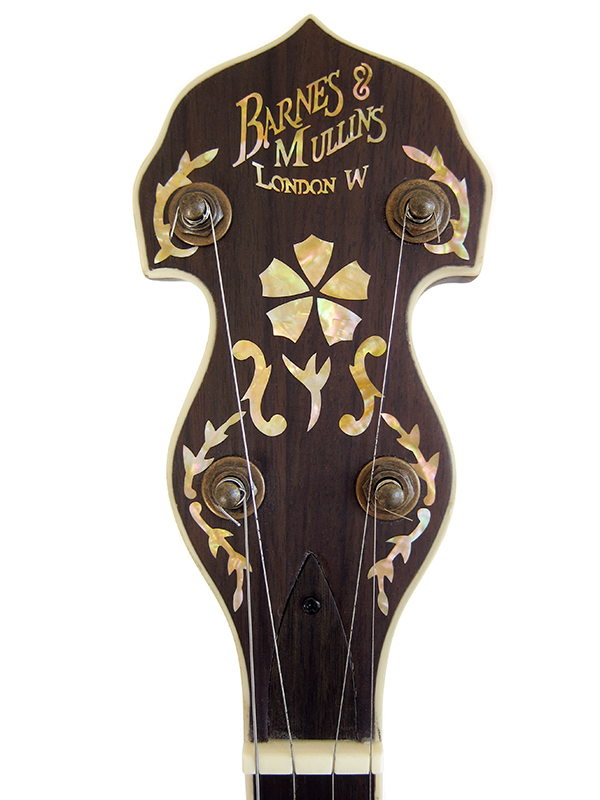
My Barnes & Mullins BJ500m 5 String Banjo built in China and set up in the UK

Eric Clapton’s “Blackie” 1956/1957, a composite of 3 different Fender Stratocasters. Sold for $959,500 at a Christie’s auction.

A lot of people I have met over my 20 years of playing guitar have told me how horrible bolt on guitars are. This is the general opinion amongst guitar players and it can easily be seen in the second hand value of old Les Paul or SG copies for an example. “Oh it has a bolt on neck, well then I’m not interested.” I think it’s important to remember a few things. Most guitars were bolt on in the beginning, especially Japanese guitars up until 1973-74. It seems like it was only Gibson and the American makers that knew how to make set necks or maybe it was just too expensive to copy for brands in Europe and Asia. If you look at all the amazing German guitars from the Sixties like Hohner, Höfner or Italians like Eko, or even Swedish like Hagström, they will most likely be bolt on up until the early 70’s. My Hagström HIIN OT that was made in Sweden in 1975 has a bolt on neck, this was standard for a lot of brands back then. This was not a cheaply made instrument and back in the day it was good enough for both Frank Zappa and Jimi Hendrix. It’s an amazing guitar and I doubt it would be any better if it had a different neck joint. With a set neck I think they would have had to make both body and neck thicker, which would be hard for Hagström to sell since they were known for having the fastest necks in the world. A combination of thin necks, special H truss rods and amazing Swedish wood was their selling point when they broke in to the American market in the late Sixties. I don’t think that Frank Zappa thought his Hagström guitars were useless just because they had a bolt on neck.

For me the quality of the guitar in general and what type of wood is being used is way more interesting than if the neck is screwed on or glued. There is a lot of discussions whether set necks has greater sustain or not and again, it’s probably more down to the wood than which type of neck joint the guitar has. I guess there could be a slight difference in sound depending on how the neck is joined together, at least if you are going to believe this Guitar Player article. Then again, it’s not really fair to compare a Gibson guitar with a Fender guitar. I think pickups, body shape and wood has more to do with why a Telecaster and a Les Paul sounds differently, not the fact that the necks are joined differently. It would make more sense to compare two Japanese Les Paul copies of equal age and quality, one with a set neck and one with a bolt on. I doubt that you could hear the difference.
If we are going to trust the old, set necks has more sustain, then all Fender instruments should have less sustain. I would have to say that I disagree since I have played and heard Stratocasters with amazing sustain. Again, I believe that the quality of the wood is causing the sustain, not the glue or screws. The most important part, as always, is to play what you like and don’t care what other people say. I’m 100% sure that a Japan made Les Paul copy from the 1970’s with bolt on neck that cost ¥50 000 back then sounds better than any modern far east made copy with a set neck. It’s all about the quality of the instrument, not how the neck is joined to the body.
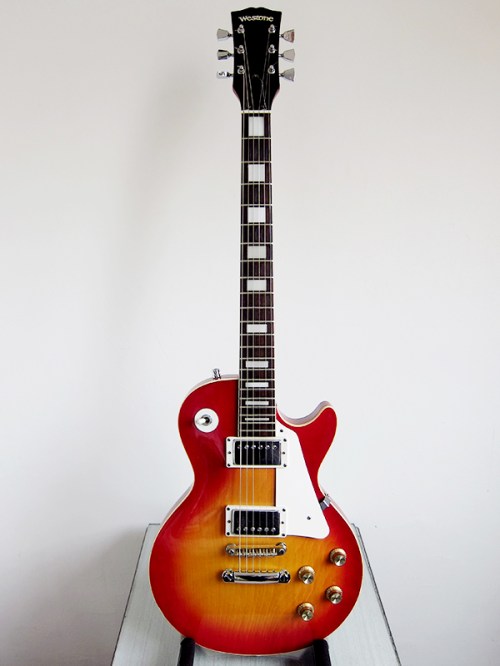 My bolt on Westone Les Paul copy from the 1970’s made by Matsumoku in Japan.
 Claescaster