Claescaster

Category: DIY

How to… crown and polish frets

Last week I got all the parts needed to try to refret my Tokai, Since I have never done any form of fret work before I thought it was a good idea to practice on some guitars before I got down to business on my beloved Les Paul. The first thing did was to crown and polish the frets on my EKO Ranger VI. It was a bit scary, like always when you do things for the first time, but I soon realised that it wasn’t harder than anything else I done in the past.

How to crown and polish frets
I masked the fretboard and then crowned the frets with my Uo-Chikyu medium fret crowning file. I read that was good to use 400, 600 and 1200 grit sandpaper to polish the frets but I could only find 400 and 800 here in Barcelona. Either way, it felt like the main difference was made by the last step, the wire wool.

How to crown and polish frets
Once the frets was shiny on smooth from the wire wool I went over them one last time with a cloth and some metal polish and the removed the masking tape and oiled up the fretboard with lemon oil. I decided to change the machine heads as well, I had a set of open back grover copies that seemed to suit fine. I think the neck almost looks like new now.

How to… refret a guitar

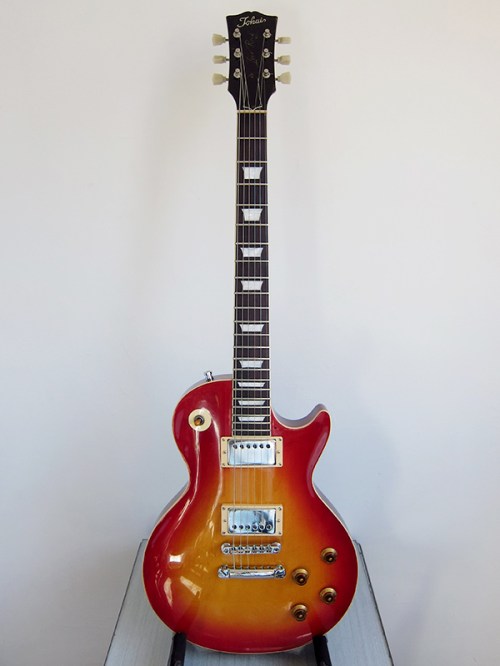
Tokai Love Rock LS-55 Les Paul Standard "Made in Japan" 1991Tokai Love Rock LS-55 Les Paul Standard “Made in Japan” 1991

Today I did it, I decided to go all in and cross the final frontier when it comes to DIY guitar work and ordered everything needed for refretting my Tokai. It has really poor frets, well not only does the frets have big groves in it but it’s hardly any frets left. It’s such a nice guitar and she deserves to be brought back to her former 1991 glory. I have thought about this for a long time, well I’ve thought about refretting her since I bought her, but if I should pay someone 240-340€ to do it or if I should just learn how to do it myself. I have to say that my trust in the quality of any form of workmanship south of the Pyrenees is pretty low. I have seen too many people charge too much for things that I could have done better myself, hopefully I’m right this time to. I bought quite a lot of things from G.M.I. tools in Greece, a fret leveler, fret puller, hammer and then I got a neck support caul and a fret rocker from Guitars & Woods in Portugal. I always try to buy things from my Mediterranean neighbours if I can to help their economy out during the recession, even though I doubt that any of these eBay sellers pay tax.  I struggled a lot when it came to what type of crowning file I should get, I watched a lot of Youtube videos to see what people were using but everyone had a different opinion. In the end I went for two fancy Japan made Uo-Chikyu files from Japarts in Canada, mainly because they were made in Japan and I’m gay for Japanese guitar things, and they had a cute fish as their logo which made me happy. I read a lot of good things about Dunlop’s fret wire on European forums, they seem to be pretty standard here, and a lot of bad things about them on American forums so in the end I trusted the Yanks and bought Jescar fret wire instead from Philadelphia Luthier. All in all I spent 172.73€ for tools that hopefully will last me a lifetime, two sets of fret wire, one for my Tokai Les Paul and one for a Strat/Tele, I don’t think you can get Jescar here so I thought I might as well get an extra set. I also got a cheap set of fret wire to practice with, I was going to refret my old Morgan neck, the original neck to the first Claescaster, just to try to get used to pulling frets and hammering new ones in. If I would just refret one guitar I guess I could just have paid someone 300€ to do it for me, but the main thing for me is to be able to crown and polish the frets on all my guitars, before they get big groves in the frets so I can’t play them. I’ve also notice that I tend to not play some guitars just because they have a bit of fret wear, not because they are hard to play, just because I don’t want them to get worse. That’s a ridiculous excuse for not playing your favourite guitars. I prefer to learn how to do it myself so the cost of refretting a guitar is 12-14€ for the fret wire, and then of course a huge amount of my time but that’s not as precious as having to pay 300€ for someone else to do it for me. Wish me luck!

Here is a list of what I ordered:
Hiroshima Files Uo-Chikyu Medium Radius Fret Crowning File
Hiroshima Files Uo-Chikyu Fret End Dressing File
G.M.I. fret-fingerboard LEVELER 400mm(15.75”)
G.M.I. fret puller-luthier’s tool-MADE IN GERMANY     
G.M.I. fret hammer-luthier’s tool-MADE IN GERMANY
G.M.I. fretboard guards    
Bahco replacment files for G.M.I. fret bevel(3 different cuts)
Guitar Neck Support Caul
Stainless Steel Guitar Fret Rocker Laser Cut – Luthier
Set 2.5mm Wide Nickel Silver Fretwire
Jescar FW47104 Electric Medium/Jumbo Fretwire Pre-radiused 12″
Jescar FW43080 Electric Medium Fretwire Pre-radiused 9.5″

How to… fit a undersaddle pickup

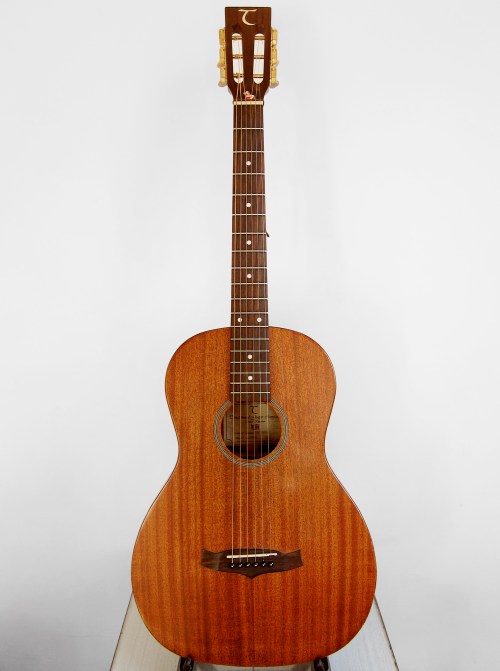
IMG_7470 copyVintage V880N Parlour acoustic, newly fitted with a ARTEC PP-607 undersaddle Piezo pickup

I got the basic ARTEC PP-607 undersaddle Piezo pickup cheap of eBay, I think it was 15€ with the endpin jack including shipping. I got around to install it last night and I have to say that I’m well pleased with the result. I had read that Piezo’s without a preamp isn’t much but I have to say I disagree. This pickup is way louder than some magnetic soundhole pickups I’ve used in the past and sounds ten times more acoustic and natural. It’s without any doubt my favourite way to amplify an acoustic guitar, well I still haven’t tried fancy things like the LR Baggs M1, I have been thinking of investing in one of those. However, this is a cheap, discrete and really nice way of playing electric with an acoustic guitar.

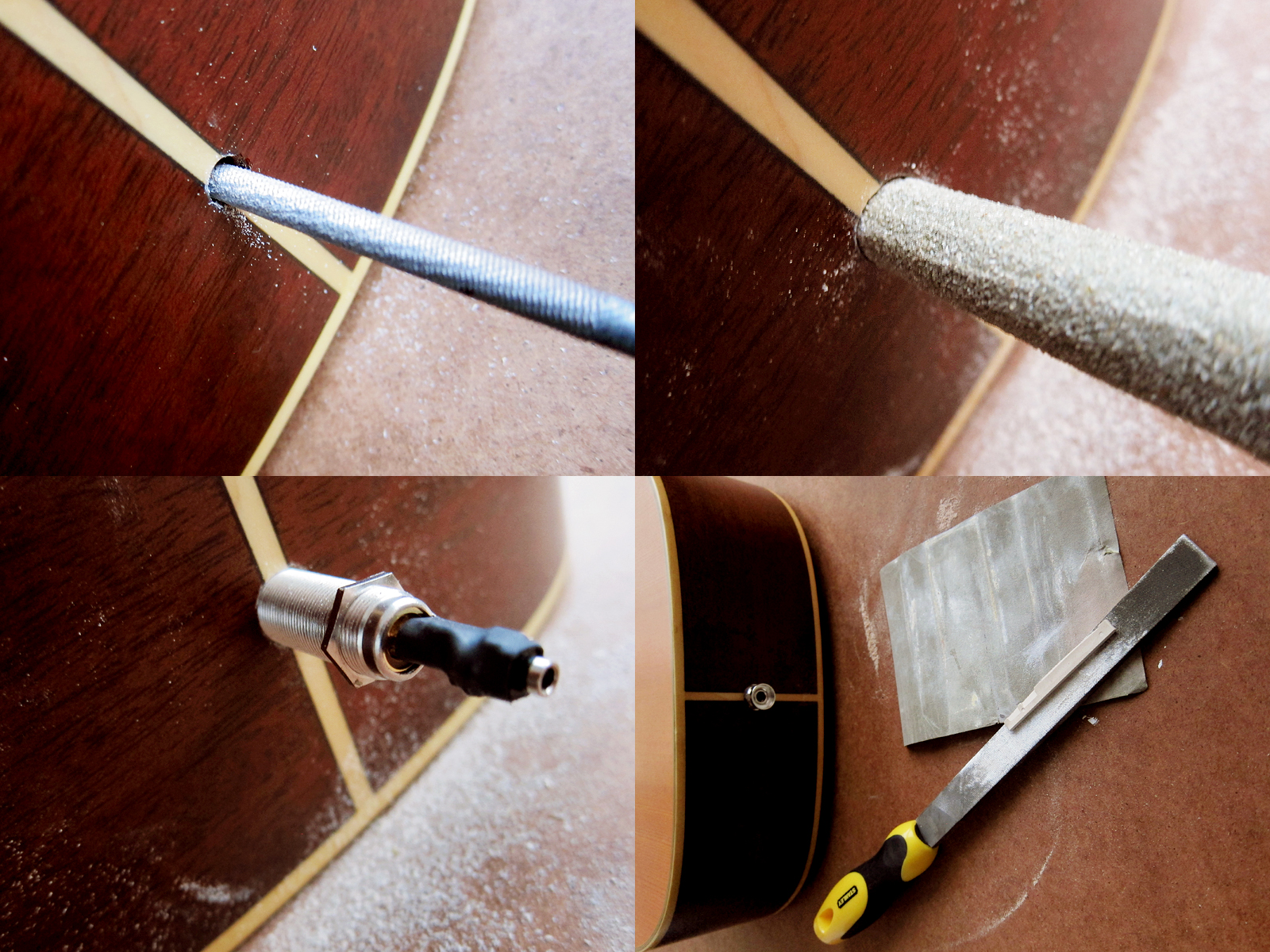
Vintage V880N Parlour acoustic I just drilled a 2 mm hole through the bridge. I wish I wouldn’t have been so lazy and gone and bought a 3 mm drill because the 2 mm was too small and the next size up in my tool box was a 4 mm which would have been too big. I tried to widen the hole with a screw, which worked but it was still a bit tight so when I was fiddling with getting the plug through the hole the plug came off. I was so happy to have purchased a solder free pickup that you could just plug in to the endpin jack, but no, not this time. I had to take the soldering iron out and fix it. I managed to figure out that the thin wire in the middle, the one shielded with plastic, should be connected to the top of the plug and the wide braided wire should be soldered to the side. It worked.

Vintage V880N Parlour acoustic I start to get used to making holes in acoustic guitars now to fit the endpin jack, this was the third one I did. I normally use a round file first to make the hole big enough and then even it out with some sandpaper rolled up, just to get the hole perfectly round. It’s important to check all the time with the plug from the outside so you don’t make the hole too big. Next I had to file down the saddle to compensate the extra height from the pickup.

This guitar is for sale here, Vintage V880N Parlour acoustic

Here is a little sound clip
https://soundcloud.com/claescaster/035-vintage-v880n-with-artec

Hondo II P-bass

Hondo II P-bass

My friend Dani bought himself a Hondo II P-bass copy the other week, well I had to buy it for him since he doesn’t have a eBay account. I took it home and spent my Sunday morning with her,  it wasn’t much work needed. The electronics are pretty old but it works and sounded pretty cool so I think we should keep it as it is for now. However, the actions was extremely high so I had to first adjust the trussrod a bit and then put in a shim in the neck pocket to get the angle of the neck right. Now it’s as low as it can go without any buzzing and it feels really nice to play.

This bass is now for sale.

Hondo II P-bass I love the wood grain, really beautiful. We bought the bass from a UK seller but it seems to have been sold in Canada originally.

Hondo II P-bass Pretty descent wood, good weight and really solid. I’m not really sure what type of pickup that is but it works and sounds good. I folded a business card and used as a shim to get the neck right and to lower the action. I couldn’t find any markings anywhere so we are still not 100% that it is made in Japan, it could be Korean made. Anyway, it feels really nice and seems to be pretty good quality so it doesn’t really matter.

How to… change pickups

Morgan Telecaster, Claescaster

Last Sunday I decided to change the pickups on my old Claescaster. I had ordered a cheap $24.00 set of Artec ones, just regular Alnico V pickups from EY Guitars. I also ordered a new Wilkinson vintage bridge, without any doubt my favourite Telecaster bridge, since I took the old one and put on the new Claescaster. It was a pretty straight forward procedure as usual, I didn’t even have to check Seymour Duncan’s wiring diagram this time.

IMG_9082 copy
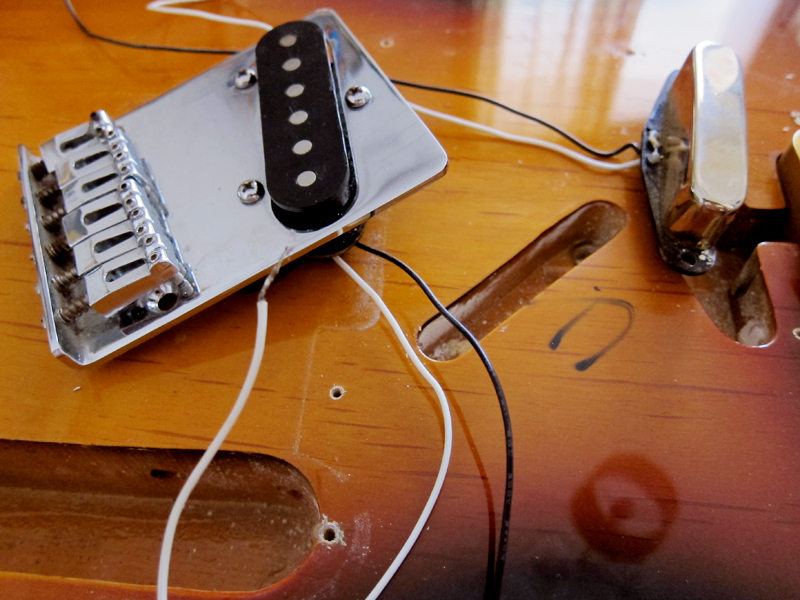
The old stock pickups and bridge from my Morgan Telecaster, aka the old Claescaster

IMG_9084 copy
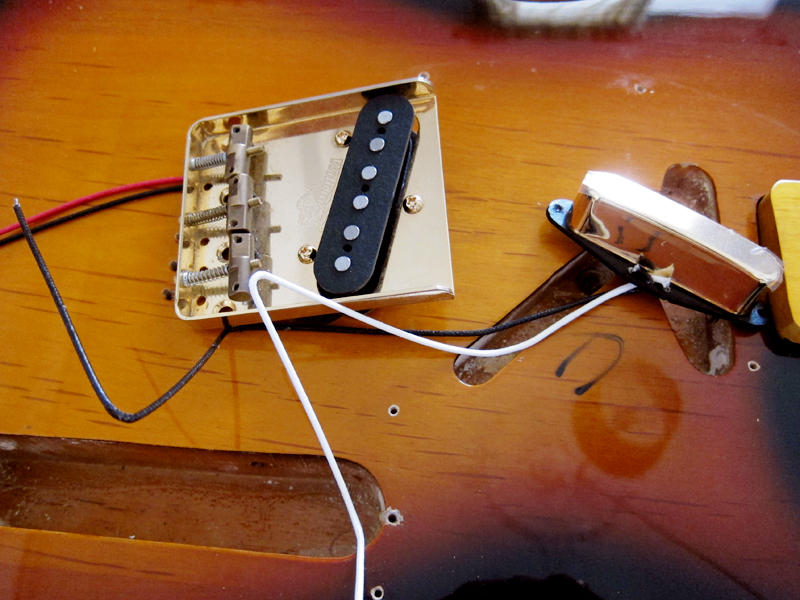
The new Artec Alnico V pickups in gold, mounted on a Wilkinson WTB bridge, in gold of course

IMG_9085 copy
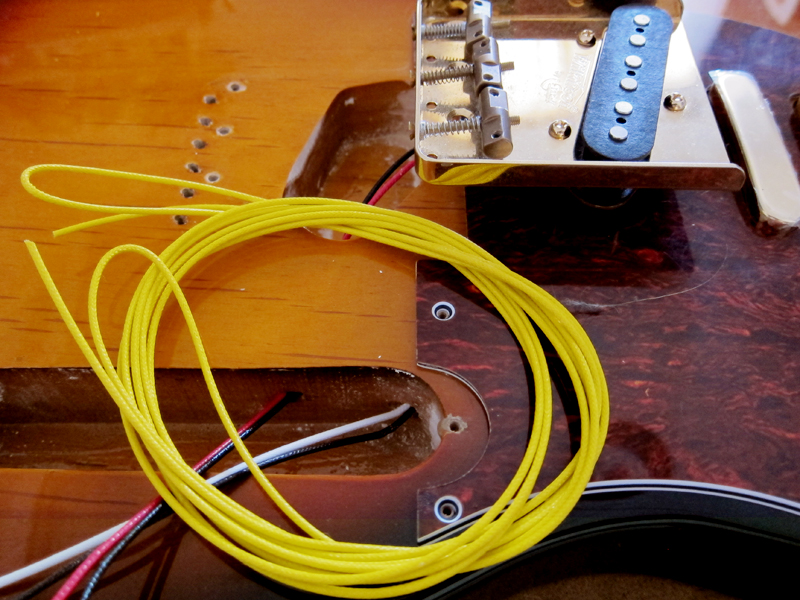
I got 3 Meters (9.8 Feet) of wax coated cloth wire, 22awg, for $1.70, that’s about a tenth of the price here

IMG_9078 copy
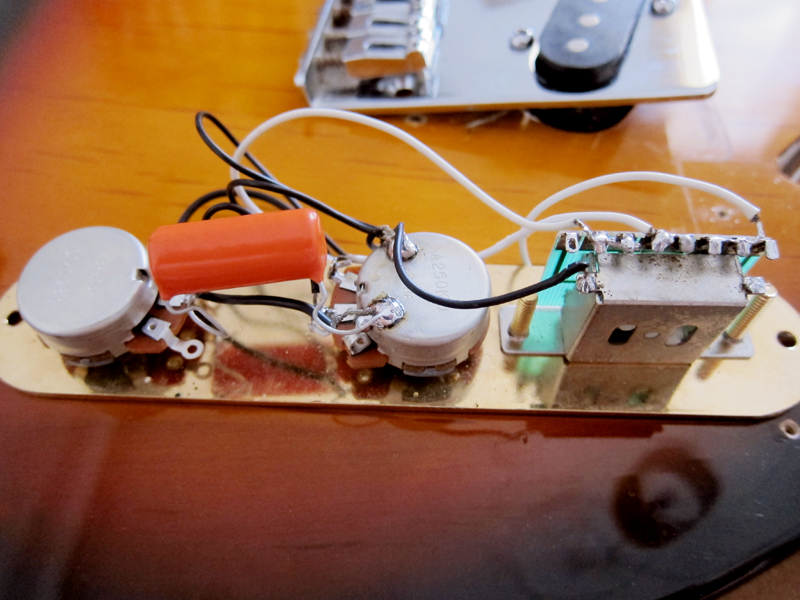
I changed the pots a while ago to nice full size Alpha 250k audio pots. I should probably get a new switch as well but the old one is still working fine

IMG_9090 copy
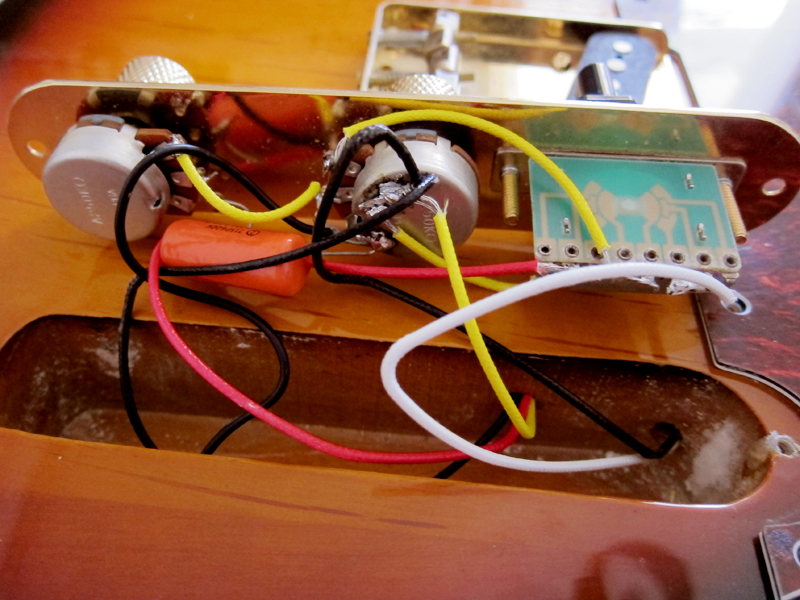
Since the new Artec pickups came with cloth wire I thought I should change all the old crappy pvc wires for some fancy 22awg cloth wire, not sure why I chose yellow though. I stuck to the old 50′s vintage wiring like I had it before

I haven’t tried them properly yet, just plugged them in to see if they worked, well I did a quick little sound clip just to see if there was any difference. I really like the bridge sound of the new ones, really twangy but the neck might be a bit too muffled. I’m rehearsing tonight so then I will get a chance to play loud and see if it was worth $24.00 or not. Hopefully the neck pickup will sound less muffled when I play it through my Fender Blues Deluxe which tends to make even humbuckers sound clear and crisp. Please don’t judge my guitar playing too hard, it was after all a Sunday morning after a long weekend. I think you can hear both my cat and my woman going about their business in the background.

Claescaster Morgan stock pickups (Neck, middle, bridge)

Claescaster ARTEC pickups (Bridge, middle, neck)

Update 2013-07-12I might have got a bit too carried away last night because the two sound clips I recorded are very LOUD. I guess I had more fun with my new pickups than I expected. I think they sound pretty good, I’m not the worlds greatest guitar player but to me they sound way better than the old stock pickups. The neck pickup didn’t sound muffled at all through my Fender Blues Deluxe, and the middle sounds sweat like hell, well worth $24.00.

Claescaster ARTEC pickups with Fender Blues Deluxe (Bridge, middle, neck)
https://soundcloud.com/claescaster/011-claescaster-artec-pickups

Claescaster ARTEC pickups with Fender Blues Deluxe (Bridge, middle, neck)
https://soundcloud.com/claescaster/014-claescaster-artec-pickups

Fender Telecaster Japan TL52-75

Fender Telecaster TL52-75, ’52 re-issue, Made in Japan Fender Telecaster TL52-75, ’52 re-issue, Made in Japan by FujiGen between 1987-1989

As a Roy Buchanan fan I always dreamt of owning my own “Nancy“. The story how Roy found his Nancy is pretty interesting. In 1969 Roy got fed up with the music industry and enrolled in a school to learn to be a hairdresser. One day during class he saw a guy walking pass the window carrying an old butterscotch blonde Telecaster and Roy fell in love at first site. He chased after the guy and told him that he could pick any guitar he wanted in a nearby music store and in the end bought him a new purple Telecaster to trade for the 1953 Fender Telecaster, serial number 2324, that later became his beloved Nancy. My story wasn’t that interesting. I had kept an eye out for a Japan made ’52 reissue and one day I saw that my favourite eBay seller in Japan, Tokyowax had one for sale. So in October 2012 I became the proud owner of a Fender Telecaster TL52-75, ’52 re-issue, Made in Japan by FujiGen between 1987-1989. There is no way to find the exact production year of these A-serial Telecaster with the serial number on the bridge plate. However, it must have been made between 1987 and 1989 since it’s a TL52-75. They were called TL52-70 between 1984-1986 and then changed to TL52-700 in 1990. I do love Nancy, she is an extremely heavy and amazing sounding Telecaster but I still struggle a but with the neck. She has a typical mid eighties Japan neck, really flat and fast playing, without any doubt the fastest guitar I have after my 1975 Hagström HIIN OT. The problem is that I’m not such a huge fan of slick and easy to play necks. I like quite high action and really fat necks so I have to make an effort to play, it’s a part of the feeling for me. Nancy is still an awesome guitar and sounds great from stock, everything is made in Japan, machine heads, pickups, switch and pots. However, there was one thing that really annoyed me, the brass saddles. If you live in a Mediterranean coast city like Barcelona, you will have to adjust your guitars a lot to cope with the humidity. I have to adjust the truss-rod and saddles on most of my guitar when the seasons change and with Nancy it was a nightmare. The only screwdriver that was small enough to fit for adjusting the height of the original saddles was a tiny little weak thing that I got for my watches. Since I didn’t have strength enough to move the screw while the guitar was tuned I had to loosen the string every time, then tune it again. I was also a bit disappointed with the intonation high up on the neck so I decided to change for my favourites, Wilkinson compensated brass saddles. I found a set really cheap from Swivel Electronics in Singapore and a couple of weeks ago I got around to change them.

♪ ♫ Roy Buchanan – CC Rider

Fender Telecaster TL52-75 The old ones might have had more sustain since they were heavier and seemed more solid but to be able to adjust the height with a simple Allen key, without having to loosen the string is more important to me.

Fender Telecaster TL52-75 All done, I’m sure they will look old in a few month and blend in perfectly with the rest of the hardware. The humidity here in Barcelona seems to age metal very quickly.

Fender Telecaster TL52-75, ’52 re-issue, Made in Japan I bought Nancy because I wanted a blackguard ’52 re-issue but quite soon I realised that everyone else in Barcelona had one too, well not a Japanese but still. It suddenly felt and looked more Bruce Springsteen than Roy Buchanan so I decided to change to a tortoise shell 5 hole pickguard to make it look a bit more Country-,  Swamp-, Southern rock. 

EY Guitars

EY Guitars

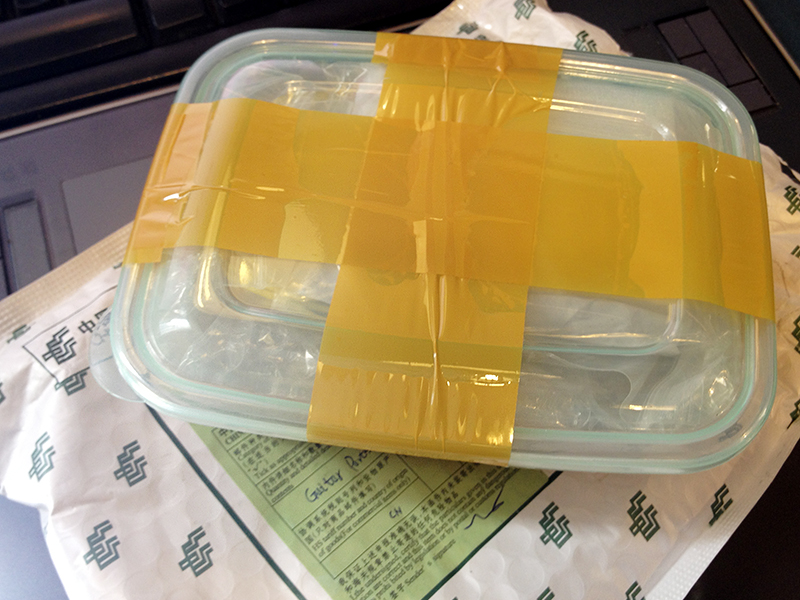
I just received my package from Hong Kong, the guitar parts I ordered from EY Guitars for the old Claescaster. How cute is this, they have packed it in a lunch box to keep it safe. I wonder if that something they always do or if it was just a really considerate worker that thought that Spain was really far away and it might be a bumpy ride so he or she better pack it in a Tupperware. They were pretty quick too, I placed the order on the 6th, sent out on the 8th and here on the 25th, just two work weeks. It was holidays here in Catalonia this weekend so I bet no one was working on Friday or Monday, it might have been lying around here in the post depot since the middle of last week, it has happened before.

The Old Claescaster

I have just ordered a new set of pickups for the old Claescaster. Since the new Claescaster is done I felt I needed another project so what could be better than giving some love to the old Claescaster. I went for some cheap Artec ones, just regular Alnico V pickups but with a bit of luck they could be good. They only cost  $24.00 for both so I don’t expect too much. I bought them from a Hong Kong site called EY Guitars, I didn’t want to order things from USA since I had so much trouble with the customs last time. I also ordered a Wilkinson vintage bridge in gold since I took the old one and put on the new Claescaster. Let’s see how it goes, how long it takes and if I get charged any extra custom fees.

cropped-claescaster3.jpg The old faithful Claescaster

These are the Artec Hot Ceramic Telecaster Pickups, a bit fancier then the ones I bought but they were sold out in gold so I had to go for something else.

The Claescaster

Mighty Mite Telecaster The new Claescaster

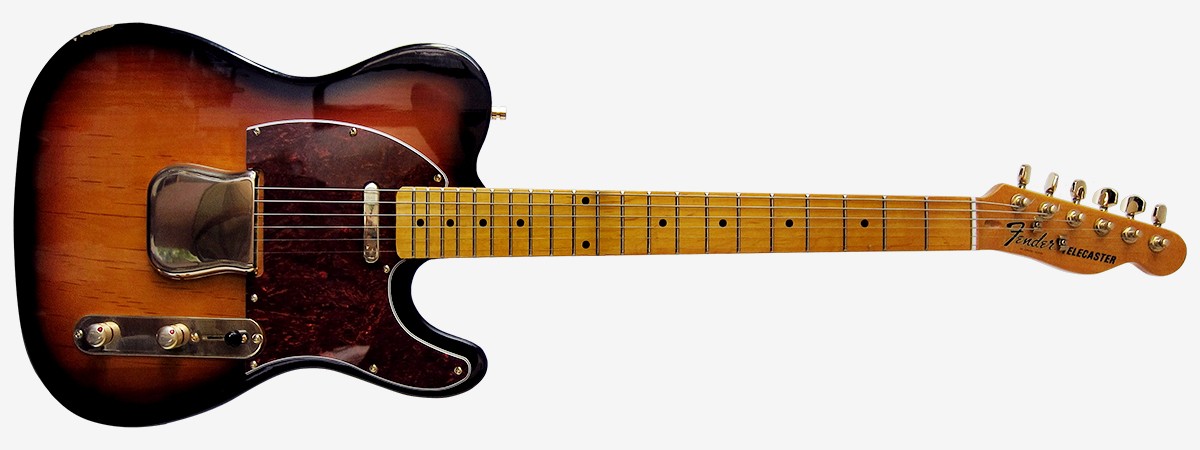
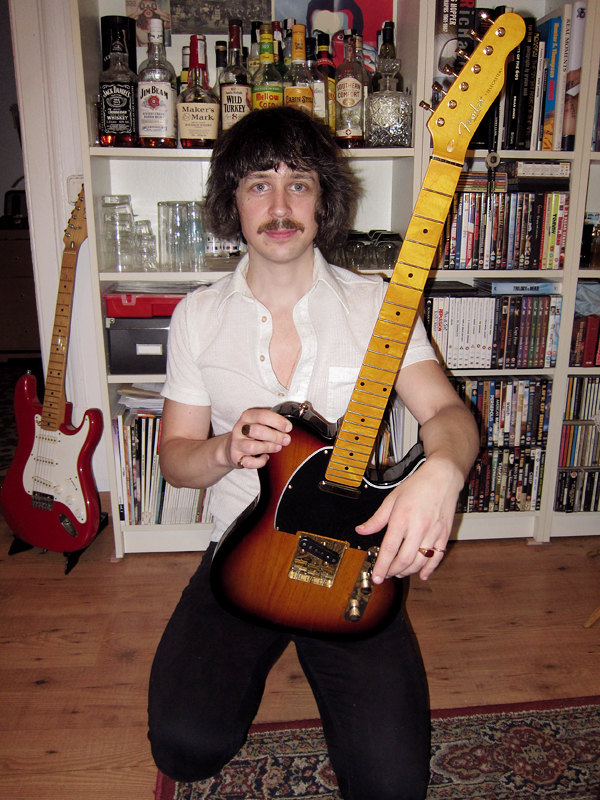
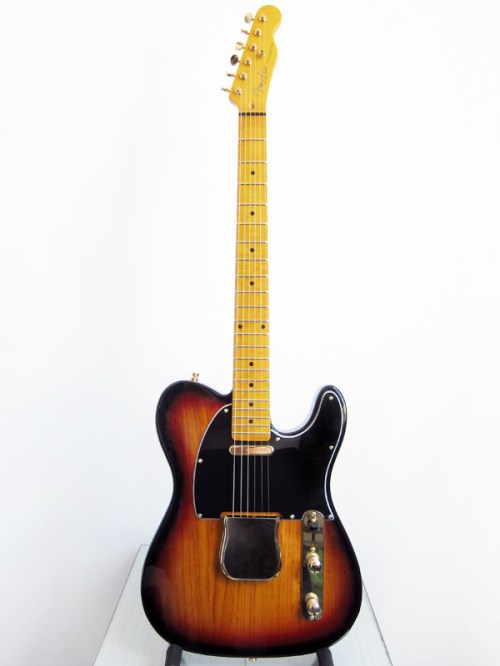
My new Claescaster is finally done. It was fun, rewarding and extremely annoying to build. If anyone plans to put a guitar together, make sure that you either stick to American parts or non American parts. To mix like I did was a nightmare since nothing fitted. I don’t think a single part fitted straight away, I had to make every hole bigger, or cut a bit here and sand a bit there. Anyway, now it’s done and I’m really happy with it. I just need to change the nut tonight for a Tusq and then we are all set.
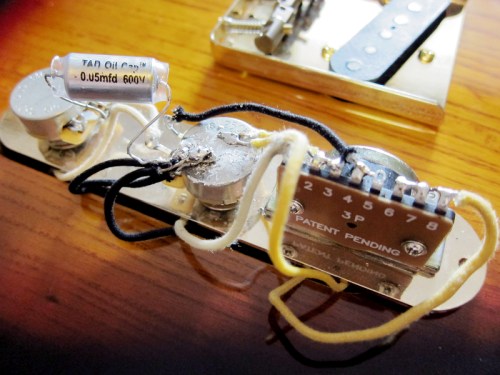
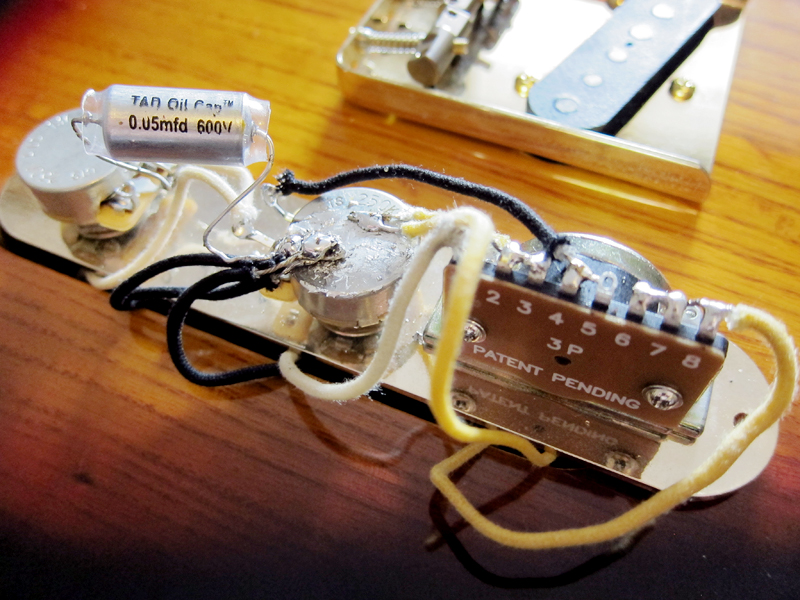
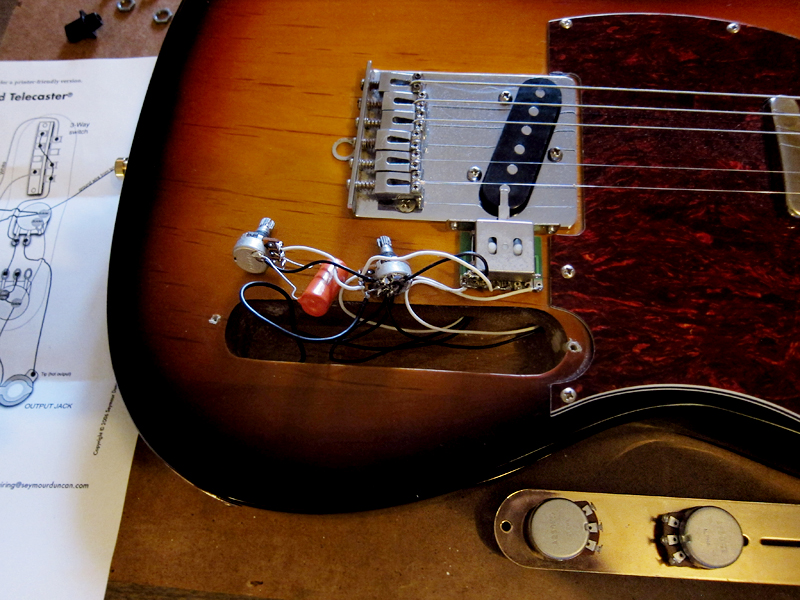
Telecaster electronics Not the cleanest soldering but at least everything works

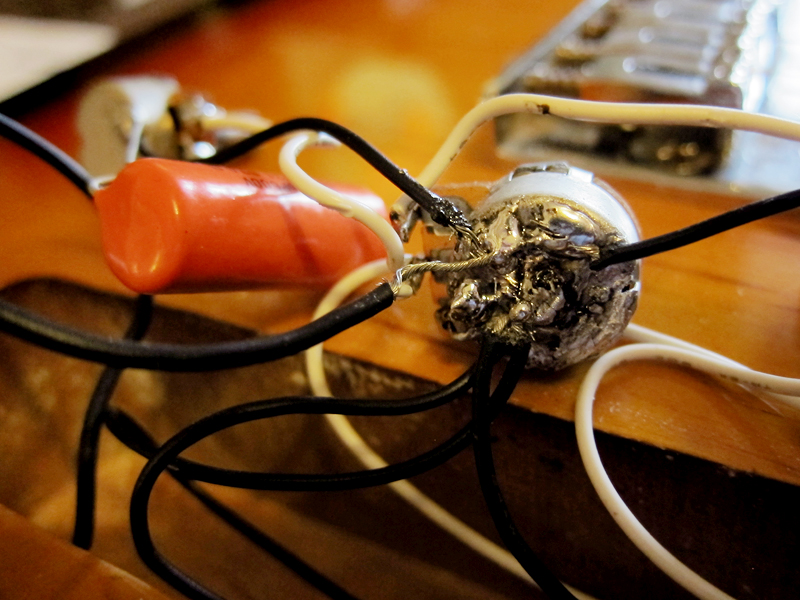
I wish the ground cables would have stuck a bit easier to the pot so the soldering wouldn’t have been such a mess. I also realised when I first plugged it in that the switch didn’t work since I had soldered 1-3 and 6-8 together, apparently 1 and 8 shouldn’t be connected.
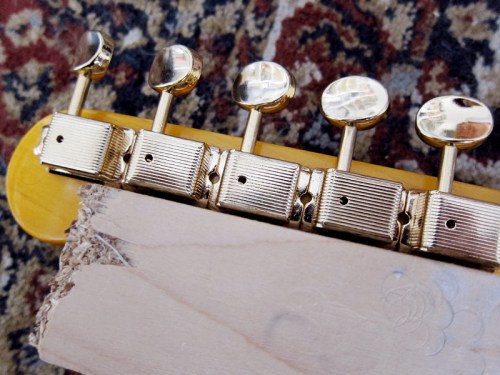
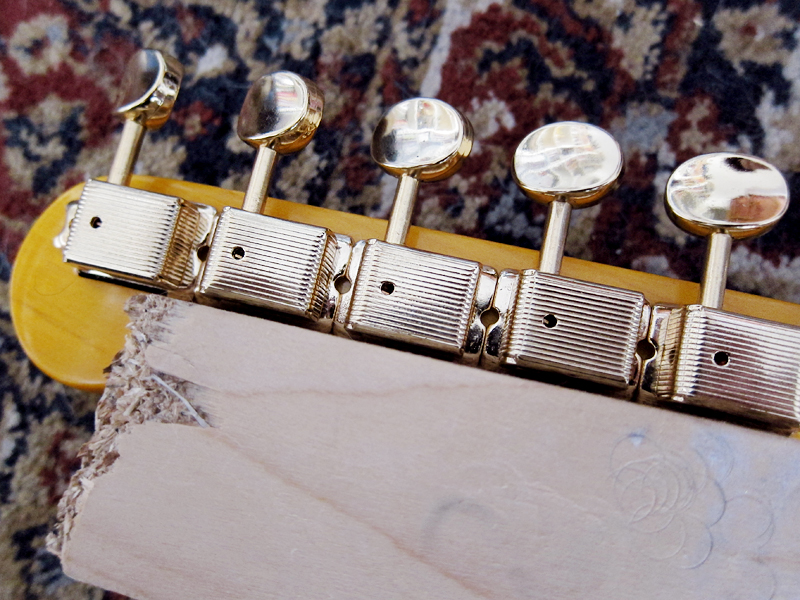
Kluson style machine heads Kluson style machine heads from Northwest Guitars

To fit the machine heads was pretty easy. Of course I had to make the holes bigger since they were 8mm and not 8.5mm as I was first told. I used a piece of wood to keep everything straight and to make sure they lined up. Then a tiny little pilot hole with the drill and in with the screw.
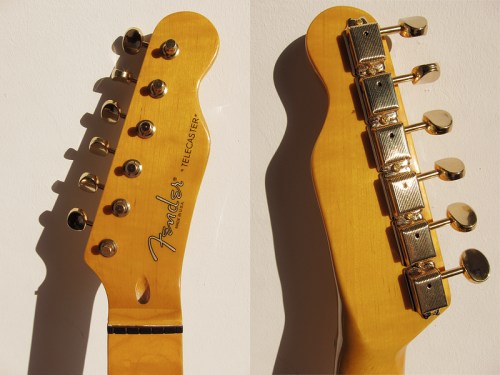
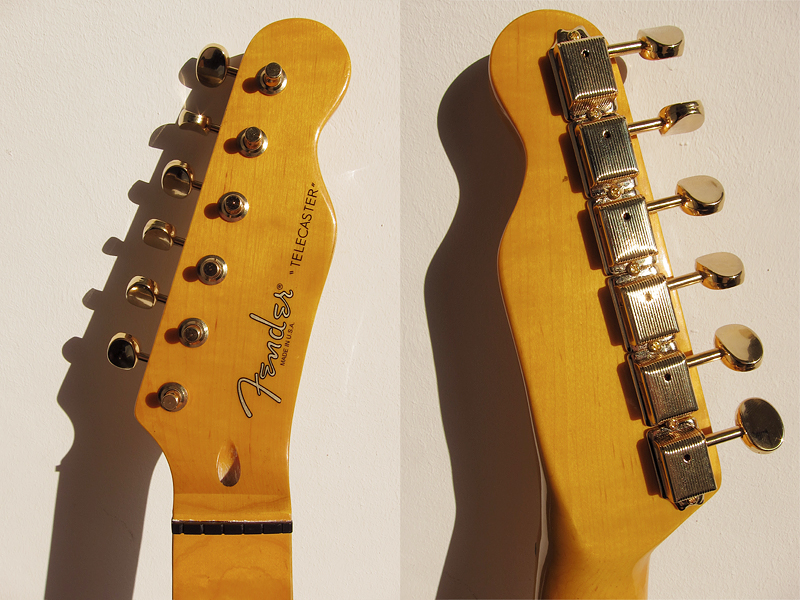
Kluson style machine heads I originally wanted a 70’s decal and modern machine heads but I think I start to prefer the 50’s logo and the Kluson style machine heads
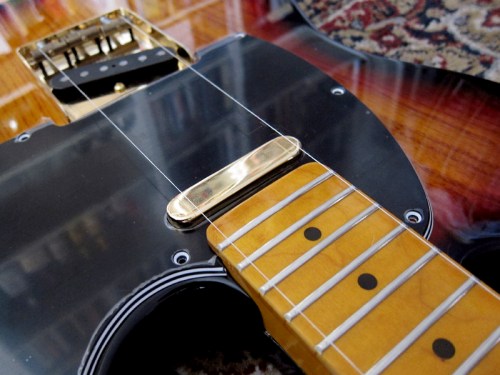
Mighty Mite Telecaster Time to fit the neck

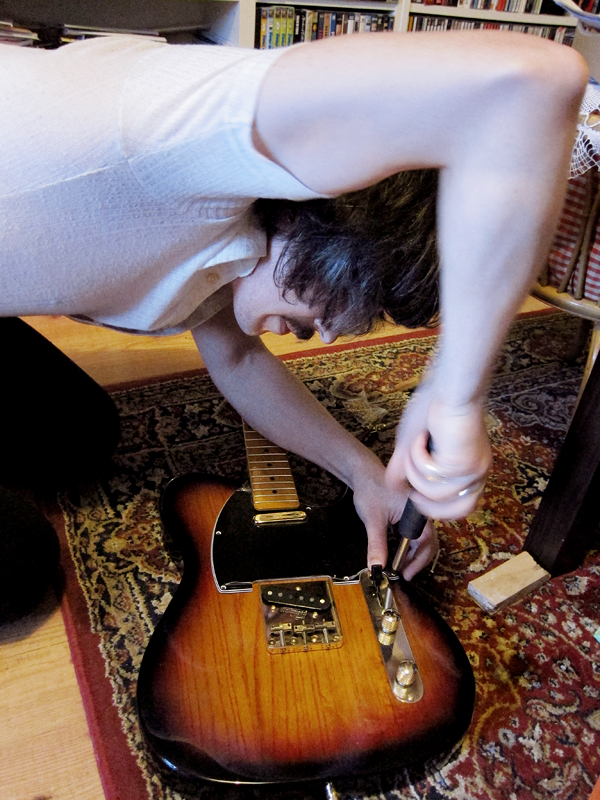
I read somewhere that this was a good trick to make sure you get the neck in the correct angle before you drill the holes. A piece of string through the body and around the two E strings to make sure that they are evenly spaced. I marked the holes with a hammer and a screwdriver before I drilled the pilot holes and then tried my best to keep the drill straight. A lot of people claim that you have to use a drill press but it works fine with a normal hand held drill.
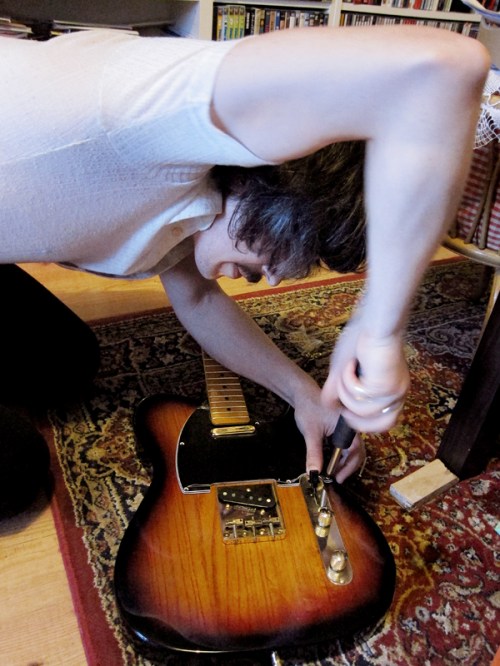
Mighty Mite Telecaster Last thing to do, fit the pickguard

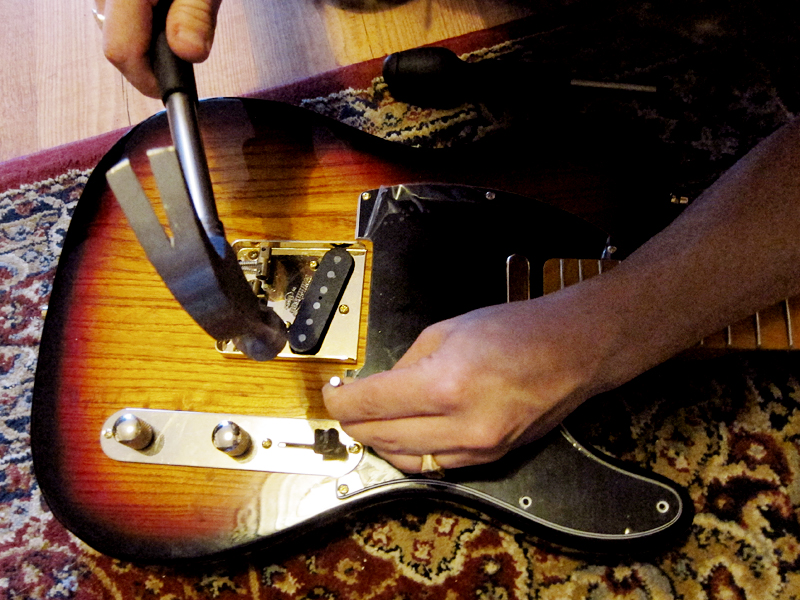
Of course the pickguard didn’t line up perfectly in the end so I had to cut out a bit more around the control plate. I used a knife and then smoothed it out with sandpaper around fat marker pen. I probably should have used a drill to make the pilot holes since the old nail and hammer tended to crack the lacquer in some places.
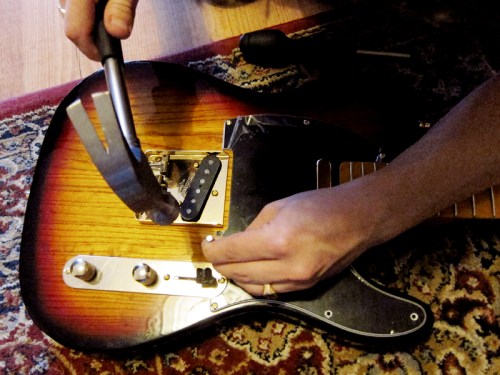
Mighty Mite Telecaster Last screw being marked out with a hammer and a nail
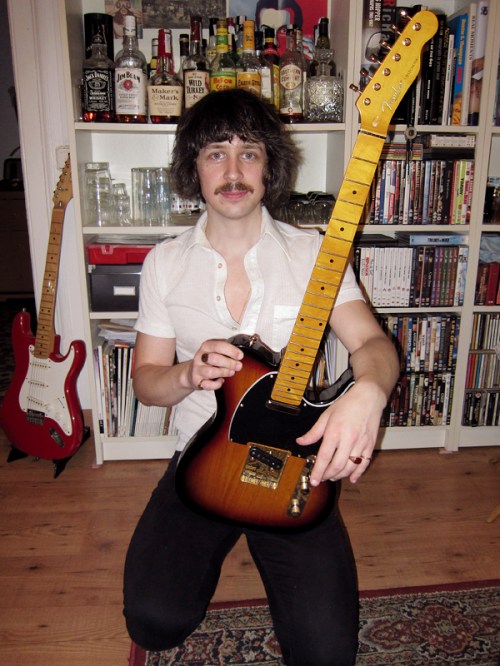
Mighty Mite Telecaster The Claescaster is finally finished

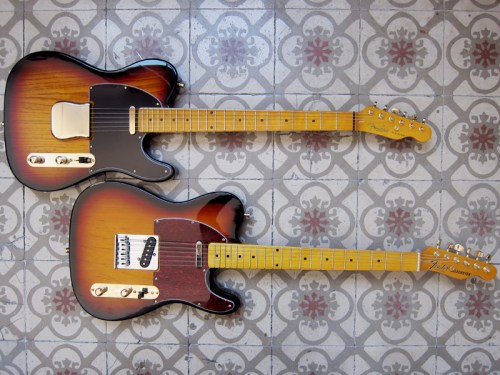
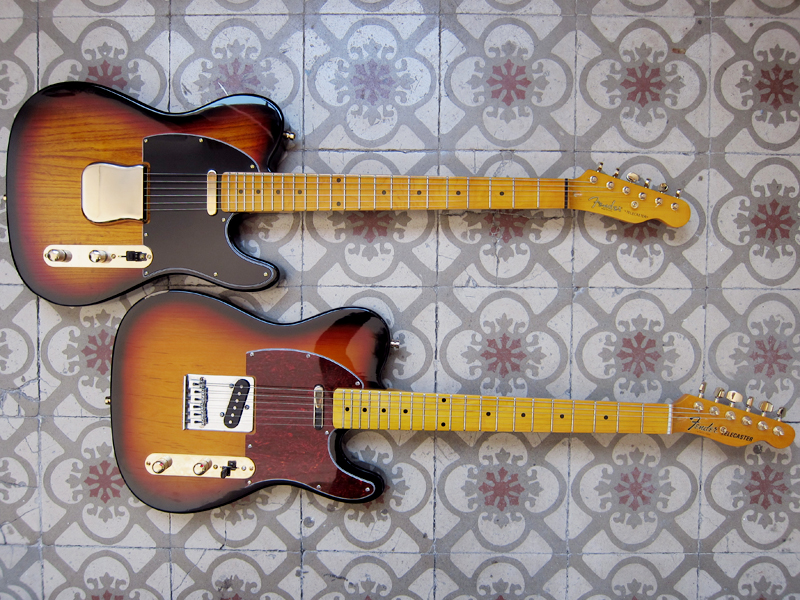
The Claescasters The old and then new Claescaster together

Look at the grain on the top one, the new swamp ash Claescaster, amazing. It weighs around 4.5 kg so a pretty fat little baby but it feels amazingly solid and nice around the neck. The old one, which is most likely basswood, weighs around 3.2 kg.

Earlier parts of the Claescaster story can be found here 1, 2, 3, 4.

How to… solder electronics

How to change a switch
I spent Saturday doing my new favourite thing, soldering. How could I have lived for thirty two years without realising how exciting this is, well maybe not, but still. It’s a nice past time and probably healthier, even with the fumes, than spending Saturday afternoons in the sun drinking beer in a terrace, that tends to happen when you live in Spain. First I changed the old 3-way switch on my Westone Strat from 1979 to a fancy US made 5-way switch that I got from Swivel Electronics on eBay Japan.

Westone Strat from 1979 Note how bent the blade of the old switch was

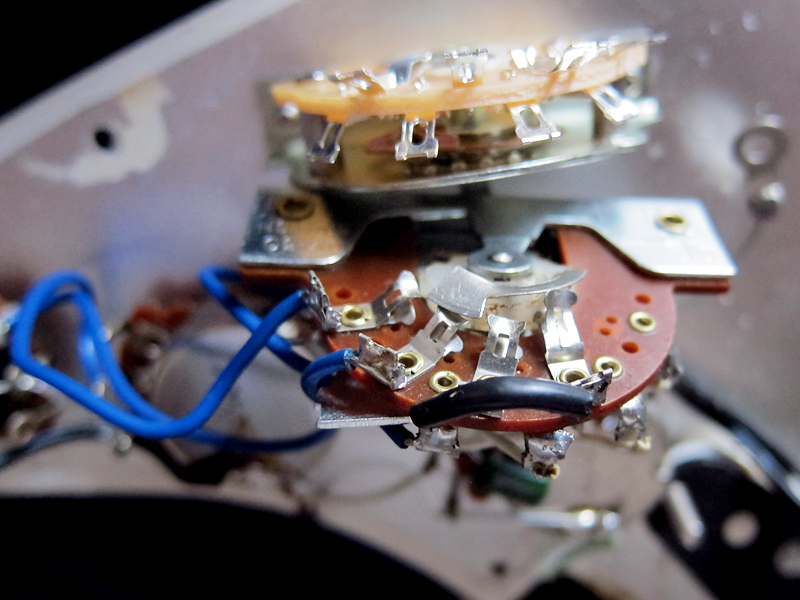
I fitted the new switch and then started to unsolder one cable at the time and moved it from the old to the new switch. Unfortunately I managed to fit the switch the wrong way around so when I was done and had put the pickguard back on and strung up the guitar again I had to take it all off and redo it. I turned out that a 5-switch wasn’t that much more complicated than a 3-way switch for a Telecaster and I know those by heart now. Suddenly I have a fully functioning 70’s Japanese Strat and who knew that the in-between pickup sounds would be so amazing.

Westone Strat from 1979 New 5-way switch fitted

How to change a potentiometer
When I ordered all the electronics needed for the new Claescaster I bought two new pots for the old Telecaster as well. I found this great guitar shop in Valencia called Stringsfield with super cheap and quick shipping so I got two Alpha 250k audio pots for my old one and two CTS 250k for my new Claescaster project, my Mighty Mite Swamp ash body that is still stuck in customs in Madrid.

Morgan Telecaster, Claescaster It was time to change the old mini 500k pots for a full size Alpha 250k

Morgan Telecaster, Claescaster I fitted the new pots on the control plate and then started to move all the cables around

The old electronics was such a mess so I changed the pots but kept cables, switch and my Orange drop capacitor. I figured there was no point buying any better cables since I wasn’t going to change the pickups yet. I might change all of that in the near future, as soon as the new Claescaster is done. I’m tempted to get the Artec Vintage Style AlNiCo Telecaster Pickup Set from Northwest Guitars, they sound really good for the price, £29.99. Of course I did the old 50’s vintage wiring again, I really liked the tone of that modification. I haven’t had time to rehearse with this guitar yet but I’m pretty sure that the new pots will make it a bit less treble sounding and hopefully make it sound a bit warmer.

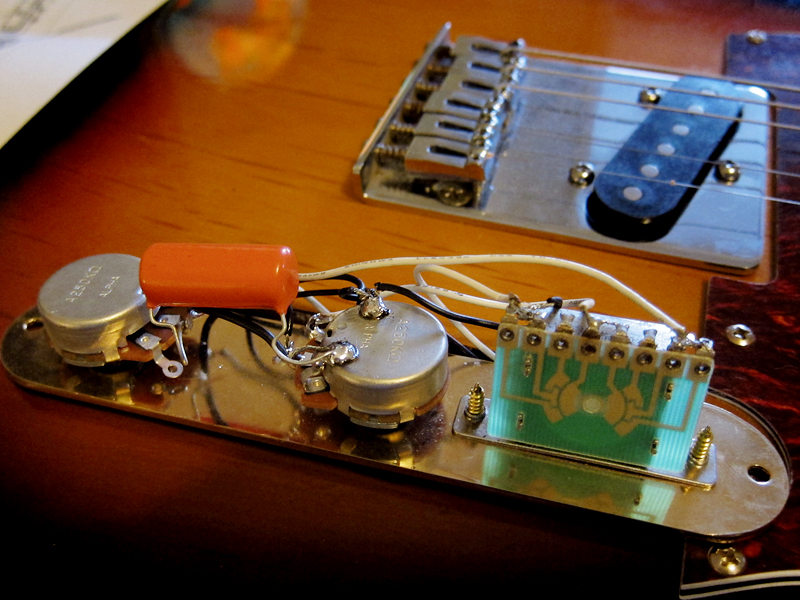
Morgan Telecaster, Claescaster Looks pretty clean and tidy to me