A really well kept Suzuki Three-S F-120. Built in 1978 by Suzuki Violin Co. LTD in Nagoya Japan.
I recently found another Suzuki Three-S F-120. These are great little Japanese built guitars that I can highly recommend. Really sweet tone and pretty descent build quality for being so inexpensive. Of course they can’t compare to Morris or K. Yairi but next to Aria, Maya, Shiro or the normally Suzuki’s they are great. It’s a simple Martin D-18 copy built in 1978 by Suzuki Violin Co. LTD in Nagoya Japan. What always surprises me with these Suzuki Three-S F-120 is how light they are compared to a lot of Japanese dreadnoughts from the 1970’s that can feel pretty heavy and bulky. Unfortunately this one was sold straight away so I only got time to fix it up and make a Youtube video of it before it was gone. If you want to know more about different Japanese guitar brands then check my previous post.
Suzuki Three-S F-120 in an old Japanese catalogue from 1979. It has spruce top, might actually be solid, with a laminated nato back and sides. Nato neck with a really dark rosewood fingerboard and bridge, it almost looks like ebony.
I recently changed the machine heads on my 1970’s Japan made Morris W-50 to Wilkinson WJ28NGD open gear in gold and I couldn’t be happier
I have said it before but it’s worth mentioning again, I really like Wilkinson hardware for my guitars. I have their vintage bridge with compensated brass saddles on numerous of my Telecasters and their machine heads on even more acoustics and electrics. So far I have tried the following models, WJ01GD, WJ44CRGD, WJ309GD and now WJ28NGD on my new Morris W-50. Wilkinson machine heads are cheap, good quality, accurate and the gold doesn’t seem to fade straight away. They are made in Korea and was first distributed through John Hornby Skewes & Co. Ltd. but now you can find them pretty much everywhere. I bought mine from Axesrus which turned out to be really nice and helpful guys. The best part is that now you can get Wilkinson machine heads with either 8 mm or 10 mm bushings which is perfect since a lot of the Japan made acoustics comes with 10 mm holes. I don’t just randomly change the machine heads on all my guitars but I can’t stand the horrible bulky 1970’s closed machine heads in chrome that most Japanese guitars comes with. How much nicer doesn’t the Morris W-50 look now with these delicate open gear tuners in gold?
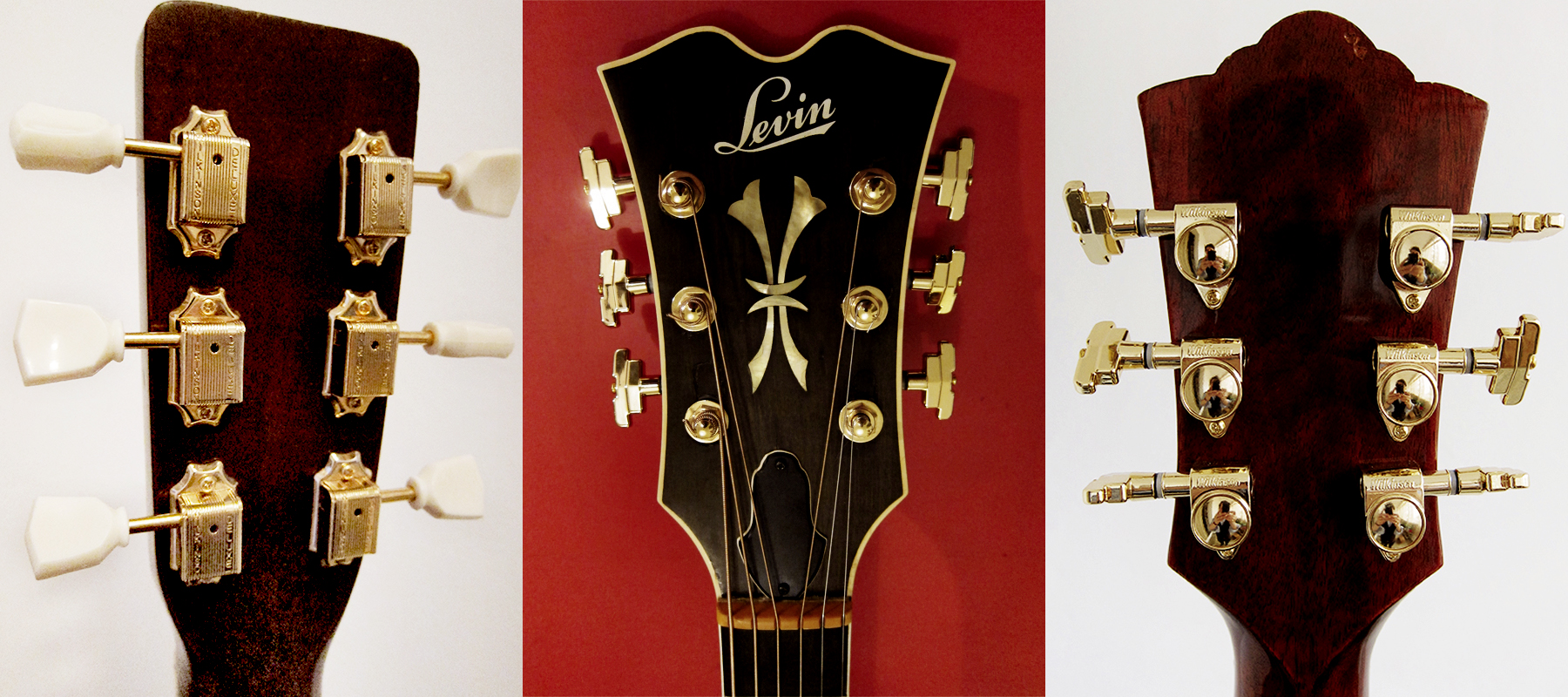
Some guitars that got the Wilkinson treatment. Morris W-40 with Wilkinson’s WJ44CRGD which comes with cream buttons, not that horrible green tinted ones. My Levin 174 and K. Yairi TG-40 got upgraded with the amazing looking Art Deco inspired WJ309GD
Gibson J-50 Deluxe, made in Kalamazoo, Michigan, between 1970-72
As mentioned before I have been dreaming of a Gibson J-50 for years now and last week I finally managed to find one. Of course I would have preferred a 1940’s or 1950’s one but it’s hard to even afford one from the 1960’s with today’s vintage guitar prices, and I really don’t approve of the adjustable bridge they used in the mid 1960’s. They changed from round shouldered to square shouldered around 1969 and at the same time got rid of the horrible adjustable bridges. Gibson reached a lot of low marks in the late 1960’s with laminated backs and sides, plastic bridges, massive bridge plates and double X-braces to stiffen up the tops and making sure that they wouldn’t belly or break. I knew when I bought this J-50 that it might not sound like James Taylor’s, not just because it’s not a round shoulder, but also because of the double X-bracing and the general build quality of a 1970’s Gibson. Even though it doesn’t sound like James Taylor’s J-50 I really like the sound of it and it’s very pleasing on the eye too, at least for me. I love the simplicity of the small black drop shaped pickguard and the grain of the top is just amazing. It’s a Gibson J-50 Deluxe with the original Gibson Deluxe machine heads, made at the Kalamazoo plant between 1970-72, apparently it’s impossible to date it any closer.
It has had a neck reset at some point and it seems like the bridge has been re-glued too, which could mean that it’s one of the earlier ones that perhaps came with an adjustable bridge and someone changed it to a normal rosewood bridge. I bought the guitar from a gentleman in Oxford, England where it had lived for the past 15 years but before that it came from Oklahoma, USA, where the repairs where made at some point. The bridge plate seems to be a really thin, delicate and made of spruce, perhaps that’s been updated too since these where know for having massive tone killing blocks of wood under the bridge. It has the double X-bracing which I guess has it’s pros and cons like any other form of bracing. It’s an extremely light and well sounding guitar, I don’t know how they managed to build it so light since these are supposed to be really heavy. Gibson got tired of all the returns which cost them a lot of money so in order to increase profit they started to build their acoustics thicker and heavier until they were built like tanks and could survive any beating. These are known as the Norlin era Gibson guitars, but it’s important to remember that even though Norlin took over in 1969, the old owners CMI kept control over the Gibson production up to 1974, so I guess that’s when the real dip in quality happened. As with any vintage guitar of any brand, there are good ones and there are bad ones. Not all Levin guitars are good, but all of the 12 I have sounds amazing so perhaps some brands are more even in the quality than others. I feel that I was lucky with this Gibson J-50 Deluxe and managed to find an extremely light built and very well sounding example. I wished that the bass was a bit deeper, it still has the Gibson bass response, but since the mid range and trebles are so good I’m still very pleased with my new guitar.
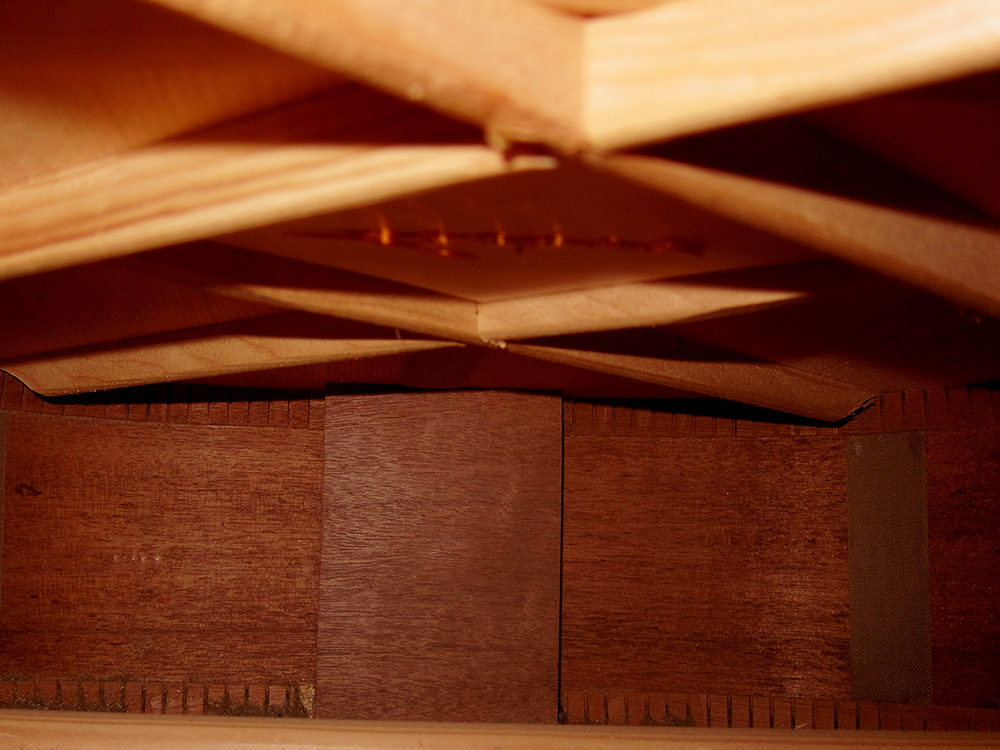
A picture of the inside, beautiful solid mahogany back and sides, with the dreaded double X-bracing. It actually sounds better than expected and since the braces are fairly thin and delicate, together with the thin spruce bridge plate, it’s a very light and resonant guitar with great sustain. Except for a little worn patch on the neck after a capo and two tiny cracks in the top where the pickguard has shrunk it’s in very good state for being 45 years old. The neck reset and general set up it had before it left Oklahoma has made it an extremely easy guitar to play with fantastic low action. It has 011 gauge strings on in the clip below, I guess with 012’s it will sound even richer.
I have decided to thin out my Levin collection a bit, I have 12 at the moment, so the first to go will be my beloved 1950 Levin Model 13 Ambassadör. It was restored a few years ago by GammelGura, a great luthier in Örnsköldsvik, Sweden. With new bronze frets, a neck re-set, cracks glued and a new bridge was created to improve the intonation, the rest is all original. It even has the sticker on the back of the head from the guitar shop in Örnsköldsvik where the guitar was bought 65 years ago. If you are interested in the guitar send me an email or give me a call, all info can be found on the For sale page.
Levin Model 13 Ambassadör
Body width: 400 mm, body length: 480 mm, scale length: 640 mm
Spruce top, walnut back and sides, 4-ply bound top, single-bound back
Mahogany neck with non-adjustable T-shaped duraluminum truss rod
Single-bound rosewood fingerboard with 18 frets and pearloid dot inlay
Single-bound headstock, rosewood bridge, nickel plated individual tuners
Sunburst finish and 10 years warranty
I love this clip, I have feeling that David Lindley have never bought a guitar himself, just borrowed other peoples guitars until they have forgotten that he has them and they become his.
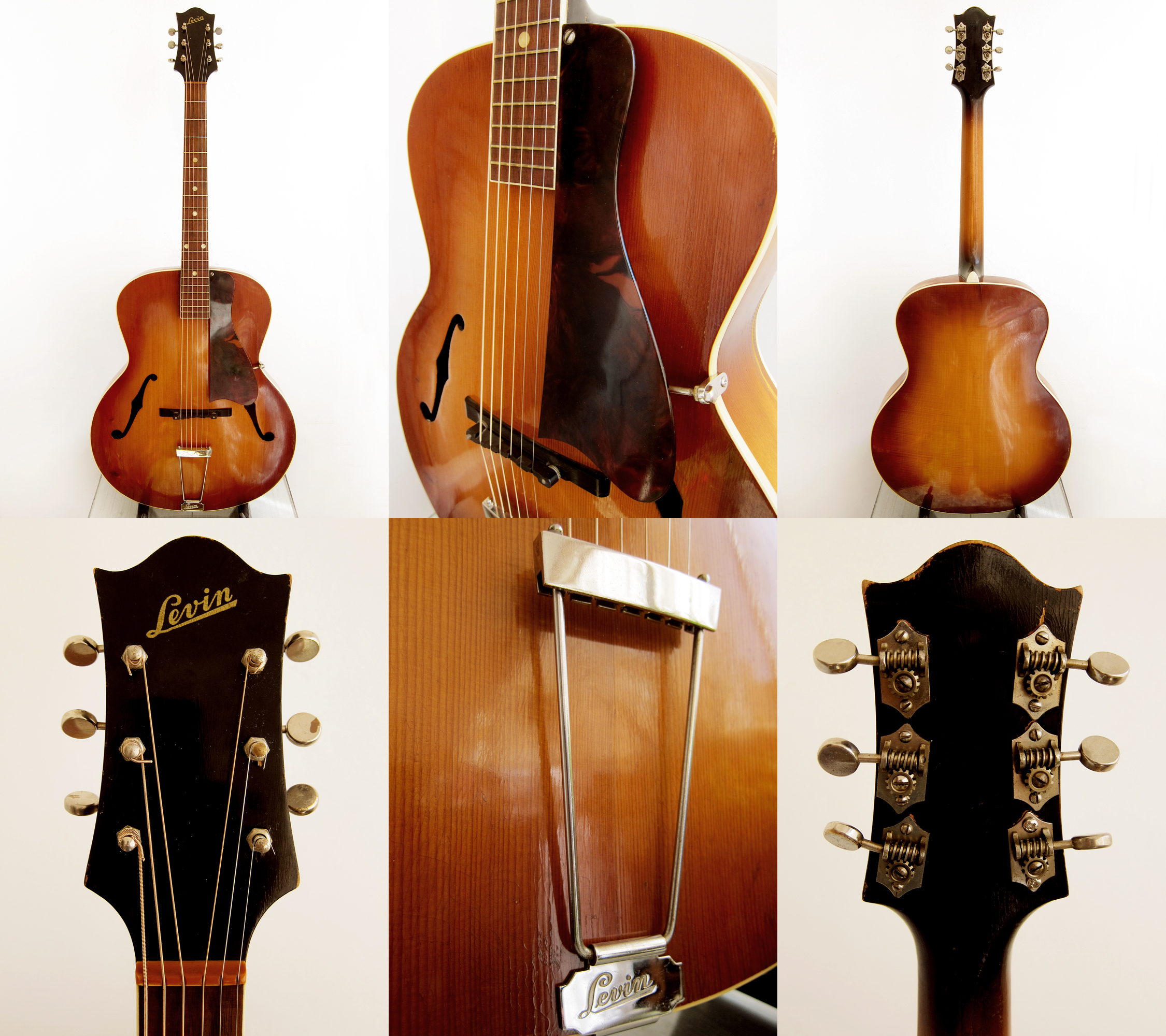
I recently got this old 1946 Levin Model 32 from an eBay seller in Vienna. The guitar has clearly seen better days but I felt she deserved a second chance in life so I got her home, dolled her up and now she is playable again. I had no idea what model it was when I got it and I was actually hoping that it would be a Model 30 from the late 1930’s, they look very similar but it turned out to be a Model 32 from the mid 1940’s instead, which isn’t bad. I guess I just wanted to have a Levin that was older than my 1942 Levin Model 65. It’s pretty close to my 1951 Levin Royal in sound and feel but with a more casual appearance. I guess there was a shortage of tonewoods all over Europe during the war so they used what they got. This one has a hand carved 3-piece Romanian spruce top and you can even see a couple of knots around the f-holes. I don’t really mind, together with all the cracks it’s just adding to that old worn archtop look and feel. The back is really beautiful though and the neck feels great, really fat and chunky as I like. It also has a quite different sunburst compared to what Levin normally used in 1940-50’s. Levin used to copy Gibson’s tobacco sunburst but this one has more of a cherry sunburst.
Levin Model 32
Non-cutaway. Body width: 420 mm, body length: 510 mm
Hand carved Romanian spruce top, mahogany back and sides
Single-bound top with unbound f-holes
Single-bound back, unbound pickguard and unbound headstock
Mahogany neck with non-adjustable T-shaped duraluminum truss rod
Single-bound rosewood fingerboard with mother-of-pearl dot inlay
Nickel plated hardware, sunburst finish and ten years warranty
Available between 1940 – 1947
Levin Model 32, here between the model above, the beautiful Model 27 and the slightly cheaper Model 35. I love that the case option offered in the bottom of each ad is a plain textile bag with a zip, really, textile? The list price for the guitar in 1946 was 285 SEK, around 30 Euro. The Royal listed that year at 575 SEK an the top of the line, the Deluxe at 1000 SEK. Taken from a 1946 Levin archtops catalog, thanks to Vintage Guitars Sweden
She looked a bit sad when she arrived, but there was nothing that couldn’t be fixed
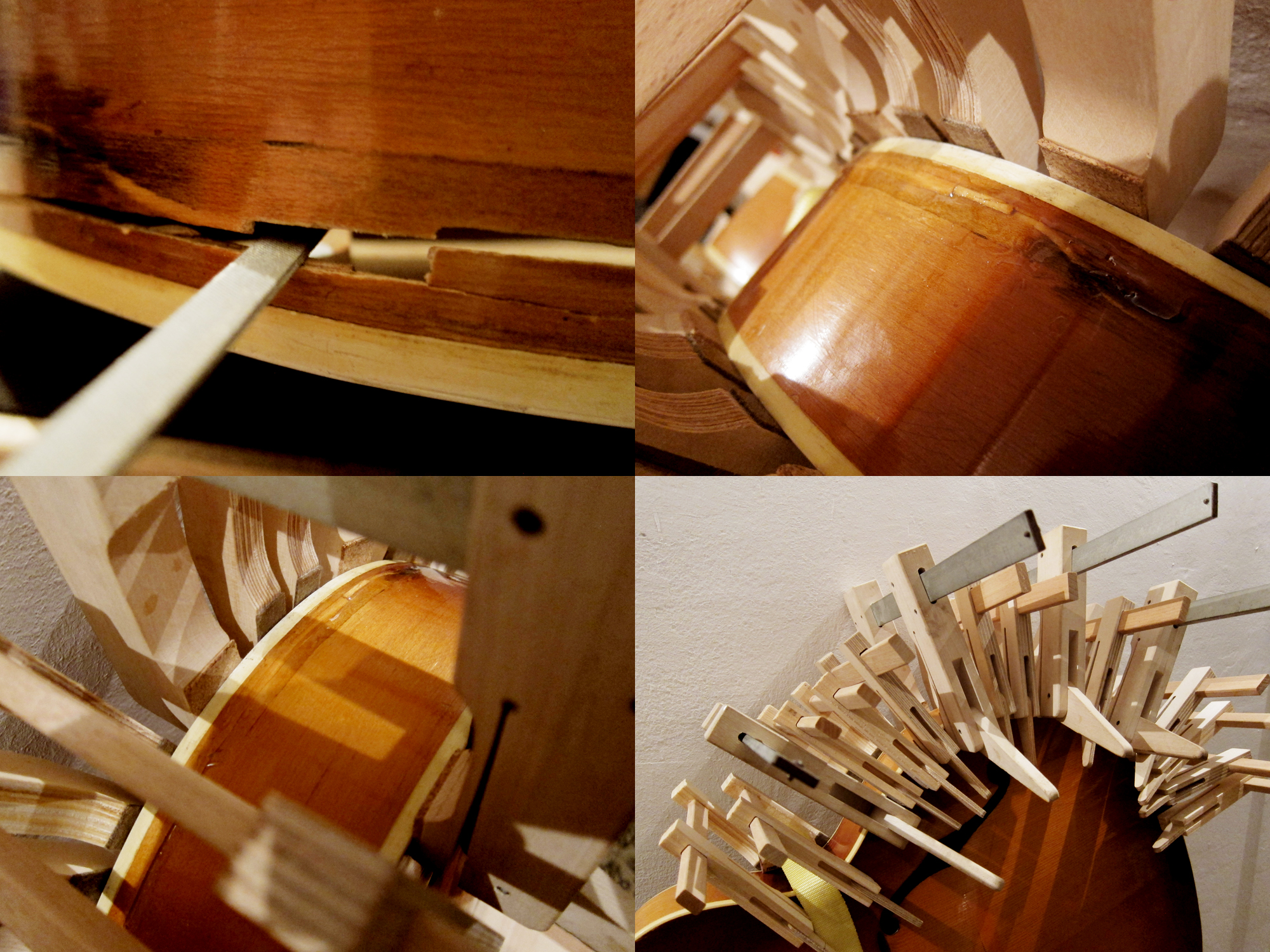
First I had to deal with the crack that was running along the whole bottom side, from the upper bout to the endpin. There was also another crack, or hole, that the previous owner had glued in perhaps not the most discrete fashion.
I have never attempted to glue anything this big before but there is a first time for everything. I noticed that there was a piece of wood missing so I started with making the hole square and then I fitted a little piece of wood in the exact same size. The main problem I had was that the guitar had been cracked for so long, with the tension of the strings I think, so the whole side had kind of warped. In parts the crack was overlapping in one way then suddenly changed to go the other way. Which meant that when I was trying to close the crack it didn’t line up, at all. I did my best and with a bit of force and a lot a clamps I managed to get it to close at least, even if it didn’t line up perfectly. I know that the correct way of doing this would have been to glue cleats on the inside and perhaps a string coming trough that you can tighten from the outside or even better, magnets, but unfortunately the crack was just over the kerfing which would have made it hard to glue any cleats on top of the kerfing. I also couldn’t figure out a way of getting any magnets inside an archtop, there wasn’t really any way of getting my hands in there.
It went ok for being my first time and it seems to be very solid after letting the fish glue cure for 48 hours, I added some extra glue over the old crack too just to be on the safe side. I sanded everything smooth and then lacquered with shellac, I was trying to match the original lacquer but it turned out to be impossible to copy the sunburst. Maybe I can figure out a way and redo this part but at least now the guitar is playable. I buffed up the old lacquer and made it blend with the new shellac by polishing it with metal polish, that always works great on old guitars. It’s the same technique I use for the back of the necks, filling the dents with nitro lacquer and then sand it smooth and buff it up with metal polish. The original machine heads are pretty wonky but they work fine and cleaned up nicely, just like the tail piece, so I decided to keep the guitar all original.
Tomorrow night Araceli and I are going to see James Taylor live at the Gran Teatre del Liceu here in Barcelona. We are very excited, it’s going to feel like a night at the opera.
I recently got myself a Morris W-50, my third Morris and it sounds as good as the other two. Solid spruce top and it looks like the back and sides are solid Brazilian rosewood and quilted maple. It was pretty beat up when I got it from Guitar Hiro in Madrid with plenty of dents and a cracked back but now I’ve fixed it up a bit and it’s playable again. It’s a nice Martin D-42 copy with snowflake inlays and the typical Martin volute where the head and neck meet. Nice inlays all around and a beautiful 3-piece back with flamed maple and rosewood. I guess it was made around 1976 since they changed to hexagon inlays in the 1979 catalogue and then renamed them from W-50 to TF around 1983.
TF Morris W-50, Made in Japan around 1976
Morris Japan catalogue 1976
There was a bit of work needed on this guitar. The back was cracked in the binding just below the heel which made the whole neck tilt forward causing a pretty high action. I cleaned out the crack, someone had put some super glue in there, filled it with fish glue that I let really sink in and connect with the neck block, clamped it and left if for 48 hours. Now it seems really solid and the action got so low that I had to make a new higher bone saddle for it. There was a lot of dents and marks on the back of the neck so I filled them with nitro lacquer and sanded it smooth and buffed it up with metal polish, here you can read more about how to repair lacquer damage. The only thing left now is to ad some gold machine heads so I ordered a set of open back Schaller ST6 this morning and will fit strap button and an endpin jack tonight.
I recently changed the machine heads on my 1970’s Japan made Morris W-50 to Wilkinson WJ28NGD open gear in gold and I couldn’t be happier
Moridaira (Morris Guitars) Founded in 1967 by Toshio “Mori” Moridaira, the Moridaira factory produced high-quality guitars, including the infamous Morris badged guitar. Moridaira also produced badged guitars for Hohner including Coronado, Futurama, H.S. Anderson, Lotus (some) and Sakai.
I’m so excited, last night I found out that both James Taylor and Jackson Browne are coming to Barcelona. My wife and I quickly booked tickets for both of them.
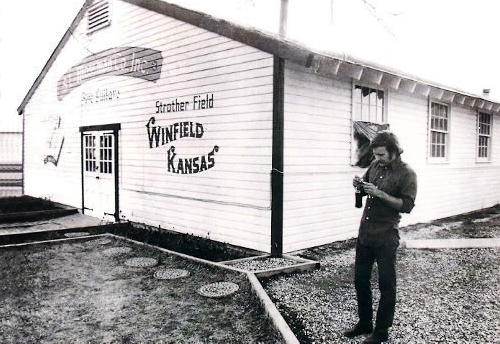
I have recently come across another American guitar maker that was previously unknown to me. I mentioned Grammer guitars earlier, this time it’s Mossman guitars that I’ve fallen in love with. One of the guitar builders that I follow on Instagram, kawvalleyguitars in Kansas, kept posting images of Mossman guitars he had done neck resets on, which awoke my curiosity. After a bit of Googleing I realised that quite a few artists liked Mossman guitars, including John Denver, Eric Clapton, Albert Lee, Doc Watson, Hank Snow, Cat Stevens and Merle Travis. Stuart Mossman got fed up with all the plywood guitars that was pumped out of the big factories in the 1960-70’s and decided to start building his own guitars with real tone woods and proper craftsmanship, and so S.L Mossman Guitars were born in Winfield, Kansas.
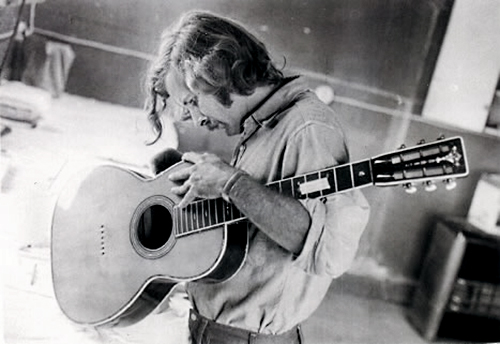
Stuart Mossman in Winfield, Kansas. Here you can read more about the Mossman story
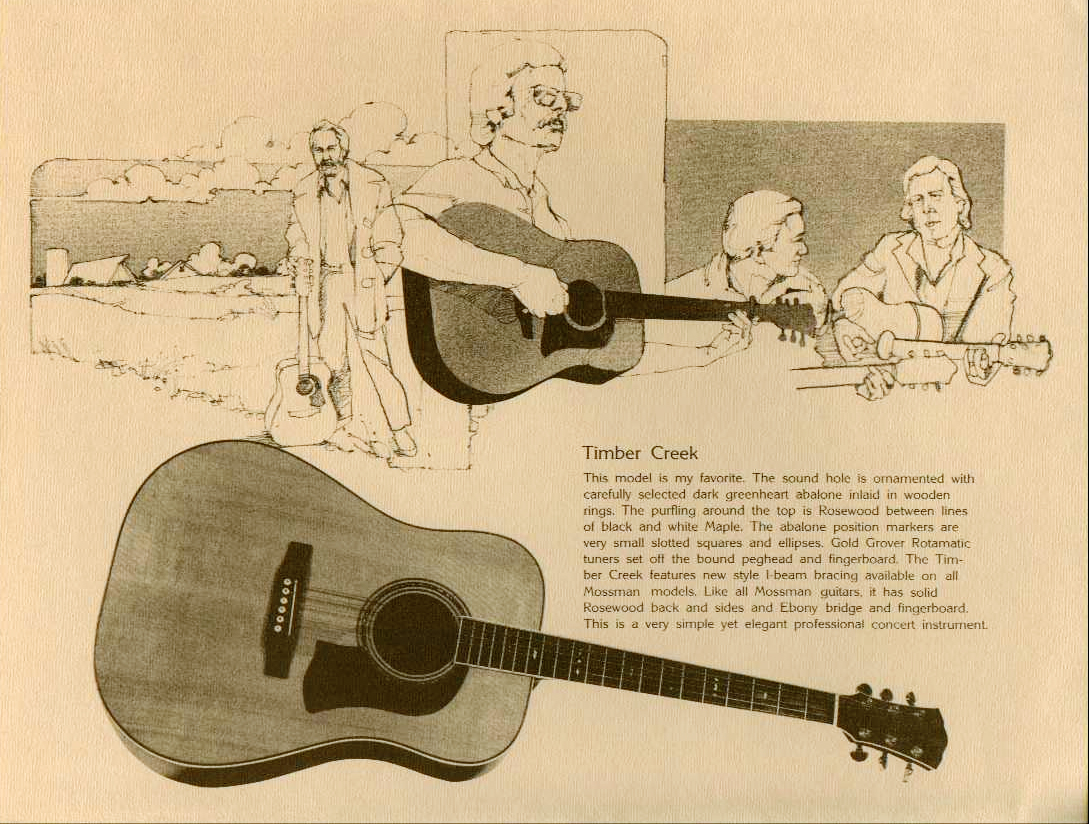
This could be the most awesome guitar brochure ever printed, the 1979 Mossman Catalogue, taken from David Hylander Guitar Works












 Claescaster