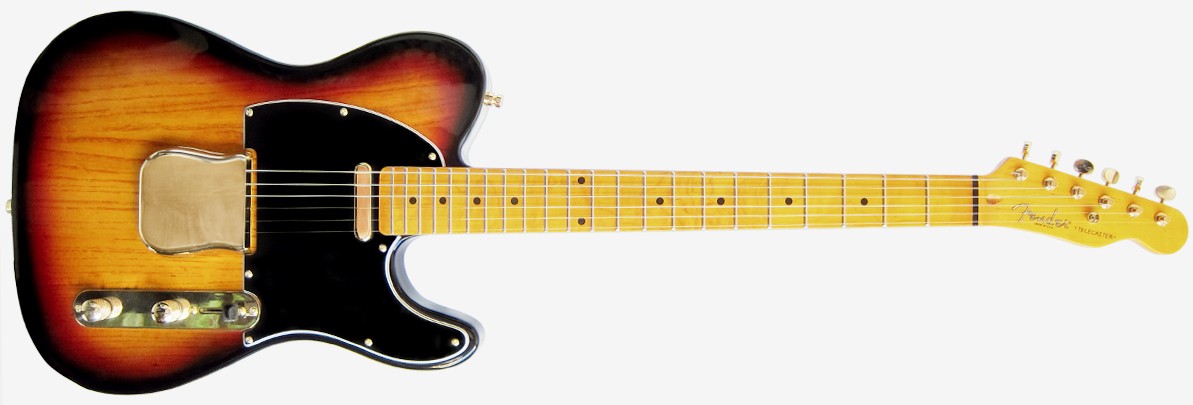
Claescaster

Tag: Telecaster

How to… solder electronics

How to change a potentiometer
When I found my Tokai Love Rock it had a broken shaft on one of the potentiometers so I’ve been planning to change that for the last month or two. This weekend I finally got around to do it. I changed the broken one for a Alpha 500k pot, not the most expensive replacement but I had heard quite good things about Alpha so I thought I would give it a try. I have no experience what so ever when it comes to soldering so I decided to play it safe and move one cable at the time from the old to the new pot. My main concern was of course that I would get confused and not manage to get all the bits back in the right place. Everything went fine, well maybe not the cleanest soldering but pretty good for being my first time. I should of course have scratched the new pot with a bit of sandpaper to get the solder to stick better, I didn’t think of that until after.

Tokai Love Rock electronicsI changed the pot one cable at the time to not mess anything up

Tokai Love Rock electronicsThe final result, my newly fitted Alpha 500 k pot. Perhaps not the cleanest soldering but OK for being my first time.

Tokai Love Rock electronicsTokai Love Rock with 4 brand knew knobs, straight from China via eBay.

How to do a 50’s vintage wiring mod for Telecaster
When I had to soldering iron out I thought I might as well sort some other stuff too. I’ve been reading about different ways of keeping the tone on a Telecaster when you turn the volume down and decided to go for the old 50’s vintage wiring on my Claescaster. It’s a really easy procedure since you just need to move one cable but when I opened the Claescaster up I realised that it wasn’t wired like the standard Telecaster, not according to Seymour Duncan’s excellent wiring diagrams, so I had to move the capacitor and another cable as well. The capacitor is the worlds biggest Orange drop but it does the trick, I might go for something smaller and a bit more suitable when I build the new Claescaster.

Telecaster 50's vintage wiringThe cables I swapped around on the Claescaster. It sounds great now and keeps the tone when you turn the volume down.

How to solder a endpin jack for acoustic guitars.
I found this nice old Shadow humbucker pickup for acoustic guitars when I was back in Sweden. I have a 12 string guitar from the 70’s that I bought cheap from an old Jazz musician and I had completely forgotten that it was equipped with a Shadow pickup. I brought the pickup back to Barcelona and have spent some time trying to figure out how to fit it in my Cort that I normally use for rehearsals. I bought a gold endpin jack and then I just needed to solder a mini jack cable to connect it. The question was, how the hell do I do that? I found and old RCA to mini jack cable that I decided to slaughter for this project but couldn’t find any info online how to connect it. I tried every single combination I could think of but just couldn’t get any sound out of it. Then it hit me, of course, a guitar cable has only on cable inside and then the shield around, so I have to make something similar to this. I twined the left and right together and then the same with the shield from both and it worked perfectly. It might not be the best cable in the world but it was what I got at home and it seems to work fine.

RCA to mini jackStandard RCA to mini jack.

Mini jack for acoustic guitarI connected the left and right and then twined the shield together

endpin jack to mini jackThe left and right soldered together to the shortest pin and then the shield to the longest.

Shadow humbucker pickupShadow humbucker pickup for acoustic guitars, newly fitted on my old Cort.
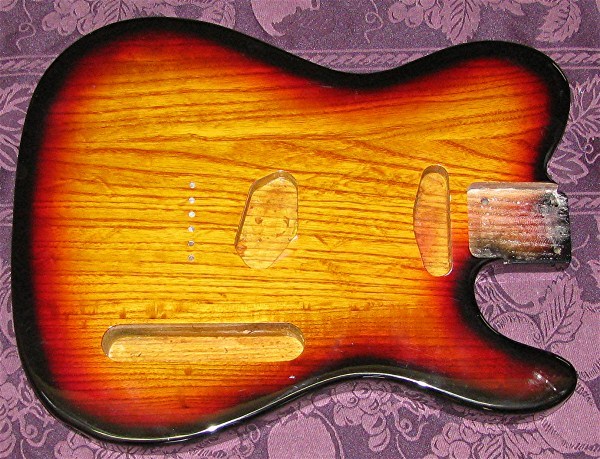
The Claescaster

Late last night I bought a new body for the Claescaster, or rather I got the first part of my new Claescaster. The idea is to build a new guitar from scratch with the best bits I can afford after the specifications of a Seventies Fender Telecaster. I have thought about this for a while and I really don’t like the grain and look of my Morgan Telecaster, especially not now when she has darkened so much since I moved to Spain, and now I found my ideal body. It’s a Mighty Mite Swamp ash body in 3 tone sunburst and I haven’t seen any Mighty Mite bodies, not even on their website, in this lovely red sunburst.

ClaescasterMighty Mite Swamp ash Telecaster body in 3 tone sunburst

It’s quite heavy for being a modern body, around 3.2 kg, which I really like. Most modern bodies I’ve seen weighs 1.5-2.5 kg, does all guitarist have back problems or why doesn’t anyone want heavy guitars any more? Or maybe it’s just the quality and density of the wood that has changed over the years and you can’t find proper wood nowadays. I’m going to build a nice blackguard Seventies Telecaster out of this with gold hardware, just because I love gold. I can’t afford a real Seventies Fender so the best I can do is to create my own, and I think I might enjoy building it too. I bought it from AZGuitarParts a US eBay seller so let’s see how it goes with import tax to Spain, I shouldn’t have to pay anything since it cost under 150€ but you never know. I bought all the gold hardware for the Claescaster from the US 2 years ago but that was a smaller package so it slipped through customs just fine, I just have to wait and see how it goes this time. I can’t afford to buy a new neck, pickups and all the hardware now so this is going to be my ongoing project over the spring. First I’m going to just change the body, meaning unsolder and move all the hardware, pickups and pots from the Claescaster and take that neck too. Then when I get some more money I will start to collect and exchange all the bits with parts I really like. Cloth covered wires, CTS pots, Oak switch and some swanky pickups, I was thinking of the Tonerider Vintage Plus, in gold of course. I also think it could be a good idea to practice soldering on the old Morgan pots and pickups so I don’t buy anything new and expensive and ruin it straight away. Then in a couple of month I will suddenly have two guitars, my Morgan Telecaster in it’s original form and the new Claescaster, a Swamp ash 1970’s Fender Telecaster copy built from scratch by me. My secret plan is to force my first born to learn how to play guitar on my old Claescaster and when they turn 20 they will inherited the new Claescaster. “Here is a guitar that I built 20 years ago and have been playing heavily ever since just too keep it warm, I built it for you”. How nice would that be, damn it, why didn’t my dad build me any guitars.

Fender Telecaster Sunburst 1977Fender Telecaster Sunburst 1977, the inspiration for the new Claescaster

Update May 6, 2013:Claescaster This is what the final Claescaster came to look like
500€ Guitars

Sometimes I wish I was stinking rich so I could buy all the guitars in the world. Then I realise that my life would probably not be that much better just because I had a million guitars. I wouldn’t have time to play them all and after a while I guess nothing really impress you. If you have a couple of Jimi Hendrix Strats in your collection then the Strats that you have that didn’t use to belong to Hendrix would probably feel pretty boring in comparison. I don’t have any really expensive guitars in my collection. Mainly because I’m not rich enough to buy a 1952 Telecaster, a 1964 L Series Strat or a 1958 Sunburst Les Paul, but also because it would be pretty pointless. When would you actually take out an instrument and play it if it was worth ten thousands of Euros? You would be so scared that something happened to it that you just kept it in a vault, like John Entwistle did. Guitars are meant to be played, and adored, but mainly played. I prefer to have guitars that I can use, bring to gigs and rehearse with, as well as hang on the wall and adore at home. Therefore I think guitars for around 500€ are ideal, at least for me. If you know what you are doing you can still get amazing Japanese guitars for 500€, especially on eBay. Expensive enough for having descent quality but cheap enough to replace if something happened to them so you really dare to use them.

Greco Les Paul Custom EG-600C A nice example of a guitar worth around 500, well maybe more like 600-700. Greco Les Paul Custom EG-600C, Made in Japan, FujiGen 1980

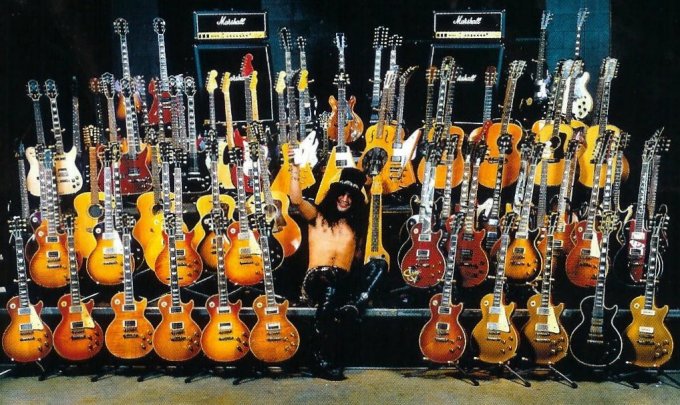
A small part of Slash's guitar collectionA small part of Slash’s guitar collection
Guitar of the day

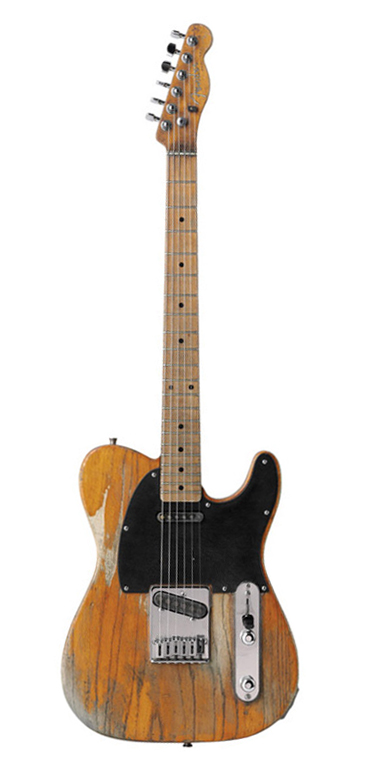
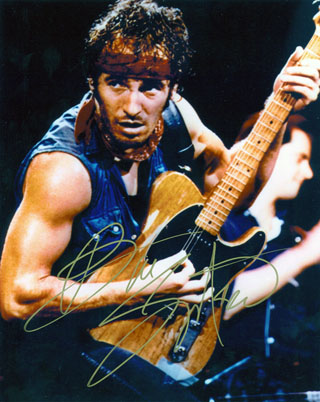
Bruce Springsteen's Fender Esquire

Bruce Springsteen’s 50’s Fender Esquire

Bruce Springsteen's guitar

Guitar of the day

George Harrison's 1968 rosewood Fender Telecaster

George Harrison’s 1968 rosewood Fender Telecaster

George Harrison’s 1968 rosewood Fender Telecaster

Are all Japanese guitars good?

I would say yes and no. Most of the early Japanese guitars I have tried have a rather “toy guitar” feel to them. My Playsound from the late 1960’s is fun to play but it’s a pretty horrible copy of a Telecaster. A lot of Japanese acoustic guitar manufactures jumped on the bandwagon and started to make electric guitars in the mid Sixties since that seemed to be what the kids wanted, here you can read more about Japanese guitar brands. Some of them managed to make pretty decent copies of American Fender’s and Gibson’s and others came up with pretty elaborate and creative designs of their own but in general they weren’t that good guitars. Most of the guitars made in the 1960’s didn’t have that great wood and the hardware was normally pretty weak but sometimes the pickups could be all right. Ry Cooder still prefers the Japanese gold foil pickups for his slide guitars and they have been quite popular in American surf music too, this could simply be because that was what people could afford back in the days. It’s important to remember that a lot of the Japanese guitars in the Sixties were mainly made as cheap entry level instruments for the West, not as elaborate copies of the real deal for professionals as they later became in the Seventies and eighties. Some early Fender and Gibson copies are horrible just because they didn’t have any real American instruments to copy, they had to rely on photos and come up with their own solutions to solve the problems that Leo Fender and the boys had already figured out back in the fifties.

Japanese guitars, MIJ, Made in Japan
The Japanese collection at the moment: Fender Telecaster TL52-75 1987, Greco Spacey Sounds TE-500N 1977, Greco Spacey Sounds TL-500 1979, Greco Les Paul Custom EG-600C 1980, Tokai Love Rock LS-55 1991, VOX Les Paul 1970′s, Hohner Telecaster 1970’s, Hohner Stratocaster 1970′s, Tokai Silver Star SS-36 1979, Jazz Bass 1978, Fender Squier 1993, Maya F335G 1970’s, K.Yairi TG-40 1977, Morris WL-40 1973, Morris WL-35 1970’s

The big change came around 1972-74, this is also when most Japanese guitar manufacturers started to put serial numbers on their instruments. Lack of serial numbers could be a good indicator of the quality, or rather the lack of quality, of an instrument but not always. There are amazing Matsumoku made Greco’s that were made in the early Seventies that lack serial numbers. I would say that most Japanese guitar makers, or at least the successful ones, started to get it right around 1972-74. Especially the Fender copies but also the Les Pauls started to really feel and sound like the real deal around this time. Most copies in the sixties were either Stratocasters / Telecasters or SG’s / 335’s, and unfortunately most of them were pretty cheaply made. In the early Seventies Stratocasters kept being popular but most makers started to try to make Les Paul’s now as well, most with bolt on neck, and some with pretty good result. Some makers kept on making low cost instruments for export and others started to make amazing quality instruments that wasn’t particularly cheap at the time. The model number is often a giveaway of the original price so my Greco Spacey Sounds TE-500N would have cost ¥50 000 back in 1977 when it was made, that’s around $500. This is not true for all brands but a lot of them started in the mid-70’s to price the instruments after the model number, or rather the other way around, and this is probably the easiest way of determining the quality of a Japanese instrument. I’m not sure what an American made Gibson Les Paul Custom cost back in the mid-70’s but if one of Greco’s top of the line like the EG-1500 cost ¥150 000 that would have been a huge investment back then, around $1500. The second hand value today, at least for the famous brands like Greco, Tokai, Ibanez and Fernandes, is roughly what they cost new. A Greco EG-500 Les Paul copy tend go for 500-700€ on eBay, the same for Tokai and Fernandes, slightly less for unknown brands. A Les Paul tend to be worth a bit more than a Stratocaster, I guess because they made more Stratocasters so they are more common or maybe it’s just because Les Paul’s are more popular today. Rare models, don’t trust people who say that the guitar they are selling is rare on eBay, I mean really rare and high end models tend to cost like a real Fender or Gibson from that time.

So what is so good with Japanese guitars? I would say the wood and the craftsmanship. Americans got really sloppy and so did the European manufactures when the productions became too big in the Seventies. Cheap Japanese made guitars, at least after the mid-Seventies, are still really well made. They tend to have good solid wood, great weight and sustain and an amazing quality feel to them. This is of course not true for all of them but at least the Japanese guitars I have played have had a great feel to them. When they made budget instruments in Japan during the Seventies and the Eighties they didn’t cut cost on wood and workmanship, only on hardware and electronics and that’s fairly cheap and easy to upgrade yourself. The best guitars I have are all made in Japan around 1980, that seems to be the height of Japanese guitar manufacturing.

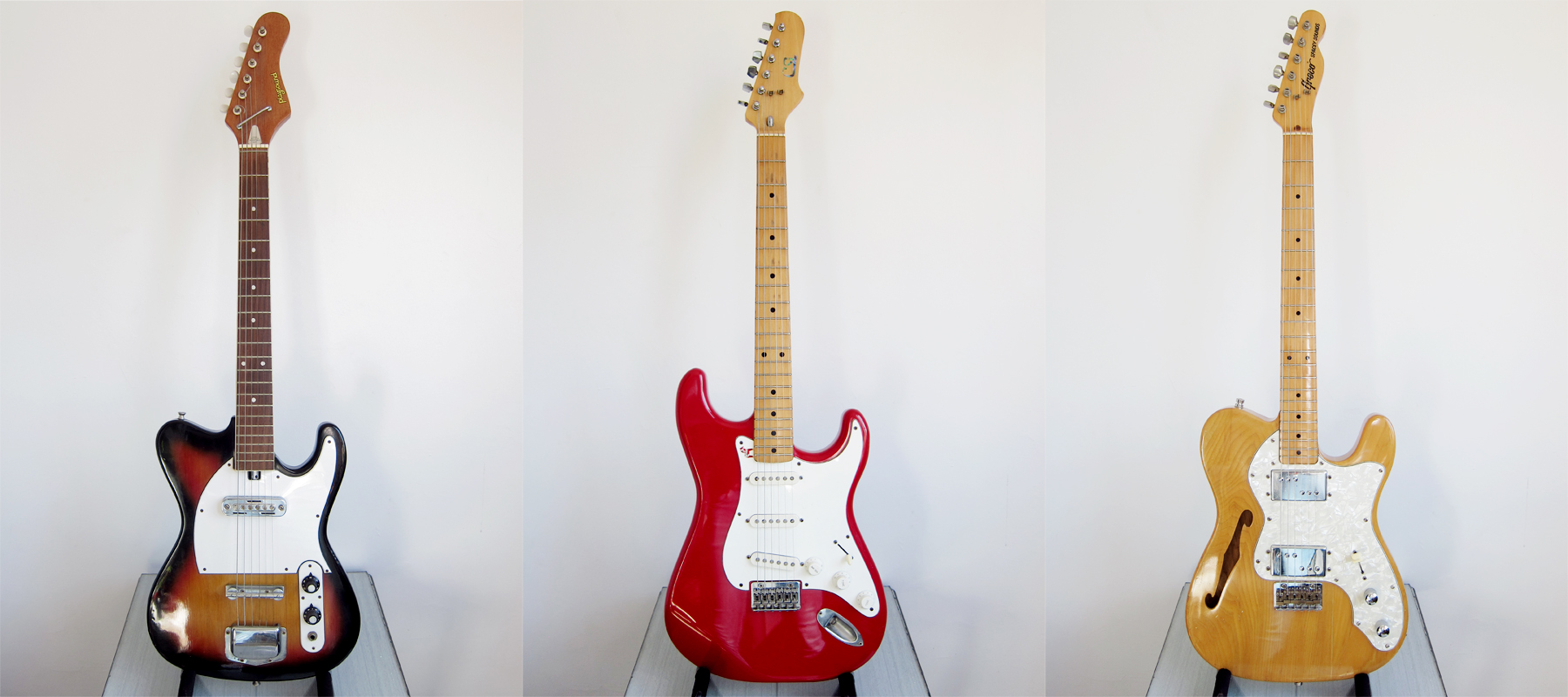
Japanese guitars Playsound (Teisco) 1960’s, CSL (Charles Summerfield Ltd) 1980’s, Greco Spacey Sounds TE-500N 1977

The Playsound guitar was labeled as Audition on the amp and Playsound on the guitar, a beginners set made by Teisco in the Sixties and sold by Woolworth in the UK. I found the whole kit very cheap in a charity shop in South Woodford, UK, the first guitar I bought to collect rather than play. CSL was made by Ibanez in the Fujigen factory and relabeled CSL (Charles Summerfield Ltd) for their UK import. I found it in a second hand shop in Spain in a terrible state so I bought it and cleaned it up and gave it as a present to cheer my girlfriend up after a hospital stay, so techincally not part of my guitar collection. Pretty classic Ibanez head from the 1980’s so clearly made after the 1977 lawsuit. Amazing neck, good feel in general but pretty weak pickups and cheap hardware. The Greco was imported straight from Japan last year, the first guitar I actually bought from outside EU. Amazing Fujigen built Thinline copy, strong original Maxon pickups but not too dark for being humbuckers and with a really fat neck, just as I like it.