Claescaster

Tag: MIJ

Fender Telecaster Japan TL52-75

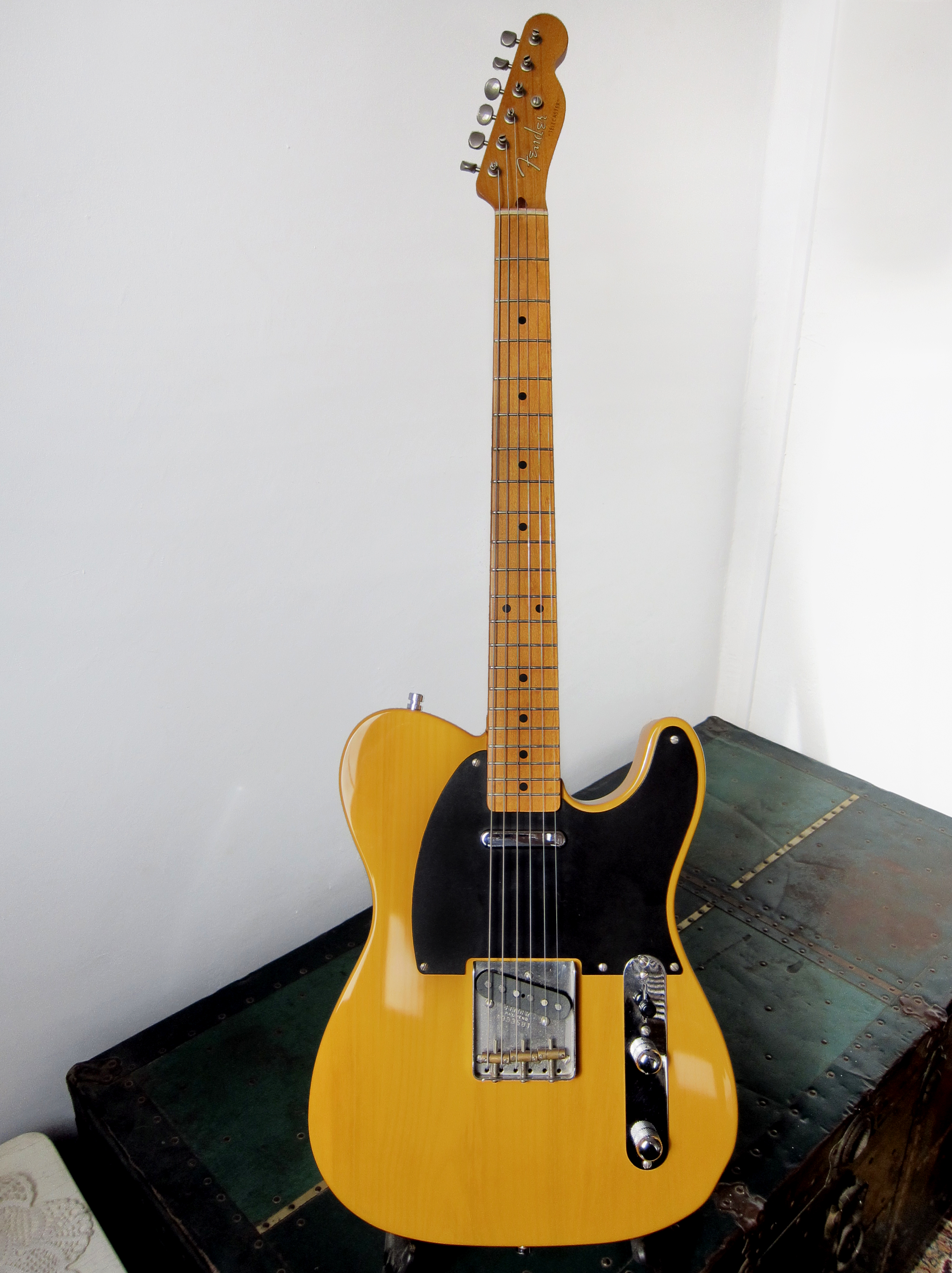
Fender Telecaster TL52-75, ’52 re-issue, Made in Japan Fender Telecaster TL52-75, ’52 re-issue, Made in Japan by FujiGen between 1987-1989

As a Roy Buchanan fan I always dreamt of owning my own “Nancy“. The story how Roy found his Nancy is pretty interesting. In 1969 Roy got fed up with the music industry and enrolled in a school to learn to be a hairdresser. One day during class he saw a guy walking pass the window carrying an old butterscotch blonde Telecaster and Roy fell in love at first site. He chased after the guy and told him that he could pick any guitar he wanted in a nearby music store and in the end bought him a new purple Telecaster to trade for the 1953 Fender Telecaster, serial number 2324, that later became his beloved Nancy. My story wasn’t that interesting. I had kept an eye out for a Japan made ’52 reissue and one day I saw that my favourite eBay seller in Japan, Tokyowax had one for sale. So in October 2012 I became the proud owner of a Fender Telecaster TL52-75, ’52 re-issue, Made in Japan by FujiGen between 1987-1989. There is no way to find the exact production year of these A-serial Telecaster with the serial number on the bridge plate. However, it must have been made between 1987 and 1989 since it’s a TL52-75. They were called TL52-70 between 1984-1986 and then changed to TL52-700 in 1990. I do love Nancy, she is an extremely heavy and amazing sounding Telecaster but I still struggle a but with the neck. She has a typical mid eighties Japan neck, really flat and fast playing, without any doubt the fastest guitar I have after my 1975 Hagström HIIN OT. The problem is that I’m not such a huge fan of slick and easy to play necks. I like quite high action and really fat necks so I have to make an effort to play, it’s a part of the feeling for me. Nancy is still an awesome guitar and sounds great from stock, everything is made in Japan, machine heads, pickups, switch and pots. However, there was one thing that really annoyed me, the brass saddles. If you live in a Mediterranean coast city like Barcelona, you will have to adjust your guitars a lot to cope with the humidity. I have to adjust the truss-rod and saddles on most of my guitar when the seasons change and with Nancy it was a nightmare. The only screwdriver that was small enough to fit for adjusting the height of the original saddles was a tiny little weak thing that I got for my watches. Since I didn’t have strength enough to move the screw while the guitar was tuned I had to loosen the string every time, then tune it again. I was also a bit disappointed with the intonation high up on the neck so I decided to change for my favourites, Wilkinson compensated brass saddles. I found a set really cheap from Swivel Electronics in Singapore and a couple of weeks ago I got around to change them.

♪ ♫ Roy Buchanan – CC Rider

Fender Telecaster TL52-75 The old ones might have had more sustain since they were heavier and seemed more solid but to be able to adjust the height with a simple Allen key, without having to loosen the string is more important to me.

Fender Telecaster TL52-75 All done, I’m sure they will look old in a few month and blend in perfectly with the rest of the hardware. The humidity here in Barcelona seems to age metal very quickly.

Fender Telecaster TL52-75, ’52 re-issue, Made in Japan I bought Nancy because I wanted a blackguard ’52 re-issue but quite soon I realised that everyone else in Barcelona had one too, well not a Japanese but still. It suddenly felt and looked more Bruce Springsteen than Roy Buchanan so I decided to change to a tortoise shell 5 hole pickguard to make it look a bit more Country-,  Swamp-, Southern rock. 

Hobbs Music P-bass

Hobbs Music

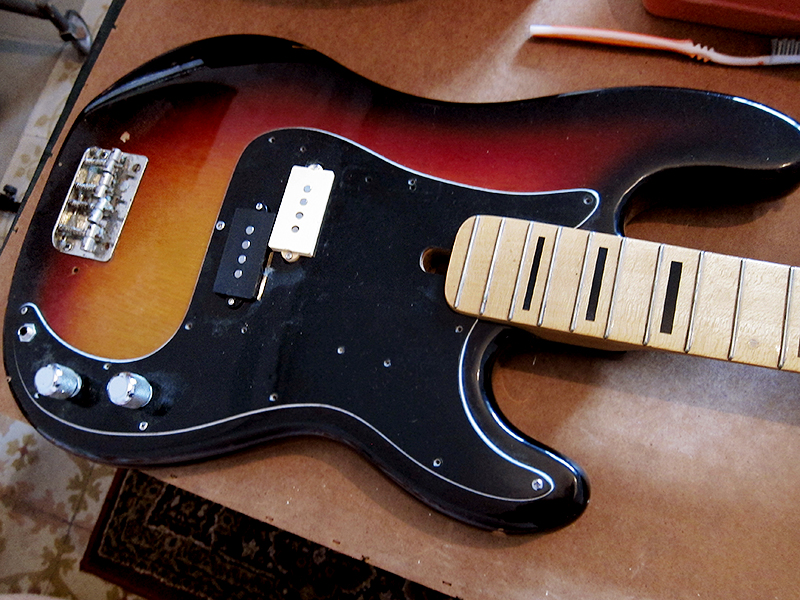
Back in January I bought a really nice Japanese made Precision bass for my friend Dani from South City Music. Well he paid for it but I had to order it since he doesn’t have an eBay account. He is as addicted as I am when it comes to buying instruments online so he doesn’t trust himself with an eBay account, probably for the best. It was pretty beat up but looked really nice in dark sunburst with a maple fretboard. It wasn’t a proper brand it just said Hobbs Music on it, which turned out to be Hobbs Musical store in Lancaster so I assume they imported it in the Seventies from Japan and put their own name on it. Anyway, the bass arrived but Dani wasn’t happy with the pickups so it was put a side for six months and now we ordered a set of Artec Alnico V P-bass pickups and new bridge and pickup covers from Custom world guitar parts. Dani fitted everything but passed the bass over to me to just look it over. He had done a good job, the wiring was correct and the soldering looked good. I did my best to clean it up, adjusted the saddles to get the action down and sorted the intonation. It’s a really heavy and solid bass, good wood for sure and the maple neck is amazing to play on. I plugged it in to check that everything was in order and sat for a half an hour playing bass by myself, something I never do. It felt quite a lot like my Japanese Jazz bass copy from 1978. It’s unbranded too, or rather someone has removed the logo on the headstock so I don’t know what brand it is. I can’t really jump to any conclusions from just two basses but I have a feeling that the Japanese basses are as well made as the guitars, even if it’s and unbranded instrument. I did an earlier post about the quality of Japanese guitars.

Hobbs Music Friday night fun, Swedish beer and a Japanese bass from the 1970’s

Hobbs Music The Hobbit, from Hobbs Musical store in Lancaster. Next step would be to get some new machine heads.

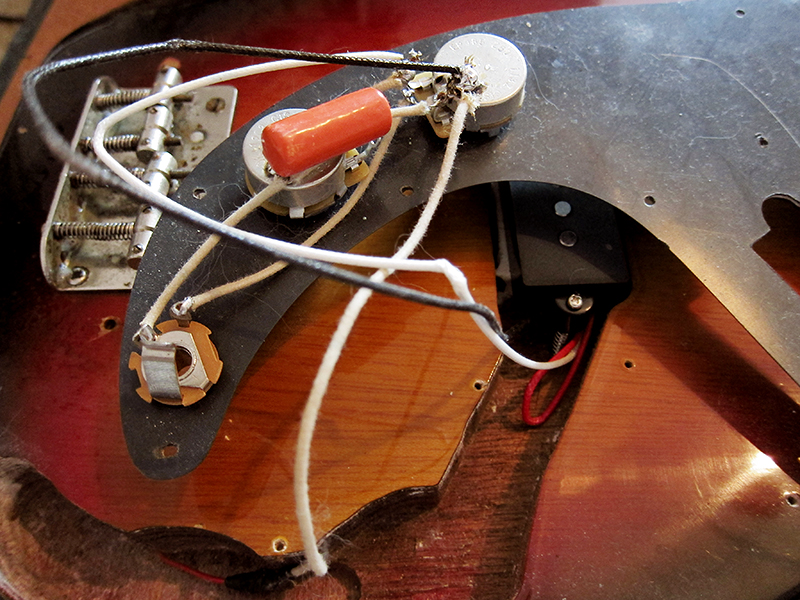
Hobbs Music  Everything seems to be in order, Dani had done a good job. Unfortunately I can’t say the same for the Japanese that routed that control cavity, seems like a pretty uneven job.

Hobbs Music Dani kept the original pickup covers, really nice in black and white. Notice my best friend in the top right corner, nothing works better than an old toothbrush when it comes to cleaning metal parts. It works great for removing grime from the bridge, saddles, machine heads and frets. If they are really dirty, a bit of oven cleaner speeds up the process.

The Claescaster

A quick update on my new Claescaster. The Mighty Mite Swamp ash body that I ordered from USA back in the beginning of March might finally be on it’s way. I saw this update when I tracked it this morning, “Customs clearance processing complete”. I presume that means that they will finally send me my body that has been stuck in Madrid since the 14th of March. How can something take a month to clear? The thing that annoys me the most is perhaps not that I had to wait for more than a month, but that they charged 40% on top of the original price including shipping. A body that cost $150 that I paid 170€ for including shipping and then I had to pay an extra 68€ in import tax and custom fees. I have imported two guitars straight from Japan without any problems so I couldn’t even in my wildest imagination think that it would be this bad just because the package came form USA. The Japanese guitars I bought, on two separate occasions, were delivered with DHL Express, cost $125 and was here within 48 hours and the tax was only about 18-20% of the actual price, not price plus shipping. I think I paid around 70-80€ when I imported Nancy, a Fender Telecaster ’52 re-issue Made in Japan from 1987-1989, but she cost six times more than the new body did. Well at least now I know that you can’t buy things from USA if you live in Spain.

Fender Telecaster TL52-75, '52 re-issue Made in Japan, FujiGen 1989 Fender Telecaster TL52-75, ’52 re-issue Made in Japan, FujiGen 1987-1989. There is no way to find the production year of these A-serial Telecaster with the serial number on the bridge plate. However, it must have been made between 1987 and 1989 since it’s a TL52-75. They were called TL52-70 between 1984-1986 and then changed to TL52-700 in 1990

500€ Guitars

Sometimes I wish I was stinking rich so I could buy all the guitars in the world. Then I realise that my life would probably not be that much better just because I had a million guitars. I wouldn’t have time to play them all and after a while I guess nothing really impress you. If you have a couple of Jimi Hendrix Strats in your collection then the Strats that you have that didn’t use to belong to Hendrix would probably feel pretty boring in comparison. I don’t have any really expensive guitars in my collection. Mainly because I’m not rich enough to buy a 1952 Telecaster, a 1964 L Series Strat or a 1958 Sunburst Les Paul, but also because it would be pretty pointless. When would you actually take out an instrument and play it if it was worth ten thousands of Euros? You would be so scared that something happened to it that you just kept it in a vault, like John Entwistle did. Guitars are meant to be played, and adored, but mainly played. I prefer to have guitars that I can use, bring to gigs and rehearse with, as well as hang on the wall and adore at home. Therefore I think guitars for around 500€ are ideal, at least for me. If you know what you are doing you can still get amazing Japanese guitars for 500€, especially on eBay. Expensive enough for having descent quality but cheap enough to replace if something happened to them so you really dare to use them.

Greco Les Paul Custom EG-600C A nice example of a guitar worth around 500, well maybe more like 600-700. Greco Les Paul Custom EG-600C, Made in Japan, FujiGen 1980

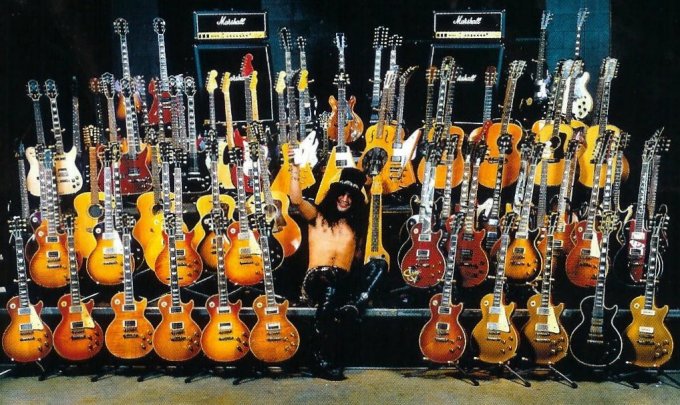
A small part of Slash's guitar collectionA small part of Slash’s guitar collection
China vs Korea

Buy American! The electric guitar was invented in the USA so there is no surprise that they used to produce the finest guitars in the world. However, in the Seventies as competition grew stronger Fender and the big boys started to focus more on market shares and suddenly quantity became more important than quality. At the same time the Japanese factories really stared to get a hang on building amazing copies of American instruments with more eye for details than the Americans themselves in some cases. Epiphone, Gibson, Fender and Grestch all moved part of their production to Japan for the amazing quality offered to a lower price. The list of world domination on the guitar building market used to be USA, Europe, Japan, Korea, Taiwan, China etc. Now things started to change and Japan took over a big part of both USA and Europe’s production. Japan was never really that cheap, well they did produce super cheap instruments too, but the top brands was still quite expensive so in order to increase their profit most of the Japanese manufacturers moved parts of the production to Korea in the Eighties. Suddenly a Japanese copy of and American guitar was now being produced in Korea. As the Eighties became the Nighties even the Korean workers started to feel expensive and production was moved to Taiwan, China or in some cases even Singapore, Indonesia or India. Japan is still the best guitar builders in the Far East but as their prices increased more and more people settled for number two, which used to be Korea but things have changed, again. The Koreans have become sloppy, and expensive so now Tokai and other companies have moved their production to China instead. China is the new Korea. I have to say that the two Tanglewood parlour guitars that my girlfriend and I have are amazingly built for the price. They are hand built in China and I doubt that anything built in Korea today could match that. Korean built instruments from the Eighties are still really good so I believe this change happened in the last 5-10 years. It’s going to be interesting to see what happens when the Chinese built instruments gets the recognition they deserve on the second hand market. Today sellers just push for guitars being MIJ, Made in Japan, or MIK, Made in Korea. When will the MIC arrive and how much will they be worth?

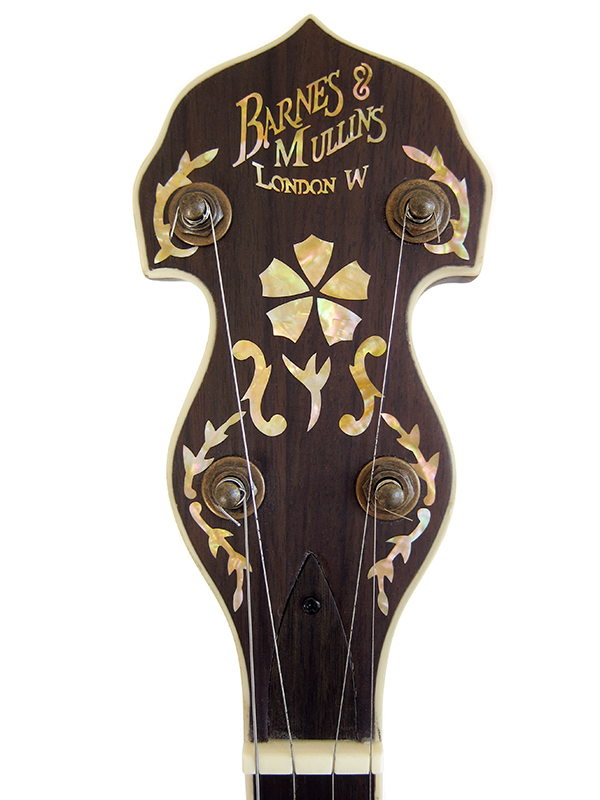
Barnes & Mullins BJ500m 5 String Banjo

My Barnes & Mullins BJ500m 5 String Banjo built in China and set up in the UK

Set neck or bolt on

A lot of people I have met over my 20 years of playing guitar have told me how horrible bolt on guitars are. This is the general opinion amongst guitar players and it can easily be seen in the second hand value of old Les Paul or SG copies for an example. “Oh it has a bolt on neck, well then I’m not interested.” I think it’s important to remember a few things. Most guitars were bolt on in the beginning, especially Japanese guitars up until 1973-74. It seems like it was only Gibson and the American makers that knew how to make set necks or maybe it was just too expensive to copy for brands in Europe and Asia. If you look at all the amazing German guitars from the Sixties like Hohner, Höfner or Italians like Eko, or even Swedish like Hagström, they will most likely be bolt on up until the early 70’s. My Hagström HIIN OT that was made in Sweden in 1975 has a bolt on neck, this was standard for a lot of brands back then. This was not a cheaply made instrument and back in the day it was good enough for both Frank Zappa and Jimi Hendrix. It’s an amazing guitar and I doubt it would be any better if it had a different neck joint. With a set neck I think they would have had to make both body and neck thicker, which would be hard for Hagström to sell since they were known for having the fastest necks in the world. A combination of thin necks, special H truss rods and amazing Swedish wood was their selling point when they broke in to the American market in the late Sixties. I don’t think that Frank Zappa thought his Hagström guitars were useless just because they had a bolt on neck.

Frank Zappa Hagstrom guitars

For me the quality of the guitar in general and what type of wood is being used is way more interesting than if the neck is screwed on or glued. There is a lot of discussions whether set necks has greater sustain or not and again, it’s probably more down to the wood than which type of neck joint the guitar has. I guess there could be a slight difference in sound depending on how the neck is joined together, at least if you are going to believe this Guitar Player article. Then again, it’s not really fair to compare a Gibson guitar with a Fender guitar. I think pickups, body shape and wood has more to do with why a Telecaster and a Les Paul sounds differently, not the fact that the necks are joined differently. It would make more sense to compare two Japanese Les Paul copies of equal age and quality, one with a set neck and one with a bolt on. I doubt that you could hear the difference.

If we are going to trust the old, set necks has more sustain, then all Fender instruments should have less sustain. I would have to say that I disagree since I have played and heard Stratocasters with amazing sustain. Again, I believe that the quality of the wood is causing the sustain, not the glue or screws. The most important part, as always, is to play what you like and don’t care what other people say. I’m 100% sure that a Japan made Les Paul copy from the 1970’s with bolt on neck that cost ¥50 000 back then sounds better than any modern far east made copy with a set neck. It’s all about the quality of the instrument, not how the neck is joined to the body.

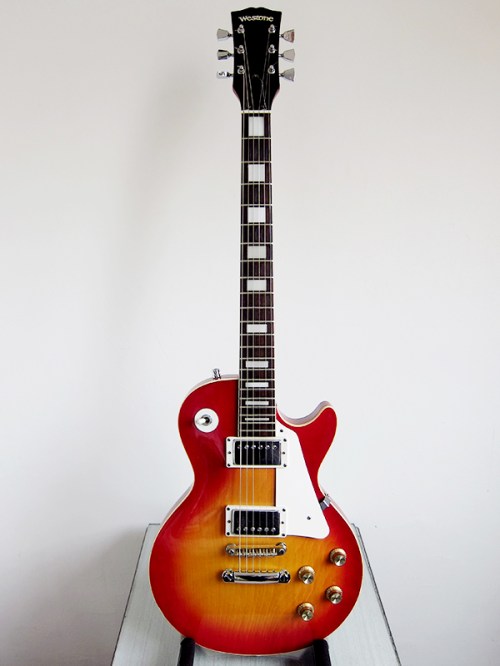
Westone Les Paul, Made in Japan, Matsumoku, mid 1970’sMy bolt on Westone Les Paul copy from the 1970’s made by Matsumoku in Japan.

Tokai Love Rock

How to… refret a guitar
Tokai Love Rock LS-55 Les Paul Standard “Made in Japan” 1991

All guitar players dream of finding something amazing, and ideally cheap, in a pawn shop but few of us do. It takes stupid amounts of persistence and a even greater amount of luck. To be hounest, most of the time they are just full of crap and you have to go almost daily since bargains don’t tend to hang around for long. Then again, sometimes you can find something awesome that they have missed the value of because it wasn’t that easy to Google. Like a Tokai Love Rock Made in Japan from 1991 that didn’t have the Made in Japan marking on it. I found this guitar a couple of weeks ago in a pawn shop, or cash converter as they tend to be called here in Spain. It was in a really bad state, I mean I have never seen a dirtier guitar in my life, a thick layer or grease and grime on the fretboard and bridge. The previous owner must have sweat like a pig because all the screw were black of rust and impossible to get out. I actually had to drill them out to change the humbucker mounting screws so I could adjust the pickups. I got this image in my head of a rather hairy and sweaty gent that had been playing Sweet Home Alabama on this guitar for the past 20 years and really gigging the hell out of it. I soaked the bridge in normal washing liquid over night and then cleaned it with an old toothbrush, my favourite cleaning tool. I bought this guitar on a whim, I mean I loved the neck, I hardly dared to touch it because it was so dirty, but the body was pretty well worn and one of the pots was broken. On top of that I had no clue if it was made in Japan, Korea, China or it might not even be a real Tokai, I read somewhere about tons of fake Tokai’s, or Fakai’s flooding the market in Canada. If I didn’t find cleaning and making guitars look pretty the best past time in the world I would probably not have bought it, but I do, so I got it straight away. I cleaned it up and took it apart and started to look for the clues.

Tokai Love Rock Made in Japan
The night I found here, unclean and weary.

I remembered that I had read that the Japan made Tokai’s had 2 screws for the trussrod cover while the Korean and Chinese had 3. Mine has 2, check. Then I noticed that both the bridge and stopbar had Made in Japan stamped under, check. Then I read on My Les Paul that the Japanese guitars has square holes from the routing under the pickups and diagonal wiring, mine has both, check. I actually read here that Tokai are still using the same router that they have used since the 1970’s so all guitars made by them, Greco briefly and recently Burny, should have this routing if it’s made in Japan. I thought that was pretty cool. To be sure I did a bit more research on Tokai registry and even did a few posts myself on different forums to see what people said. They all agreed, it’s a Tokai Love Rock Made in Japan from 1991.

Tokai Love Rock Made in Japan
Now, all dolled up. I just need to change the broken pot, a set of new amber knobs are already on their way from China.

Tokai Love Rock electronics
A quick update, in mid-March 2013 the Tokai got the broken pot fixed. I also decided to change the frets, something you can read about here and here.

Are all Japanese guitars good?

I would say yes and no. Most of the early Japanese guitars I have tried have a rather “toy guitar” feel to them. My Playsound from the late 1960’s is fun to play but it’s a pretty horrible copy of a Telecaster. A lot of Japanese acoustic guitar manufactures jumped on the bandwagon and started to make electric guitars in the mid Sixties since that seemed to be what the kids wanted, here you can read more about Japanese guitar brands. Some of them managed to make pretty decent copies of American Fender’s and Gibson’s and others came up with pretty elaborate and creative designs of their own but in general they weren’t that good guitars. Most of the guitars made in the 1960’s didn’t have that great wood and the hardware was normally pretty weak but sometimes the pickups could be all right. Ry Cooder still prefers the Japanese gold foil pickups for his slide guitars and they have been quite popular in American surf music too, this could simply be because that was what people could afford back in the days. It’s important to remember that a lot of the Japanese guitars in the Sixties were mainly made as cheap entry level instruments for the West, not as elaborate copies of the real deal for professionals as they later became in the Seventies and eighties. Some early Fender and Gibson copies are horrible just because they didn’t have any real American instruments to copy, they had to rely on photos and come up with their own solutions to solve the problems that Leo Fender and the boys had already figured out back in the fifties.

Japanese guitars, MIJ, Made in Japan
The Japanese collection at the moment: Fender Telecaster TL52-75 1987, Greco Spacey Sounds TE-500N 1977, Greco Spacey Sounds TL-500 1979, Greco Les Paul Custom EG-600C 1980, Tokai Love Rock LS-55 1991, VOX Les Paul 1970′s, Hohner Telecaster 1970’s, Hohner Stratocaster 1970′s, Tokai Silver Star SS-36 1979, Jazz Bass 1978, Fender Squier 1993, Maya F335G 1970’s, K.Yairi TG-40 1977, Morris WL-40 1973, Morris WL-35 1970’s

The big change came around 1972-74, this is also when most Japanese guitar manufacturers started to put serial numbers on their instruments. Lack of serial numbers could be a good indicator of the quality, or rather the lack of quality, of an instrument but not always. There are amazing Matsumoku made Greco’s that were made in the early Seventies that lack serial numbers. I would say that most Japanese guitar makers, or at least the successful ones, started to get it right around 1972-74. Especially the Fender copies but also the Les Pauls started to really feel and sound like the real deal around this time. Most copies in the sixties were either Stratocasters / Telecasters or SG’s / 335’s, and unfortunately most of them were pretty cheaply made. In the early Seventies Stratocasters kept being popular but most makers started to try to make Les Paul’s now as well, most with bolt on neck, and some with pretty good result. Some makers kept on making low cost instruments for export and others started to make amazing quality instruments that wasn’t particularly cheap at the time. The model number is often a giveaway of the original price so my Greco Spacey Sounds TE-500N would have cost ¥50 000 back in 1977 when it was made, that’s around $500. This is not true for all brands but a lot of them started in the mid-70’s to price the instruments after the model number, or rather the other way around, and this is probably the easiest way of determining the quality of a Japanese instrument. I’m not sure what an American made Gibson Les Paul Custom cost back in the mid-70’s but if one of Greco’s top of the line like the EG-1500 cost ¥150 000 that would have been a huge investment back then, around $1500. The second hand value today, at least for the famous brands like Greco, Tokai, Ibanez and Fernandes, is roughly what they cost new. A Greco EG-500 Les Paul copy tend go for 500-700€ on eBay, the same for Tokai and Fernandes, slightly less for unknown brands. A Les Paul tend to be worth a bit more than a Stratocaster, I guess because they made more Stratocasters so they are more common or maybe it’s just because Les Paul’s are more popular today. Rare models, don’t trust people who say that the guitar they are selling is rare on eBay, I mean really rare and high end models tend to cost like a real Fender or Gibson from that time.

So what is so good with Japanese guitars? I would say the wood and the craftsmanship. Americans got really sloppy and so did the European manufactures when the productions became too big in the Seventies. Cheap Japanese made guitars, at least after the mid-Seventies, are still really well made. They tend to have good solid wood, great weight and sustain and an amazing quality feel to them. This is of course not true for all of them but at least the Japanese guitars I have played have had a great feel to them. When they made budget instruments in Japan during the Seventies and the Eighties they didn’t cut cost on wood and workmanship, only on hardware and electronics and that’s fairly cheap and easy to upgrade yourself. The best guitars I have are all made in Japan around 1980, that seems to be the height of Japanese guitar manufacturing.

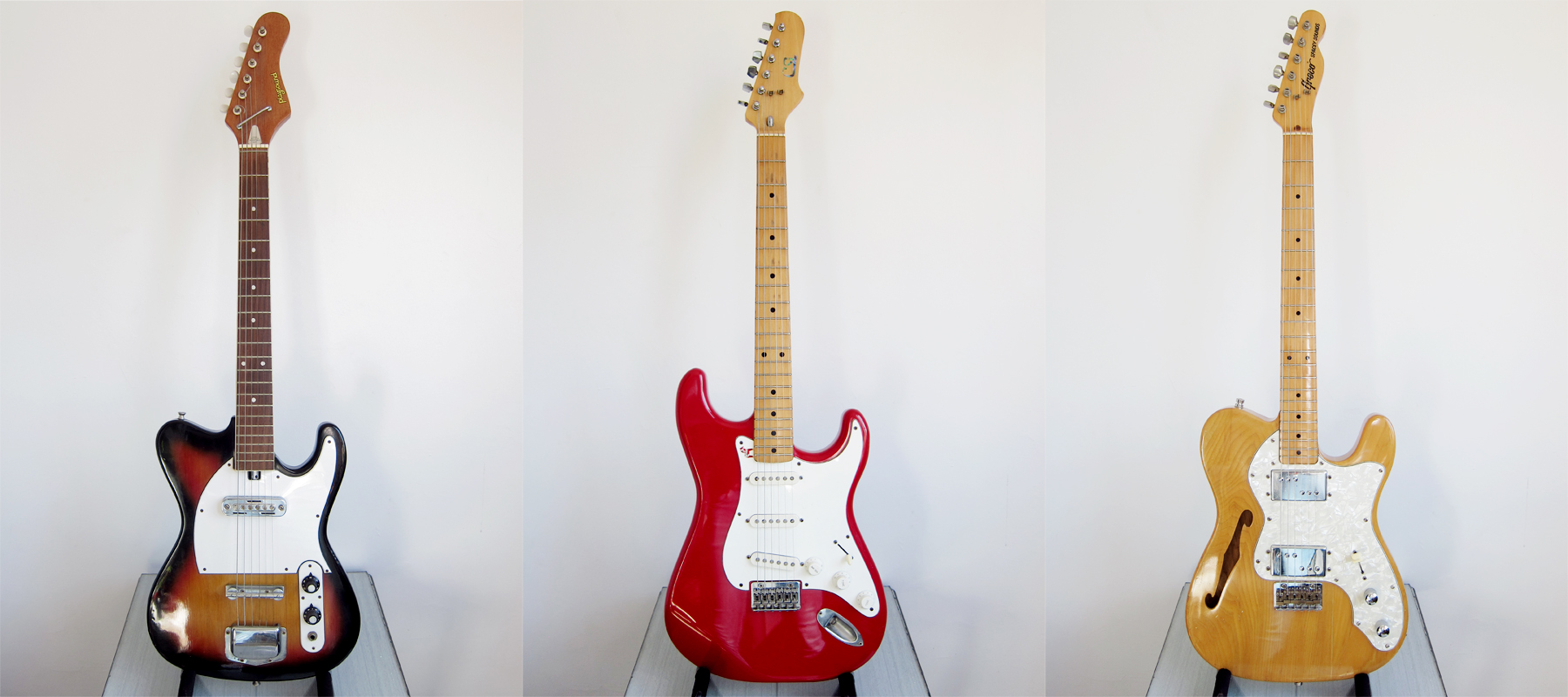
Japanese guitars Playsound (Teisco) 1960’s, CSL (Charles Summerfield Ltd) 1980’s, Greco Spacey Sounds TE-500N 1977

The Playsound guitar was labeled as Audition on the amp and Playsound on the guitar, a beginners set made by Teisco in the Sixties and sold by Woolworth in the UK. I found the whole kit very cheap in a charity shop in South Woodford, UK, the first guitar I bought to collect rather than play. CSL was made by Ibanez in the Fujigen factory and relabeled CSL (Charles Summerfield Ltd) for their UK import. I found it in a second hand shop in Spain in a terrible state so I bought it and cleaned it up and gave it as a present to cheer my girlfriend up after a hospital stay, so techincally not part of my guitar collection. Pretty classic Ibanez head from the 1980’s so clearly made after the 1977 lawsuit. Amazing neck, good feel in general but pretty weak pickups and cheap hardware. The Greco was imported straight from Japan last year, the first guitar I actually bought from outside EU. Amazing Fujigen built Thinline copy, strong original Maxon pickups but not too dark for being humbuckers and with a really fat neck, just as I like it.