The Fretboard Journal’s Martin Guitar Anthology eBook After nearly ten years of publishing, the FJ has amassed quite an array of stories featuring iconic Martin guitars and Martin artists. We decided to partner with Martin to share some of these great stories once again (a few have been out-of-print for years now). Included are the full-length (and, in some cases, out-of-print) features on Tony Rice, David Crosby, Loudon Wainwright III and many others. We’ve also included the latest edition of Martin: The Journal of Acoustic Guitars, their in-house magazine filled with more Martin tales. We hope you like this eBook anthology and stay tuned for future editions featuring your favorite brands and artists.
I have a couple of more guitars for sale now so if you’re interested or have any questions just send me an email claesgellerbrink@gmail.com or give me a call 639586158.
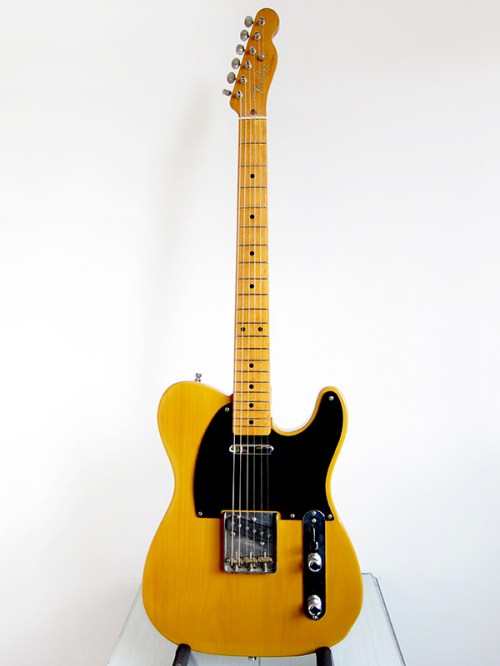
Hohner Telecaster, Made in Japan, Moridaira factory, 1970’s, 500€ SOLD A great Telecaster copy in a good shape for age but with some dings to the bottom of the body. Frets are in great condition and there isn’t a single mark on the back of the neck. It’s a pretty heavy Telecaster with great sustain and nice feel to it. The pickups sounds awesome and everything is working fine, all original except for the 3-way switch that wasn’t working properly so I replaced it with a new one. Really fast and smooth neck, lovely to play. A great sounding guitar with amazing sustain and great Japanese build quality. Made in Japan by Morris in the Moridaira factory, where H.S. Anderson made the Mad Cats that Prince uses. You can read more about the guitar here and here is a Youtube clip.
VOX Les Paul, Made in Japan, 1970’s, 350€ SOLD This is the first Japan made VOX guitar I’ve found in Spain. It’s a pretty decent copy of a 1958′ Les Paul with a great feeling fat neck and narrow head. The body has a lovely grain and the guitar is in pretty good shape for the age with a couple scratches and a few dents. Frets show some wear but are still fine and everything is working perfectly. The humbuckers have a nice tone too them, not too heavy or muffled. A pretty versatile and nice guitar to play with great Japanese build quality. You can read more about the guitar here and here is a Youtube clip.
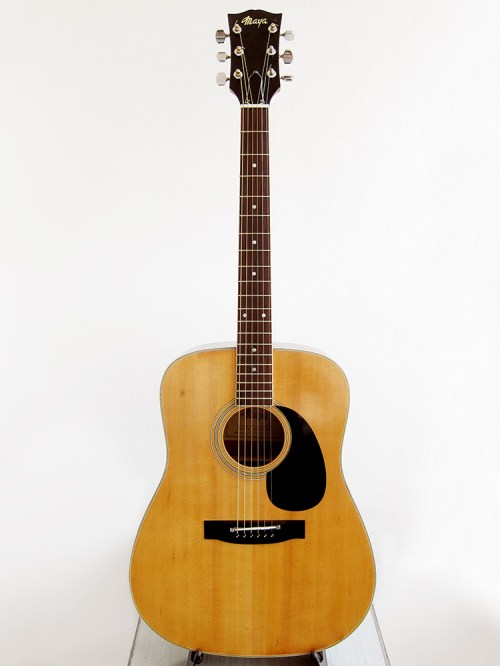
Maya F335G, Dreadnought acoustic, Made in Japan, 1970’s, 250€ SOLD Japan made Gibson J-50 copy in a pretty good state for it’s age. I couple of marks on the spruce top and few knocks on the head but structurally very sound without any cracks. This Maya F334G was made by Chushin Gakki in Kobe, Japan, during the 1970’s. It has a really fat neck, it’s feels great to play, adjustable bridge with both bone nut and saddle. The sound is very full with a great booming bass, you can listen to it here. If you want more pictures you can check the post I wrote about it.
Fender Telecaster TL52-75, ’52 re-issue Made in Japan, FujiGen 1987-1989. 900€ SOLD In mint condition, all original, without any doubts the best Telecaster I have ever played. Imported straight from Japan. The only reason for selling is because I prefer fat 70’s necks. There is no way to find the production year of these A-serial Telecaster with the serial number on the bridge plate. However, it must have been made between 1987 and 1989 since it’s a TL52-75. They were called TL52-70 between 1984-1986 and then changed to TL52-700 in 1990. You can read more about the guitar here and listen to it in this Youtube clip.
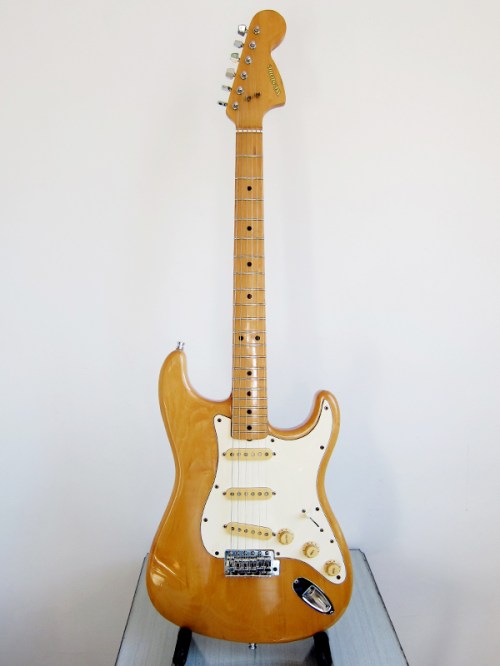
Westone Stratocaster, Made in Japan, Matsumoku factory, 1979, 400€ SOLD An amazing Stratocaster copy from 1979 made in Japan by Matsumoku. In really good shape for age but with some dings and scratches to the body. Frets are in great condition and there isn’t a single mark on the back of the neck. The wood in the body is amazing, without any doubt the heaviest and most solid Strat I have ever seen with fantastic sustain. Really nice tone in the pickups and everything is working fine, the original 3-way switch has been replaced with an Oak Grigsby 5-way switch. Really fast and smooth neck, lovely to play. A great sounding guitar with amazing sustain and great Japanese build quality.Here is some more info about the Westone brand. Here is a Youtube clip with the guitar.
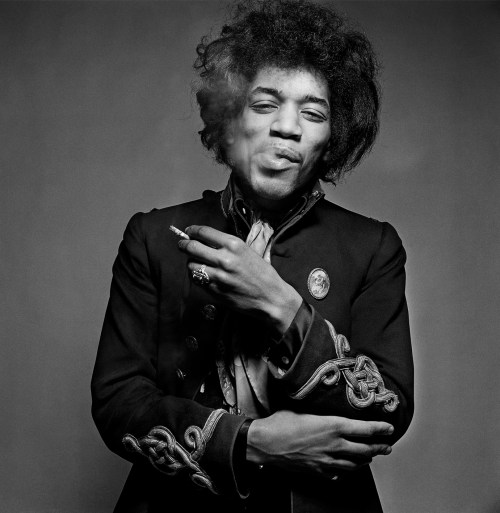
Jimi Hendrix past away on this day 44 years ago. If it wasn’t for this awesome guy, I might never had fallen in love with the guitar or dress the way I do, he was a huge influence 20 years ago when I started playing. Earlier Hendrix posts, Guitar of the day and Guitar of the day
On Saturday I found myself a Maya F335G. As mentioned before, I’ve been after a Gibson J-45 or J-50 for quite a while so when I saw this Japan made Gibson J-50 copy I couldn’t resist. It was in a terrible state and strung with 4 nylon strings so I couldn’t test it but I trusted my gut feeling. It doesn’t sound like a Gibson J-50, I didn’t really expect it too either, but it does sound pretty good. I would say that it sounds better than the two Suzuki’s I used to have, the Kiso Suzuki WE-150 and Suzuki Three-S F-120, even though the build quality is pretty much the same. There is a huge step up to my Morris WL-35 and Morris W-40 and my beloved K.Yairi TG-40, both in build quality and sound. Having said that, there is something with this Maya that I really like, it has way more bass then the Suzuki’s and overall a pretty nice and full sound. The only downside is that it feels pretty stiff to play so I will probably put 011’s on it next time I change the strings. According to my previous post about Japanese guitar brands Maya was made by Chushin Gakki in Kobe, Japan, during the 1970-80’s. Even though I really like this guitar I have it listed for sale if anyone is interested in buying it.
Maya F335G made by Chushin Gakki in Kobe, Japan
The previous owner had used a collection of random oversized wood screws to keep the machine heads in place so the first thing I did was to remove them and fill the holes. I polished the frets and oiled the super dry fretboard and then put on a bone nut and saddle which improved the tone quite a lot.
My new Hohner Telecaster, made in Japan in the 1970’s most likely by Morris in the Moridaira factory.
This weekend I received a 1970’s Japan made Hohner Telecaster. These old Hohner’s have a nice solid feel to them and good resonance even though the bodies are made out of plywood, or some form of wood sandwiched together. Having said that, this Telecaster is extremely heavy so maybe they sandwiched a chunk of mahogany together with an ash or alder top layer. This would have put me off if I wasn’t so gay for my old beat up Hohner Strat. This was one of the first Japan made guitars I bought, I found it in a charity shop in Camden in London for £50 in 2009. It’s not the best Strat I have ever played but the neck is really chunky and the pickups sounds really good. It’s the same with the new Hohner Telecaster, pretty nice neck and great pickups. The neck pickup actually sounds a bit like the in-between neck and middle position on a Strat. I would have preferred that the Telecaster neck was a wee bit thicker, but it’s still very playable. Hohner only produced guitars in Japan for a couple of years during the late 1970’s and later moved to Korea like a lot of other brands. I really enjoy this Telecaster but I have too many guitars at the moment and therefore it’s up for sale.
According to my previous post about Japanese guitar brands they were made by Morris in the Moridaira factory. I took my list from Who Made My MIJ Guitar so I hope we can trust his research.
Moridaira (Morris Guitars) Founded in 1967 by Toshio “Mori” Moridaira, the Moridaira factory produced high-quality guitars, including the infamous Morris badged guitar. Moridaira also produced badged guitars for Hohner including Coronado, Futurama, H.S. Anderson, Lotus (some) and Sakai.
One thing that would prove the Hohner connection to Moridaira would be Prince’s Telecaster. He used to play a a H.S. Anderson Mad Cat, as I mentioned in a previous post. Hohner later copied the Mad Cat, first in Japan and later as the Prinz guitar made in Korea by Cort. Those early Mad Cats under Hohner was made by Moridaira. “A little over 500 Mad Cats were made during the ‘70s, including a small batch made OEM for Hohner USA with a Hohner logo in the H.S. Anderson style. Pop artist Prince discovered one of these rare guitars early on in his career, and used it live and on countless hit-records like Purple Rain, 1999, Controversy, etc. for over 30 years now.” Taken from the history page at Mad Cat guitars
I took the guitar a part to look over the electronics and give it a good clean and set it up properly. The Switch is a bit worn so I will order a new one and replace that but the Japanese 500k pots are crackle free so I will keep the rest. This one is wired in an even weirder way than my Greco, with the ground from the bridge going to the first post on the treble pot. There were two big chunks on the back of the neck that was either worn or sanded down, which I didn’t like. I applied some Nitrocellulose lacquer with a sponge for not getting any sharp edges around, which worked pretty well, and then sanded it smooth with 2500 grit paper.
Update: August 30, 2014 I got around to change the 3-way switch so now I finally got to hear the bridge pickup, not bad at all. I also bought 6 new screws that I cut since the original ones were really annoyingly long. When I got this guitar the action was too low for me and when I raised the saddles the screws that are holding them in place almost touched the strings so I decided to replace them with something shorter. I really starting to like this Telecaster now, it has a great twang and feel to it.
My beat up old Hohner Stratocaster, bought cheap in London back in 2009. Notice that the logo is different on these two.
The Claescaster, put together in May 2013 out of a Mighty Mite Swamp ash body, Tonerider Vintage Plus pickups, Wilkinson hardware and a cheap but fairly fat China neck.
Last night I decided to change the pots and install a treble bleed on my new Claescaster, I never liked the feel of the CTS pots I had on. I’m still not sure if I like the new changes or not, in my head it sounded better before but I stupidly forgot to record it so I can’t compare the before and after. I think it had a clearer sound with more highs, now I feel that the neck pickup is more muffled. I’m not sure if this is down to cheaper pots, the treble bleed or the wiring. I changed the wiring too from a more standard wiring to Seymour Duncan’s suggestion for a ’66 wiring which matched what I had seen for the treble bleed. Maybe it has more to do with the changes in wiring than the actual treble bleed because before I had an old 50′s vintage wiring to help with the lack of treble at lower volumes and I was pretty happy with that. I’m so confused with all the different wiring options, I have no idea who’s doing what to whom, and where? I might just have to redo it again and copy the original wiring on my Greco TL-500 or my Fender TL52-75, they both sounds great.
The new Claescaster got a treble bleed and the ’66 wiring, bottom right photo shows the original wiring on my 1979 Greco TL-500
Update: December 27, 2014, Since I had the soldering iron out to fit the electronics in my new home built Claescaster I took the treble bleed out in this one and changed the wiring back to it’s original 50′s vintage wiring
The 1960’s Juan Estruch Barcelona guitar before and after I cleaned it up.
I recently bought an old Juan Estruch guitar for my friend Rafa. He has mentioned numerous times, actually since the day that I found my Francisca Montserrat, that he would love to have an old Spanish guitar. So for his birthday Araceli and I went to all the Cash converters we could think of an eventually found a beat up Juan Estruch for him. The brand was founded here in Barcelona by Juan Estruch Rosell in 1880. This guitar seems to have been made between 1960-1969, according to the label, and has a solid top. There was a few things that needed to be sorted to get it playable but I could tell straight away, even with strings missing, that it had a nice tone and great projection.
This is what it looked like when I bought it
Here is some info about the brand taken from Wikipedia, unfortunately in Spanish for you English readers: Guitarras Juan Estruch es una marca de guitarras y otros instrumentos musicales de Barcelona. La compañía fue fundada por Juan Estruch Rosell en 1880, siendo maestro de otros luthiers de fama como Enrique Sanfeliu1 de quien exponen una guitarra en el ministerio de educación de Uruguay. Después de la guerra civil, su hijo Joan Estruch Sastre se hizo cargo del taller de la calle Ample continuando con la construcción artesanal de guitarras siguiendo la tradición familiar. A su muerte (1970), su hijo Joan Estruch Pipó, se hizo cargo de la empresa hasta su muerte en 1989. Hoy en día la empresa sigue en Rubí, con el nombre ESTRUCH Luthiers , a cargo de la viuda y el antiguo encargado del taller Rafael Montes que entró a los 14 años, aunque la mayor parte de su producción es para la exportación. En los años sesenta muchos de los cantautores de la nueva canción catalana fueron clientes del taller de la calle Ample haciendo un lugar de encuentro con animadas tertulias.
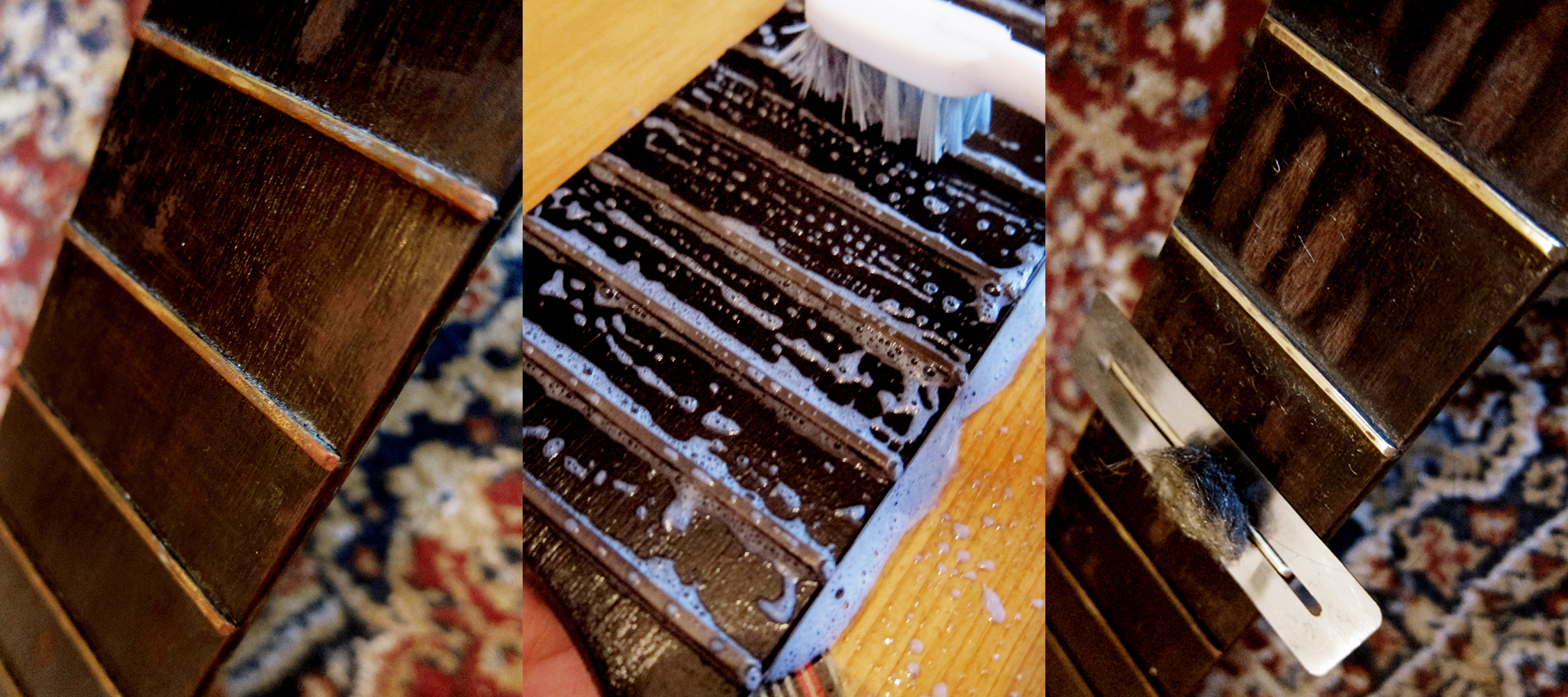
The normal cleaning, polishing frets and oiling the fretboard
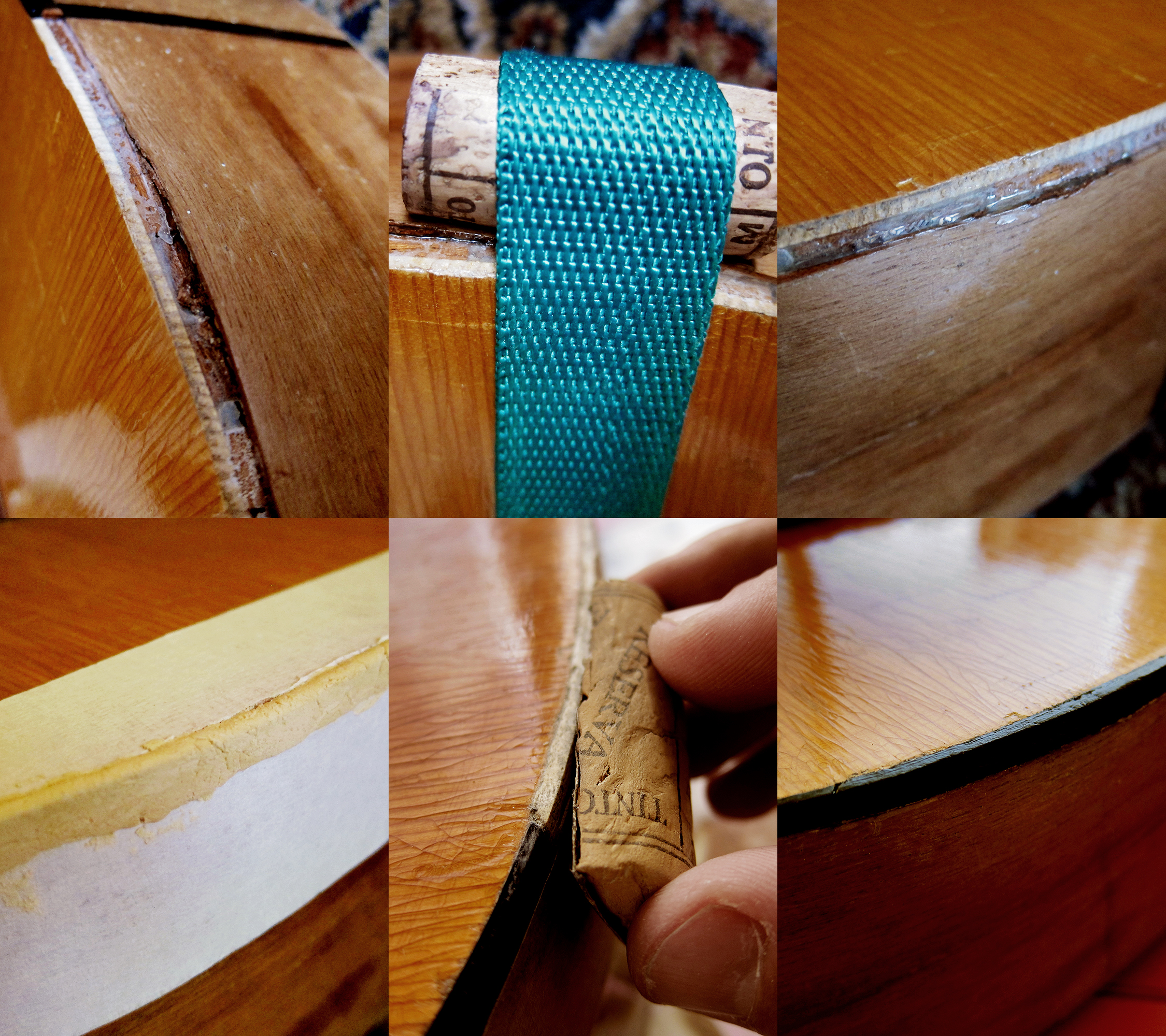
I wasn’t really sure how to fix the missing binding. In the end I decided to do a MacGyver and just use what every I could find at home. First I closed the gap between the side and top with fish glue and then I filled it up with wood filler. When it was dry I sanded it in to shape, got it smooth and then painted it black to match the original plastic binding.
Unfortunately I had to change the machine heads since one was broken, I would have loved to keep it all original
The final result, a fully playable birthday present for my friend Rafa
Rafa from the band Cobarde with his new Juan Estruch guitar
The old Claescaster before and after the transformation, well I just changed the pickguard.
I recently did a little order from my favourite Hong Kong site, EY Guitars. I wanted to change the pots on the new Claescaster, I’m really not happy with the fancy CTS pots I got and decided to put on some Asian ones instead. I also ordered a new black pickguard for the old Claescaster for 5€, I had grown tired of the cheap looking tortoise that has been on for 4 years. I also changed the knobs for flat topped gold ones so now the old Claescaster looks just like the new Claescaster, if it wasn’t for the Fender logo and the beautiful wood grain on the swamp ash body on the new one.
Now I have two Claescaster’s that looks pretty much the same. Boring perhaps but I really love the look of the 1970’s Fender Telecasters with their 3-tone sunburst, black pickguards and maple necks.
K.Yairi TG-40 a Guild D-40 copy from 1977. Every K.Yairi guitar is given birth in Kani, a small community in the beautiful mountainside area of Honshu, Japan.
My new K.Yairi TG-40 has finally arrived, after 40 days stuck in Spanish customs. I have mentioned earlier that it’s a lot easier to import things from Japan to Spain compared to buying things from the US, well that was a lie. I have bought three electric guitars, mainly Greco’s from an eBay seller called Tokyowax. They all arrived within 48 hours so I stupidly assumed that everything from Japan would arrive quickly and without any problems, but no. Tokyowax uses DHL Express and they tend to deliver things within 2-5 days and you pay the taxes straight to them when they deliver the guitar. It wasn’t that easy with EMS Japan, that package went straight to customs in Madrid and spent 40 days in their lazy company. How can anything take that long? K. Yairi could probably have built me a new guitar in that time, if he was still alive. It seems like the only option now when buying guitars on eBay is to use the Global Shipping Program, that worked for my Goya 163 at least. Anyway, the guitar is amazing so it was well worth waiting for.
It has a really nice tone with great bass response. It easily has the best bass of all my acoustics, even better than my Morris W-40 which has that Martin D-45 bass sound, this is nicer and a lot clearer. I guess it sounds like an old Guild D-40, at least if I can trust the Youtube clips I have seen since I haven’t had the chance to play one myself. It actually reminds me a bit of a Gibson Jumbo, like I mentioned in my Gibson J-45/J-50 post: “The Yairi TG-40 is a Guild D-40 copy, which was introduced in the Sixties as a competitor to Gibson’s J-45. The Guild D-40 became famous as the Bluegrass guitar for their even response over all the strings and I really like the sound of them, it’s actually not too far off from a Sixties Gibson J-45. With a bit of luck it’s going to be an awesome Yairi copy of an Guild which might sound a bit like a Gibson.”
I didn’t have to do much to it, it was ready to play when I got it. However, the pickguard was loose so I had to remove that, clean it up and then glue it back again with my trusty fish glue. When the strings was off I quickly polished the frets and oiled the ebony fretboard. I also installed a jack for my LR Baggs M1 and a strap button.
I bought this K.Yairi TG-40 from a really nice eBay seller called montebell86 who was a pleasure to deal with. The guitar was listed as “Taniguchi Gakki” Japanese guitar shop original model, very rare. Solid spruce top, sides and back in solid mahogany, neck in Honduras mahogany, bridge and Fretboard in black ebony. The label states it was made in 1977 but the serial number starts with 51 which was the 51st year of Emperor Shōwa and puts it to 1976.
I got this K.Yairi TG-40 fairly cheap since the pickguard needed to be reglued and one machine head wasn’t working properly. It also has two cracks, one on each side that has been professionally repaired and can’t be seen from the outside. Since the machine heads needed to be replaced I decided to change them for Wilkinson WJ-309 in gold, just like I did on my Levin 174
Here is a quick little comparison between the K.Yairi TG-40 and my Morris W-40, they sound pretty similar and I don’t think I would be able to tell them apart in a blind test. Well the Morris has a bit more bass and is a slightly weaker on the treble side, I feel that the Yairi is more even over all the strings.
K.Yairi TG-40in the Japanese catalogue from the late 1970′s. List price ¥60.000, around 420€, which must have been a fortune back in 1977. Then again, this was a fairly cheap guitar for being K Yairi, the top model cost ¥200.000, about 1400€.








 Claescaster
