Claescaster

Tag: Greco

Greco Spacey Sounds TL-500

Greco Spacey Sounds TL-500
Greco Spacey Sounds TL-500, Made in Japan by FujiGen in August 1979

Yesterday the newest member of my Greco family arrived from Japan. I went a bit bananas last week when I saw that my favourite eBay seller Tokyowax was selling a Greco Spacey Sounds TL-500 so I bought it straight away. These Greco TL-500 are pretty rare, there are about 3-4 Greco TE-500, the Thinline version, for sale on eBay at the moment but I have only seen 2-3 Greco TL-500 for sale in the last two years. I’m not sure if they produced more Thinline copies in late Seventies than normal Telecasters or if people refuse to sell them, but you rarely see these and when you do they are normally very expensive. I got mine fairly cheap since one of the string ferrules on the back was missing. Well I shouldn’t really call it cheap and now the import tax from Japan had increased as well, I had to pay 95€ instead of the normal 75-80€.  I didn’t have to do much to her, everything was pretty well set up already. The frets looked pretty bad so I polished them, oiled the machine heads, tightened all the screws and restrung her. She plays amazingly, even better than my old mistress, my Greco Spacey Sounds TE-500 Thinline copy. It might seem weird that I put my old “Nancy”, my Fender Telecaster TL52-75, up for sale and then bought a new one the same week. The truth is that even though I love my Japan made Fender, I don’t dare to use it since it’s in such a good state. I prefer guitars that are older than me and have a couple of battle scars already. I guess I’m also a bit gay for late 1970’s Greco guitars.

Greco Spacey Sounds TL-500

Greco Spacey Sounds TL-500
The body has quite a few marks on it but the back of the neck is like new and that’s the only thing I really care about.

Greco Spacey Sounds TL-500
The frets looked pretty bad so I masked the fretboard and polished them with 400 and 800 grit and then wire-wool. It looked like they had put the frets on before they applied lacquer to the neck and then after 35 years of playing half of it had worn off. The electronics seemed to be in good order and the guitar sounded awesome when I plugged it in so no reason to mess with that.

Greco Spacey Sounds TE-500N, Greco Spacey Sounds TL-500, Greco Les Paul Custom EG-600C
Greco Spacey Sounds TE-500N 1977, Greco Les Paul Custom EG-600C 1980, Greco Spacey Sounds TL-500 1979

500€ Guitars

Sometimes I wish I was stinking rich so I could buy all the guitars in the world. Then I realise that my life would probably not be that much better just because I had a million guitars. I wouldn’t have time to play them all and after a while I guess nothing really impress you. If you have a couple of Jimi Hendrix Strats in your collection then the Strats that you have that didn’t use to belong to Hendrix would probably feel pretty boring in comparison. I don’t have any really expensive guitars in my collection. Mainly because I’m not rich enough to buy a 1952 Telecaster, a 1964 L Series Strat or a 1958 Sunburst Les Paul, but also because it would be pretty pointless. When would you actually take out an instrument and play it if it was worth ten thousands of Euros? You would be so scared that something happened to it that you just kept it in a vault, like John Entwistle did. Guitars are meant to be played, and adored, but mainly played. I prefer to have guitars that I can use, bring to gigs and rehearse with, as well as hang on the wall and adore at home. Therefore I think guitars for around 500€ are ideal, at least for me. If you know what you are doing you can still get amazing Japanese guitars for 500€, especially on eBay. Expensive enough for having descent quality but cheap enough to replace if something happened to them so you really dare to use them.

Greco Les Paul Custom EG-600C A nice example of a guitar worth around 500, well maybe more like 600-700. Greco Les Paul Custom EG-600C, Made in Japan, FujiGen 1980

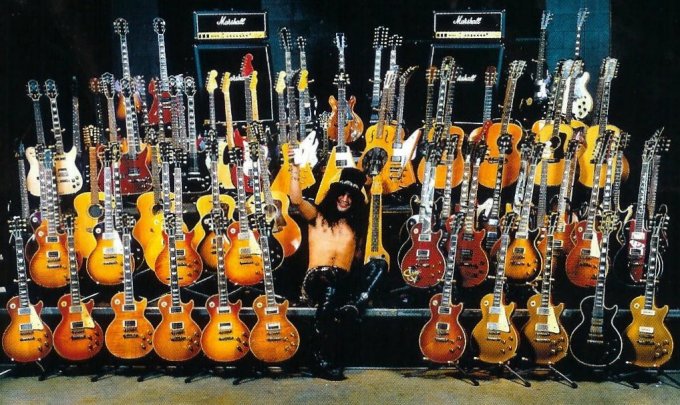
A small part of Slash's guitar collectionA small part of Slash’s guitar collection

Tokai Love Rock

How to… refret a guitar
Tokai Love Rock LS-55 Les Paul Standard “Made in Japan” 1991

All guitar players dream of finding something amazing, and ideally cheap, in a pawn shop but few of us do. It takes stupid amounts of persistence and a even greater amount of luck. To be hounest, most of the time they are just full of crap and you have to go almost daily since bargains don’t tend to hang around for long. Then again, sometimes you can find something awesome that they have missed the value of because it wasn’t that easy to Google. Like a Tokai Love Rock Made in Japan from 1991 that didn’t have the Made in Japan marking on it. I found this guitar a couple of weeks ago in a pawn shop, or cash converter as they tend to be called here in Spain. It was in a really bad state, I mean I have never seen a dirtier guitar in my life, a thick layer or grease and grime on the fretboard and bridge. The previous owner must have sweat like a pig because all the screw were black of rust and impossible to get out. I actually had to drill them out to change the humbucker mounting screws so I could adjust the pickups. I got this image in my head of a rather hairy and sweaty gent that had been playing Sweet Home Alabama on this guitar for the past 20 years and really gigging the hell out of it. I soaked the bridge in normal washing liquid over night and then cleaned it with an old toothbrush, my favourite cleaning tool. I bought this guitar on a whim, I mean I loved the neck, I hardly dared to touch it because it was so dirty, but the body was pretty well worn and one of the pots was broken. On top of that I had no clue if it was made in Japan, Korea, China or it might not even be a real Tokai, I read somewhere about tons of fake Tokai’s, or Fakai’s flooding the market in Canada. If I didn’t find cleaning and making guitars look pretty the best past time in the world I would probably not have bought it, but I do, so I got it straight away. I cleaned it up and took it apart and started to look for the clues.

Tokai Love Rock Made in Japan
The night I found here, unclean and weary.

I remembered that I had read that the Japan made Tokai’s had 2 screws for the trussrod cover while the Korean and Chinese had 3. Mine has 2, check. Then I noticed that both the bridge and stopbar had Made in Japan stamped under, check. Then I read on My Les Paul that the Japanese guitars has square holes from the routing under the pickups and diagonal wiring, mine has both, check. I actually read here that Tokai are still using the same router that they have used since the 1970’s so all guitars made by them, Greco briefly and recently Burny, should have this routing if it’s made in Japan. I thought that was pretty cool. To be sure I did a bit more research on Tokai registry and even did a few posts myself on different forums to see what people said. They all agreed, it’s a Tokai Love Rock Made in Japan from 1991.

Tokai Love Rock Made in Japan
Now, all dolled up. I just need to change the broken pot, a set of new amber knobs are already on their way from China.

Tokai Love Rock electronics
A quick update, in mid-March 2013 the Tokai got the broken pot fixed. I also decided to change the frets, something you can read about here and here.

Are all Japanese guitars good?

I would say yes and no. Most of the early Japanese guitars I have tried have a rather “toy guitar” feel to them. My Playsound from the late 1960’s is fun to play but it’s a pretty horrible copy of a Telecaster. A lot of Japanese acoustic guitar manufactures jumped on the bandwagon and started to make electric guitars in the mid Sixties since that seemed to be what the kids wanted, here you can read more about Japanese guitar brands. Some of them managed to make pretty decent copies of American Fender’s and Gibson’s and others came up with pretty elaborate and creative designs of their own but in general they weren’t that good guitars. Most of the guitars made in the 1960’s didn’t have that great wood and the hardware was normally pretty weak but sometimes the pickups could be all right. Ry Cooder still prefers the Japanese gold foil pickups for his slide guitars and they have been quite popular in American surf music too, this could simply be because that was what people could afford back in the days. It’s important to remember that a lot of the Japanese guitars in the Sixties were mainly made as cheap entry level instruments for the West, not as elaborate copies of the real deal for professionals as they later became in the Seventies and eighties. Some early Fender and Gibson copies are horrible just because they didn’t have any real American instruments to copy, they had to rely on photos and come up with their own solutions to solve the problems that Leo Fender and the boys had already figured out back in the fifties.
Japanese guitars, MIJ, Made in Japan
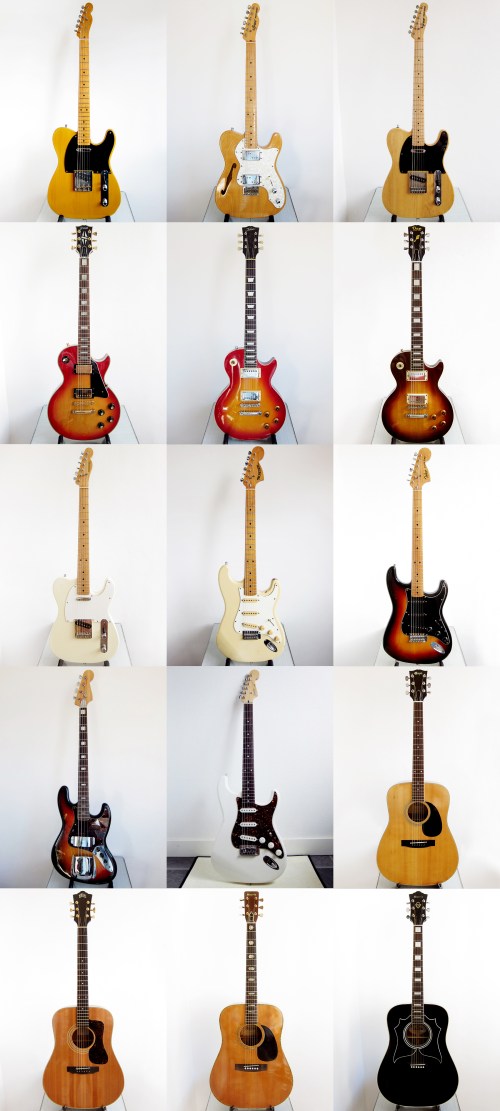
The Japanese collection at the moment: Fender Telecaster TL52-75 1987, Greco Spacey Sounds TE-500N 1977, Greco Spacey Sounds TL-500 1979, Greco Les Paul Custom EG-600C 1980, Tokai Love Rock LS-55 1991, VOX Les Paul 1970′s, Hohner Telecaster 1970’s, Hohner Stratocaster 1970′s, Tokai Silver Star SS-36 1979, Jazz Bass 1978, Fender Squier 1993, Maya F335G 1970’s, K.Yairi TG-40 1977, Morris WL-40 1973, Morris WL-35 1970’s

The big change came around 1972-74, this is also when most Japanese guitar manufacturers started to put serial numbers on their instruments. Lack of serial numbers could be a good indicator of the quality, or rather the lack of quality, of an instrument but not always. There are amazing Matsumoku made Greco’s that were made in the early Seventies that lack serial numbers. I would say that most Japanese guitar makers, or at least the successful ones, started to get it right around 1972-74. Especially the Fender copies but also the Les Pauls started to really feel and sound like the real deal around this time. Most copies in the sixties were either Stratocasters / Telecasters or SG’s / 335’s, and unfortunately most of them were pretty cheaply made. In the early Seventies Stratocasters kept being popular but most makers started to try to make Les Paul’s now as well, most with bolt on neck, and some with pretty good result. Some makers kept on making low cost instruments for export and others started to make amazing quality instruments that wasn’t particularly cheap at the time. The model number is often a giveaway of the original price so my Greco Spacey Sounds TE-500N would have cost ¥50 000 back in 1977 when it was made, that’s around $500. This is not true for all brands but a lot of them started in the mid-70’s to price the instruments after the model number, or rather the other way around, and this is probably the easiest way of determining the quality of a Japanese instrument. I’m not sure what an American made Gibson Les Paul Custom cost back in the mid-70’s but if one of Greco’s top of the line like the EG-1500 cost ¥150 000 that would have been a huge investment back then, around $1500. The second hand value today, at least for the famous brands like Greco, Tokai, Ibanez and Fernandes, is roughly what they cost new. A Greco EG-500 Les Paul copy tend go for 500-700€ on eBay, the same for Tokai and Fernandes, slightly less for unknown brands. A Les Paul tend to be worth a bit more than a Stratocaster, I guess because they made more Stratocasters so they are more common or maybe it’s just because Les Paul’s are more popular today. Rare models, don’t trust people who say that the guitar they are selling is rare on eBay, I mean really rare and high end models tend to cost like a real Fender or Gibson from that time.

So what is so good with Japanese guitars? I would say the wood and the craftsmanship. Americans got really sloppy and so did the European manufactures when the productions became too big in the Seventies. Cheap Japanese made guitars, at least after the mid-Seventies, are still really well made. They tend to have good solid wood, great weight and sustain and an amazing quality feel to them. This is of course not true for all of them but at least the Japanese guitars I have played have had a great feel to them. When they made budget instruments in Japan during the Seventies and the Eighties they didn’t cut cost on wood and workmanship, only on hardware and electronics and that’s fairly cheap and easy to upgrade yourself. The best guitars I have are all made in Japan around 1980, that seems to be the height of Japanese guitar manufacturing.
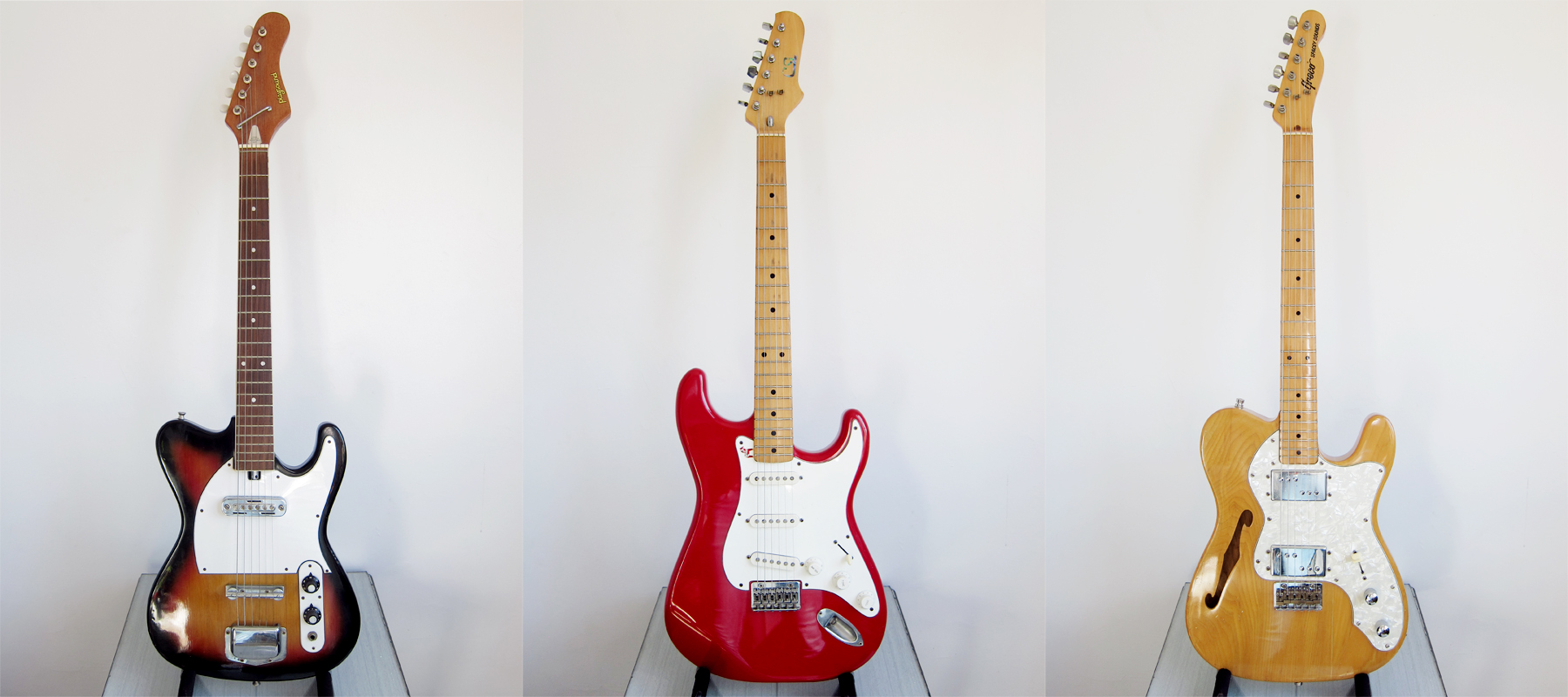
Japanese guitars Playsound (Teisco) 1960’s, CSL (Charles Summerfield Ltd) 1980’s, Greco Spacey Sounds TE-500N 1977

The Playsound guitar was labeled as Audition on the amp and Playsound on the guitar, a beginners set made by Teisco in the Sixties and sold by Woolworth in the UK. I found the whole kit very cheap in a charity shop in South Woodford, UK, the first guitar I bought to collect rather than play. CSL was made by Ibanez in the Fujigen factory and relabeled CSL (Charles Summerfield Ltd) for their UK import. I found it in a second hand shop in Spain in a terrible state so I bought it and cleaned it up and gave it as a present to cheer my girlfriend up after a hospital stay, so techincally not part of my guitar collection. Pretty classic Ibanez head from the 1980’s so clearly made after the 1977 lawsuit. Amazing neck, good feel in general but pretty weak pickups and cheap hardware. The Greco was imported straight from Japan last year, the first guitar I actually bought from outside EU. Amazing Fujigen built Thinline copy, strong original Maxon pickups but not too dark for being humbuckers and with a really fat neck, just as I like it.