Claescaster

Tag: Epiphone

Hagstrom Viking

Hagstrom Viking, Tobacco Sunburst 2008Hagstrom Viking, Tobacco Sunburst 2008

It’s with a heavy heart that I have decided to part with my Hagstrom Viking. I bought the guitar back in 2010 and have unfortunately not had time to play it as much as I wanted, some Japanese Telecasters got in the way. I had three semi-hollow bodied guitars at one point and kept this the longest, I sold the other two last year. I guess the more guitars you have the more you realise what feels good for you to play. For me, fat necked Telecasters feels really nice to play, I’m a bit gay for old Greco Telecasters from the 1970’s. If you are interested in inherit this Hagstrom Viking from the Claes Collection then get in touch. You can read more about it here for sale, or in Spanish here.

Update: April 4, 2014 The Hagstrom Viking is now sold to Rafa from Cobarde.

Hagstrom, or Hagström as we call it back home, was founded in 1925 by Albin Hagström in Älvdalen, Sweden. They made amazing electric guitars from 1958 to 1983, played by guys like Elvis Presley, Jimi Hendrix, Noel Redding, Joe Walsh, Dweezil and Frank Zappa to name a few. I have played on a lot of Hagstrom guitars and amps during my teenage years back in Sweden and learned to play bass on my stepdad Sten’s Hagstrom Jazz bass from 1976. I have an fairly mint Hagström HIIN OT from 1975 back in Sweden that I really like. I guess it was out of national pride that I got so excited and bought the Hagstrom Viking when they started to make them again in 2004. They have a few models that are made in the EU, but not in Sweden, and the rest is made in China. I have actually only played my Viking from 2008 so I can’t really comment on the quality of the Chinese Hagstroms today but mine is very well built for the price. I would say that they are better than Gretsch Electromatic, Epiphone and the Ibanez semi-hollow bodied, all in roughly the same price range.

Zappa plays Zappa, Hagstrom ad

China vs Korea

Buy American! The electric guitar was invented in the USA so there is no surprise that they used to produce the finest guitars in the world. However, in the Seventies as competition grew stronger Fender and the big boys started to focus more on market shares and suddenly quantity became more important than quality. At the same time the Japanese factories really stared to get a hang on building amazing copies of American instruments with more eye for details than the Americans themselves in some cases. Epiphone, Gibson, Fender and Grestch all moved part of their production to Japan for the amazing quality offered to a lower price. The list of world domination on the guitar building market used to be USA, Europe, Japan, Korea, Taiwan, China etc. Now things started to change and Japan took over a big part of both USA and Europe’s production. Japan was never really that cheap, well they did produce super cheap instruments too, but the top brands was still quite expensive so in order to increase their profit most of the Japanese manufacturers moved parts of the production to Korea in the Eighties. Suddenly a Japanese copy of and American guitar was now being produced in Korea. As the Eighties became the Nighties even the Korean workers started to feel expensive and production was moved to Taiwan, China or in some cases even Singapore, Indonesia or India. Japan is still the best guitar builders in the Far East but as their prices increased more and more people settled for number two, which used to be Korea but things have changed, again. The Koreans have become sloppy, and expensive so now Tokai and other companies have moved their production to China instead. China is the new Korea. I have to say that the two Tanglewood parlour guitars that my girlfriend and I have are amazingly built for the price. They are hand built in China and I doubt that anything built in Korea today could match that. Korean built instruments from the Eighties are still really good so I believe this change happened in the last 5-10 years. It’s going to be interesting to see what happens when the Chinese built instruments gets the recognition they deserve on the second hand market. Today sellers just push for guitars being MIJ, Made in Japan, or MIK, Made in Korea. When will the MIC arrive and how much will they be worth?

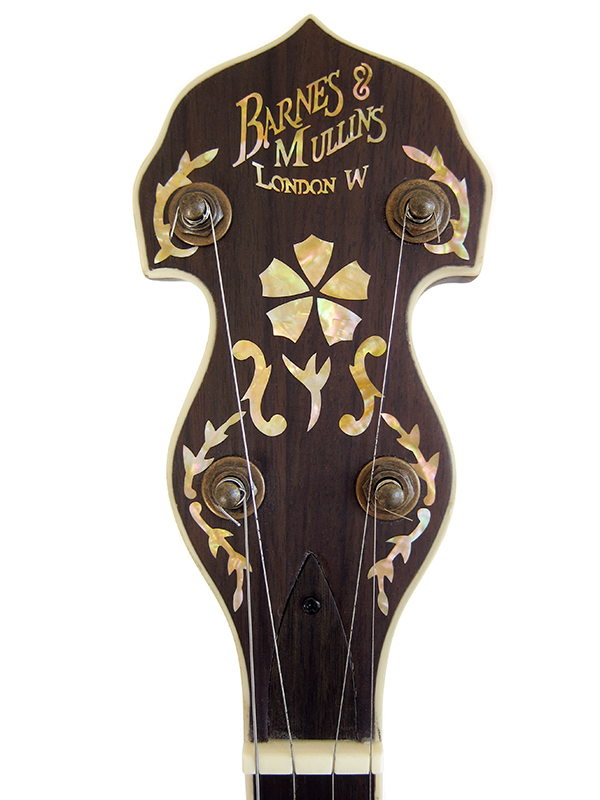
Barnes & Mullins BJ500m 5 String Banjo

My Barnes & Mullins BJ500m 5 String Banjo built in China and set up in the UK