Claescaster

Tag: acoustic guitars

Guitars for sale

I have a couple of more guitars for sale now so if you’re interested or have any questions just send me an email claesgellerbrink@gmail.com or give me a call 639586158.

1970's Japan made Hohner TelecasterHohner Telecaster, Made in Japan, Moridaira factory, 1970’s, 500€ SOLD
A great Telecaster copy in a good shape for age but with some dings to the bottom of the body. Frets are in great condition and there isn’t a single mark on the back of the neck. It’s a pretty heavy Telecaster with great sustain and nice feel to it. The pickups sounds awesome and everything is working fine, all original except for the 3-way switch that wasn’t working properly so I replaced it with a new one. Really fast and smooth neck, lovely to play. A great sounding guitar with amazing sustain and great Japanese build quality. Made in Japan by Morris in the Moridaira factory, where H.S. Anderson made the Mad Cats that Prince uses. You can read more about the guitar here and here is a Youtube clip.

VOX Les Paul Made in Japan 1970'sVOX Les Paul, Made in Japan, 1970’s, 350€ SOLD
This is the first Japan made VOX guitar I’ve found in Spain. It’s a pretty decent copy of a 1958′ Les Paul with a great feeling fat neck and narrow head. The body has a lovely grain and the guitar is in pretty good shape for the age with a couple scratches and a few dents. Frets show some wear but are still fine and everything is working perfectly. The humbuckers have a nice tone too them, not too heavy or muffled. A pretty versatile and nice guitar to play with great Japanese build quality. You can read more about the guitar here and here is a Youtube clip.
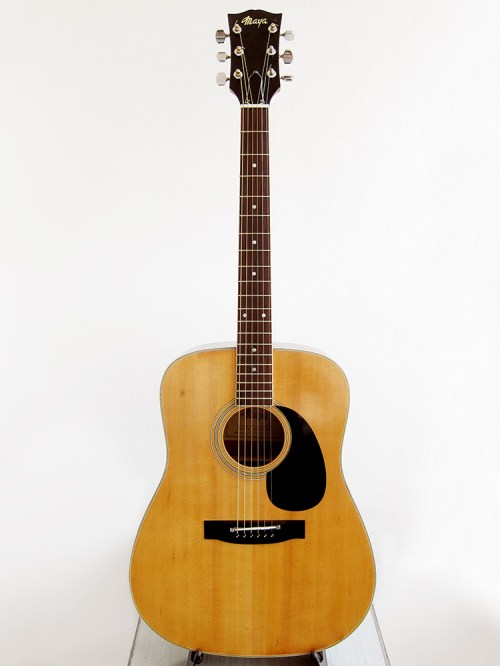
Maya F335G, Made in Japan 1970'sMaya F335G, Dreadnought acoustic, Made in Japan, 1970’s, 250€ SOLD
Japan made Gibson J-50 copy in a pretty good state for it’s age. I couple of marks on the spruce top and few knocks on the head but structurally very sound without any cracks. This Maya F334G was made by Chushin Gakki in Kobe, Japan, during the 1970’s. It has a really fat neck, it’s feels great to play, adjustable bridge with both bone nut and saddle. The sound is very full with a great booming bass, you can listen to it here. If you want more pictures  you can check the post I wrote about it.
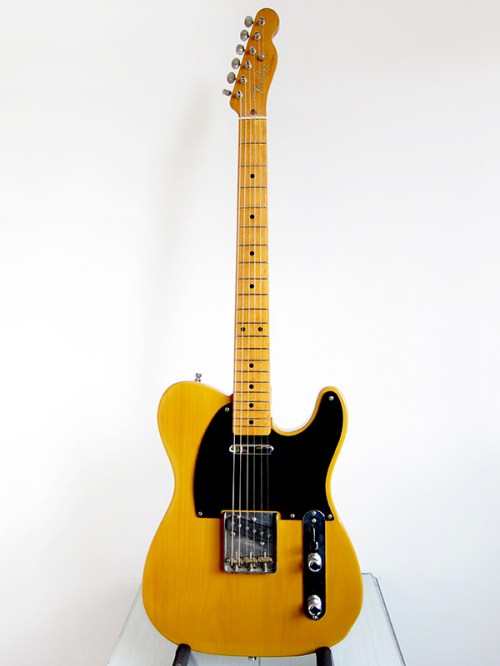
Fender Telecaster TL52-75, ’52 re-issue, Made in JapanFender Telecaster TL52-75, ’52 re-issue Made in Japan, FujiGen 1987-1989. 900€ SOLD
In mint condition, all original, without any doubts the best Telecaster I have ever played. Imported straight from Japan. The only reason for selling is because I prefer fat 70’s necks. There is no way to find the production year of these A-serial Telecaster with the serial number on the bridge plate. However, it must have been made between 1987 and 1989 since it’s a TL52-75. They were called TL52-70 between 1984-1986 and then changed to TL52-700 in 1990. You can read more about the guitar here and listen to it in this Youtube clip.
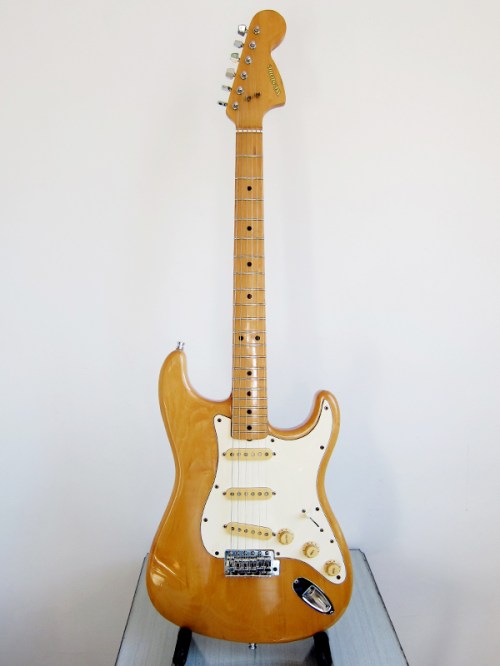
Westone Stratocaster, Made in Japan, Matsumoku, 1979Westone Stratocaster, Made in Japan, Matsumoku factory, 1979, 400€ SOLD
An amazing Stratocaster copy from 1979 made in Japan by Matsumoku. In really good shape for age but with some dings and scratches to the body. Frets are in great condition and there isn’t a single mark on the back of the neck. The wood in the body is amazing, without any doubt the heaviest and most solid Strat I have ever seen with fantastic sustain. Really nice tone in the pickups and everything is working fine, the original 3-way switch has been replaced with an Oak Grigsby 5-way switch. Really fast and smooth neck, lovely to play. A great sounding guitar with amazing sustain and great Japanese build quality. Here is some more info about the Westone brand. Here is a Youtube clip with the guitar.

Maya F335G, Made in Japan

Maya F335G, Made in Japan 1970'sMaya F335G, Made in Japan 1970’s

On Saturday I found myself a Maya F335G. As mentioned before, I’ve been after a Gibson J-45 or J-50 for quite a while so when I saw this Japan made Gibson J-50 copy I couldn’t resist. It was in a terrible state and strung with 4 nylon strings so I couldn’t test it but I trusted my gut feeling. It doesn’t sound like a Gibson J-50, I didn’t really expect it too either, but it does sound pretty good. I would say that it sounds better than the two Suzuki’s I used to have, the Kiso Suzuki WE-150 and Suzuki Three-S F-120, even though the build quality is pretty much the same. There is a huge step up to my Morris WL-35 and Morris W-40 and my beloved K.Yairi TG-40, both in build quality and sound. Having said that, there is something with this Maya that I really like, it has way more bass then the Suzuki’s and overall a pretty nice and full sound. The only downside is that it feels pretty stiff to play so I will probably put 011’s on it next time I change the strings. According to my previous post about Japanese guitar brands Maya was made by Chushin Gakki in Kobe, Japan, during the 1970-80’s. Even though I really like this guitar I have it listed for sale if anyone is interested in buying it.

Maya F335G, Made in Japan 1970's Maya F335G, Made in Japan 1970's Maya F335G made by Chushin Gakki in Kobe, Japan

Maya F335G, Made in Japan 1970's The previous owner had used a collection of random oversized wood screws to keep the machine heads in place so the first thing I did was to remove them and fill the holes. I polished the frets and oiled the super dry fretboard and then put on a bone nut and saddle which improved the tone quite a lot.

Video of the day

K. Yairi TG-40

K. Yairi TG-40 Made in Japan 1977K.Yairi TG-40 a Guild D-40 copy from 1977. Every K.Yairi guitar is given birth in Kani, a small community in the beautiful mountainside area of Honshu, Japan.

My new K.Yairi TG-40 has finally arrived, after 40 days stuck in Spanish customs. I have mentioned earlier that it’s a lot easier to import things from Japan to Spain compared to buying things from the US, well that was a lie. I have bought three electric guitars, mainly Greco’s from an eBay seller called Tokyowax. They all arrived within 48 hours so I stupidly assumed that everything from Japan would arrive quickly and without any problems, but no. Tokyowax uses DHL Express and they tend to deliver things within 2-5 days and you pay the taxes straight to them when they deliver the guitar. It wasn’t that easy with EMS Japan, that package went straight to customs in Madrid and spent 40 days in their lazy company. How can anything take that long? K. Yairi could probably have built me a new guitar in that time, if he was still alive. It seems like the only option now when buying guitars on eBay is to use the Global Shipping Program, that worked for my Goya 163 at least. Anyway, the guitar is amazing so it was well worth waiting for.

K. Yairi TG-40 Made in Japan 1977

It has a really nice tone with great bass response. It easily has the best bass of all my acoustics, even better than my Morris W-40 which has that Martin D-45 bass sound, this is nicer and a lot clearer. I guess it sounds like an old Guild D-40, at least if I can trust the Youtube clips I have seen since I haven’t had the chance to play one myself. It actually reminds me a bit of a Gibson Jumbo, like I mentioned in my Gibson J-45/J-50 post: “The Yairi TG-40 is a Guild D-40 copy, which was introduced in the Sixties as a competitor to Gibson’s J-45. The Guild D-40 became famous as the Bluegrass guitar for their even response over all the strings and I really like the sound of them, it’s actually not too far off from a Sixties Gibson J-45. With a bit of luck it’s going to be an awesome Yairi copy of an Guild which might sound a bit like a Gibson.”

K. Yairi TG-40 Made in Japan 1977I didn’t have to do much to it, it was ready to play when I got it. However, the pickguard was loose so I had to remove that, clean it up and then glue it back again with my trusty fish glue. When the strings was off I quickly polished the frets and oiled the ebony fretboard. I also installed a jack for my LR Baggs M1 and a strap button.

I bought this K.Yairi TG-40 from a really nice eBay seller called montebell86 who was a pleasure to deal with. The guitar was listed as “Taniguchi Gakki” Japanese guitar shop original model, very rare. Solid spruce top, sides and back in solid mahogany, neck in Honduras mahogany, bridge and Fretboard in black ebony. The label states it was made in 1977 but the serial number starts with 51 which was the 51st year of Emperor Shōwa and puts it to 1976.

K. Yairi TG-40 Made in Japan 1977K. Yairi TG-40 Made in Japan 1977I got this K.Yairi TG-40 fairly cheap since the pickguard needed to be reglued and one machine head wasn’t working properly. It also has two cracks, one on each side that has been professionally repaired and can’t be seen from the outside. Since the machine heads needed to be replaced I decided to change them for Wilkinson WJ-309 in gold, just like I did on my Levin 174

Here is a quick little comparison between the K.Yairi TG-40 and my Morris W-40, they sound pretty similar and I don’t think I would be able to tell them apart in a blind test. Well the Morris has a bit more bass and is a slightly weaker on the treble side, I feel that the Yairi is more even over all the strings.

Yairi TG-40 Japan Catalogue 1970'sK.Yairi TG-40in the Japanese catalogue from the late 1970′s. List price ¥60.000, around 420€, which must have been a fortune back in 1977. Then again, this was a fairly cheap guitar for being K Yairi, the top model cost ¥200.000, about 1400€.

Kalamazoo Gals

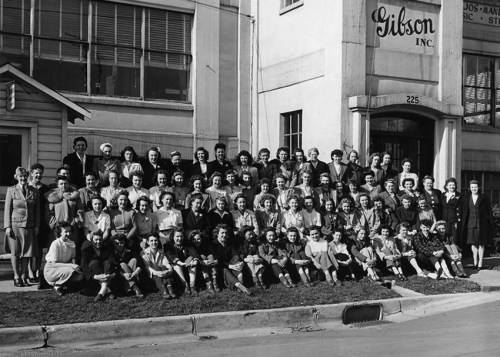
gibson-kalamazoo-girls-MAIN

I have never thought about before but of course everything was built by women during the war. Not just guns, aircraft and cars, guitars as well. Kalamazoo Gals: A Story of Extraordinary Women & Gibson’s ‘Banner’ Guitars of WWII by John Thomas is a book that came out in 2013.

The book revolves around the interviews of a dozen women who appeared in the Gibson Guitar Company’s 1944 workforce photograph. Prior to my discovery of these women, Gibson had claimed in Wartime advertisements and in a 1973 company history authored by its WWII personnel director that it ceased producing guitars during the War. The younger members of its workforce had left to serve the military War effort. The remaining seasoned craftsmen repaired some instruments but, because of their limited numbers and wartime restrictions on the use of raw materials, were unable to construct new musical instruments. I discovered that the female workforce produced nearly 25,000 instruments during the war. Taken from Banner Gibson

K.Yairi TG-40

Yairi TG-40 Made in Japan 1977
K.Yairi TG-40 a Guild D-40 copy from 1977. Every K.Yairi guitar is given birth in Kani, a small community in the beautiful mountainside area of Honshu, Japan.

Sometimes when I’m left unsupervised, especially on Sunday nights, I end up buying guitars that maybe I shouldn’t have bought, or rather that maybe I don’t really need. I’ve been thinking a lot about trying to find a 1970’s Gibson J-45, I can’t really afford anything earlier, but that would still set me back a at least 1500€ which is really hard to justify for a guitar player on my level. I’ve managed to track down the guitar sound that I love to Gibson’s old jumbo models, think Jackson Browne, and the J-45 or J-50 would have been ideal, I think, it’s hard to know without trying but from all the Youtube clips I’ve been listening to they all have a very similar sound. It’s that dry woody booming bass sound that is unmistakably a Gibson J-45. Now I got a Japanese made Guild D-40 copy instead, it wasn’t really planned but I couldn’t resist, or I got carried away, anyway, it’s mine now. The Guild D-40 has a lot of awesome qualities, it’s a proper bluegrass guitar and was built for their even response over all the strings. I trust that Yairi did a good job 37 years ago and even if it doesn’t sound like a Gibson J-45, I’m sure it will have a lot of warmth and good bass, just what I’ve been looking for. On top of that, it’s a freaking Yairi, I never thought I would be able to afford that and I’ve dreamt of a Yairi since I bought my first Japanese acoustic.

Yairi TG-40 Japan Catalogue 1970's K.Yairi TG-40in the Japanese catalogue from the late 1970’s. List price ¥60.000, around 420€, which must have been a fortune back in 1977. Then again, this was a fairly cheap guitar for being K Yairi, the top model cost ¥200.000, about 1400€.

Ad of the day

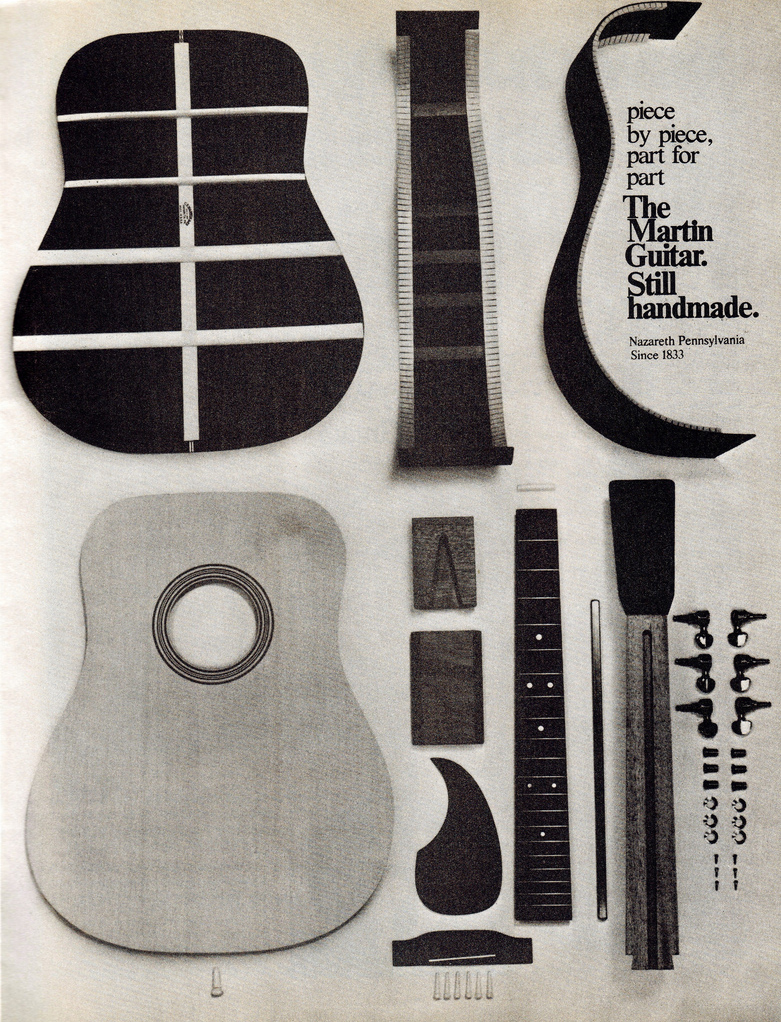
Martin guitar ad from Guitar Player Magazine, September 1974
Martin guitar ad from Guitar Player Magazine, September 1974. I love how few parts an acoustic guitar has.

Kazuo Yairi

Master Luthier, Kazuo Yairi Dies Aged 81

I just found out that Kazuo Yairi died earlier this month at the age of 81. As I mentioned before, I would love to one day afford a K.Yairi and big reason for that is the philosophy of Mr Yairi himself:

Good materials are hard to find so it’s better to make guitars through limited production by hand instead of mass production. Trees are very important “precious” things so we should make good use of them. Guitars made with “heart” are the best use of trees.  Kazuo Yairi

Martin D-45 copy, 1976 K.Yairi YW-1000
The most beautiful Martin D-45 copies in the world, a 1976 K.Yairi YW-1000

Video of the day

Here is a nice post about Townes from a great blog called Johanna’s Visions

How to… install side dots

Francisca Montersat
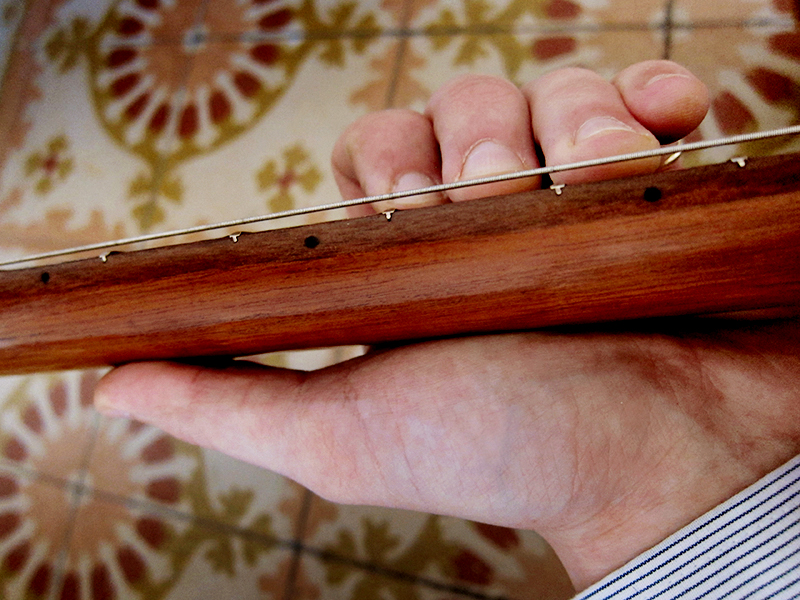
Francisca Montserrat with her new side dots

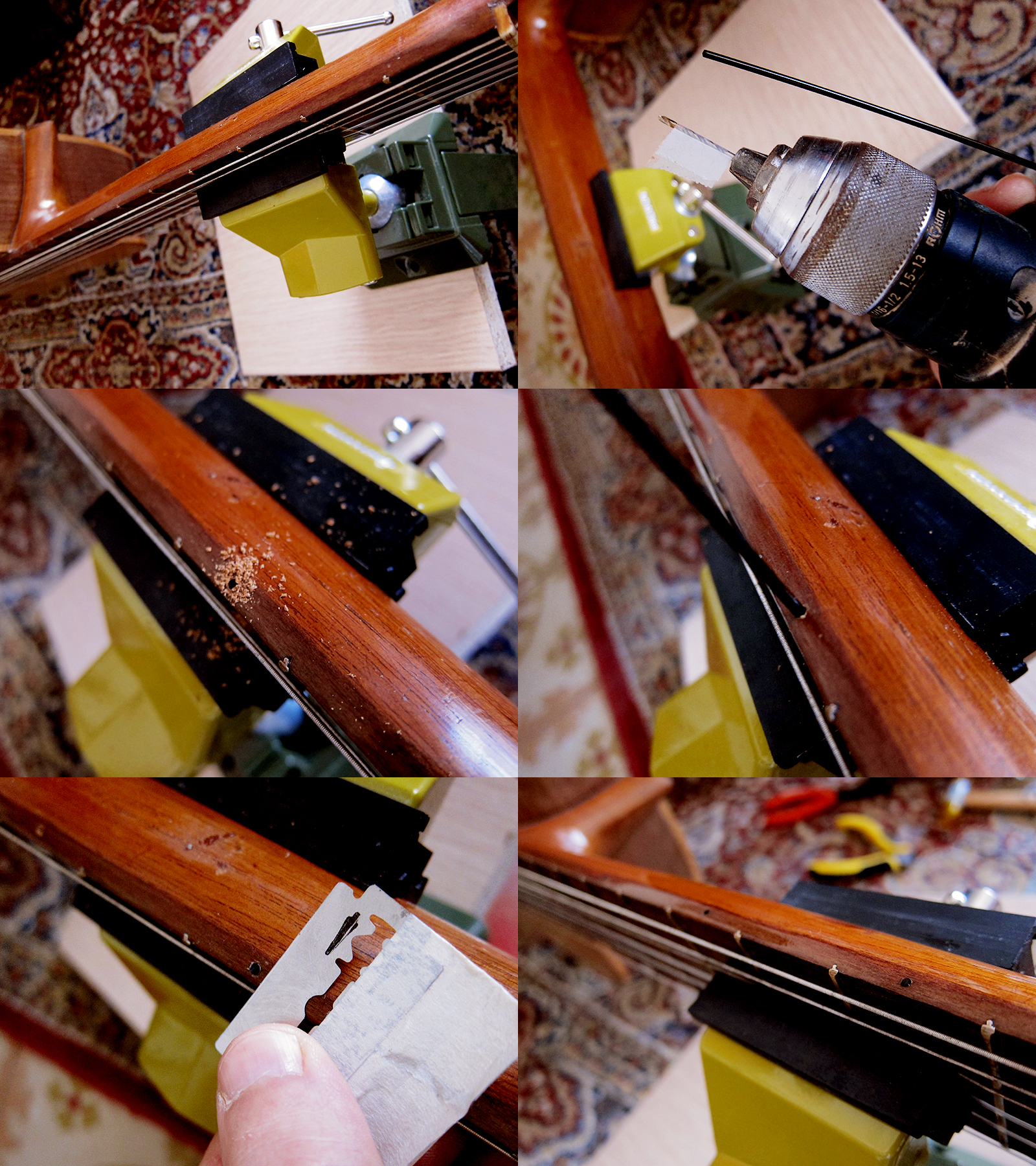
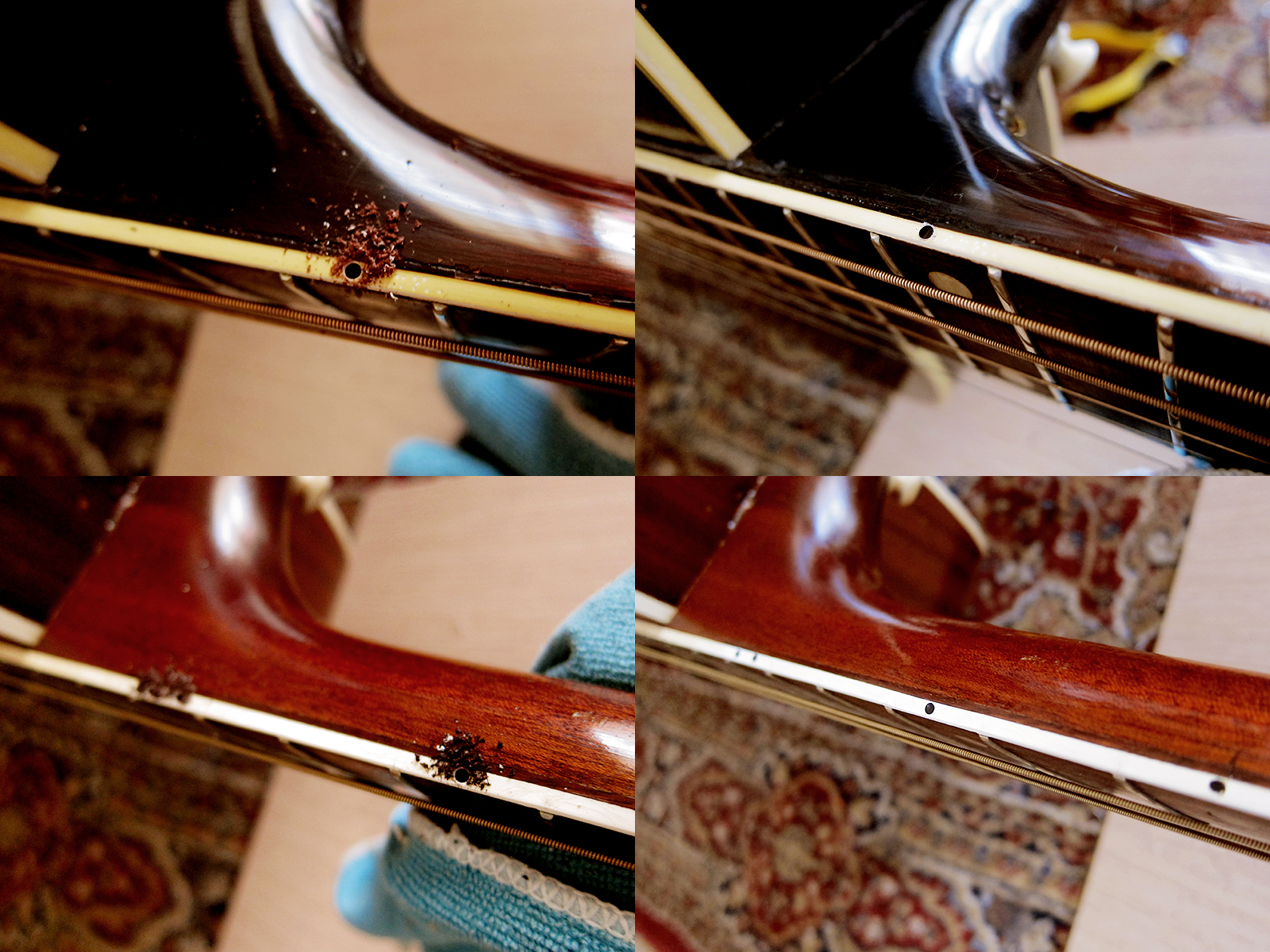
I get really confused when I play on guitars without side dots. You are playing your cowboy chords and everything is fine and then suddenly you want to play a bit of solo up on the 12th fret and you realise that there are no markers above the 5th fret and you have to guess where to put your hand. Well on a 14th fret acoustic guitar you know roughly where the 12th fret is, 2 above where the body and neck joins but say that you need to quickly find the 11th, or 9th fret. For me position markers, or side dots, are essential. Flamenco guitars seems to never have any side dots at all and a lot of Spanish or Classic guitars seems to have forgotten them too. I guess if you are used to it, if you have played your whole life without them maybe it’s fine but I come from the world of electric guitars with clear indications where you are on the neck. My Levin guitars only have side dots up until the 7th fret, it’s just my Goya T-18 that has markers up to the 12th fret, so I decided to change that. I had to order some new Jescar frets from my favourite eBay luthier supplier in the States, Philaluthiertools, so I got some 2mm side dot position markers in black as well. I was a bit scared to drill in to thin strip of binding on my 40-50 years old Levin guitars but after practising on my Francisca Montserrat I felt ready and just did it. It went pretty well, no real drama. It was interesting to see what the fretboards was really made off when you saw the sawdust. Some of the Levin’s had normal rosewood freatboards but the Levin 174 has a ebony fretboard, how fancy pants is that? My dads old Levin LT-16 is supposed to have a rosewood fretboard but I think that sawdust looks very dark for being normal rosewood.

Francisca MontersatFirst I installed 3 side dots on my Francisca Montserrat just to warm up. There might be some Flamenco purists saying that I’ve ruined this guitar now but I think it was a fairly discrete modification that will make it hundred times easier for me to play it. I just drilled a 2mm hole, same as the plastic side dot, about 3-4mm deep. I didn’t use any ruler, I felt that my eyes would be the best judge to make a visual estimatation and get them to line up. I made a little mark with a black pen and then when I was happy with that I made a little pilot hole with a nail so the drill wouldn’t slip. I put some super glue in the end of the side dot stick, stuck it in and then cut it off with a pair of pliers. I got it smooth with a razor blade and then sanded it down with 400, 800, 1500, 2000 and 2500 grit paper, the same technique I use for repairing lacquer damage.

Levin LM-26, Levin LT-16
All my Levin’s got new side dots installed, here is a 1959 Levin LM-26 on top and a 1966 Levin LT-16 below. I have to say that the dots I put in on the 9th and 12th fret on my dads LT-16 looks better than the original one on the 7th fret that was installed 48 years ago at the Levin factory in Gothenburg.