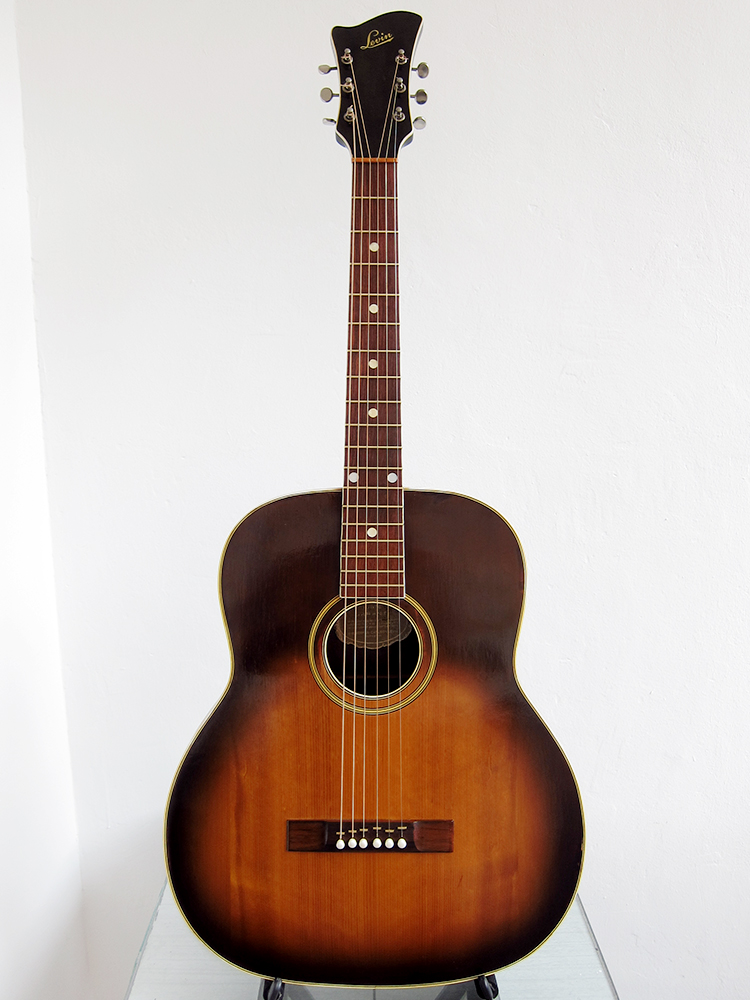
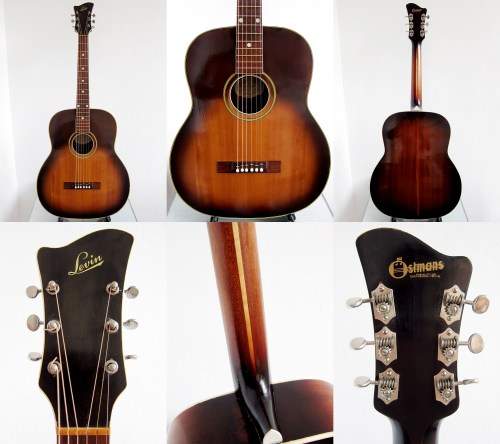
I have decided to thin out my Levin collection a bit, I have 12 at the moment, so the first to go will be my beloved 1950 Levin Model 13 Ambassadör. It was restored a few years ago by GammelGura, a great luthier in Örnsköldsvik, Sweden. With new bronze frets, a neck re-set, cracks glued and a new bridge was created to improve the intonation, the rest is all original. It even has the sticker on the back of the head from the guitar shop in Örnsköldsvik where the guitar was bought 65 years ago. If you are interested in the guitar send me an email or give me a call, all info can be found on the For sale page.
Levin Model 13 Ambassadör
Body width: 400 mm, body length: 480 mm, scale length: 640 mm
Spruce top, walnut back and sides, 4-ply bound top, single-bound back
Mahogany neck with non-adjustable T-shaped duraluminum truss rod
Single-bound rosewood fingerboard with 18 frets and pearloid dot inlay
Single-bound headstock, rosewood bridge, nickel plated individual tuners
Sunburst finish and 10 years warranty
I recently got myself a Morris W-50, my third Morris and it sounds as good as the other two. Solid spruce top and it looks like the back and sides are solid Brazilian rosewood and quilted maple. It was pretty beat up when I got it from Guitar Hiro in Madrid with plenty of dents and a cracked back but now I’ve fixed it up a bit and it’s playable again. It’s a nice Martin D-42 copy with snowflake inlays and the typical Martin volute where the head and neck meet. Nice inlays all around and a beautiful 3-piece back with flamed maple and rosewood. I guess it was made around 1976 since they changed to hexagon inlays in the 1979 catalogue and then renamed them from W-50 to TF around 1983.
TF Morris W-50, Made in Japan around 1976
Morris Japan catalogue 1976
There was a bit of work needed on this guitar. The back was cracked in the binding just below the heel which made the whole neck tilt forward causing a pretty high action. I cleaned out the crack, someone had put some super glue in there, filled it with fish glue that I let really sink in and connect with the neck block, clamped it and left if for 48 hours. Now it seems really solid and the action got so low that I had to make a new higher bone saddle for it. There was a lot of dents and marks on the back of the neck so I filled them with nitro lacquer and sanded it smooth and buffed it up with metal polish, here you can read more about how to repair lacquer damage. The only thing left now is to ad some gold machine heads so I ordered a set of open back Schaller ST6 this morning and will fit strap button and an endpin jack tonight.
I recently changed the machine heads on my 1970’s Japan made Morris W-50 to Wilkinson WJ28NGD open gear in gold and I couldn’t be happier
Moridaira (Morris Guitars) Founded in 1967 by Toshio “Mori” Moridaira, the Moridaira factory produced high-quality guitars, including the infamous Morris badged guitar. Moridaira also produced badged guitars for Hohner including Coronado, Futurama, H.S. Anderson, Lotus (some) and Sakai.
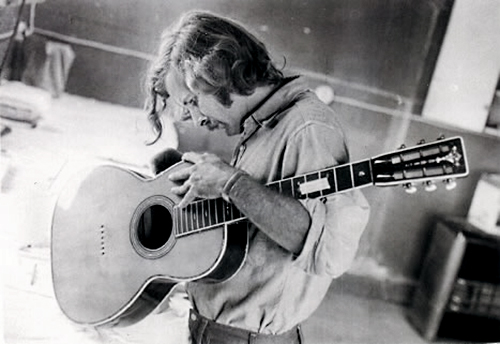
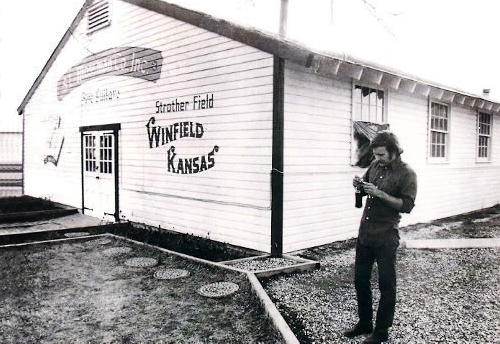
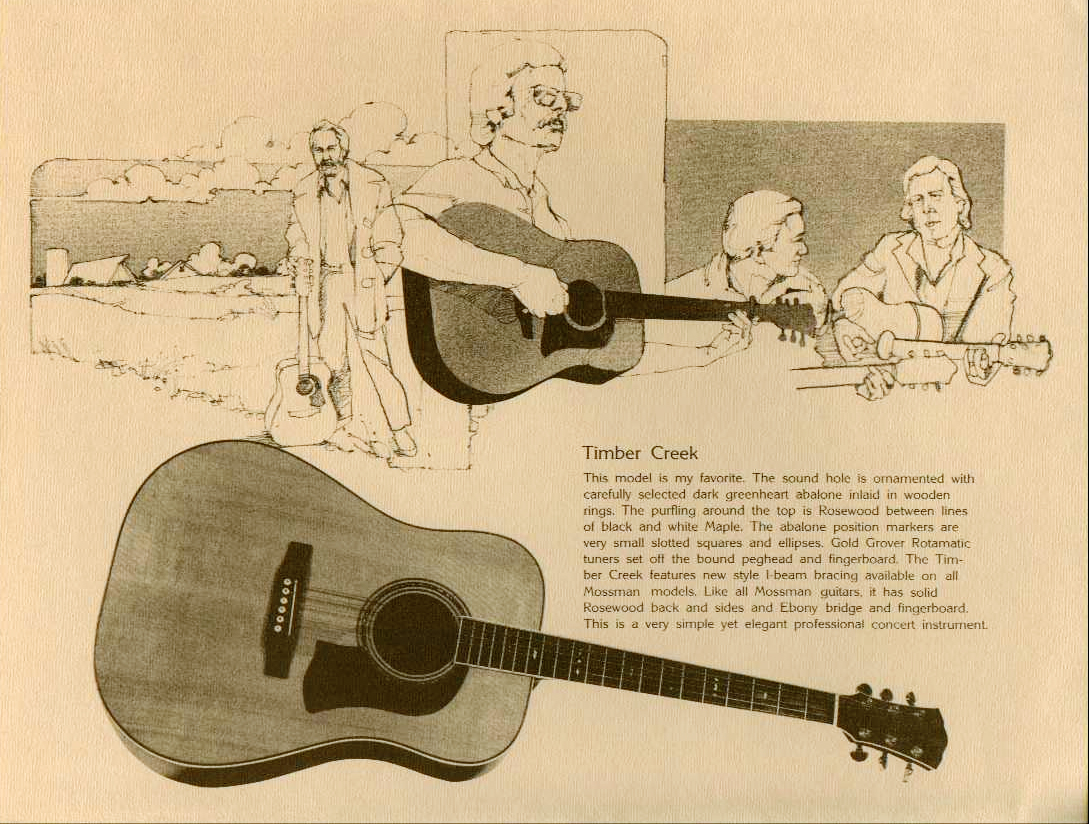
I have recently come across another American guitar maker that was previously unknown to me. I mentioned Grammer guitars earlier, this time it’s Mossman guitars that I’ve fallen in love with. One of the guitar builders that I follow on Instagram, kawvalleyguitars in Kansas, kept posting images of Mossman guitars he had done neck resets on, which awoke my curiosity. After a bit of Googleing I realised that quite a few artists liked Mossman guitars, including John Denver, Eric Clapton, Albert Lee, Doc Watson, Hank Snow, Cat Stevens and Merle Travis. Stuart Mossman got fed up with all the plywood guitars that was pumped out of the big factories in the 1960-70’s and decided to start building his own guitars with real tone woods and proper craftsmanship, and so S.L Mossman Guitars were born in Winfield, Kansas.
Stuart Mossman in Winfield, Kansas. Here you can read more about the Mossman story
This could be the most awesome guitar brochure ever printed, the 1979 Mossman Catalogue, taken from David Hylander Guitar Works
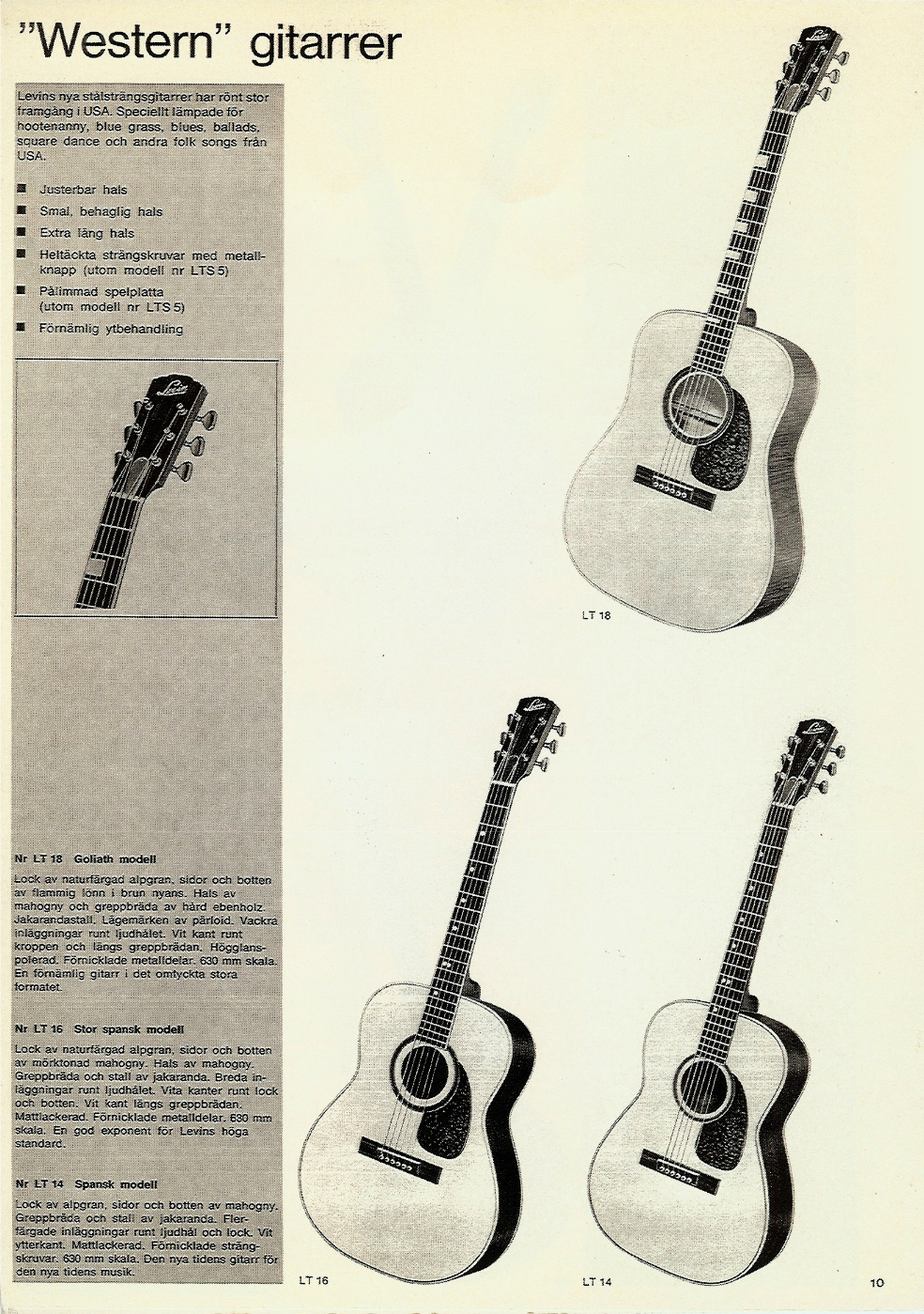
It has been an extremely good Christmas, not only did I manage to find a 1979 Fender Stratocaster, I also received a little Levin LT-14 from 1965. It’s the smallest of the 1960’s Levin guitars and is roughly like a Martin 00 in size. I bought it about two weeks ago from a guy in Heidelberg, Germany and then it got stuck in some warehouse over Christmas until the Spanish post service could be asked to deliver it. It’s an awesome guitar, pretty much like my dad’s old Levin LT-16 but a tiny bit smaller and with a bit less bass but with more clarity in the upper register. It’s also ladder braced instead of X braced which is not necessarily a bad thing in this case, it gives it a pretty great sound. The weirdest thing is that it’s so well kept for being 50 years old, close to mint and it can’t have been played much in it’s life. Well that’s going to change now because I really like it, especially for finger picking and I’m sure it will mature and sound better and better the more it gets played. This is my 10th Levin, or 11th if you count a Levin LS-16 that I have waiting for me in Sweden. Perhaps it’s time to stop buying old Levin guitars but I can’t, they are just too good to turn down. I have liked some of my Levin guitars less and then one day they surprise you and just sound amazing. I guess the more you play them, the better they sound.
It’s the first time I get a 50 years old guitar home and I have to do nothing to it. There are actually no scratches to the top, that’s just in the grain of the spruce.
Levin LT-14 / Goya T-14 Grand Concert size: Body width: 360 mm, body length: 465 mm, body depth: 98 mm
Fingerboard width: 43 mm, scale length: 630 mm
Spruce top, mahogany back and sides, 4-ply bound top, single-bound back
Mahogany bolt-on neck with adjustable truss rod
Unbound rosewood fingerboard with bass side dot inlay
Nickel plated individual Van Gent tuners with metal buttons
Rosewood bridge, matte natural finish and one year warranty
Now I actually have all three, the Levin LT-18, well it’s a Goya T-18 but close enough, my dad’s old Levin LT-16 and this new little Levin LT-14. Taken from a 1965 Levin catalogue. Thanks to Vintage Guitars Sweden
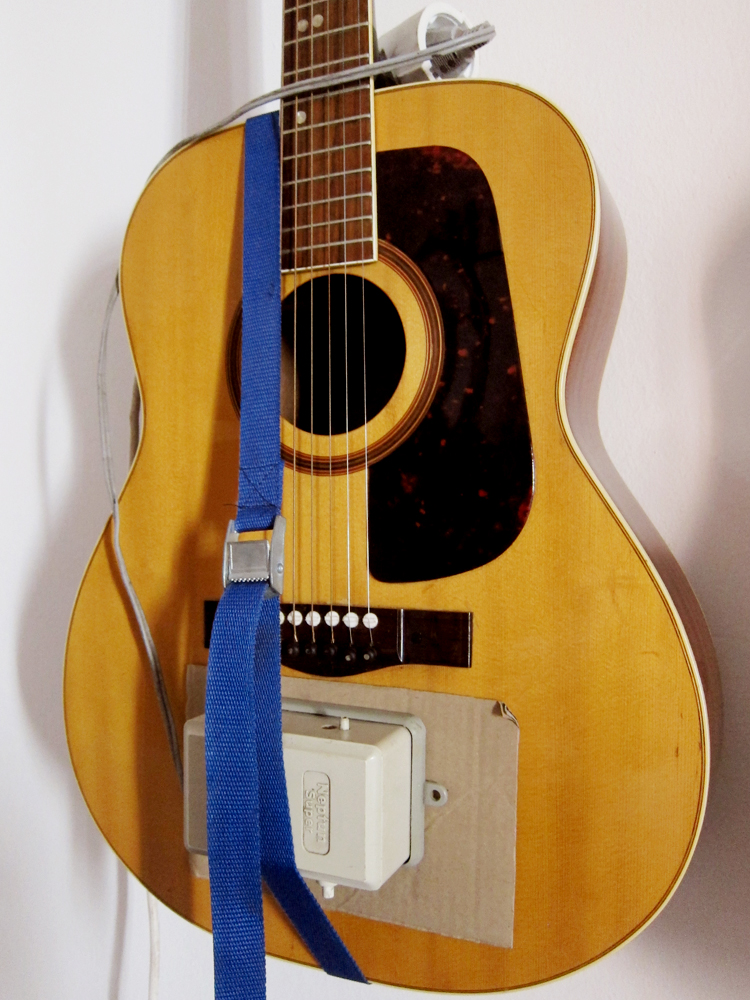
A great way to improve the tone of your acoustic guitar and to get it to open up is to use a normal air pump from a fish tank to give the top a massage. I got an old one, I think the older they are the more they vibrate, that I use on guitars that I buy that hasn’t been played for years. It works great and seems to add both bass, volume and clarity to the guitar. A day or two with the pump is like months of actually playing.
As mentioned before, there are two guitars that I really would like to own. The first would be a Gibson J-50, ideally from before 1970. The Second would be a mid 1970’s K. Yairi YW-1000, the most beautiful Martin D-45 copy ever made. Having said that, I might have to add a third guitar in my list of holy grails, a Grammer Guitar. Imagine to find an original, before Ampeg took over, The Grammer Guitar RG&G, built by Billy and the boys in Nashville, Tennessee. Here you can read the history of the Grammer Guitar, it’s a pretty interesting story, especially if you like country music as I do. In the mid 1960’s Billy Grammer, a musician himself, decided to make an affordable flat top guitar for his friends in the Country music business. He took a Gibson J-45 and a Martin D-18 apart, studied their bracing pattern and how they were built and then made a copy with the best of both worlds, The Grammer Guitar. Maybe the reason I like them so much is because they remind me of my big headed Levin guitars from the 1970’s.
The Last Grammer Guitar made by RG&G, built in 1968 on 715 Poplar Avenue in Nashville, Tennessee
I’m not much of a Joe Bonamassa fan but he plays a 1969 Grammer Johnny Cash model, I mainly respect him for taking his vintage guitars on tour and using them instead of just collection them. The Guitar Of The Week part on the Joe Bonamassa’s site is well worth a visit if you like old guitars.
Joe Bonamassa’s 1969 Grammer Johnny Cash model, here is a Youtube clip of him playing it live
Here is Billy when he was young and awesome
And here is Billy when he is old and blind, but still kind of awesome
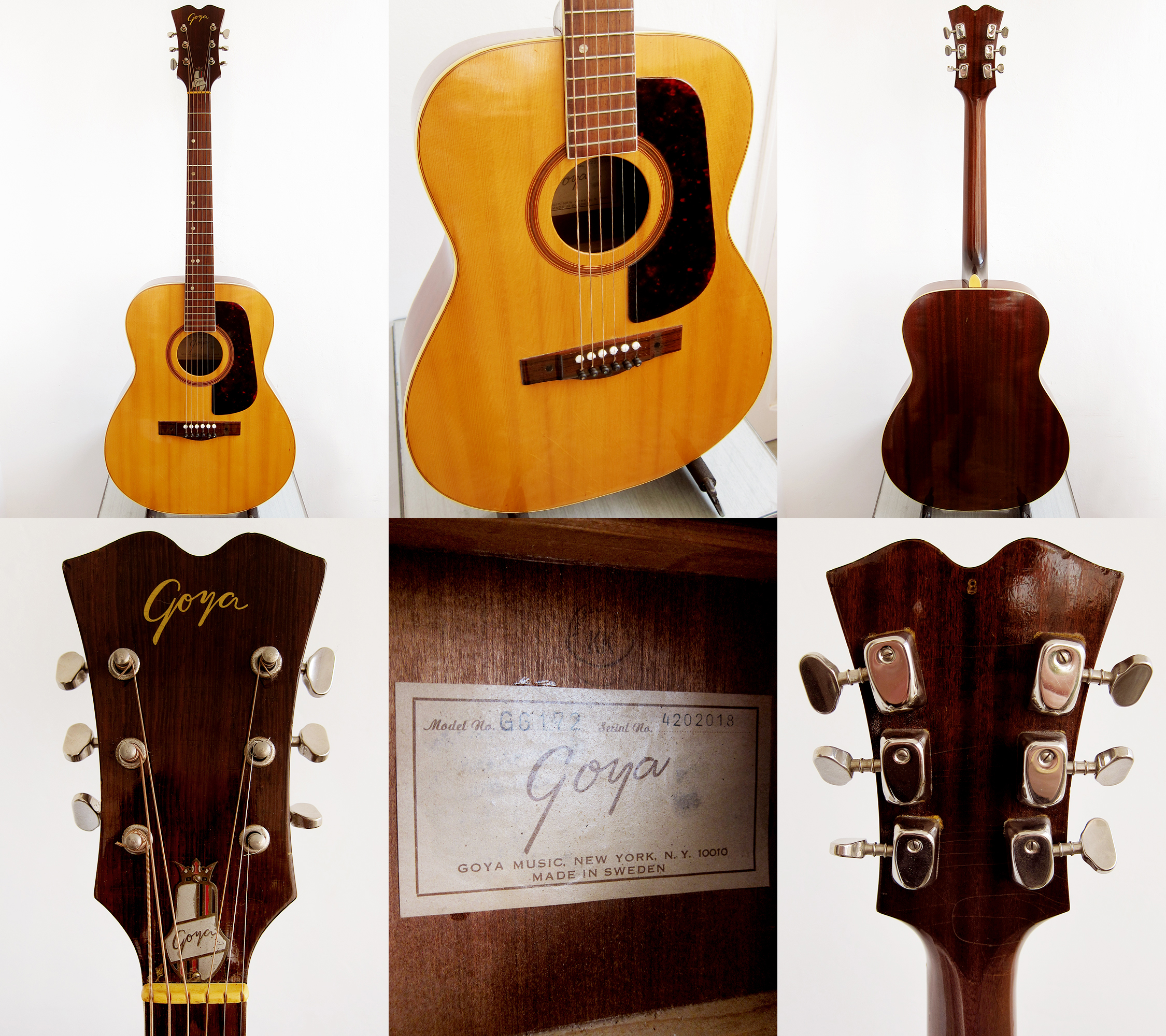
I feel really ashamed, I’ve had a beautiful Levin at home since June without fixing her up. There was a lot of things to got in the way, me building a Telecaster from scratch being the main one, but also that I had a lot of different ideas of what to do with this guitar that in the end never happened. This is my 8th Levin, or actually it’s number 9 in the collection since I got my 1951 Levin Royal after. It’s an old worn Goya Model GG-172 from 1970, according to Vintage Guitars Sweden. You can check how old your Levin / Goya is here, Levin serial numbers / Goya serial numbers. It plays very well now after my little restoration and starts to sound better and better, I have a feeling that no one has played this for a very long time. The Goya GG-172 is grand concert sized Levin, the same size as my dad’s old Levin LT-16. They are 38 cm wide just like a Martin 000, they are 15″ which is 38.1 cm. It’s a very nice size to play, slightly smaller than a normal Dreadnought but with decent bass from the solid mahogany back and sides. I bought the guitar via eBay from a pawn shop in Browns Mills, New Jersey, I freaking love the internet. I used the Global Shipping Program which worked fine this time as well, it took 2 weeks just like it did when I bought my Goya 163. I really wished that the Japanese sellers would start with this as well since it was such a mess when I bought my K.Yairi TG-40, it took 40 days to get through customs, with the Global Shipping Program you pay all the import taxes and charges straight away so it just goes straight trough customs without any delays. It’s a really nice little Levin but since I have 9 of them now and actually another on the way, I might have to consider selling it to make some room. If you are interested send me an email to claesgellerbrink@gmail.com
Levin Model 172 / Goya Model 172 / Goya GG-172 Grand Concert size: Body width: 380 mm, body length: 480 mm, body depth: 98 mm
Fingerboard width: 43 mm, scale length: 630 mm
Spruce top, mahogany back and sides, 4-ply bound top, single-bound back
Mahogany bolt-on neck with adjustable truss rod
Single-bound rosewood fingerboard with bass side pearloid dot inlay
Rosewood bridge with individual height adjustable plastic saddles
Nickel plated individual Van Gent tuners with metal buttons
Matte natural finish and ten year warranty
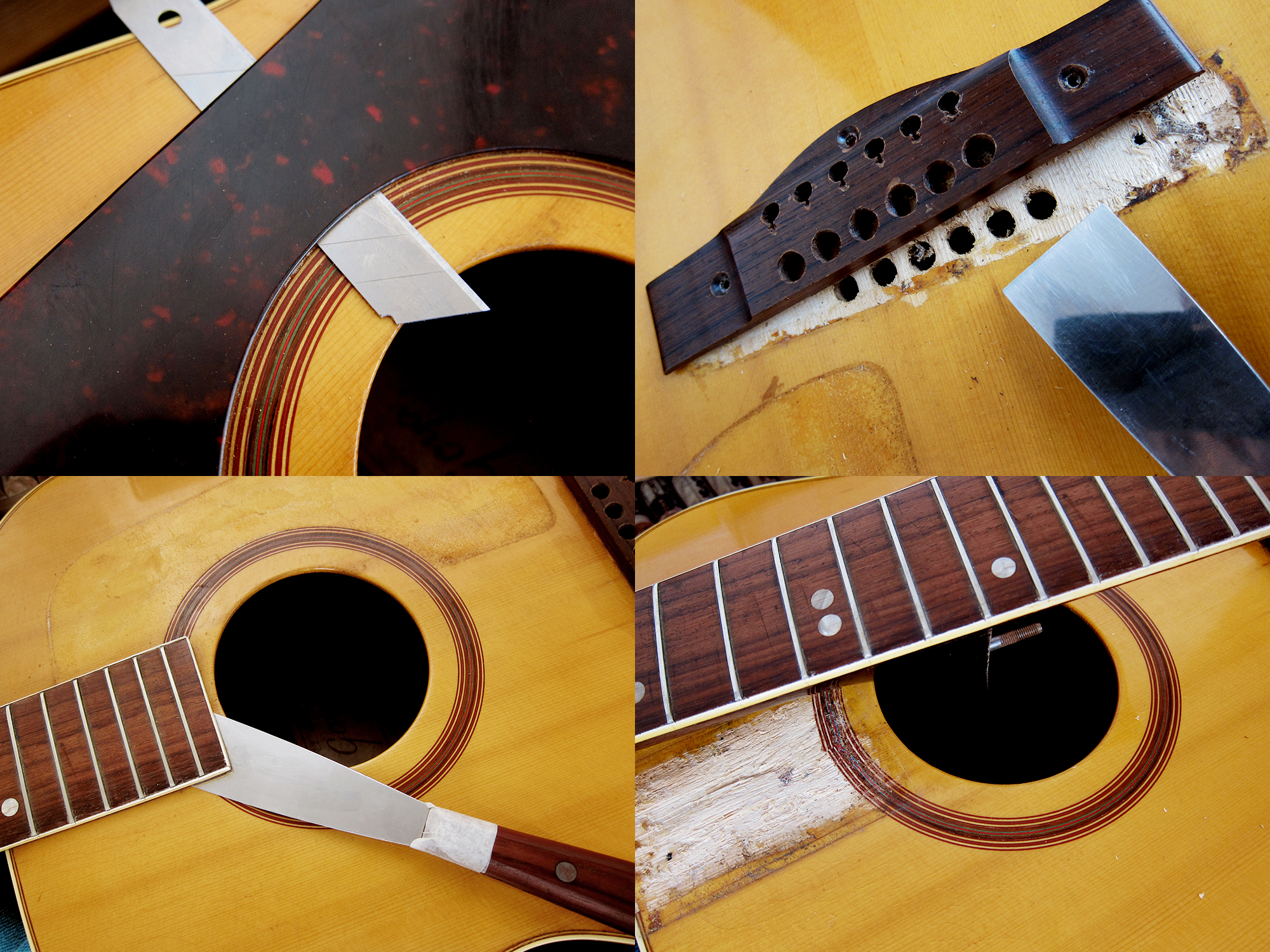
I started with taking the guitar apart. The neck needed a reset, the pickguard was loose and the previous owner had bolted the bridge to the top. I used a spatula that I heated on a normal clothes iron, worked like a charm.
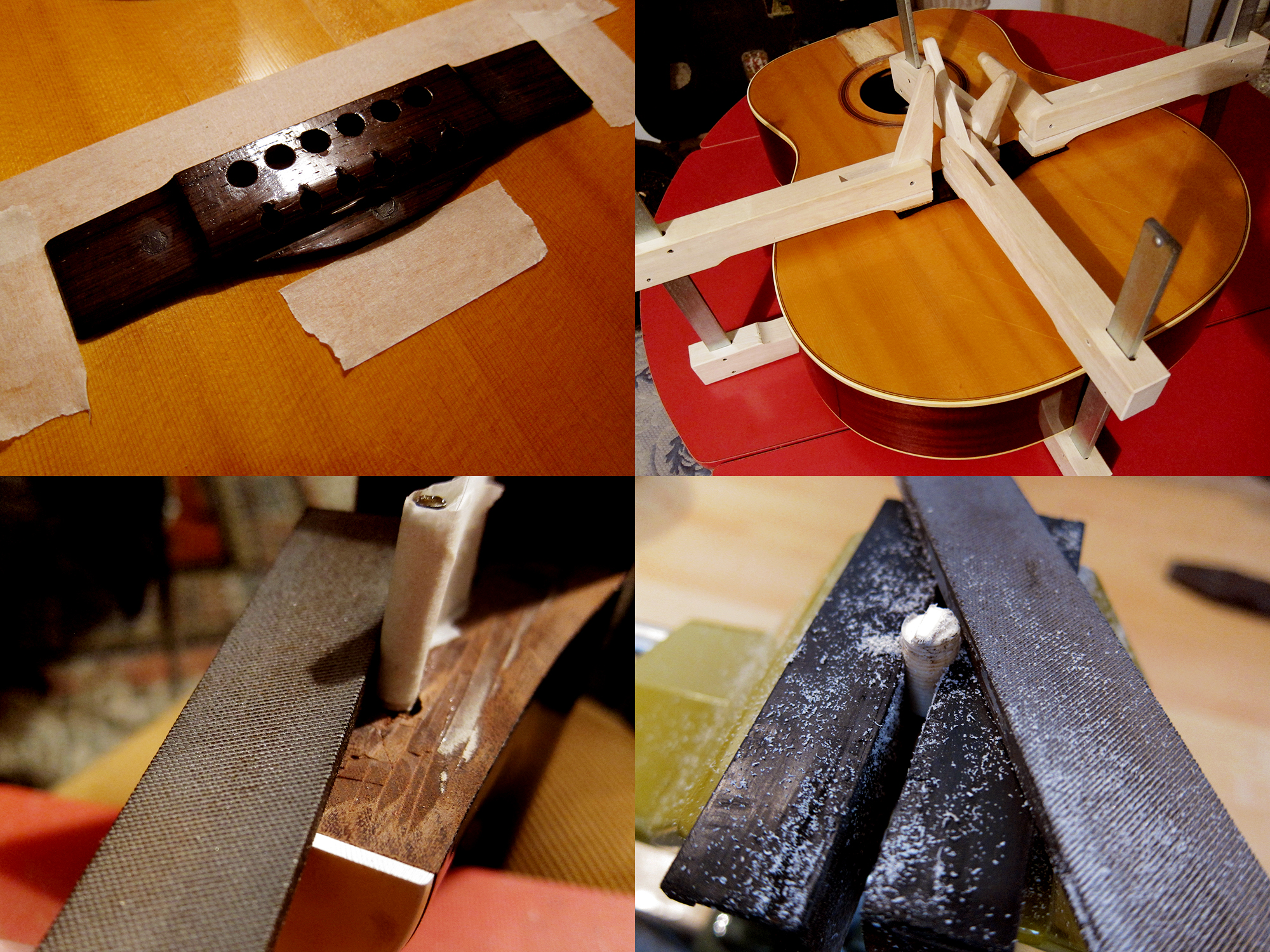
I filled the holes in the bridge and then glued it back. I filed down the heel to get the neck angle correct and get guitar playable again. I re-glued the pickguard and reshaped the top on the saddle screws.
When arrived to the office on Monday morning I noticed that Yuma, one of the eBay sellers that I follow from Japan, had added a new guitar, a 1979 Tokai Silver Star SS-36. I’ve always admired, well admired is not strong enough, I’ve always been totally gay for the 3-tone sunburst that Fender used in 1970’s. I even built the Claescaster because of this, since I couldn’t find a Telecaster with the right colour I decided to assemble one myself. For the past two years I’ve been looking at different Japanese big headed Stratocasters with the 3-tone 1970’s sunburst and black pickguard and was pretty convinced that a Greco SE-500 would be my next electric guitar or perhaps a late Seventies Fernandes Burny but they never seemed to have necks that were fat enough. I was in touch with a couple of the Japanese sellers and asked which brand had the fattest neck and got this reply, none. One seller explained that most Japanese guitars have fairly flat necks since the Japanese have small hands, which sounded a bit racist but whatever the reason is, most Japan made guitars had soft profiled necks up until now. I’ve played a couple of Crafted in Japan Fenders with great V-profile but that’s just in the last couple of years, none of the Japanese guitars that I’ve tried from 1970-80’s has had any baseball bat necks. This was a beautiful looking Tokai Silver Star with great grain showing through the 3-tone sunburst. I asked the seller about the neck and he replied that it wasn’t super fat, more of a soft U-profile, well that sounded close enough to me. The truth is that I’ve really missed the sound of the Fernandes RST-50 ’57 that I had for a short while. The Grey Bobbin pickups just sounded so amazingly good but I could never really come to terms with the small head or the fact that the guitar was black. Eric Clapton’s Blackie in all honour but they look pretty bland and boring to me, I like wood coloured or 3-tone sunburst guitars. My head started to think, well what could be better than Greco’s Maxon pickups, well the Ferndandes grey bobbin pickups, any day. Who was making Fernades in the late Seventies, well Tokai. Does that mean that this Tokai Silver Star will have some form of similar pickups? I tried to do some research but before I had even come to any conclusion I was the happy owner of a 1979 Tokai Silver Star SS-36. It was a Monday morning, I was a bit hungover, most of my guitar purchases has been made in that state, or perhaps when I’m drunk. I tend to be really concerned about money, I like to plan ahead, save for a rainy day, and then suddenly I sit there in front of the computer drunk or hungover without any filters whatsoever and just thinking GAS, GAS, GAS.
To be honest I didn’t know that much about Tokai, a part of me has always classed it like Ibanez, kind of bellow Greco in terms of quality. Then again, I can’t really say that I have felt a huge difference in quality between the Fender Japan made by FujiGen or the ones by Tokai, but everyone seems to prefer the Made in Japan to the later Tokai built Crafted in Japan. I have a 1991 Tokai Love Rock LS-55 Les Paul copy that is awesome but that doesn’t mean that an entry level Strat from 1979 would be equally good, but luckily it was. The Tokai Silver Strat SS-36 was the cheapest in the line of the late Seventies Fender copies that Tokai made but I think the main difference between the top and the bottom was if they had 3 or 4 screws bolt-on-necks, how many pieces of wood was used for the bodies and the quality of machine heads and hardware, and less about the pickups. Or perhaps these are the shittiest pickups Tokai produced and they still sound awesome.
Tokai (Tōkai Gakki) Tōkai Gakki was founded in 1947 and is based in Hamamatsu, Japan. Tokai began production of acoustic guitars in 1965 and by 1968 was producing electric guitars for the American market. Tokai still exists as guitar manufacturer. Tokai made guitars for Fernandes, Mosrite and Fender Japan. Tokai badged guitars included the house brand Tokai as well as Cat’s Eyes, Conrad, Drifter, Hondo, Love Rock, Mosrite, Sigma and Silver Star. Possible badges include Artist Ltd., Gaban, Gallan, Gession and Robin. It’s suggested that Tokai made Hummingbird acoustics as well, but if these were related to those made by Humming Bird I haven’t quite sorted out yet. Taken from my previous post about Japanese guitar brands
Fender replicas were started in 1977 officially. These were great guitars too. Using good quality wooden material with great craft man ship. “Springy Sound” Stratocaster replicas and the “Breezy Sound” Telecaster replicas are superior to the original Fender. Tokai has own factory and has built guitars for many famous known brands such as Fernandes and Fender Japan. For that mean, Tokai is only one original electric guitar manufacturer in Japan. (Note: Fender Japan used many sub constructors such as Fujigen, Dyna, Tokai, and Terada. The JV and E serial were made by Fujigen. Tokai made has “Made in Japan” under serial number in cursive handwriting). Taken from Music-Trade Japan
The guitar has a really nice soft U-shaped 1-piece maple neck with a nut width of just 40.6 mm, which didn’t feel that different to me. The body is 4 pieces Sen (Japanese ash) with poly lacquer in the classic 1970’s Fender 3-tone sunburst, which I truly love. I’m not sure if the pickups are similar to the L-5000 Vintage Arched PP Grey Bobbin pickups that the Fernandes RST-50 ’57 had or just some other grey bottom pickups. I tried to find some more information about them but they are just refereed to as grey bottom Tokai PU at Music-Trade Japan. Tokai Was building Fernandes at this time so I assume they would have used similar pickups for both. Either way, I love the pickups in this Tokai and it sounds almost as good as the Fernades did. I added an extra spring to the tremolo block since I never use the wammy bar and prefer a more solid hardtail feel, just like a real late 1970’s Fender Stratocaster.
I will try to get a new video up soon where I play a bit louder so you can hear the pickups properly, I was worried about the neighbours, and ideally play a bit better.
Well here it is, I might not play any better, but at least it is a more of it. I changed the string to 010, always Ernie Ball Regular Slinky, raised the action and fitted a 4th spring to the tremolo. Not sure what difference it made sound vice but it made it felt better to me playing.
Even though I love the Louvin Brothers I have to say that this must be the ugliest guitar I’ve ever seen. Satan is Real is a great album but the cover is just not good enough to put on a Martin, just look at the devil. I could have bought it for the kitsch value and because I like Ira and Charlie, but not for $4,666.00. I found it in the Martin Guitar Anthology eBook that I posted earlier. You can read more about the guitar here Martin D-28 Louvin Brothers.
The Fretboard Journal’s Martin Guitar Anthology eBook After nearly ten years of publishing, the FJ has amassed quite an array of stories featuring iconic Martin guitars and Martin artists. We decided to partner with Martin to share some of these great stories once again (a few have been out-of-print for years now). Included are the full-length (and, in some cases, out-of-print) features on Tony Rice, David Crosby, Loudon Wainwright III and many others. We’ve also included the latest edition of Martin: The Journal of Acoustic Guitars, their in-house magazine filled with more Martin tales. We hope you like this eBook anthology and stay tuned for future editions featuring your favorite brands and artists.








 The Last Grammer Guitar made by RG&G, built in 1968 on 715 Poplar Avenue in Nashville, Tennessee
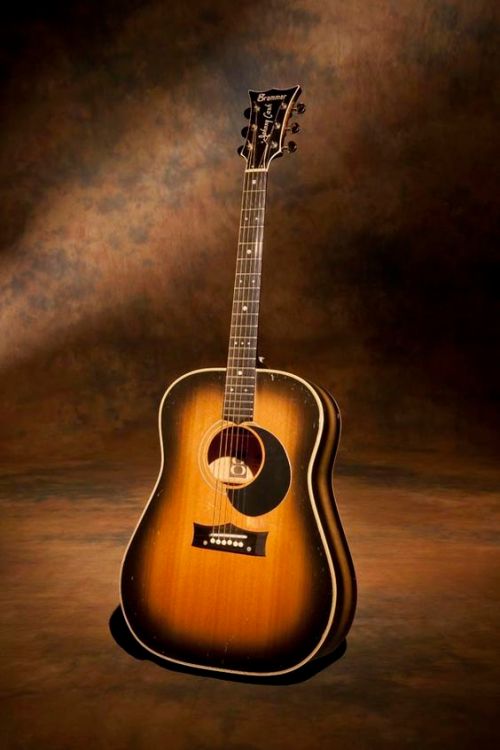 Joe Bonamassa’s 1969 Grammer Johnny Cash model, here is a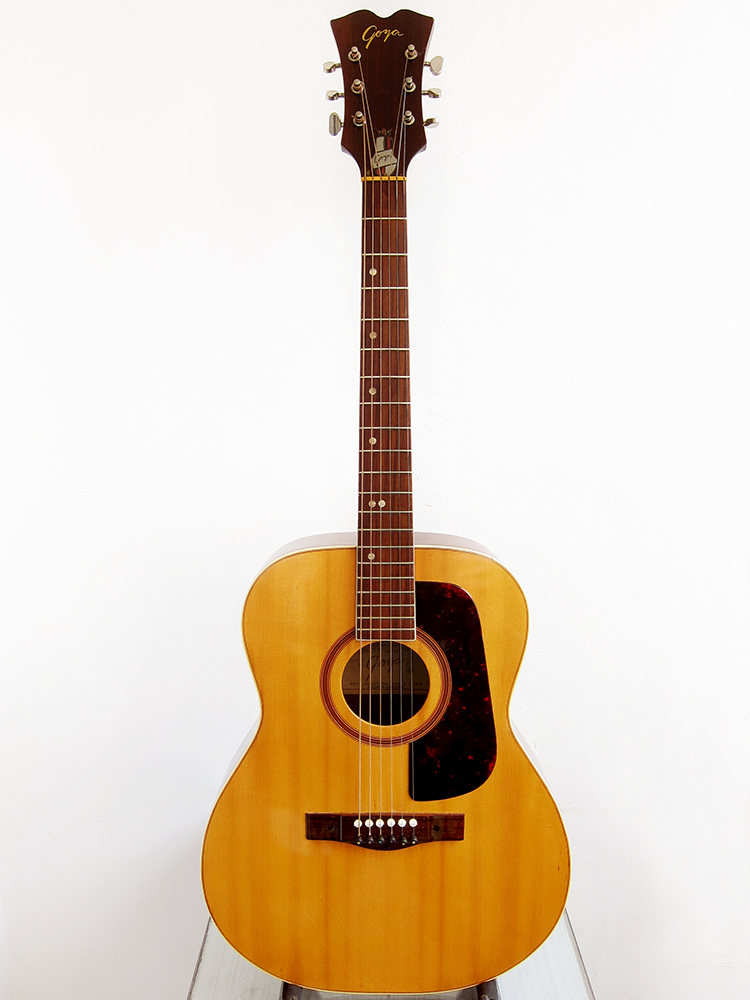


 Claescaster