How playing an instrument benefits your brain
I love this clip, I have feeling that David Lindley have never bought a guitar himself, just borrowed other peoples guitars until they have forgotten that he has them and they become his.

Levin Model 32 made in Sweden by Levin in 1946
I recently got this old 1946 Levin Model 32 from an eBay seller in Vienna. The guitar has clearly seen better days but I felt she deserved a second chance in life so I got her home, dolled her up and now she is playable again. I had no idea what model it was when I got it and I was actually hoping that it would be a Model 30 from the late 1930’s, they look very similar but it turned out to be a Model 32 from the mid 1940’s instead, which isn’t bad. I guess I just wanted to have a Levin that was older than my 1942 Levin Model 65. It’s pretty close to my 1951 Levin Royal in sound and feel but with a more casual appearance. I guess there was a shortage of tonewoods all over Europe during the war so they used what they got. This one has a hand carved 3-piece Romanian spruce top and you can even see a couple of knots around the f-holes. I don’t really mind, together with all the cracks it’s just adding to that old worn archtop look and feel. The back is really beautiful though and the neck feels great, really fat and chunky as I like. It also has a quite different sunburst compared to what Levin normally used in 1940-50’s. Levin used to copy Gibson’s tobacco sunburst but this one has more of a cherry sunburst.
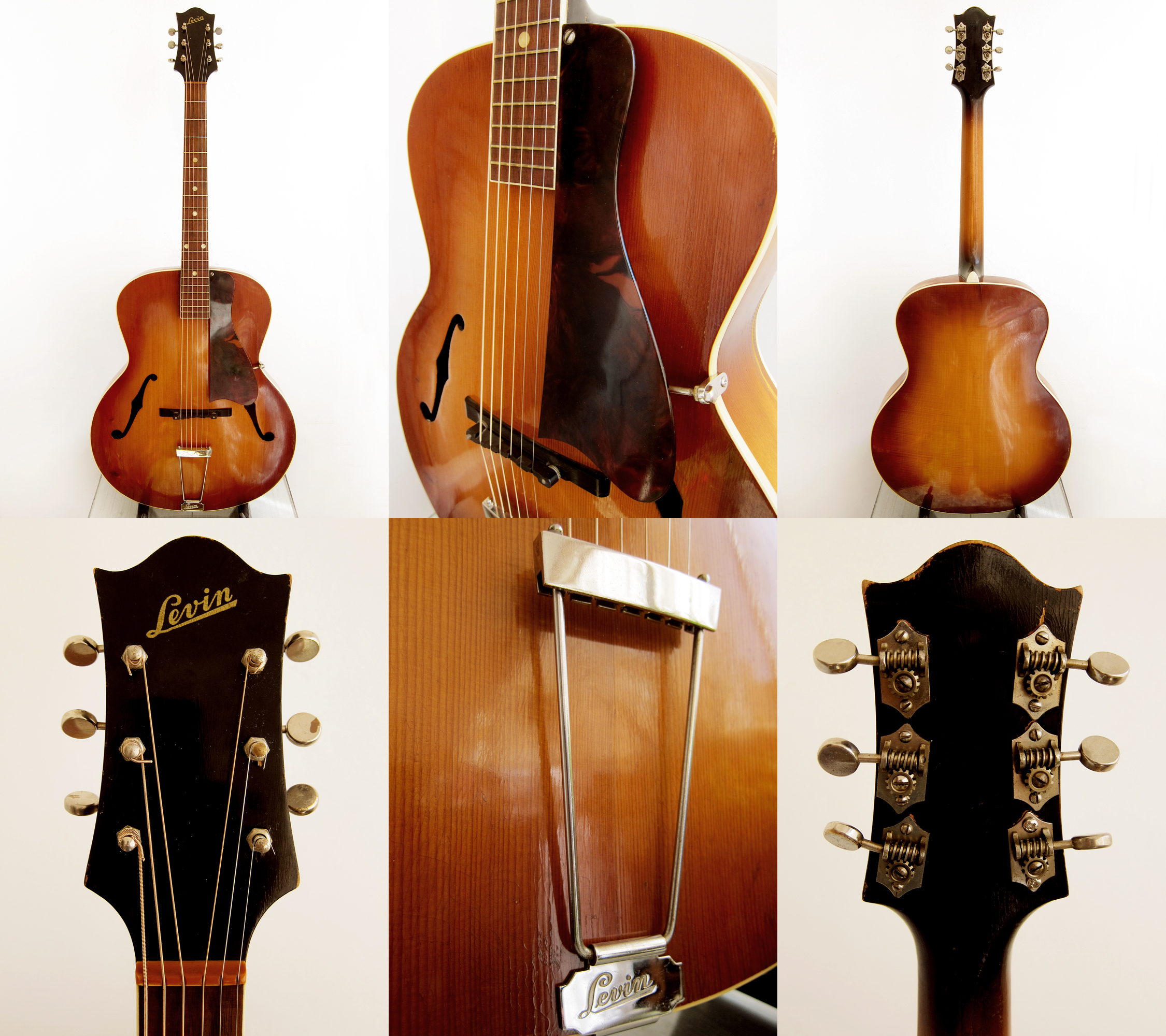
Levin Model 32
Non-cutaway. Body width: 420 mm, body length: 510 mm
Hand carved Romanian spruce top, mahogany back and sides
Single-bound top with unbound f-holes
Single-bound back, unbound pickguard and unbound headstock
Mahogany neck with non-adjustable T-shaped duraluminum truss rod
Single-bound rosewood fingerboard with mother-of-pearl dot inlay
Nickel plated hardware, sunburst finish and ten years warranty
Available between 1940 – 1947

Levin Model 32, here between the model above, the beautiful Model 27 and the slightly cheaper Model 35. I love that the case option offered in the bottom of each ad is a plain textile bag with a zip, really, textile? The list price for the guitar in 1946 was 285 SEK, around 30 Euro. The Royal listed that year at 575 SEK an the top of the line, the Deluxe at 1000 SEK. Taken from a 1946 Levin archtops catalog, thanks to Vintage Guitars Sweden

She looked a bit sad when she arrived, but there was nothing that couldn’t be fixed

First I had to deal with the crack that was running along the whole bottom side, from the upper bout to the endpin. There was also another crack, or hole, that the previous owner had glued in perhaps not the most discrete fashion.
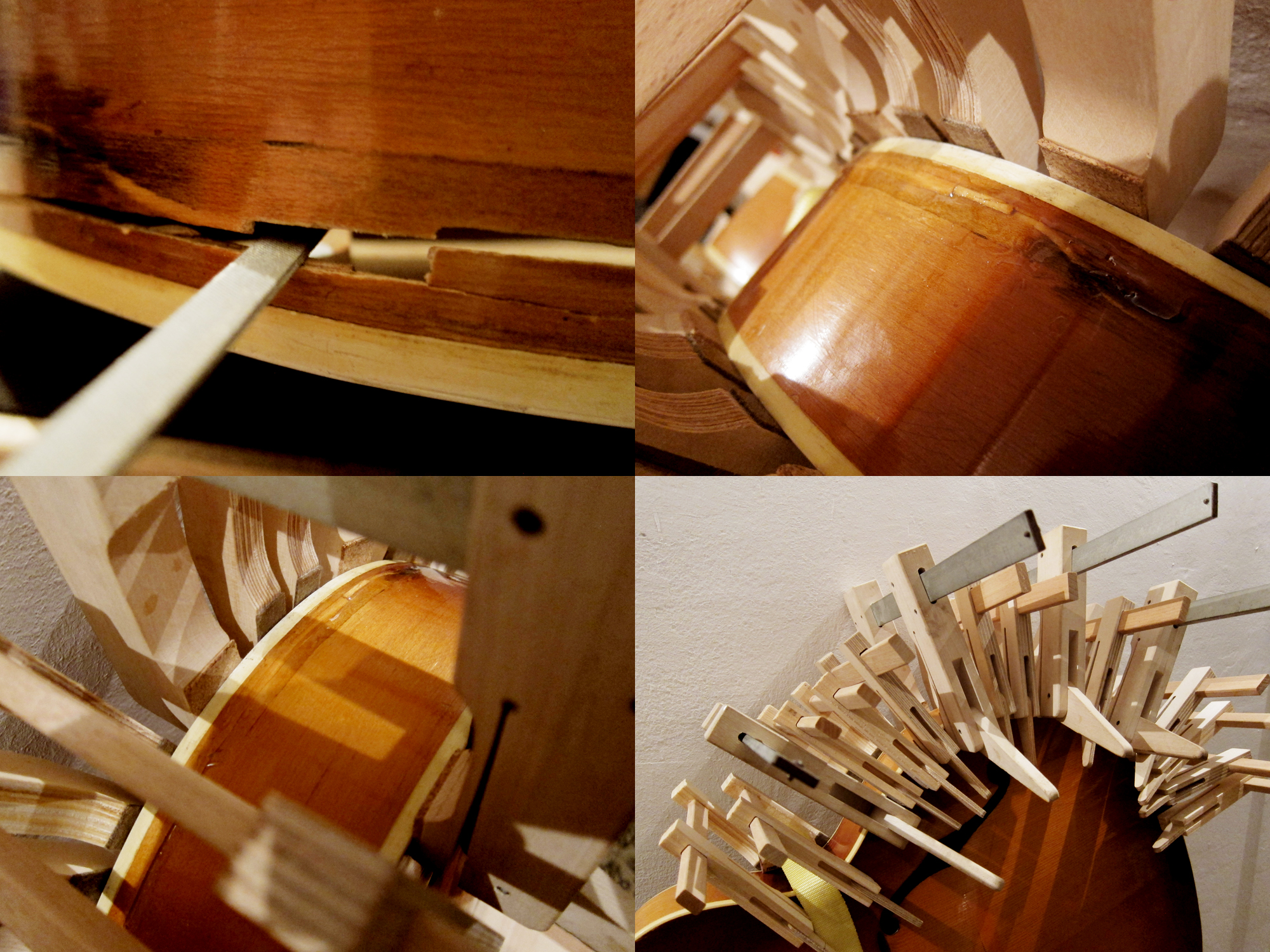
I have never attempted to glue anything this big before but there is a first time for everything. I noticed that there was a piece of wood missing so I started with making the hole square and then I fitted a little piece of wood in the exact same size. The main problem I had was that the guitar had been cracked for so long, with the tension of the strings I think, so the whole side had kind of warped. In parts the crack was overlapping in one way then suddenly changed to go the other way. Which meant that when I was trying to close the crack it didn’t line up, at all. I did my best and with a bit of force and a lot a clamps I managed to get it to close at least, even if it didn’t line up perfectly. I know that the correct way of doing this would have been to glue cleats on the inside and perhaps a string coming trough that you can tighten from the outside or even better, magnets, but unfortunately the crack was just over the kerfing which would have made it hard to glue any cleats on top of the kerfing. I also couldn’t figure out a way of getting any magnets inside an archtop, there wasn’t really any way of getting my hands in there.

It went ok for being my first time and it seems to be very solid after letting the fish glue cure for 48 hours, I added some extra glue over the old crack too just to be on the safe side. I sanded everything smooth and then lacquered with shellac, I was trying to match the original lacquer but it turned out to be impossible to copy the sunburst. Maybe I can figure out a way and redo this part but at least now the guitar is playable. I buffed up the old lacquer and made it blend with the new shellac by polishing it with metal polish, that always works great on old guitars. It’s the same technique I use for the back of the necks, filling the dents with nitro lacquer and then sand it smooth and buff it up with metal polish. The original machine heads are pretty wonky but they work fine and cleaned up nicely, just like the tail piece, so I decided to keep the guitar all original.

I recently got myself a Morris W-50, my third Morris and it sounds as good as the other two. Solid spruce top and it looks like the back and sides are solid Brazilian rosewood and quilted maple. It was pretty beat up when I got it from Guitar Hiro in Madrid with plenty of dents and a cracked back but now I’ve fixed it up a bit and it’s playable again. It’s a nice Martin D-42 copy with snowflake inlays and the typical Martin volute where the head and neck meet. Nice inlays all around and a beautiful 3-piece back with flamed maple and rosewood. I guess it was made around 1976 since they changed to hexagon inlays in the 1979 catalogue and then renamed them from W-50 to TF around 1983.


TF Morris W-50, Made in Japan around 1976


Morris Japan catalogue 1976

There was a bit of work needed on this guitar. The back was cracked in the binding just below the heel which made the whole neck tilt forward causing a pretty high action. I cleaned out the crack, someone had put some super glue in there, filled it with fish glue that I let really sink in and connect with the neck block, clamped it and left if for 48 hours. Now it seems really solid and the action got so low that I had to make a new higher bone saddle for it. There was a lot of dents and marks on the back of the neck so I filled them with nitro lacquer and sanded it smooth and buffed it up with metal polish, here you can read more about how to repair lacquer damage. The only thing left now is to ad some gold machine heads so I ordered a set of open back Schaller ST6 this morning and will fit strap button and an endpin jack tonight.

I recently changed the machine heads on my 1970’s Japan made Morris W-50 to Wilkinson WJ28NGD open gear in gold and I couldn’t be happier
Moridaira (Morris Guitars)
Founded in 1967 by Toshio “Mori” Moridaira, the Moridaira factory produced high-quality guitars, including the infamous Morris badged guitar. Moridaira also produced badged guitars for Hohner including Coronado, Futurama, H.S. Anderson, Lotus (some) and Sakai.

The whole family, Morris W-50, Morris W-40 and Morris WL-35


Fender Stratocaster, Made in USA at the Fullerton plant in 1979
This weekend I restored my 1979 Fender Stratocaster to it’s original state. One pot has been changed at some point and I needed to put in a new 5 ways switch but the rest seems to be all original. Well the middle pickup is a bit of a mystery, I’m not sure if it’s a Fender pickup or if it’s something completely different, either way it sounds awesome. It has staggered pole pieces, something that Fender stopped with in the mid 1970’s so I would say that it’s either an older Fender or a newer Japanese pickup. I really like the look of the guitar now, a classic late 1970’s 3 tone sunburst hardtail Fender Stratocaster. The guitar is for sale here.
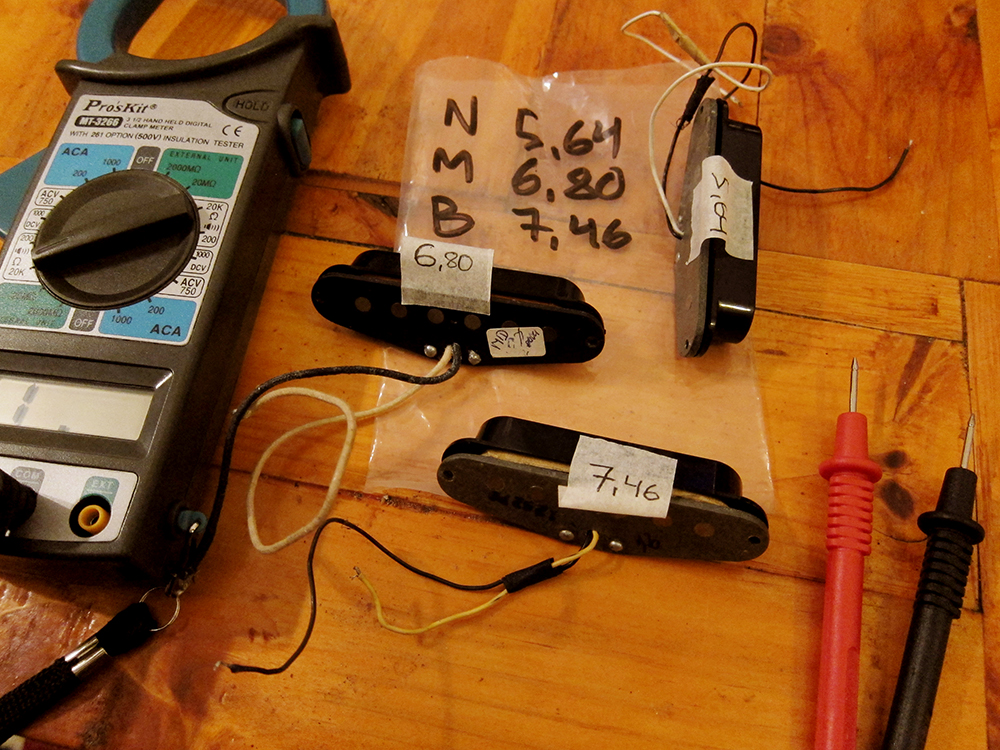
First I had to check that the original pickups even worked. After getting pretty strong readings I decided to install them, now I knew in which order to put them too since they weren’t marked with neck, middle and bridge.

I filled the old holes from the gold Gotoh machine heads with a tooth pick and normal wood glue, it worked really well. When I removed the terrible shielding job that was done before I could for the first time see the serial number, this body was made on a Monday in the 5th week of 1979. The neck is from 1978 which makes sense if it was put together early the following year. I have to go through the soldering again though, there is something that isn’t right. I noticed when I had put it back together that there something wrong with the middle pickup, it sounded like a wah wah stuck in one position. Well first thing I realised was that the switch was the wrong way around so that has been flipped now, then after a lot of detective work I figured out what was wrong. The middle pickups wires was the other way around, the white was the ground and the black was going to the switch. There was also an extra capacitor on the second tone pot that I had to remove. Now everything works perfectly and it sounds awesome, I really love this guitar. Thanks again to Dating Late 1970’s Fender Stratocasters for all the useful information.

1979 Mossman Catalogue, taken from David Hylander Guitar Works
I have recently come across another American guitar maker that was previously unknown to me. I mentioned Grammer guitars earlier, this time it’s Mossman guitars that I’ve fallen in love with. One of the guitar builders that I follow on Instagram, kawvalleyguitars in Kansas, kept posting images of Mossman guitars he had done neck resets on, which awoke my curiosity. After a bit of Googleing I realised that quite a few artists liked Mossman guitars, including John Denver, Eric Clapton, Albert Lee, Doc Watson, Hank Snow, Cat Stevens and Merle Travis. Stuart Mossman got fed up with all the plywood guitars that was pumped out of the big factories in the 1960-70’s and decided to start building his own guitars with real tone woods and proper craftsmanship, and so S.L Mossman Guitars were born in Winfield, Kansas.
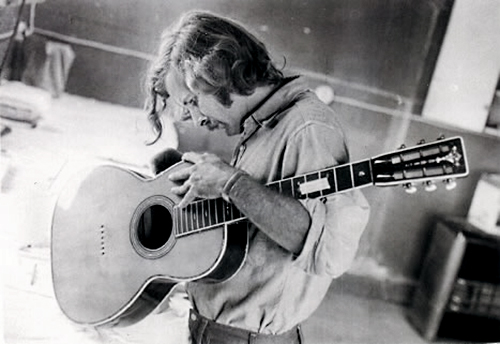
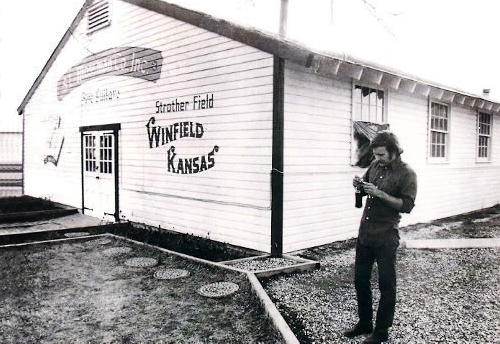
Stuart Mossman in Winfield, Kansas. Here you can read more about the Mossman story


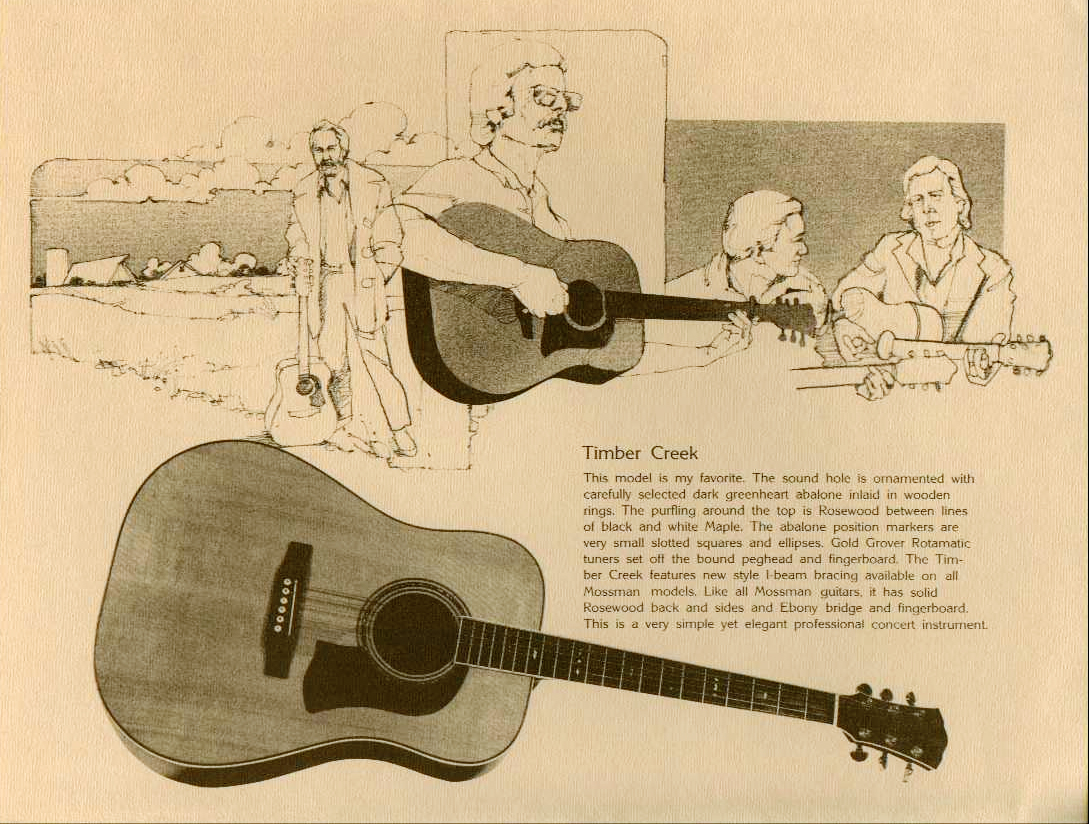

This could be the most awesome guitar brochure ever printed, the 1979 Mossman Catalogue, taken from David Hylander Guitar Works
 Levin LT-14 Made in Sweden in 1965
It has been an extremely good Christmas, not only did I manage to find a 1979 Fender Stratocaster, I also received a little Levin LT-14 from 1965. It’s the smallest of the 1960’s Levin guitars and is roughly like a Martin 00 in size. I bought it about two weeks ago from a guy in Heidelberg, Germany and then it got stuck in some warehouse over Christmas until the Spanish post service could be asked to deliver it. It’s an awesome guitar, pretty much like my dad’s old Levin LT-16 but a tiny bit smaller and with a bit less bass but with more clarity in the upper register. It’s also ladder braced instead of X braced which is not necessarily a bad thing in this case, it gives it a pretty great sound. The weirdest thing is that it’s so well kept for being 50 years old, close to mint and it can’t have been played much in it’s life. Well that’s going to change now because I really like it, especially for finger picking and I’m sure it will mature and sound better and better the more it gets played. This is my 10th Levin, or 11th if you count a Levin LS-16 that I have waiting for me in Sweden. Perhaps it’s time to stop buying old Levin guitars but I can’t, they are just too good to turn down. I have liked some of my Levin guitars less and then one day they surprise you and just sound amazing. I guess the more you play them, the better they sound.
 It’s the first time I get a 50 years old guitar home and I have to do nothing to it. There are actually no scratches to the top, that’s just in the grain of the spruce.
Levin LT-14 / Goya T-14
Grand Concert size: Body width: 360 mm, body length: 465 mm, body depth: 98 mm
Fingerboard width: 43 mm, scale length: 630 mm
Spruce top, mahogany back and sides, 4-ply bound top, single-bound back
Mahogany bolt-on neck with adjustable truss rod
Unbound rosewood fingerboard with bass side dot inlay
Nickel plated individual Van Gent tuners with metal buttons
Rosewood bridge, matte natural finish and one year warranty
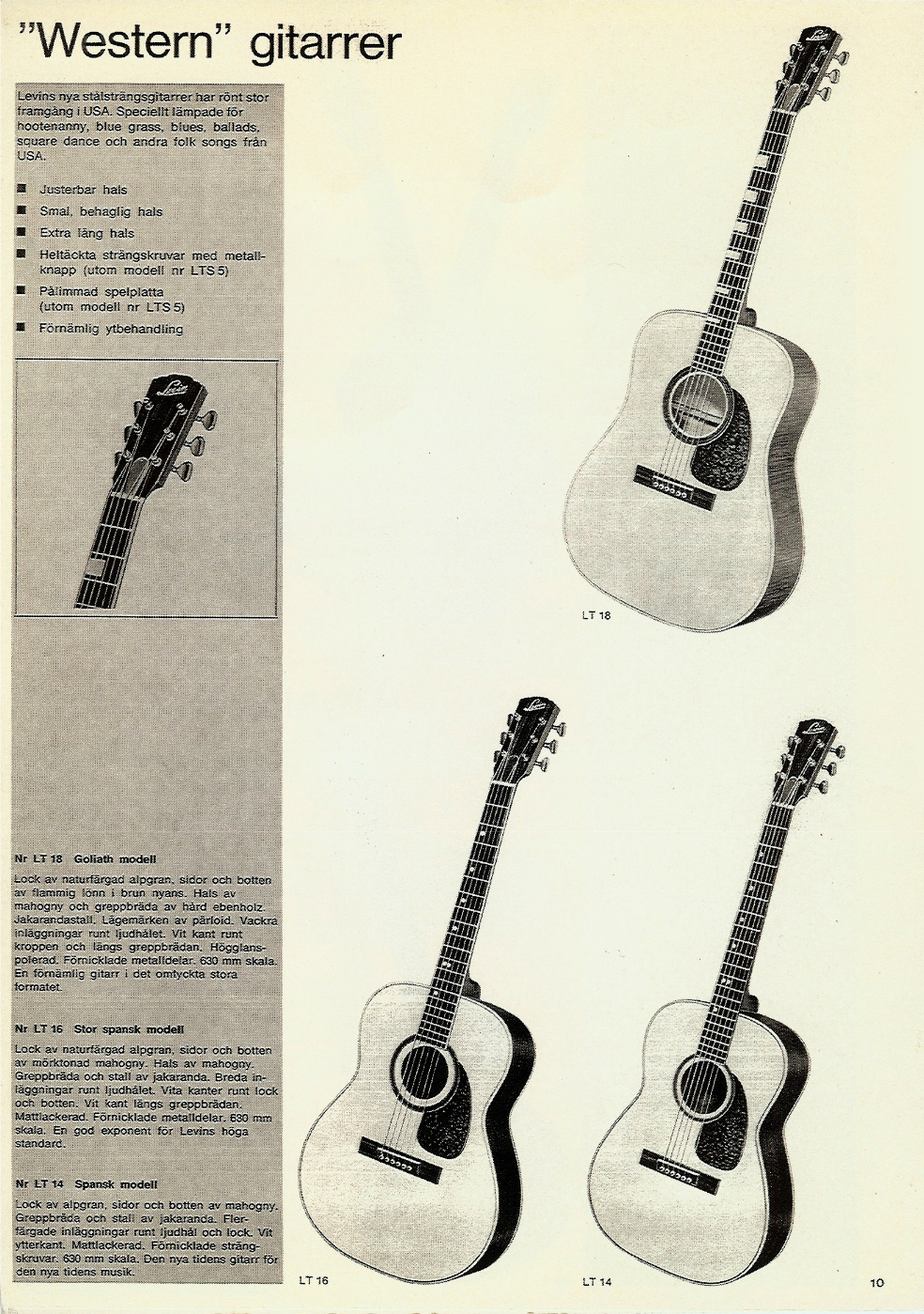 Now I actually have all three, the Levin LT-18, well it’s a Goya T-18 but close enough, my dad’s old Levin LT-16 and this new little Levin LT-14. Taken from a 1965 Levin catalogue. Thanks to Vintage Guitars Sweden
 The Levin family at the moment, from left to right: Goya GG-172 (1970), Levin Model 13 (1950), Goya Model 163 (1968), Levin Model 174 (1972), Levin Royal (1951), Levin LM-26 (1959), Levin Model 65 (1942), Goya T-18 (1966), Levin LT-14 (1965), Levin LT-16 (1966)
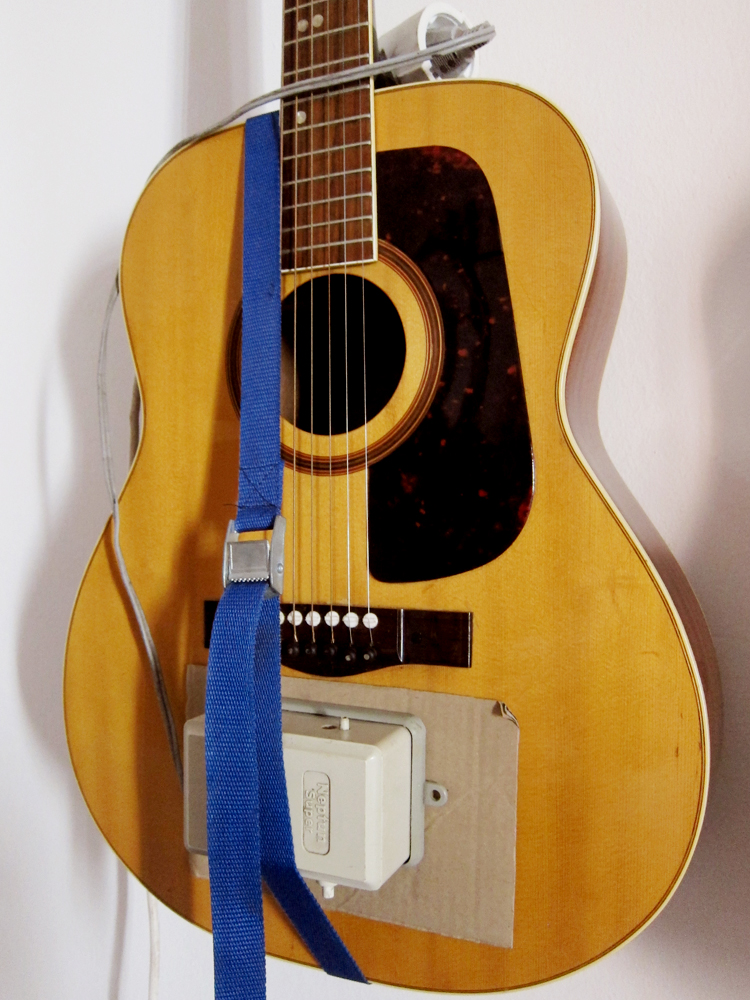 Goya GG-172 Made in Sweden by Levin in 1970
A great way to improve the tone of your acoustic guitar and to get it to open up is to use a normal air pump from a fish tank to give the top a massage. I got an old one, I think the older they are the more they vibrate, that I use on guitars that I buy that hasn’t been played for years. It works great and seems to add both bass, volume and clarity to the guitar. A day or two with the pump is like months of actually playing.
 Claescaster