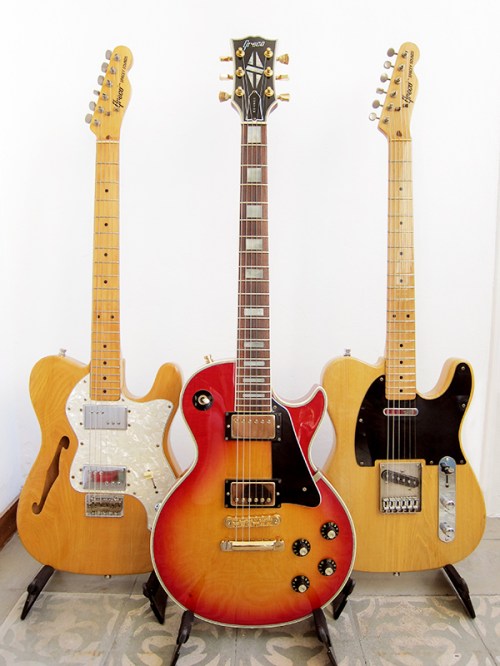
The Greco family, Greco Spacey Sounds TE-500N 1977, Greco Les Paul Custom EG-600C 1980, Greco Spacey Sounds TL-500 1979
I guess it will come as no surprise that I love Japanese guitars, especially Greco’s. I have over the years learned quite a lot about different brands and makers but it can get pretty confusing for me too. Luckily I found this great list of Japanese guitars brands, or rather a list of guitar makers. The list might not be complete but it’s a good start. Taken from Who Made My MIJ Guitar
Atlansia
This guitar manufacturer started out as a parts supplier in the early 1970’s. Atlansia didn’t begin production of guitars under their badge until infamous engineer and designer Nobuaki Hayashi of Matsumoku fame became the company’s president and chief designer in the late 1970’s. Since then, Atlansia has continued to produce cutting-edge guitar designs in Nagano, Japan. The company did not make any other badged guitars other than namesake Atlansia.
Chushin Gakki
Chushin is still in operation today in Nagano, Japan and does business with guitar giant Fender. I believe that Chushin may have been a member of the Matsumoto Musical Instruments Association listed further down because both companies produced Fresher guitars during different periods….with Matsumoto beginning production and Chushin ending it (perhaps because the Association was disbanded?). During the 1960-1980 period they were responsible for badges Bambu, Cobran, El Maya and Hisonus as well as some Charvel, Fresher and Jackson badges. The company may have possibly made some guitars with the Aztec, Maya and Robin badges, but that is not verified. Guitars made by Chushin from this period are well-made and appreciated by guitar enthusiasts worldwide.
Daimaru
Founded in the city of Matsumoto, Japan in the early 1960’s, Daimaru produced their own house brand, although they outsourced electric guitar production to Teisco during the 1970’s period. Daimaru appears to have gone out of business after 1980.
Dyna Gakki
Dyna Gakki began production in 1972 in the city of Nagano, Japan. They manufactured guitars for Fender Japan and Greco, so they couldn’t have been a terrible manufacturer as Fender is very choosy about outsourcing their product. Dyna was responsible for the JooDee badge and may have been a source for Japanese manufacturer Yamaki. Dyna also produced the infamous Ibanez badges for a short period of time.
Electric Sound Products (ESP)
Founded in 1975 by Hisatake Shibuya, this wildly-popular manufacturer focused on making quality basses for export as well as electric guitars. ESP survived the ‘copy’ era and is still in business today. Badges made by ESP included their house brand ESP as well as Navigator during the late 1970’s. A possible badge made by the company was Robin.
Elk Gakki (also known as Miyuki)
Makers of the Elk badged guitar from the early to mid 1960’s to 1975, although other sources indicate that the Elk brand did not stop production until the early 1980’s. Elk badged guitars came in clear acrylics in addition to colors in the early 1970’s, which was an attempt to copy clear acrylics designed by the legendary Dan Armstrong in the late 1960’s.
Fernandes
Fernandes Guitars started production in 1969 in Osaka, Japan. It grew and became one of the largest producers of Japanese-made guitars, rivaling competitors Fujigen and Matsumoku. Fernandes produced guitars with the Burny and Nady badges as well as house brand Fernandes. A possible badge made by Fernandes was the oddly named Orange guitar.
Fujigen Gakki
Fujigen Gakki began operation in 1960 as a classical guitar manufacturer, moving into the lucurative electric guitar markets in 1962. The company was the largest producer of Japanese guitars during the 1960-1980 period. They were known for producing high quality products, especially for the badged guitar market, which is why the company was selected by so many major American brands. It wasn’t until 1970 that the company began making products for the venerable Ibanez brand, which was an unqualified success. Fujigen Gakki was the main manufacturer of choice for Greco badged guitars in the 1970 to 1980 period. They also produced guitars for major manufacturer Yamaha. Badged guitars made by Fujigen include Antoria, Epiphone, Jason and Mann. Badged guitars that may have been made by Fujigen Gakki were Marlin and St. Moritz.
Guyatone
Guyatone produced electric guitars for major guitar manufacturer Suzuki. The company also produced their house brand Guyatone. Badged guitars produced by Guyatone include Barclay, Broadway, Coronado, Crestwood, Futurama, Howard, Hi-Lo, Ibanez, Ideal, Imperial, Johnny Guitar, Kent, Kingston, Lafayette, Marco Polo (electrics only), Montclair, Omega, Orpheus, Prestige, Royalist, Saturn, Silhouette, Silvertone, Vernon, Winston and Zenta, an impressive amount of names produced by a single company. Other badges that may have been produced by Guyatone are Beeton (not to be confused by the Beeton Brass Guitar company founded in 1994), Bradford, Canora and Regent.
Hayashi/Zenon
Hayashi was one of the premier acoustic guitar makers among Japanese manufacturers from this time frame. Hayashi bought out small manufacturer Zen-On in 1968 during a period of expansion for the company. Credited with making Pearl badged acoustic guitars, Hayashi was also responsible for making Cortez, Custom and Emperador acoustics.
Hitachi Gakki/Hitachi Musical Instruments Manufacturing
I’m unsure if this company existed or not, but since many major electronics manufacturers jumped into the electric guitar market in the 1970’s, it seems reasonable that Hitachi could have ventured briefly into guitar production. A seller of the badged guitar “Splender” claims it was made by this company. Yet another seller claims the badge Slendon was made by this company.
Hoshino Gakki Ten/ Tama
Hoshino Gakki were known primarily for producing Ibanez guitars during this time although that wasn’t the only badged guitar they made. Badged guitars produced by Hoshino include Cimar, Cimar by Ibanez, Penco, Howard. Tama Industries began guitar production from 1962 to 1967 as a factory of Hoshino, producing more badged Ibanez guitars as well as Continental, Crest, Goldentone, Jamboree, King’s Stone, Maxitone, Star, Starfield (some), Tulio and Jason. Tama eventually took over badged guitar production from STAR Instruments in the mid-1960’s. There’s some evidence that Tama began producing guitars under their own badge from 1975-1979. I’m unsure at this point if this Tama had any relation to the Tama that existed under Hoshino Gakki Ten.
Humming Bird
Little-known manufacturer in operation in the early 1960’s until 1968. Humming Bird made electrics that were copies of Mosrite guitars. It’s possible they also made acoustics.
Iida
Iida began manufacturing guitars in 1958 in Nagoya, Japan. Iida is still producing guitars, but mostly in their factory located in Korea. They were mainly responsible for producing acoustic and semi-acoustic rather than electric guitars for major manufacturers Ibanez and Yamaha. There is speculation that Iida may have assisted Moridara for a short period in making Morris badged guitars, but that is not verified.
Kasuga
Kasuga produced their own house brand in Kasuga guitars. For a brief period of time the company produced Yamaha acoustic guitars. Kasuga guitars were first sold in America in 1972. Unlike many Japanese manufacturers who outsourced their guitar production in other factories outside the main maker, Kasuga produced all their products in-house. Badged guitars known to have been made by Kasuga include Conrad, Emperador, ES-S, Ganson, Heerby, Hondo, Mei Mei and Roland. Kasuga went out of business in 1996.
Kawai Teisco
Kawai Teisco was founded by Atswo Kaneko and Doryu Matsuda. The company also produced the popular Ibanez badge in the 1960’s. Kawai Teisco made their own house brands Kawai, Teisco, Del Rey and Teisco Del Rey. Badged guitars produced by the Kawai Teisco factories include Apollo, Aquarius, Arbiter, Atlas, Audition, Avar, Ayar, Barth, Beltone, Black Jack, Cipher, Concert, Cougar, Crown, Daimaru, Decca, Diasonic, Domino, Duke, Emperador, Heit Deluxe, Hy-Lo, Holiday, Imperial, Inter-Mark Cipher, Jedson, Kay, Kent, Kimberly, Kingsley, Kingston, Keefy, Lindell, Marquis, May Queen, Minister, Noble, Prestige, Randall, Recco, Regina, Rexina, Sakai, Satellite, Schaffer, Sekova, Silvertone, Sorrento, Sterling, Swinger, Tele Star, Top Twenty, Victoria, and Winston. Possible badged guitars made by the company include: Astrotone, Demian, G-Holiday, Lafayette, Master, Orange, Tamaki and Trump.
Kyowa Shokai
This company, which may have been a distributor as opposed to a manufacturer, was a member of the Matsumoto Musical Instrument Association. They have been credited with Camel and Fresher badged guitars, although Freshers were also made by Chushin in the late 1970’s.
Magnavox/Ampeg
Ampeg was swallowed up by Japanese electrical giant Magnavox in 1971, when they wanted to get in on the electric guitar copy craze of the 1970’s. Magnavox produced electric and bass guitars under the Stud badge as well as the successful Ampeg brand. It’s been suggested that Magnavox was also responsible for producing Selmer acoustic guitar badges during this time, but that has not been verified. Selmer was sold to Magnavox around the same time they bought Ampeg, so it certainly seems plausible they could have made Selmer acoustic badged guitars as an offering for that market. Stud badged guitars were made until ’75, with Ampeg guitar production continuing until 1980. Opus was another badge made by the company. Magnavox lost their interest in Ampeg shortly thereafter and the brand languished until it was resurrected over a decade later by another American company.
Maruha Gakki
We know this company existed in the 1970’s in Japan because of stickers found inside repaired Maruha guitars. Maruha made high-quality acoustics, some of which are badged F. Hashimoto (some long lost master luthier?) along with the Maruha badges. These guitars are highly sought-after because of the overall quality.
Matsumoku
Matsumoku is one of the Japanese manufacturers that did not survive long after the heyday of the 1970’s guitar market despite having a long tradition of quality stringed instrument craftsmanship. Matsumoku produced guitars for major manufacturers Greco, Guyatone and Yamaha. Matsumoku made Arai, Aria, Aria Pro II and Aria Diamond badges, with Aria being their primary badge for a majority of this time frame. Badged guitars known to have been made by Matsumoku include Apollo, Arita, Barclay, Burny, Capri, Columbus, Conrad, Cortez (electrics only), Country, Cutler, Dia, Domino, Electra, Epiphone, Granada, Hi Lo, Howard, Ibanez, Lindberg, Lyle, Luxor, Maxitone (this guitar differs from Tama’s Maxitone badge), Mayfair, Memphis, Montclair, Pan, Pearl (electrics only), Raven, Stewart, Tempo, Univox ,Vantage, Ventura, Vision, Volhox, Washburn (in 1979 and 1980), Westbury, Westminster and Westone. Possible Matsumoku badges include: Bruno, Crestwood, Conqueror, Eros, Mako, Memphis, Orlando and Toledo.
Matsumoto Musical Instrument Manufacturers Association
The Matsumoto Musicial Instrument Manufacturers Association was the organization responsible for Fresher guitars. Little is known about this association, other than it did not have larger guitar manufacturers Matsumoku or Fujigen Gakki as members. Nakai Gakki was a possible member of the association. Fresher guitars began production in 1973 by the Kyowa Shokai Company, an association member, which was also responsible for the Camel badge. It’s interesting to note that Fresher guitars were eventually being produced by Chushin, which leads me to believe that they may have been an Association member along with Kyowa. The beginning production year was considered a low quality benchmark for the company. The Fresher brand continuously improved in quality until 1980.
Maya Guitar Company
Located in Kobe, Japan, this manufacturer made the famous Maya brand guitar. Maya guitars were in production from 1970-1980. It’s been suggested that Maya may have been responsible for the Aztec badge. You’ll notice that Maya has been attributed to a company known as Tahara. At this point I do not know if Maya assisted in production or if Tahara produced some Maya guitars as a subcontractor. Maya and El Maya badges have also been attributed to Chushin Gakki. More research is needed to clarify this point.
Moridaira (Morris Guitars)
Founded in 1967 by Toshio “Mori” Moridaira, the Moridaira factory produced high-quality guitars, including the infamous Morris badged guitar. Moridaira also produced badged guitars for Hohner including Coronado, Futurama, H.S. Anderson, Lotus (some) and Sakai.
Nakai Gakki
Little-known manufacturer from Osaka, Japan, this company is responsible for the oddly named John Bennet badge. Nakai has been mentioned as a possible Matusmoto Musical Instruments Association member in the past. The company still exists and is producing musical instruments, quite a feat in light of so many manufacturers who faded after the golden electric guitar age.
Shinko Musical Company
A very small, unknown company that is attributed to being the manufacturer of the Pleasant guitar from 1960 to 1966. Shinko later moved to Korea sometime in the early 1970’s where they produced the Drive guitar badge.
Shiro Musical Instrument Manufacturing Company, Limited
This little-known company is responsible for the St. George badge. This particular badge was made from 1963-1967. It also produced the rare Shiro guitar. It is possible that the company may also be responsible for the Pleasant guitar badge after 1966. This company may have been a small offshoot of Aria Guitar Company, founded by Shiro Arai, but that has not been verified as of today.
STAR Instruments
This company slowly merged into Hoshino/Tama but prior to their unification, produced instruments with the Star badge, mainly drums. They also produced guitars, including the infamous Zim-Gar badged electric and acoustic guitars. Over time, drum production was segmented to Pearl, while guitar contracts were taken up by Tama. Zim-Gar production was relatively short, as these were budget guitars made for K-mart between 1962 and 1968.
Suzuki Musical Instrument Manufacturing
Suzuki had two factories in Kiso and Hamamatsu where they made popular Suzuki guitars. The Hummingbird Suzuki guitar was manufactured in the Kiso factory. Suzuki is also credited with making the Canora and Takeharu badged guitars along with Marco Polo acoustics. Holly is another badge ascribed to Suzuki, although that has not been verified.
Tahara
Founded by a father and son, Ryohei Tahara and the unknown Tahara. I do not know which was the father and which was the son. The company existed until the late 1979 when it was bought up by Saga Musical Instruments. In all, the company existed less than a decade as Tahara. Both the Maya and El Maya badges are attributed to Tahara. Saga Musical Instruments exists to this day.
Takamine
Founded in 1962 in Sakashita, Japan, this manufacturer survived the copy era and is still producing guitars to this day. Takamine was among the first to make and export electric acoustics with their own house brand, although they are primarily known for their acoustic guitars. It is unknown if they made badged guitars.
Terada
Terada was one of the smaller Japanese manufacturers of acoustic guitars during the period of 1960 to 1980, producing products for Epiphone, Fender Japan, Grapham, Gretch and Vesta. Terada produced some Kingston badges until 1975. Other badged guitars produced by Terada include some Burny badges and interesting Thumb guitars. Terada has been in continuous operation since 1912.
Tokai
Tokai was founded in 1947 and is based in Hamamatsu, Japan. Tokai began production of acoustic guitars in 1965 and by 1968 was producing electric guitars for the American market. Tokai still exists as guitar manufacturer. Tokai made guitars for Fernandes, Mosrite and Fender Japan. Tokai badged guitars included the house brand Tokai as well as Cat’s Eyes, Conrad, Drifter, Hondo, Love Rock, Mosrite, Sigma and Silver Star. Possible badges include Artist Ltd., Gaban, Gallan, Gession and Robin. It’s suggested that Tokai made Hummingbird acoustics as well, but if these were related to those made by Humming Bird I haven’t quite sorted out yet.
Tombo
Tombo was the only Japanese manufacturer who produced Norma badged guitars. Tombo made Norma guitars from 1965 to 1970. Badged guitars produced by Tombo include Angelica, Asama, Columbus, Condor, Duke, Horugel, Kinor, Montaya, Queen, Regina, Schaffer and Yamato.
Toyota
Is there anything T. Kurosawa didn’t attempt to manufacture in the 1970’s? Yes, Toyota manufactured a high-end line of acoustic, electric and bass guitars from approximately 1972. Toyota ceased manufacturing guitars in a short span of time (probably because they didn’t sell), although exactly when in the 1970’s production ended, I’m not sure.
Yamaha/Nippon Gakki
Founded in 1946, Yamaha is still going strong in the electric guitar market as a manufacturer. During the timeframe this article covers (1960-1980) all Yamaha guitars were made in Japan, although not necessarily in their factories as they outsourced to other manufacturers.
Yamaki
Yamaki was founded in the 1960 by brothers Yasuyuki and Hirotsygu. Yamaki exists today as a major manufacturer of guitar parts for outside Japanese guitar manufacturers. Yamaki produced a house brand, as well as Daion, Dion, Grande and Jedson badged guitars.
Zen-On (see also Hayashi)
Little known Japanese manufacturer who was out of business by 1968. Zen-On made electric guitars with the house brand Zen-on badge, as well as Beltone, Morales and Zenon badges. Zen-On bought out Hayashi, but exactly when that took place is clouded in mystery.
Thanks again to Who Made My MIJ Guitar for the extensive research. Another great source is the Japanese site Music Trade, where you can read Koyama’s first hand experience with some more obscure brands. I have only tried Fender Japan (MIJ and CIJ), Greco, Tokai, Fernandes, Morris, Suzuki, Westone, Hohner, CSL and Teisco so if you have any questions regarding these brands your are more than welcome to get in touch. I did a previous post about the quality of Japan made guitars that can be found here, Are all Japanese guitars good? Here is the Japanese section of the Claes collection, however some of these guitars have found a new home now.
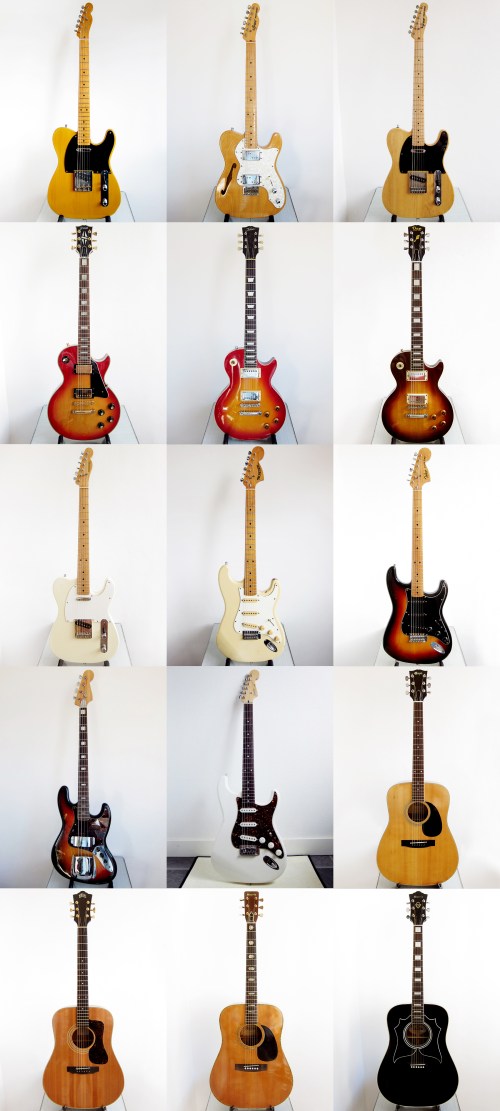
The Japanese collection at the moment: Fender Telecaster TL52-75 1987, Greco Spacey Sounds TE-500N 1977, Greco Spacey Sounds TL-500 1979, Greco Les Paul Custom EG-600C 1980, Tokai Love Rock LS-55 1991, VOX Les Paul 1970′s, Hohner Telecaster 1970’s, Hohner Stratocaster 1970′s, Tokai Silver Star SS-36 1979, Jazz Bass 1978, Fender Squier 1993, Maya F335G 1970’s, K.Yairi TG-40 1977, Morris WL-40 1973, Morris WL-35 1970’s






 Claescaster