Claescaster

Category: Acoustic guitars

Gibson J-45 / J-50

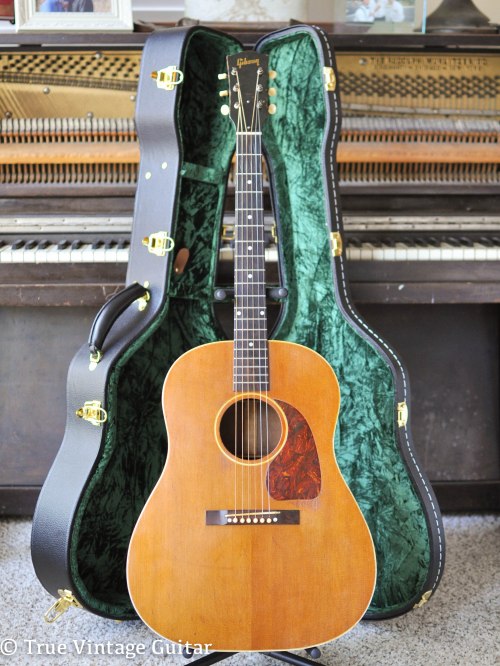
originalMy new dream guitar, an old Gibson J-50

A year ago when I started to buy acoustic guitars I had no idea what the difference between a Gibson or Martin was or how different body shapes, models and tone woods affected the sound. I could easily have told you who was playing a Telecaster, Stratocaster or Les Paul while listening to a song but I could never have told you if someone was playing an acoustic Gibson, Guild or Martin. Over the year I have added 6 Levin guitars to my collection and 5 Japanese acoustics, two of them sold by now, and played a lot of new made Chinese and Korean guitars and I have come to following conclusion. My favourite acoustic guitar is an old Gibson J-45. This is nothing new, I realised that last summer after seeing Kris Kristofferson, I did a post about it with some great acoustic guitar demo’s to prove my point. There is something very special with the old Gibson Jumbos, it doesn’t really matter if it’s a J-45, J-50, Southern Jumbo or Advanced Jumbo, they all have that special booming bass sound. If you listen to any acoustic Jackson Browne, early James Taylor or even Bob Dylan you will understand what I mean straight away. There was a lot of Country players that favoured this sound before the singer and songwriters of the Sixties and Seventies. Two modern examples that I really like is Gillian Welch and Daniel Romano, he is actually playing something more modern like a Gospel but the bass is still there. If you listen to Dan Tyminski and hear his 1946 Martin D-28 I’m sure you would want a wartime Martin straight away but still, there is something special with the Gibson Jumbo sound. I’m not even sure if I would prefer a Gibson J-45 or a J-50, actually I really like the Southern Jumbo too with their fretboard inlays, so I guess as long as it’s old, worn and sounds like a Gibson Jumbo I would be happy. I mentioned earlier that I recently ordered a 1977 K.Yairi TG-40, which I have very high hopes for. I bought it straight from Japan and unfortunately it got stuck in the Spanish customs and has been there since the 12th of April. The Yairi TG-40 is a Guild D-40 copy, which was introduced in the Sixties as a competitor to Gibson’s J-45. The Guild D-40 became famous as the Bluegrass guitar for their even response over all the strings and I really like the sound of them, it’s actually not too far off from a Sixties Gibson J-45. With a bit of luck the customs will release my guitar soon and with even more luck it’s going to be an awesome Yairi copy of an Guild which might sound a bit like a Gibson.

Bob Dylan Gibson J-50
Bob Dylan with his worn old Gibson J-50 in the early Sixties. The Gibson J-45 and J-50 is more or less the same guitar, it was just that they used nicer looking wood for the soundboard on the J-50 so they wouldn’t have to paint it in sunburst to cover up any imperfections.


Enjoy the sound of James Taylor’s Gibson J-50

Chest Fever

Chest FeverAraceli and I have a gig tomorrow night, Wednesday 16th of April, with our band Chest Fever. This time we are actually headlining and are going to do a 1 hour set in 33 I 45. We will start around 20.30 so if you are in town and feel up for some Swedish/Spanish country sung in English then please come by. This will be our fifth gig and I have actually managed to never perform twice with the same guitar. Tomorrow I will bring my beloved Morris W-40 and maybe an old Greco Telecaster for some country twang.

Update: April 18, 2014
Chest Fever – Not so young anymore, live at 33 I 45 in Barcelona 16th April 2014


K.Yairi TG-40

Yairi TG-40 Made in Japan 1977
K.Yairi TG-40 a Guild D-40 copy from 1977. Every K.Yairi guitar is given birth in Kani, a small community in the beautiful mountainside area of Honshu, Japan.

Sometimes when I’m left unsupervised, especially on Sunday nights, I end up buying guitars that maybe I shouldn’t have bought, or rather that maybe I don’t really need. I’ve been thinking a lot about trying to find a 1970’s Gibson J-45, I can’t really afford anything earlier, but that would still set me back a at least 1500€ which is really hard to justify for a guitar player on my level. I’ve managed to track down the guitar sound that I love to Gibson’s old jumbo models, think Jackson Browne, and the J-45 or J-50 would have been ideal, I think, it’s hard to know without trying but from all the Youtube clips I’ve been listening to they all have a very similar sound. It’s that dry woody booming bass sound that is unmistakably a Gibson J-45. Now I got a Japanese made Guild D-40 copy instead, it wasn’t really planned but I couldn’t resist, or I got carried away, anyway, it’s mine now. The Guild D-40 has a lot of awesome qualities, it’s a proper bluegrass guitar and was built for their even response over all the strings. I trust that Yairi did a good job 37 years ago and even if it doesn’t sound like a Gibson J-45, I’m sure it will have a lot of warmth and good bass, just what I’ve been looking for. On top of that, it’s a freaking Yairi, I never thought I would be able to afford that and I’ve dreamt of a Yairi since I bought my first Japanese acoustic.

Yairi TG-40 Japan Catalogue 1970's K.Yairi TG-40in the Japanese catalogue from the late 1970’s. List price ¥60.000, around 420€, which must have been a fortune back in 1977. Then again, this was a fairly cheap guitar for being K Yairi, the top model cost ¥200.000, about 1400€.

Ad of the day

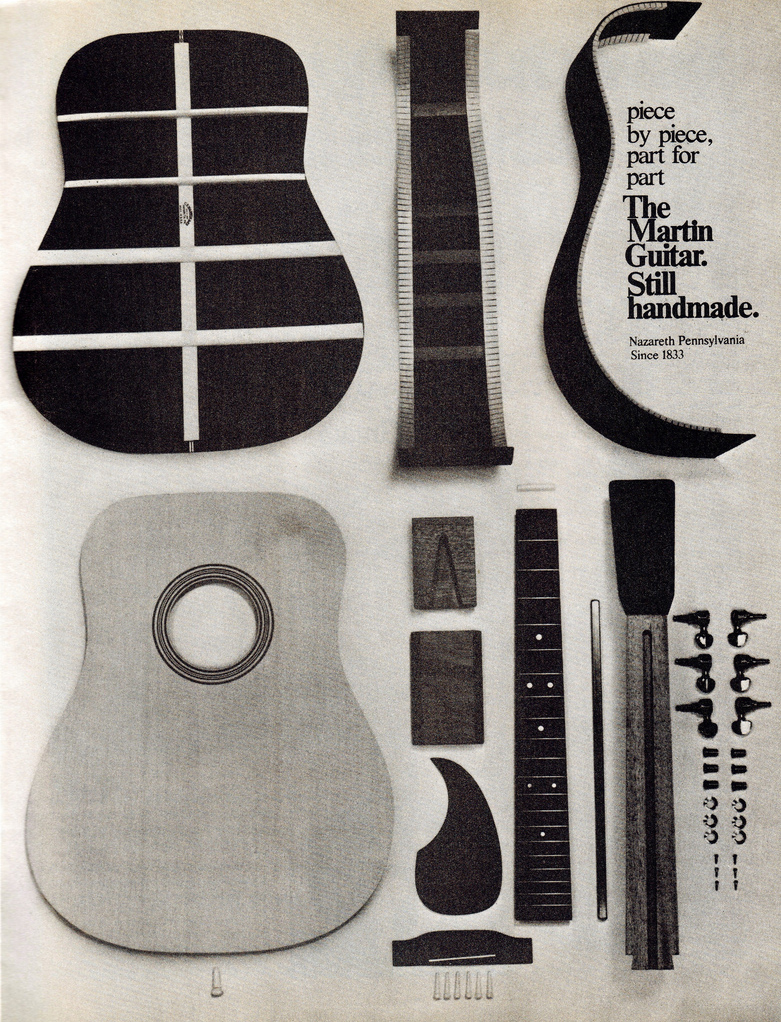
Martin guitar ad from Guitar Player Magazine, September 1974
Martin guitar ad from Guitar Player Magazine, September 1974. I love how few parts an acoustic guitar has.

Kazuo Yairi

Master Luthier, Kazuo Yairi Dies Aged 81

I just found out that Kazuo Yairi died earlier this month at the age of 81. As I mentioned before, I would love to one day afford a K.Yairi and big reason for that is the philosophy of Mr Yairi himself:

Good materials are hard to find so it’s better to make guitars through limited production by hand instead of mass production. Trees are very important “precious” things so we should make good use of them. Guitars made with “heart” are the best use of trees.  Kazuo Yairi

Martin D-45 copy, 1976 K.Yairi YW-1000
The most beautiful Martin D-45 copies in the world, a 1976 K.Yairi YW-1000

Levin information pages

Goya Model 163 (1968), Goya T-18 (1966), Levin Model 13 (1950), Levin LT-16 (1966), Levin Model 65 (1942), , Levin LM-26 (1959), Levin Model 174 (1972)Levin guitars, from left to right: Goya Model 163 (1968), Goya T-18 (1966), Levin Model 13 (1950), Levin LT-16 (1966), Levin Model 65 (1942), Levin LM-26 (1959), Levin Model 174 (1972), might be the greatest Levin collection in Spain.

If there is anything you would like to know about Levin guitars, then Vintage Guitars Stockholm is your best bet. They have the Levin information pages where you can find pretty much every model Levin ever made, serial numbers, history, photos and information. Rikard who runs the place just put up photos of my three latest Levin guitars on their site so now you can find all seven online. Here are the links: Levin Model 65, Levin Model 13 Ambassadör, Levin LT-16, Goya T-18, Levin LM-26, Goya Model 163, Levin Model 174.

Vintage Guitars Stockholm Sweden

How to… install side dots

Francisca Montersat
Francisca Montserrat with her new side dots

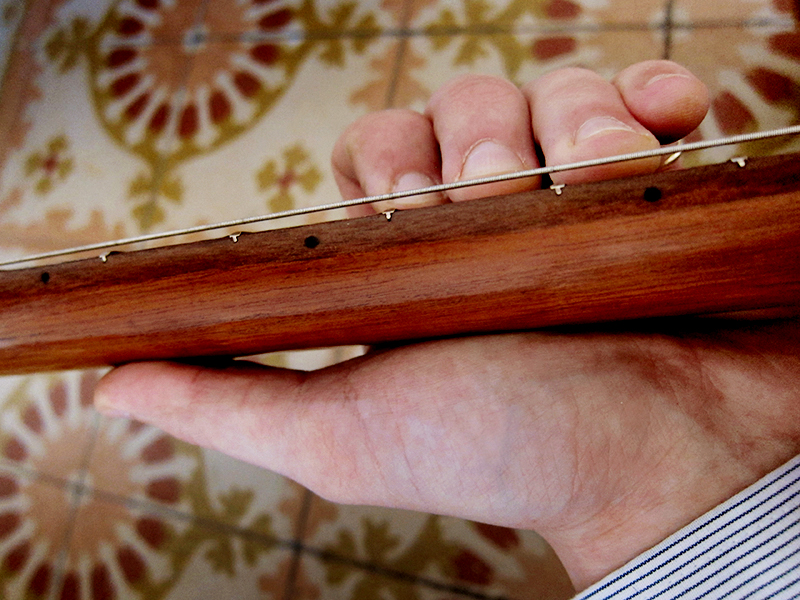
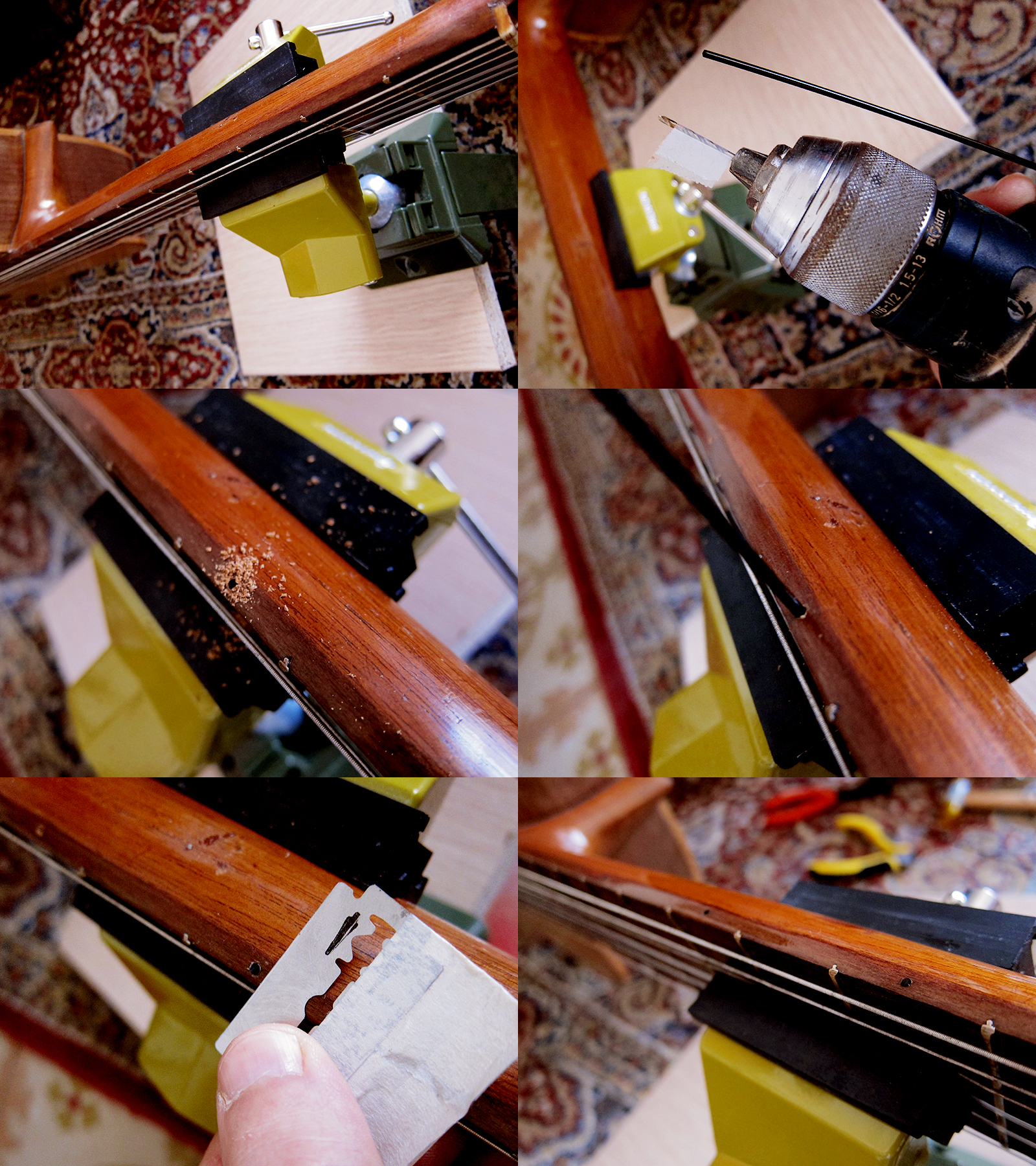
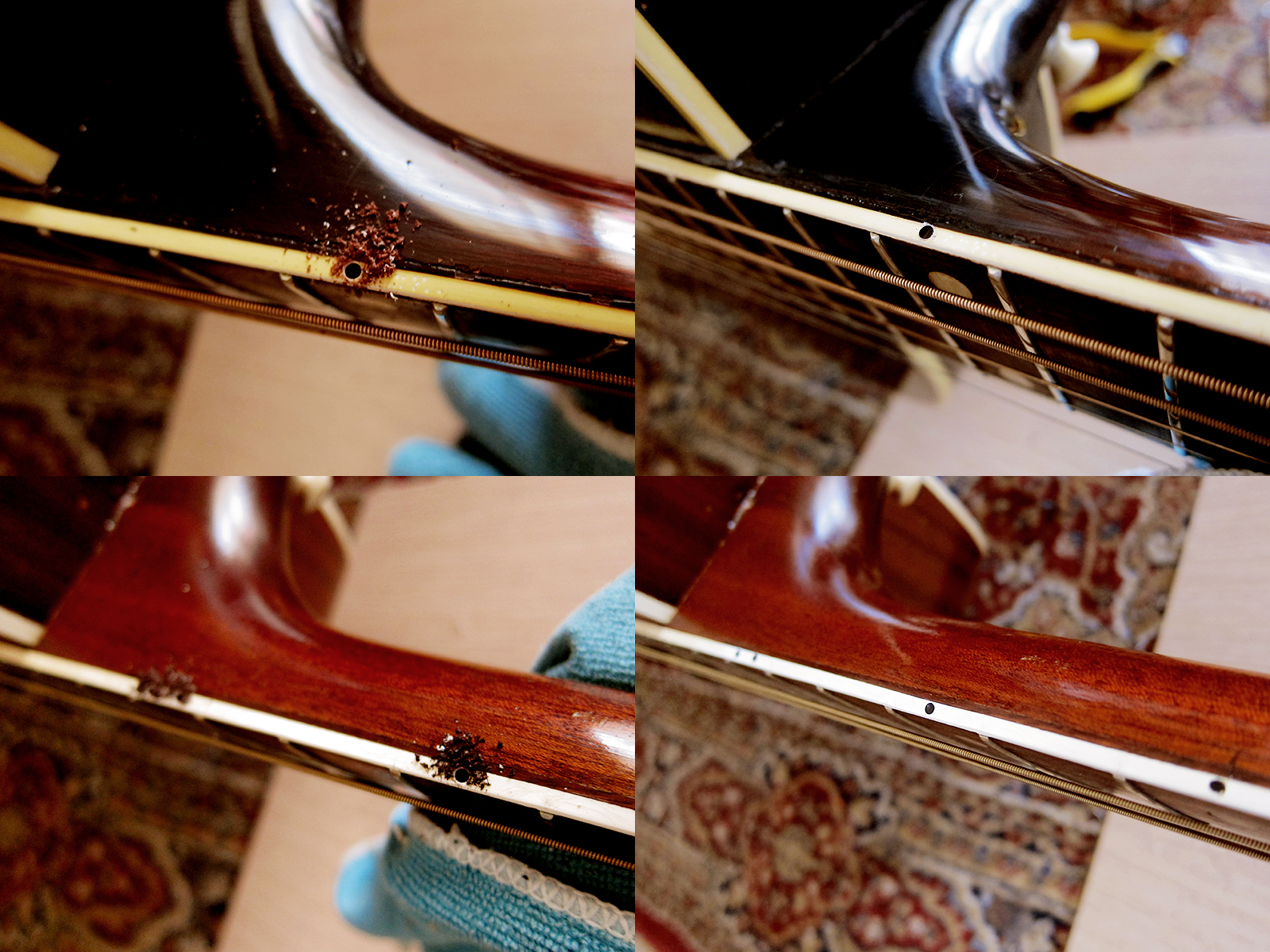
I get really confused when I play on guitars without side dots. You are playing your cowboy chords and everything is fine and then suddenly you want to play a bit of solo up on the 12th fret and you realise that there are no markers above the 5th fret and you have to guess where to put your hand. Well on a 14th fret acoustic guitar you know roughly where the 12th fret is, 2 above where the body and neck joins but say that you need to quickly find the 11th, or 9th fret. For me position markers, or side dots, are essential. Flamenco guitars seems to never have any side dots at all and a lot of Spanish or Classic guitars seems to have forgotten them too. I guess if you are used to it, if you have played your whole life without them maybe it’s fine but I come from the world of electric guitars with clear indications where you are on the neck. My Levin guitars only have side dots up until the 7th fret, it’s just my Goya T-18 that has markers up to the 12th fret, so I decided to change that. I had to order some new Jescar frets from my favourite eBay luthier supplier in the States, Philaluthiertools, so I got some 2mm side dot position markers in black as well. I was a bit scared to drill in to thin strip of binding on my 40-50 years old Levin guitars but after practising on my Francisca Montserrat I felt ready and just did it. It went pretty well, no real drama. It was interesting to see what the fretboards was really made off when you saw the sawdust. Some of the Levin’s had normal rosewood freatboards but the Levin 174 has a ebony fretboard, how fancy pants is that? My dads old Levin LT-16 is supposed to have a rosewood fretboard but I think that sawdust looks very dark for being normal rosewood.

Francisca MontersatFirst I installed 3 side dots on my Francisca Montserrat just to warm up. There might be some Flamenco purists saying that I’ve ruined this guitar now but I think it was a fairly discrete modification that will make it hundred times easier for me to play it. I just drilled a 2mm hole, same as the plastic side dot, about 3-4mm deep. I didn’t use any ruler, I felt that my eyes would be the best judge to make a visual estimatation and get them to line up. I made a little mark with a black pen and then when I was happy with that I made a little pilot hole with a nail so the drill wouldn’t slip. I put some super glue in the end of the side dot stick, stuck it in and then cut it off with a pair of pliers. I got it smooth with a razor blade and then sanded it down with 400, 800, 1500, 2000 and 2500 grit paper, the same technique I use for repairing lacquer damage.

Levin LM-26, Levin LT-16
All my Levin’s got new side dots installed, here is a 1959 Levin LM-26 on top and a 1966 Levin LT-16 below. I have to say that the dots I put in on the 9th and 12th fret on my dads LT-16 looks better than the original one on the 7th fret that was installed 48 years ago at the Levin factory in Gothenburg.

Gretsch Rancher Falcon

 G6139CB Falcon™ Center-Block Single Cutaway
G6139CB Falcon™ Center-Block Single Cutaway
cost 3.169€ at Thomann

I’ve always been a huge fan of White Falcons but never really felt I could afford one. They are so over the top Las Vegas bling but still works so well on scruffy looking musicians like Neil Young, see below. I’m not overly keen on newly made acoustic guitars, I believe that everything sounds better after 20 years, but after seeing this I have to admit I have second thoughts. Gretsch has just launched a White Falcon acoustic, and not only does it look awesome, it’s cheap too. Compared to a White Falcon that cost around 3200€ it feels pretty cheap with 550€ for the new Rancher Falcon in white. It’s almost as exciting as when Fender released the Fender Japan TN72G-FT.

 Neil Young, San Diego, CA, 1969 © Henry Diltz, 1969
Neil Young, San Diego, CA, 1969 © Henry Diltz

 G5022CWFE Rancher™ Falcon
G5022CWFE Rancher™ Falcon
cost 548€ at Thomann

Jack White’s impromptu two-song acoustic set 2011
Jack White is doing a surprise gig at the South by Southwest festival Austin Texas in 2011 with a custom made Gretsch White Falcon acoustic. When I saw this picture I really felt that I wanted one too. I have an all black Morris WL-35, really Johnny Cash, but imagine to have an all white Gretsch guitar with extra gold. Hmm, gold, I love gold.

Chest Fever

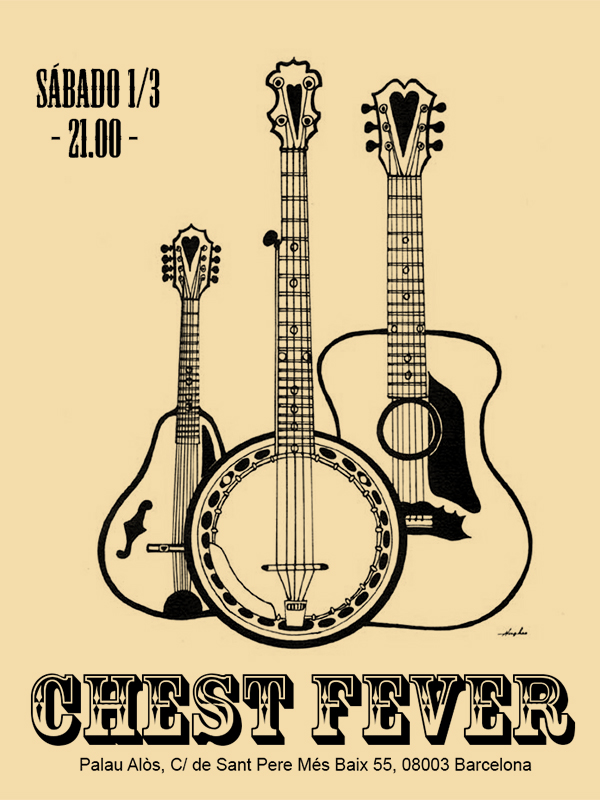
Chest Fever gig 1/3 2014

Tomorrow night Araceli and I have a gig with our band Chest Fever at Palau Alòs, C/ Sant Pere més Baix 55 in Barcelona. We are on at 21 so if you are in town and feel up for some Swedish/Spanish country sung in English then come by. I will bring my Levin 174 which sounds a bit like the Goya T-18 in the clip below.

Update: March 3, 2014
Chest Fever – We got to keep on moving, live at the Palau Alòs in Barcelona 1st March 2014


Tanglewood Premier TW133

Tanglewood Premier TW133 2010
Tanglewood Premier TW133, designed in the UK and handcrafted in China in 2010

When I met my other half Araceli back in 2007 she already new the basic cowboy chords but never really played guitar, I had only heard her strum a handful of times. She told me that she didn’t really like to play on my guitars since I seemed to care so much about them so I thought the best way around that would be to get her a guitar of her own. I also felt that since I had experienced so much joy through music in my life that would be the least I could give to the woman I love. I talked to her family and we agreed to put in 50 Euro each and get her a guitar for her birthday in September 2010. It was down to me to find a suitable guitar within our budget so I started to do some research. I knew that a parlour guitar would be best option, she is pretty small so I thought that a small bodied guitar would be easier for her to handle. I already had an inexpensive parlour a Vintage V880N that I liked but didn’t love so I thought I would try another brand this time and started to read about Tanglewood. People seemed to really like them, especially in the UK, and they had quite a few parlour sized models so it felt like a good start. Since you can’t just walk in to a guitar shop here in Barcelona and try what you are looking for, the shops here are useless and have nothing in stock, I had to rely on reviews and then order the guitar online. In the end I went for the Tanglewood Premier TW133, since I thought she would really like the look of it, or at least I loved the dark wood and the simplicity of it. I also felt that a solid mahogany top and back would give a bit more warmth and body to it compared to most new made parlour guitars which I feel normally lack that. She was really happy with her birthday present and started to play almost daily and soon after we even started a band together called Chest Fever.

© Claes Gellerbrink, photographs can't be used without permission. Araceli and Claes Chest Fever session, Barcelona 29-04-2012
Araceli, Chest Fever session, Barcelona 29-04-2012

Tanglewood Premier Historic TW133 ASM
SHAPE: Parlour, TOP: Solid Mahogany, BACK: Solid Mahogany
SIDES; Mahogany, NECK: One Piece Mahogany
FINGERBOARD: Rosewood, BRIDGE: Rosewood
SADDLE: PPS, Compensated, 72mm, NUT: PPS (43mm)
SCALE LENGTH: 650mm, BRIDGE PINS: Black with White Dots
MACHINE HEADS: Chrome open geared (changed to gold Grovers)
FINISH Natural Satin, STRINGS: D’Addario EXP11, 12-53, RRP: £269.95